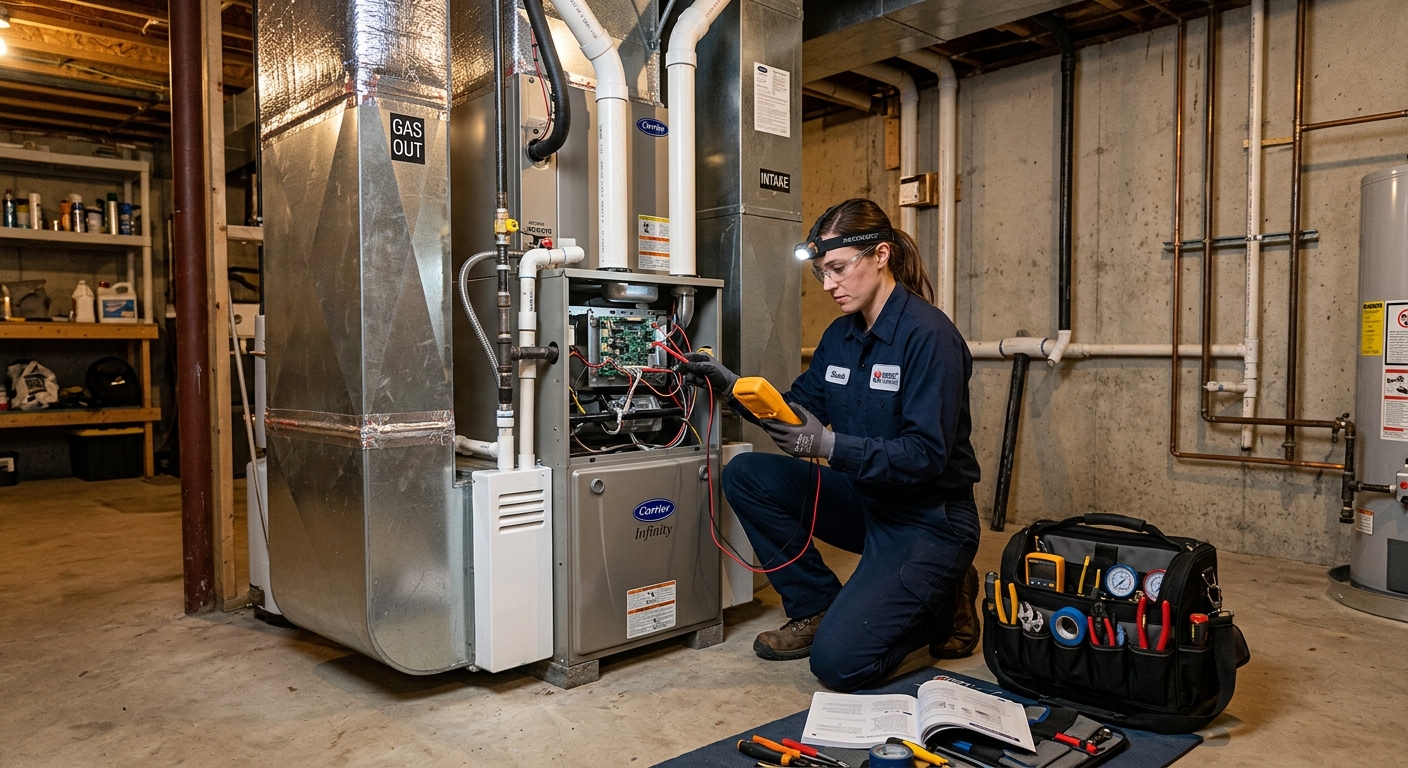
HVAC costs in California — 2026
In California, homes vary in age and ownership, but if you look at the real figures in places like Washington County, Pennsylvania, the market isn’t strictly one or the other. With a homeownership rate at only 44.4% and almost 80% of homes built before 1980 (U.S. Census Bureau, ACS 2024), this is overwhelmingly a retrofit market — jobs here are much more often about replacing or updating old equipment and ducting, not installing from scratch. Most split-level homes in Peters and North Strabane weren't built with modern HVAC in mind, so the presence and quality of ductwork is hit-or-miss. When ducts aren't present or are in poor shape, full duct installation can drive up the overall project cost substantially.
Washington County’s heating climate dominates: 5,600 heating degree days dwarf the 1,050 cooling degree days, with a winter design temperature down to 8 °F. Heating demand shapes everything — system recommendations, sizing calculations, and the value equation between heat pumps, furnaces, and central air conditioners.
| System |
Best for |
Efficiency |
Price range (installed) |
| Central AC replacement (existing ducts) |
homes with sound ductwork |
16–20 SEER2 |
$4,500–$11,000 |
| Air source heat pump (ducted) |
year-round heating and cooling |
8–10 HSPF2 |
$7,300–$15,500 |
| Cold-climate heat pump (ducted) |
heat pump as primary heat |
9–11 HSPF2 |
$12,000–$15,500 |
| Ductless mini-split (single zone) |
additions, rooms without ducts |
20–30 SEER2 |
$2,900–$6,400 |
| Full duct system installation |
homes with no existing ducts |
— |
$8,200–$16,500 |
Installed estimates for a typical California home. Equipment tonnage, duct condition and electrical capacity move these more than brand.
Filtration, humidification and ventilation
Southwestern Pennsylvania’s cold winters and humid summers create a split challenge for indoor air control. With 5,600 heating degree days, dry air is a chronic winter complaint — especially in older, leaky homes that exchange a lot of air with the outside. Whole-house humidifiers address this, but they require routine service: annual cleaning and pad replacement are not optional if you want to avoid mold or scale buildup. Don’t let anyone tell you otherwise.
Come summer, humidity can spike — particularly in homes with newer, tightly-sealed windows. Here’s a pitfall: an oversized central air conditioner cools quickly, but doesn’t run long enough to actually dehumidify. In many retrofitted homes, swapping for a right-sized system or adding a variable-speed blower does more for comfort than an add-on dehumidifier.
For air filtration, MERV 8 to MERV 13 filters balance dust removal with airflow. If you push beyond MERV 13 in a standard residential blower, you’ll choke off airflow and stress the fan, often for little added benefit. Don’t fall for pricey air purifiers unless you have specific respiratory needs.
In post‑1960 split-level homes that have seen extensive air sealing, mechanical ventilation (an ERV or HRV) can be valuable, but most houses here are still leaky enough that whole-house ventilators are oversold. Stick to right-sizing, moderate filtration, and simple humidification done correctly — expensive add-ons rarely pay back here.
Operating cost, not sticker price
Sticker price isn’t the full story. In Washington County, where West Penn Power is the electric utility, the true cost of owning an HVAC system stacks up over years of energy bills — and heating loads are the main driver, thanks to 5,600 heating degree days each winter and a winter design temperature as low as 8 °F.
To gauge operating cost, multiply three things: equipment efficiency, climate demand, and energy price. For example, a heat pump’s HSPF2 rating means how many BTUs of heat you get per watt-hour of electricity. The more heating degree days, the more your annual bill rises. The same logic runs for cooling in summer, though with only about 1,050 cooling degree days, it matters less here than in a hot-summer state.
Say your actual electric rate appears right on your West Penn Power bill. If you burn 10,000 kWh for heating in a year — that’s just a sample value — and pay $0.15 per kWh, that’s $1,500/year. An upgrade from an 8 HSPF2 to a 10 HSPF2 heat pump means roughly 25% lower consumption: $1,125 instead of $1,500.
But don’t get lost in the math — assumptions matter. Air leakage, duct losses, or undersized returns can wipe out real-world savings no efficiency label can overcome. A well-installed, mid-level system with tight, clean ducts often beats a high-end unit botched on installation or crippled by duct losses. Always check ductwork and sealing first; an efficient system on bad ducts is a missed opportunity.
Permits, licensing and inspections in California
In Pennsylvania, the rules for HVAC contractors and work are set at the municipal level. There is no state-issued HVAC license for residential work: contractor registration comes in the form of Home Improvement Contractor (HIC) registration, required for residential jobs over $500. Always verify HIC registration at the official state registry before you sign, especially for larger contracts.
Mechanical or building permits are needed for new or replacement central HVAC installations or ductwork in cities like Washington, while something as basic as swapping a thermostat in Peters Township often goes permit-free. For any job involving refrigerant, EPA Section 608 certification is mandatory and applies nationwide. Always ask your contractor about this — if they’re handling refrigerant or charging an AC or heat pump, they must be certified.
Inspections aren’t optional: municipal offices inspect new or replacement systems for code compliance. Pennsylvania’s Uniform Construction Code (UCC), which is based on the International Residential Code, sets these standards. Insurance verification is critical, too. Workers’ compensation is mandatory for every employer — confirm coverage through the state WCAIS system. Never assume a handshake is enough: written contracts are required for jobs over $500, along with your three-day right to cancel.
How to vet an HVAC contractor in California
The truth here is simple: brand matters far less than installation. You can bolt up the best equipment money can buy into a leaky, poorly-sized system and regret it from the first season. In suburban areas like Washington and Peters, moderate competition means homeowners must do the homework.
First, verify your contractor’s Home Improvement Contractor (HIC) registration using the official state lookup site before you sign. If your job includes handling refrigerant — AC, heat pump, or mini-split — ask to see the technician’s EPA Section 608 certification; it is required by law. Make sure your proposal includes a proper load calculation, not just a rule-of-thumb tonnage estimate, and check that all quoted equipment has listed model numbers. Finally, ask about commissioning: demand written, measured startup data on airflow and refrigerant charge. This is about physics, not promises.
- Check HIC registration on the state registry
- Verify EPA 608 certification for the refrigerant technician
- Confirm written contract and three-day cancellation right
- Details on municipal mechanical permit and required inspections
- Workers’ compensation insurance verification via WCAIS
- Equipment model numbers in the written proposal
- Full load calculation (Manual J or equivalent)
- Duct system evaluation with leakage measurement if possible
- Startup documentation: airflow, refrigerant charge, thermostat operation
- Clear labor and material warranty terms
- No upfront cash deposits over one-third total price
- References for recent jobs in your area
Red flags: in a moderate-density market like Washington County, be wary of contractors rushing the quote, skipping ductwork inspection, or pressuring for “today-only” prices. If a company won’t document the work, you’re just betting with your money.
Ductwork: the part nobody quotes properly
Distribution loss is the silent killer of HVAC performance in older homes — and, in Washington County, 78.7% of homes were built before 1980 (U.S. Census Bureau, ACS 2024), so most duct systems here are at least forty years old. Duct leakage wastes real dollars: a standard duct blaster test measures how much air escapes before reaching rooms, not just how well the equipment runs. If you skip this test, you’re flying blind.
Leaky or uninsulated ducts, especially those running through unconditioned attics or crawlspaces, can lose a third or more of produced heat or cooling. Sealing is usually worth trying first, but in post‑1960 split-level homes in Peters and North Strabane, original ducts were sized for small furnaces, not today’s larger coils or heat pumps — so undersized return ducts and odd splits are common. No matter the efficiency of your equipment, choked airflow means poor comfort and more blower wear.
Modern ductwork retrofits aren’t cheap — a new full system runs $8,200–$16,500 — but can finally deliver the performance your equipment is designed for. When in doubt, have duct leakage and sizing tested before committing to a new unit. It is almost never money well spent to buy a high-efficiency system for leaky or undersized ducts; spend the testing money first and only proceed to replacement or sealing when you have hard results.
R-410A phase-down: repair or replace?
The HVAC industry is going through a refrigerant changeover. New residential systems today are moving away from R-410A to lower-impact refrigerants like R-454B and R-32 to meet phased-in climate regulations. But if you have an existing R-410A system at home, there’s no legal push to replace it. Service and repairs on existing equipment remain fully legal — there’s no hidden rule making your system obsolete overnight.
The real rub is cost: as production of R-410A drops, the price for servicing systems that use it is slowly climbing, especially for leak repairs. That makes a big expensive repair (like a compressor or coil replacement that requires recharging with R-410A) more likely to tip a homeowner toward replacement, especially on 10-to-15-year-old systems. For many, it makes sense to run your R-410A system until a major refrigerant issue arises, then weigh service cost against investing in new equipment with an updated refrigerant. Bottom line — you don’t have to replace working equipment, but the cost calculus is shifting as refrigerant becomes harder to find.
Frequently asked questions — HVAC installation in California
Is a high-efficiency system worth the extra cost here?
In Washington County — like much of California with its older housing stock and moderate cooling needs — high-efficiency equipment doesn’t always guarantee a better investment. When you compare, for example, the cost of a top-tier air source heat pump at $15,500 to a more standard model at $7,300, the extra outlay can take many years to recoup, especially if your home is not air sealed or ductwork is leaky. The real-world savings depend on how much heating you do — heating degree days are high in this area, so homes using a heat pump for primary heat might see faster payback. But a high-efficiency unit on untested or old ducts often runs no better than a midrange one on a tighter system. My advice: before you go high-end, get your system tested and prioritized.
Do I need a permit to replace HVAC in California?
Permitting isn’t statewide for residential work — it happens at the municipal level in Pennsylvania. In the City of Washington, replacing or installing central HVAC equipment or ductwork triggers a mechanical or building permit; inspections will follow. In places like Peters Township, where like-for-like thermostat swaps don’t require a permit, replacing an entire system absolutely does. Permits confirm that work meets the Pennsylvania Uniform Construction Code, and that licensed, registered contractors are on the job. Expect your contractor to include permit cost (sometimes several hundred dollars for a furnace or central AC replacement, on top of the main system price tag of $4,500–$11,000), not ask you to pull it yourself. You’re protecting your warranty and resale value — skipping the permit is not worth the risk.
Do older California homes need ductwork replaced?
Most older homes here — and about 78.7% in Washington County were built before 1980 (U.S. Census Bureau, ACS 2024) — have ductwork that predates today’s larger coils and variable-speed blowers. Duct leakage, undersized returns, and poor insulation haunt these systems. But not every home needs a full rip-and-replace, especially given that new duct systems cost $8,200–$16,500. Start with a duct blaster test to measure leakage. In some split-level houses from Peters or North Strabane, sealing and adding insulation to ducts brings enough improvement to justify keeping the originals. Only after testing and inspection should you decide on major ductwork replacement; jumping straight to it is how you overspend.
How much does ductwork add to an HVAC installation?
Adding new ductwork is a major chunk of the bill if your California home never had central HVAC. In Washington County, a full duct system installation lands between $8,200–$16,500, on top of whatever you pay for the main equipment. Retrofitting ducts in post-1960 split-level homes, especially in Peters and North Strabane, often means more attic and crawlspace work, so expect labor to drive up the price. If you already have ducts and they’re in good shape, replacing just the central AC might sit at $4,500–$11,000 — a much better deal. Always demand a duct inspection before you accept a quote "including all ductwork"; otherwise, surprises will find you after demolition starts.
Should I replace the furnace and AC at the same time?
In California’s market, and especially in areas like Washington County, many old homes have separate, mismatched AC and furnace systems. If both are old or unreliable, replacement together often saves on labor and gets you a matched, efficient setup. But if the furnace is young and the AC is shot (or vice versa), you don’t have to spend money to force a matched pair — just don’t expect full “system” efficiency ratings. Full replacements run $7,300–$15,500 for a heat pump system (with ducts), or you might just pay $4,500–$11,000 to swap out one part. Bottom line: replace both if they’re old, inefficient, or require major duct changes, otherwise it’s fine to stage the work and save.
What does HSPF2 measure?
HSPF2 stands for “Heating Seasonal Performance Factor, version 2”. In Pennsylvania and California, where heating loads rule, this matters: HSPF2 rates how efficiently a heat pump turns electricity into heat over the course of a season. Higher numbers mean less power used for every unit of heat delivered. For example, an 8 HSPF2 system is an entry-level performance, while modern cold-climate units hit 10 or more. That swings a typical heat pump installation from $7,300 for basic to $15,500 for best-in-class. It’s a big spread, so match the technology to the weather you get — not just the sticker on the box.
What HVAC tax credits are available to California homeowners?
Incentives do change year to year, but in Pennsylvania (and usually elsewhere too), most homeowners see credits for qualified high‑efficiency heat pumps and some air conditioners through federal programs. Typically, systems above a certain SEER2 and HSPF2 rating — for example, cold-climate ducted heat pumps at $12,000–$15,500 — may qualify for a tax credit. Your contractor should be familiar with what’s eligible this season and be able to provide the necessary documentation. Always double-check the qualifying criteria before signing — tax credits rarely offset a poor installation, but they do help tip the value equation on high-efficiency systems when you’re on the fence.
How long should an HVAC system last in California?
In places like Washington County, with many homes carrying 30–50 years of patchwork updates, a properly installed HVAC system should give 15–20 years of useful service for AC or furnace, and 12–17 for heat pumps. Lifespan depends on maintenance and duct conditions as much as factory design. If you’re installing a new system now (say, a central AC at $7,300), regular filter changes and annual checkups will help you reach or exceed those numbers. Pay special attention if your ducts are old, leaky, or return runs are undersized — systems in those homes typically fail younger. It’s not about luck; it’s about care and setup.
How far ahead should I schedule in California?
For Washington County and similar markets, plan at least a month in advance if you want your pick of reputable HVAC contractors, especially during spring and fall when demand spikes for tune-ups or pre-season installs. In the heat of July or a January deep freeze, waits can stretch even longer. For a central AC replacement (usually $4,500–$11,000 installed), a rushed emergency job is rarely your best value — scheduling ahead keeps your options open and can mean better equipment prices. This is not a market where last-minute price drops appear; solid contractors book up early when the weather turns.