HVAC costs in Pequea — 2026
Pequea’s housing mix steers HVAC choices in ways you won’t see in brand-new suburbs. With a homeownership rate of 71.8% and nearly 38% of homes built before 1980 (U.S. Census Bureau, ACS 2024), most system replacements here are retrofits into long-owned homes. Many rowhomes in Lancaster city, built before the era of forced air, have never had traditional ductwork—or the ducts they do have are often undersized, leaky, or routed in ways that rule out easy upgrades. For these houses, ductless or high-velocity systems fill the need where conventional duct runs don’t fit.
Our climate is heating-dominated, with 5,200 heating degree days and just 1,250 cooling degree days. That means most Pequea homeowners spend a lot more on warmth than on keeping cool. Reliable heat—whether delivered by a heat pump, furnace, or boiler—matters more for savings than bumping up the cooling efficiency. Still, the humid Central PA summers make air conditioning a must for most single-family homes. Ducted central AC is common where ducts exist and are in serviceable shape. In other cases, particularly in older housing, a ductless mini-split is often the only practical solution for targeted cooling or all-electric upgrades.
| System |
Best for |
Efficiency |
Price range (installed) |
| Central AC replacement (existing ducts) |
homes with sound ductwork |
16–20 SEER2 |
$5,400–$13,000 |
| Air source heat pump (ducted) |
year-round heating and cooling |
8–10 HSPF2 |
$8,700–$18,500 |
| Cold-climate heat pump (ducted) |
heat pump as primary heat |
9–11 HSPF2 |
$14,000–$18,500 |
| Ductless mini-split (single zone) |
additions, rooms without ducts |
20–30 SEER2 |
$3,500–$7,600 |
| Full duct system installation |
homes with no existing ducts |
— |
$9,700–$19,500 |
Installed estimates for a typical Pequea home. Equipment tonnage, duct condition and electrical capacity move these more than brand.
Reading the yellow label
Every new HVAC system in Pequea comes with an efficiency label: SEER2 for cooling, HSPF2 for heating, and for furnaces, AFUE. SEER2 rates cooling efficiency under updated, more realistic test conditions than the old SEER, so numbers from older articles or equipment aren't apples-to-apples. HSPF2 does the same for heat pump heating. In simple terms, higher SEER2 means more efficient cooling, and higher HSPF2 means the system uses less electricity per unit of heat delivered.
Lancaster County’s 5,200 heating degree days dwarf the 1,250 cooling degree days. This means that, in Pequea, HSPF2 matters a lot more on your power bill than an extra point of SEER2. It rarely makes sense to pay top dollar for a 20+ SEER2 air conditioner or mini-split unless you want the quietest or most feature-rich unit. The payback from ultra-high cooling efficiency is slow here. For most, a SEER2 in the 16–18 range is enough, but don’t skimp on heating efficiency—an HSPF2 of 9 or better makes a real dent in winter bills. Think of it as tuning your investment to local weather: buy efficiency for what you’ll use most.
The new yellow labels help you compare, but don't chase the highest number unless the climate and your budget justify it. Aim for the tier where the utility savings balance the extra up-front cost within the expected life of the system.
What a Pennsylvania HVAC contractor must hold
Pennsylvania does not issue a statewide HVAC trade license for residential work. Instead, your contractor in Pequea must hold a Home Improvement Contractor (HIC) registration from the Pennsylvania Office of Attorney General if the contract is more than $500. This is not a trade test or qualification—it simply means the business is registered and insured as required.
Residential mechanical permitting and inspection are handled locally. In Lancaster city, replacing or installing central HVAC equipment generally means you’ll need a mechanical permit and an inspection from the city’s code office. Surrounding townships in Lancaster County run their own permitting programs, with similar requirements.
No matter where you are in the county, any installer working with refrigerants must hold a federal EPA Section 608 certification. This is important for handling, installing, or servicing air conditioning and heat pump refrigerants properly and legally.
Workers’ compensation is mandatory for all employers in Pennsylvania. You can verify a contractor’s workers’ comp status using the WCAIS system. For residential jobs, always ask for documented insurance and double-check their registration at hic.attorneygeneral.gov. Never accept a proposal from a contractor who can’t prove both.
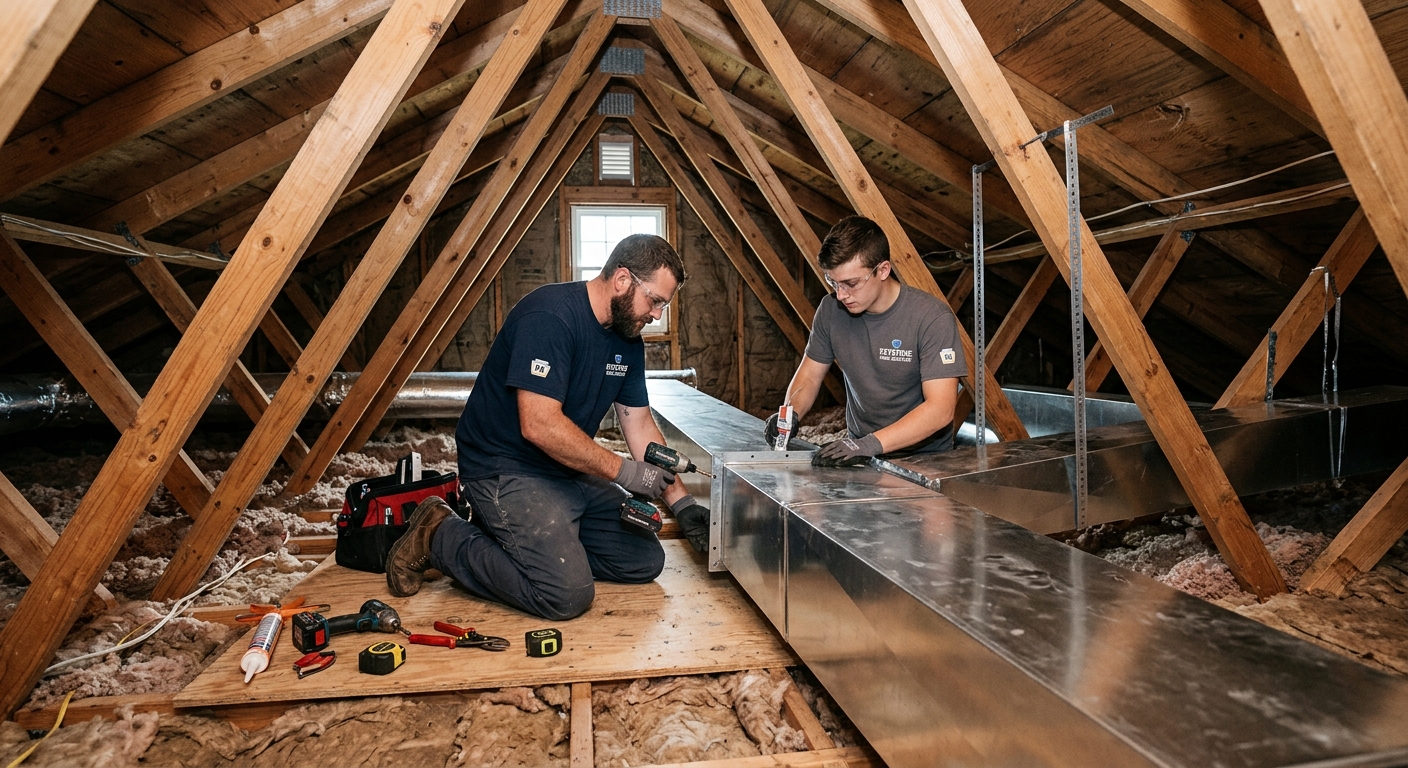
Duct condition, leakage and sealing
If you live in an older Pequea or Lancaster home, the ductwork—if it exists—can matter just as much as your new HVAC system. Duct leakage is a hidden energy waste: poorly sealed or disconnected ducts can lose 20–30% of the air you’re paying to heat or cool, especially in basements, crawlspaces, or attics. That’s real money lost each month.
A duct blaster test is the gold standard for checking how airtight your system really is. It temporarily pressurizes the ductwork and measures how much air escapes. High leakage may be fixed with duct sealing (from the attic, basement, or even inside the ducts), but if the ducts are rusted, kinked, or too small—often the case in homes retrofitted for forced air after 1930—replacement or high-velocity options are better investments.
Many Lancaster city rowhomes dating from 1880–1930 were never built with central ducts, or ducts were sized solely for heating with a coal or oil furnace—these rarely move enough air for modern AC. Returns are especially overlooked; too few or too small returns silently choke older systems and should be evaluated along with the supply side.
If your ducts run through unconditioned spaces, uninsulated lines lose heating and cooling fast. In these cases, sealing, insulating, or rerouting should be considered during any major HVAC replacement. My best advice: test the ducts before replacing heating or cooling equipment. There’s no point in spending thousands on new hardware, only to lose the benefit through leaky, undersized, or uninsulated ducts. Confirm duct performance first to make your new system actually perform as rated.
Comparing HVAC estimates in Pequea
When comparing HVAC proposals in Pequea, detail matters. Always see model numbers for indoor and outdoor units—mixing unmatched units may void efficiency ratings and manufacturer warranties. Tonnage should come with a load calculation that matches your home's square footage, insulation, and window count. Ductwork calls for a written assessment—ignoring seals, leaks, or undersized returns is a warning sign. For line sets (the copper refrigerant pipes), your quote should specify replacement or clear documentation that safe reuse is warranted.
Electrical work is a frequent surprise. Upgrading from an older furnace to a heat pump, or adding modern AC, can require heavier circuits or even a panel upgrade. Quotes should specify what’s included or flag extras. Condensate handling—where the water goes—needs to be accounted for. Thermostats: some estimates bury the cost, while others leave it to you. Every quote for a permit-required installation in Lancaster city or a township should itemize the mechanical permit, and commissioning should mean more than a quick start-up—ask for a summary of measured airflow and refrigerant charge.
Lastly, get clarity on the labor warranty. Most manufacturers only cover parts, not the labor to replace them. If any estimate is just a brand and a price, you don’t have enough information to compare or protect yourself.
| Line item |
What to look for |
Red flag if… |
| Equipment |
model numbers, indoor and outdoor matched |
brand name only |
| Sizing |
load calculation attached |
matched to the old nameplate |
| Ductwork |
condition assessed, sealing scoped |
not mentioned |
| Electrical |
circuit and panel capacity confirmed |
assumed adequate |
| Line set |
replaced or documented as reused |
silent |
| Commissioning |
measured airflow and charge, documented |
no startup report |
| Warranty |
labour years stated separately |
manufacturer only |
| Permit |
included and priced |
'not needed' |
R-410A phase-down: repair or replace?
As of 2025, all new residential air conditioning and heat pump systems sold in Pequea use lower-GWP refrigerants like R-454B or R-32 to meet new federal targets. R-410A is being phased down for new equipment, but it isn’t banned in existing systems and remains legal for service. If your current heat pump or AC uses R-410A and it’s running without issues, you are not required—or even encouraged—to replace it just because of the refrigerant switch.
The real impact comes if your R-410A system develops a refrigerant leak or a major component failure. As R-410A production is curtailed, the cost of the refrigerant will rise over the next several years, which means expensive repairs (particularly if significant recharging is needed) may approach the cost of newer, more efficient equipment. But for minor repairs or routine maintenance, you can keep servicing your system for years. There’s no legal cutoff—just start to weigh repair costs against the cost of a full replacement, especially if the system is 12+ years old or has developed a persistent leak. The switch doesn’t make your equipment obsolete, just eventually less economical to maintain.
Pequea's housing stock and its HVAC needs
Pequea’s housing stock tells the story: with 37.9% of homes built before 1980, many properties are on their second or third major HVAC system (U.S. Census Bureau, ACS 2024). Pre-1980 homes here often began life with steam or hot water heat, with little to no accommodation for air conditioning or even forced-air heating. Many lack ductwork altogether, or have small, low-efficiency ducts threaded through walls—good for heating, but not for drawing enough air to cool multiple rooms. Insulation and window quality typically lag behind newer standards, making these homes more demanding on their HVAC systems during both the cold snaps and the sticky PA summers.
Electrical panels in these houses were usually sized without modern air conditioners or heat pumps in mind. If you’re considering a switch to a heat pump (especially all-electric), have your panel's capacity checked. For homes running on gas or oil, the condition of the chimney or flue matters for furnace or boiler replacement—liners may be necessary and add cost.
In newer Pequea subdivisions—those built after 1980, with more single-family homes and open floor plans—full duct systems and central air are typical. If your HVAC is original and your home dates to the late 1990s or early 2000s, you’re likely facing your first major replacement now. These systems were often sized generously (sometimes too large), making a proper load calculation worthwhile when shopping for new equipment.
Frequently asked questions — HVAC installation in Pequea
How is a tax credit different from a rebate?
Tax credits and rebates both put money back in your pocket but in different ways. A tax credit reduces the amount of income tax you owe to the federal or state government—if you install a qualifying heat pump or other high-efficiency HVAC system in Pequea, you can claim the credit when you file your taxes the following year. Rebates, on the other hand, are usually direct payments from your utility or a manufacturer and may come as a check or a bill credit, often within weeks of installation. For example, if you install a ductless mini-split system for $3,500–$7,600, you could check if PPL Electric Utilities or another local energy provider offers a rebate, but the federal tax credit would apply when you file your taxes. The impact: rebates help right away; tax credits show up next spring.
What does a ductless mini-split cost in Pequea?
In Pequea, a ductless mini-split single-zone system (sized to cool or heat one space, such as a living room or bedroom) generally runs $3,500–$7,600 installed. The lower end covers a simple, straightforward install with a short line set, while the upper end is typical if you need a long refrigerant line, have challenging wall assemblies (which are common in older Lancaster-area homes), or want a model with high-end features. Multi-zone systems cost more, but if your home lacks ductwork—often true of properties built before 1930—mini-splits can be the most efficient option. It pays to have a contractor assess layout and electrical capacity before you commit.
Is natural gas available throughout Lancaster County?
Natural gas is not available everywhere in Lancaster County. In Pequea and many rural townships, propane and fuel oil remain common heating fuels. UGI Utilities supplies natural gas in Lancaster city and in larger townships like Manheim Township and East Hempfield Township, but rural areas often lack gas mains. If you’re thinking about switching to a gas furnace or upgrading from oil, check with UGI and talk to neighbors first. For many outlying properties, it’s not practical or possible to bring natural gas service to the home, making heat pumps or propane-fired equipment the main alternatives.
Can a heat pump heat my house without backup?
A modern cold-climate heat pump can handle most of the heating in Pequea’s winters, but a backup source—either electric resistance strips or a furnace—is still wise for our 12 °F winter design temps. For homes with good insulation and updated windows, a cold-climate heat pump can serve as the primary heat source for much of the season, and systems with HSPF2 ratings of 9–11 operate efficiently even during cold snaps. Expect to pay $14,000–$18,500 installed for a ducted cold-climate heat pump. In older, poorly insulated homes, backup is more important. Your contractor should size the system based on a load calculation, not a guess or only the old furnace size.
Can I service my R-410A system after the refrigerant change?
Yes, you can still service your R-410A heat pump or central AC in Pequea after the refrigerant transition. There’s no ban on repairing or topping up R-410A systems—service and refrigerant remain legal. The main issue will be rising cost for R-410A as supplies tighten, which may make future repairs pricier, especially if your system has a significant leak. If you’re facing a repair close to half the price of a new unit—say, $5,400–$13,000 for a new central AC—it may be worth comparing long-term value. For now, keep a well-running system going with routine checks and only consider replacement when repair costs get steep.
Does Pennsylvania license HVAC contractors?
Pennsylvania does not issue a state HVAC license for residential contractors. Instead, anyone working on an HVAC replacement worth more than $500 in Pequea must be registered as a Home Improvement Contractor with the Office of Attorney General, and individual municipalities control their own mechanical permitting and inspections. Make sure your installer presents a valid HIC registration for your peace of mind, especially for jobs like a ducted heat pump installed at $8,700–$18,500, and ask to see proof of insurance before you sign anything.
What does a heat pump cost installed in Pequea?
An air source heat pump installed in a Pequea home with existing ductwork runs $8,700–$18,500, typically about $14,000. The price depends on system size, the brand you choose, and whether your ducts need modification or sealing. Upgrading to a cold-climate model or tackling needed panel upgrades can put you near the top of the range. These prices apply to standard two-story homes, not multi-zone ductless or large luxury properties. If your quote falls well outside these numbers, ask to see a detailed scope—extras like duct replacement or major electrical work can shift costs upward substantially.
What is commissioning and why does it matter?
Commissioning is a formal process your Pequea HVAC contractor follows to be sure your new system actually delivers what it says on paper. After installation, a good contractor will check measured airflow, refrigerant charge, and system safety controls—then document those results. Without commissioning, there’s no guarantee your $5,400–$13,000 central AC or $8,700–$18,500 heat pump is operating anywhere near its rated efficiency or comfort. Skipping this step can mean higher bills and more repairs. Ask for the commissioning report with your paperwork. It protects your warranty and your comfort all year.
How often should I change my filter?
Most Pequea homeowners should change their HVAC filter every 1–3 months, depending on the type (1-inch filters usually need changing monthly, high-efficiency or 4–5 inch filters last longer), how much you run your system, and whether you have pets or allergy concerns. In older Lancaster area homes, dust and construction debris from renovations can clog filters quickly. Replacing filters is one of the few HVAC tasks that does not require a permit or a professional in Lancaster County, so it's easy and low cost to do yourself—especially compared to a repair bill in the $5,400–$13,000 range for neglected systems. Make it a habit and your HVAC investment will last longer and perform better.