HVAC costs in Bangor — 2026
Bangor, much like the rest of Northampton County, is full of homes built before 1980, with almost all of them falling into this bracket (U.S. Census Bureau, ACS 2024). With a homeownership rate of 62.3%, most HVAC work here is retrofit or replacement, not new-build installation. In Bethlehem and Easton, many early-1900s rowhomes weren’t designed for air conditioning, which limits options for running new ductwork and makes outdoor condenser placement a headache. In Bangor, the same vintage challenges apply, so expect to find a patchwork of equipment types, from aging central air and boilers to window units and baseboard electric heaters.
Northeastern Pennsylvania leans heavily toward heating — 6,100 heating degree days compared to just 850 for cooling. Winters are real here, with a 4 °F design temperature and deep frost lines. If you’re weighing where to spend your budget, focus on heating performance and efficiency before anything else. Air conditioning is important, but it only runs a fraction of the hours your heat does. That fact alone shapes whether a heat pump, furnace, or a mix makes the most sense. In some Bangor rowhomes, retrofitting ducts will be the hardest part of any change-out, and sometimes mini-splits really are the only reasonable answer.
| System |
Best for |
Efficiency |
Price range (installed) |
| Central AC replacement (existing ducts) |
homes with sound ductwork |
16–20 SEER2 |
$4,800–$11,500 |
| Air source heat pump (ducted) |
year-round heating and cooling |
8–10 HSPF2 |
$7,700–$16,500 |
| Cold-climate heat pump (ducted) |
heat pump as primary heat |
9–11 HSPF2 |
$12,500–$16,500 |
| Ductless mini-split (single zone) |
additions, rooms without ducts |
20–30 SEER2 |
$3,100–$6,700 |
| Full duct system installation |
homes with no existing ducts |
— |
$8,600–$17,500 |
Installed estimates for a typical Bangor home. Equipment tonnage, duct condition and electrical capacity move these more than brand.
Separating installers from equipment sellers
In Bangor and Northampton County, the installer’s skill matters much more than the brand on your new heat pump or furnace. Two homes with the same unit can see completely different results — comfort, efficiency, and reliability all depend on the quality of the installation. Fancy brand names and big promises don’t fix bad ductwork or compensate for a rushed job.
The smart approach: start by verifying contractor credentials. In Pennsylvania, residential HVAC contractors must have a Home Improvement Contractor (HIC) registration if the contract is over $500 — you can look this up online. Anyone handling refrigerants must hold a federal EPA Section 608 card. Ask if the quote includes a room-by-room load calculation (not just a rule-of-thumb sizing), and make sure it lists the specific equipment model, not just generic “14 SEER, 3-ton” language. Good installers always commission the system, meaning they’ll take and document airflow and refrigerant readings at startup. That’s not just numbers on a clipboard — it’s proof the system is set up right.
- Verify Home Improvement Contractor registration through the state lookup.
- Check for valid EPA Section 608 certification for refrigerant work.
- Ask if a manual J load calculation is included (not a guess).
- Demand specific equipment model and serial numbers in the bid.
- Commissioning: will they test and document airflow and refrigerant charge?
- Obtain proof of insurance — check workers’ compensation through the WCAIS system.
- Look for a written, signed contract as required by state law for jobs over $500.
- Ask about municipal permit and inspection — every township handles this differently.
- Get clear terms on warranty — what’s covered, for how long, who does the work?
- Ask how they will deal with existing ductwork problems — or if they’ll even check.
- Get at least one reference from a recent job in Northampton County.
- Be wary if the bid is much lower than everyone else (corners are cut somewhere).
Watch for “truck in a day” contractors who bounce around the Lehigh Valley and focus on pushing hardware, not solving problems. With so many options in a densely populated metro market, the best installers in Bangor are busy for a reason and will answer every question you can throw at them.
Permits, licensing and inspections in Bangor
Pennsylvania does not issue statewide HVAC licenses for residential work. Instead, contractors working in Bangor and the rest of Northampton County must have a Home Improvement Contractor (HIC) registration for any contract over $500, and municipalities handle permits and code inspections. That means what’s required can shift from one township to the next. In Bethlehem, for example, replacing or installing central HVAC equipment almost always triggers a mechanical permit and a required inspection. In nearby boroughs like Nazareth, you might swap out a thermostat without a permit but need one for bigger work.
When refrigerant lines are touched, EPA Section 608 certification is required — this is a federal rule, not just a state one. Make sure whoever is handling your new heat pump or AC has their card on hand. As for insurance, every employer in the state must carry workers’ compensation; you can verify this with the WCAIS system. Proof of liability insurance should also be provided up front.
Regardless of brand, always require a written, signed contract for work over $500. Pennsylvania law gives you a three-business-day right to cancel. Permits ensure that your installation follows the Pennsylvania Uniform Construction Code (UCC), which is based on the International Residential Code, and keeps your home saleable down the line. In Bangor, getting these steps right is worth it — cutting corners on permitting or choosing an unregistered installer is likely to cause headaches and void warranties.
When ductless is the right answer
Ductless mini-splits are often the best call in Bangor, especially in homes that were never built for central air. Additions, attic and basement conversions, or rooms on the end of a duct run that stay stuffy in July — these are the ideal scenarios. In many early-1900s rowhomes seen in Bethlehem, Easton, and here in Bangor, running new ducts is often total overkill and means tearing up finished walls or ceilings.
A single-zone mini-split — one outdoor unit hooked up to one indoor head — is simplest and most efficient. Multi-zone setups (one outdoor unit serving multiple indoor heads) “look” tidier outdoors, but each head can underperform compared to a dedicated system, especially in heating-heavy climates like northeastern PA. For a whole house, costs climb quickly, and payback drops.
Common objections revolve around having a boxy wall unit in every room, but with careful placement — up high, centered, or even in soffits — most people stop noticing after a week. Don’t overlook condensate: every indoor head needs a reliable, freeze-resistant drain, especially with our sub-10-degree winter lows.
In Bangor’s older housing, mini-splits often dodge the worst headaches of duct installation and allow for true zoning. For rooms left out by legacy systems or finished spaces added later, ductless is faster, cleaner, and usually cheaper in the long run.
Why your ducts may be the real problem in Bangor
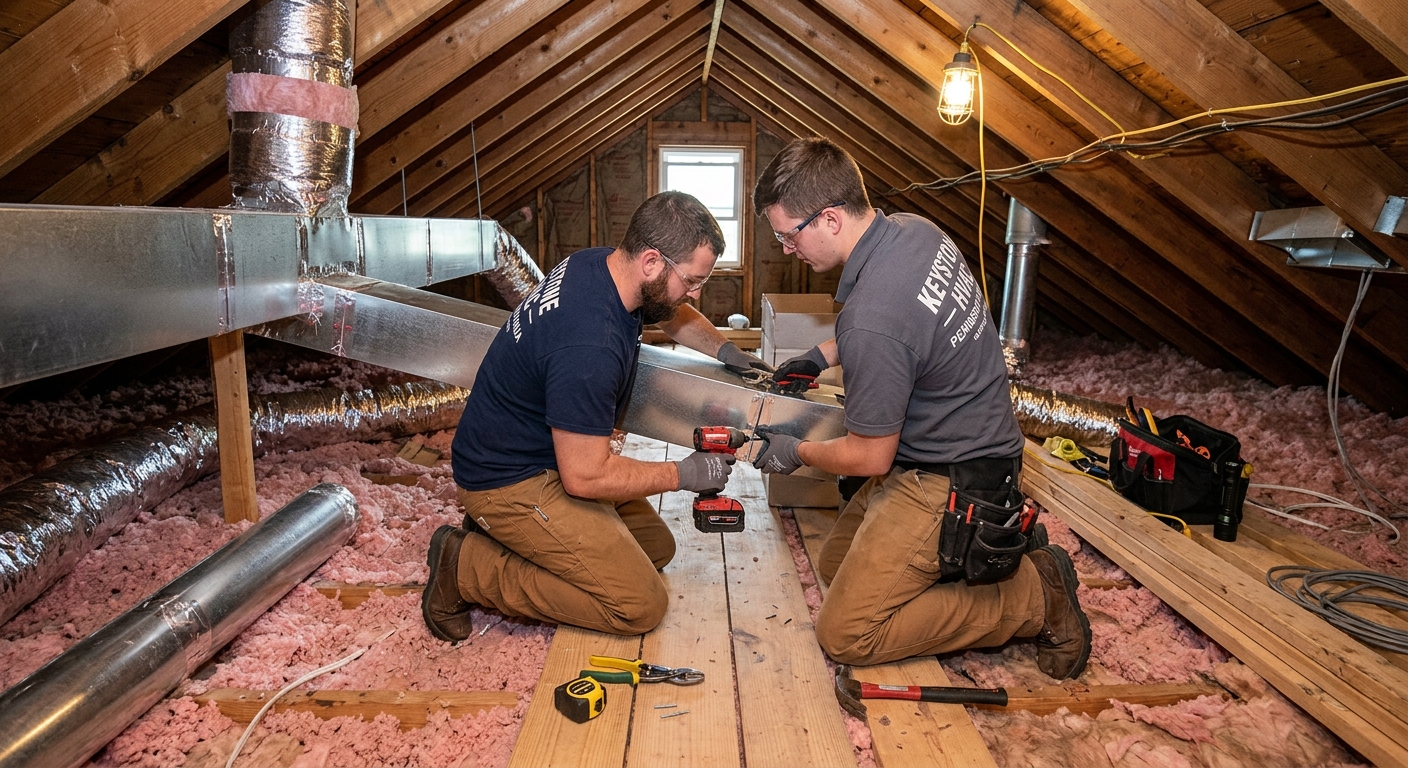
If your HVAC system never seems to get the house comfortable, don’t assume it’s just the age of the equipment. In Bangor, where nearly every home predates 1980 and a huge chunk are even older, ductwork is very often the actual culprit. Bethlehem and Easton’s early-1900s rowhomes rarely had central air, so when ductwork was added later (if at all), it was often sized just for a furnace, not for AC, and almost never sealed properly.
Duct leakage can easily send 20–30% of heated or cooled air into unconditioned spaces like attics or crawlspaces. The older the ducts, the worse the leakage tends to be, especially if they run through uninsulated areas. Undersized return ducts are another common, invisible problem — the system can never get enough air back to operate efficiently or quietly.
A duct blaster test is the only way to know real leakage numbers. This pressurizes the ducts and measures exactly how much air escapes, revealing leaks that a visual inspection will miss. Sometimes, sealing with mastic or aerosolized sealant is enough; other times, especially where ducts are undersized or dangerously rusted out, replacement may be the only answer.
In Bangor, you should always test the ducts before sinking good money into a new heat pump, furnace, or AC. Upgrading equipment without fixing bad distribution wastes both comfort and efficiency. If your installer doesn’t bring up duct testing before quoting a new system, take it as a warning sign — they’re selling gear, not delivering solutions.
SEER2, HSPF2 and AFUE decoded
SEER2 is the updated measure of AC and heat pump cooling efficiency. It stands for Seasonal Energy Efficiency Ratio 2, and is meant to reflect actual installed performance under more real-world test conditions. HSPF2 (Heating Seasonal Performance Factor 2) does the same for heat pump heating, measuring how efficiently the system heats over an entire winter. AFUE is Annual Fuel Utilization Efficiency, telling you what percentage of each fuel dollar goes to heat, not up the chimney.
In Northampton County, payback on ultra-high SEER2 often isn’t worth the jump in install price. With just 850 cooling degree days but 6,100 heating degree days, our climate is heating-dominated. That means you get better return boosting your HSPF2 than SEER2; a cold-climate heat pump with a 9–11 HSPF2 rating can pay back every winter. Spend just enough to get into the upper mid-tier for cooling efficiency (think 16–18 SEER2), but don’t throw money at the highest numbers.
One last note: older articles and product labels used SEER and HSPF. These numbers run higher for the same real-world performance, so don’t make comparisons without checking if the newer SEER2/HSPF2 scale is being used.
Gas, electric or both in northeastern Pennsylvania
In Northampton County, the core HVAC question is about heat, not just cooling. With a winter design temperature of 4 °F and 6,100 heating degree days, this is a true cold-climate market. Old advice that “heat pumps don’t work here” is now dated; modern cold-climate heat pumps do hold useful capacity well below freezing, especially with our milder swing seasons. But even the best see declining output as temperatures nosedive — that’s why backup heat or dual-fuel systems remain a wise choice.
Natural gas is widely available in Bangor and urban spots like Bethlehem and Easton, courtesy of local gas utilities. In outlying townships such as Lower Saucon, many homes still rely on propane or oil. For homeowners with gas on site, a gas furnace and central AC bundle remains tough to beat for lowest operating cost on the coldest days. But if you want to go all-electric, have a decent building envelope, or can tap energy efficiency incentives, a cold-climate ducted heat pump becomes a real contender.
If your only choices are fuel oil or propane, a high-efficiency heat pump will usually win out on operating cost and long-term savings, often enough to justify the higher installed $7,700–$16,500 for ducted systems. Dual-fuel (heat pump plus gas backup) makes sense where you have gas onsite but want to maximize efficient heat pump use before switching to gas on the year's coldest nights.
In short: if you have gas at the curb and see subzero temperatures every winter, furnaces are still king. If you're on oil or propane, or want to move away from fossil fuels, heat pumps — especially cold-climate models — are finally ready for Bangor.
| Option |
Installed cost |
Operating cost here |
Best when |
Incentive eligible |
| Gas furnace + central AC |
$4,800–$11,500 |
low (if gas available) |
existing gas service, coldest zones |
some rebates possible |
| Ducted heat pump (cold climate) |
$7,700–$16,500 |
moderate (all-electric), lower with good envelope |
good envelope, all-electric goal |
yes, especially for cold-climate units |
| Dual fuel (heat pump + gas backup) |
$12,500–$16,500 |
lowest (flexible fuel use) |
gas on site, deep cold spells |
yes, with right equipment |
| Ductless multi-zone |
$8,600–$17,500 |
moderate — depends on zoning & insulation |
no ductwork, zone control |
yes, per zone/efficiency |
Frequently asked questions — HVAC installation in Bangor
What HVAC tax credits are available to Bangor homeowners?
For Bangor homeowners, federal tax credits under the Inflation Reduction Act can offset a chunk of the cost for qualifying high-efficiency heat pumps, central air conditioners, and furnaces. To count, your equipment must meet or exceed the minimum SEER2, HSPF2, or AFUE benchmarks set by the program. Installation must be in an existing home (not new construction), and both ducted and ductless systems are eligible if they clear the efficiency bar. In addition, Pennsylvania occasionally offers state-level rebates for certain equipment, but these vary and aren't always available every year. For a ducted cold-climate heat pump, you could receive a credit worth up to 30% of cost, capped at certain limits — on a typical Bangor installation at $12,500, that’s potentially several thousand dollars back. Always confirm eligibility with your installer and keep every receipt, including the model number and efficiency documentation.
Should I replace the furnace and AC at the same time?
In Bangor’s older homes, it often makes sense to replace both the furnace and AC (or add a heat pump) at the same time, especially if either system is over 15 years old or if your ductwork is being revised. Modern systems are designed and tested together, which translates into more reliable performance, fewer compatibility headaches, and sometimes better installer pricing. If your furnace or AC is still relatively new and running well, replacement can often be staggered — but don’t throw good money at jury-rigged old equipment. A bundled install — like a gas furnace and central AC combo at $4,800–$11,500 — generally costs less in labor and gets you a matched efficiency setup. In Bangor, the cost of running two separate jobs weeks or months apart can outweigh any savings in keeping old equipment limping along.
When is the best time of year to replace HVAC in Bangor?
In Bangor, the best time to schedule HVAC replacements is spring or early fall — the shoulder seasons. Installers tend to be less slammed, you’re less likely to shiver or sweat through a delay, and a bit of scheduling flexibility can even net you a promotional price. Summer heatwaves and deep winter freezes see installers booked solid across the Lehigh Valley, so emergency replacement jobs cost more and go in behind no-heat calls. With pre-1980 homes making up nearly all Bangor housing, advance planning around these off-peak windows helps ensure you can choose your contractor wisely, address any duct or electrical surprises ahead of time, and maybe get closer to the lower end of the typical installed range (for example, $7,700 for a standard ducted heat pump).
What does HSPF2 measure?
HSPF2, or Heating Seasonal Performance Factor 2, is the latest metric that measures how efficiently a heat pump delivers heating over a full season — the higher the number, the more heat output you get per dollar of electricity used. It replaces the old HSPF standard with tougher test procedures that better represent real-world performance. In Bangor, with 6,100 heating degree days, your system will rack up a lot of runtime during the long Pennsylvania winter, so HSPF2 matters more here than in a place with mild winters. A system advertised with a HSPF2 of 9 or higher is considered efficient in our market, especially given high electricity rates. Opting for a cold-climate heat pump with high HSPF2 could save substantially over the system’s life, even if it’s priced at the higher end, say $12,500.
How much does a furnace replacement cost in Bangor?
The installed cost for a new gas furnace in Bangor, when paired with a compatible central air unit and using existing ductwork, usually falls in the $4,800–$11,500 range. Many older homes already have gas service, so most replacements can use the existing fuel source with little modification. Prices swing based on furnace efficiency (look for AFUE ratings), home size, any needed duct repairs or code updates, and whether your current system is up to code for venting and gas shutoff. If you’re still on oil or propane, conversion adds more. Always get at least two written estimates — some Lehigh Valley contractors push higher-output models than your Bangor home actually needs, which won’t save you a dime in winter.
Do I need a permit to replace HVAC in Bangor?
In Bangor and most of Northampton County, you almost always need a mechanical permit for a major replacement or new installation of central heating and cooling equipment. This requirement is driven by your municipality, not the state — Bethlehem, for example, insists on permits and inspections for central HVAC work, while some local boroughs only require permits for specific types of work. Small jobs like thermostat swaps are typically unpermitted, but anything involving new refrigerant lines, major ductwork, or new appliances must pass inspection to meet the Pennsylvania Uniform Construction Code. No permit (and no inspection) could endanger insurance coverage and stall a home sale. So, even for a standard system at $7,700–$16,500, get it permitted — it’s not just box-checking, it’s your legal protection.
Do older Bangor homes need ductwork replaced?
In Bangor, where nearly 95% of homes were built before 1980, chances are good your ducts aren’t in great shape. Age alone doesn’t guarantee replacement, but leaky, rusted, undersized, or uninsulated ductwork can sap 20–30% of heating or AC output. A duct blaster test is the best way to judge; many leaks can be solved with professional sealing, but when ducts are run through unconditioned attics or crawlspaces, or are originally sized only for a furnace (not AC or heat pump), replacement may be the only fix. Replacing ducts is a significant investment, typically $8,600–$17,500. But if your installer doesn’t even mention duct testing, they’re probably just selling you new equipment, not a whole-system solution.
How often should I change my filter?
For most Bangor homes, changing the HVAC filter every 2–3 months is a good rule of thumb, but many older Northampton County systems have undersized or hard-to-access filter slots — and dusty basements don’t help. If you have pets, allergies, or significant renovation dust, check monthly. A clogged filter restricts airflow, causing your equipment to work harder and possibly break down sooner. In cold-climate markets like Bangor, where heating runs hard all winter, a dirty filter can spike energy use and even cause safety shutdowns. Most local installers recommend using a standard pleated filter unless your system is specifically designed for a specialty type. Whether you’re running a gas furnace at $4,800 or a new heat pump at $7,700, don’t skip this $10 maintenance step.
Is a high-efficiency system worth the extra cost here?
In Bangor — a heating-dominated climate — spending for higher heating efficiency (a higher HSPF2 on a heat pump or a high-AFUE furnace) pays off much quicker than maxing out cooling efficiency. With 6,100 heating degree days and often older, less insulated homes, every uptick in HSPF2 or AFUE trims your energy bills. But chasing top-end SEER2 (cooling) ratings is usually not cost-effective unless you’re oversizing for a specific reason, like lots of sun-facing glass or home offices. The sweet spot for most Bangor homes is a mid- to upper-tier heating system — for example, a cold-climate ducted heat pump at $12,500. Installing the absolute highest efficiency model makes sense if you plan to stay for the long haul and have or are improving the home’s envelope (windows, air sealing). Otherwise, put the savings toward insulation or duct upgrades and get more bang for your buck.