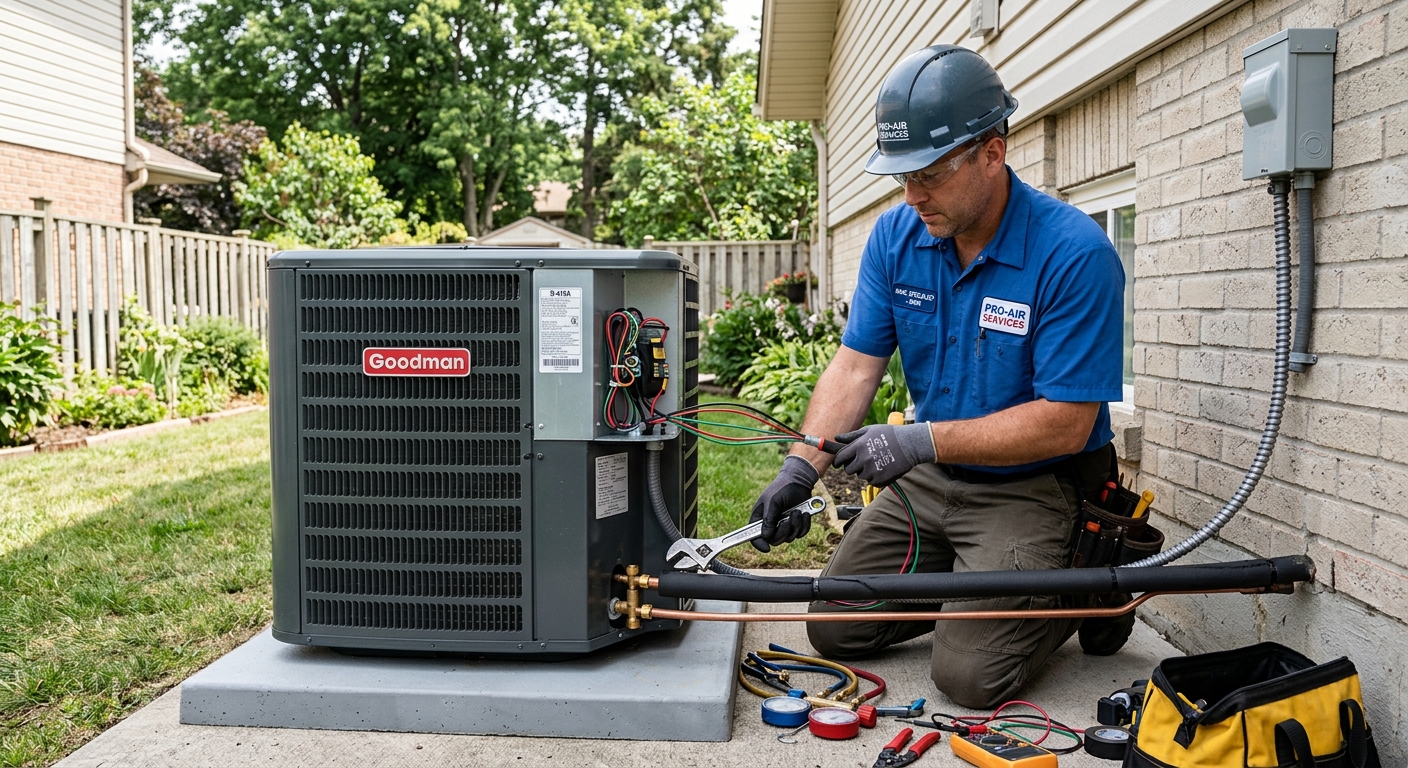
Lancaster heating and cooling prices by system type — 2026
Lancaster’s HVAC market is a balancing act between an older housing stock and a mix of owners and renters. Only 46.7% of homes here are owner-occupied, and a striking 88.0% were built before 1980 (U.S. Census Bureau, ACS 2024). That means replacement systems have to cope with aging infrastructure: many rowhomes and single-family houses in Lancaster were constructed well before modern ducted systems were standard, which is why ductless and high-velocity retrofits are common, especially in the city’s East Side neighborhoods. Full duct replacements are rare unless the home has undergone major renovations, since many existing systems were sized just for heating, not today’s higher-output ACs.
South-central Pennsylvania’s climate places more demand on heating than cooling. Lancaster sees about 5,200 heating degree days and just 1,250 cooling degree days annually. So, while air conditioning matters on humid summer days, it’s cold weather performance—and keeping gas or electric bills in check—that should shape most system decisions here. Residents in owner-occupied homes get the most value from high-efficiency systems and thoughtful upgrades, while those with older rowhomes often find ductless mini-splits a better investment than trying to shoehorn new ducts into tight chases.
| System |
Best for |
Efficiency |
Price range (installed) |
| Central AC replacement (existing ducts) |
homes with sound ductwork |
16–20 SEER2 |
$4,800–$11,500 |
| Air source heat pump (ducted) |
year-round heating and cooling |
8–10 HSPF2 |
$7,700–$16,500 |
| Cold-climate heat pump (ducted) |
heat pump as primary heat |
9–11 HSPF2 |
$12,500–$16,500 |
| Ductless mini-split (single zone) |
additions, rooms without ducts |
20–30 SEER2 |
$3,100–$6,700 |
| Full duct system installation |
homes with no existing ducts |
— |
$8,700–$17,500 |
Installed estimates for a typical Lancaster home. Equipment tonnage, duct condition and electrical capacity move these more than brand.
When an HVAC repair stops being worth it
In Lancaster, most homeowners get the best value by repairing rather than replacing—until specific triggers make a replacement the clear choice. If your HVAC system is less than 10 years old, a single component failure, like a blower motor or capacitor, can almost always be repaired economically. Once systems approach or pass 12–15 years, especially in older homes common here, major issues like refrigerant leaks, bad compressors, or cracked heat exchangers tip the cost-benefit toward replacement.
A good rule of thumb is: if the repair costs more than one-third of a full replacement—or if the failure involves high-cost parts (compressor or heat exchanger)—it’s time to weigh new equipment. Another factor is refrigerant: systems using R-22, found in pre-2010 installations, are increasingly expensive to service and not worth ongoing investment. In Lancaster’s heating-dominated climate, efficiency upgrades only pay back if your existing equipment is old enough that modern units are a big leap, or if your energy bills remain stubbornly high after you’ve sealed ducts and improved insulation.
Mandatory replacement situations are: a cracked heat exchanger (carbon monoxide risk and code violation) and a compressor failure on a system that’s out of warranty or past 12–15 years. For high bills without clear equipment failure, get the ducts and building envelope professionally tested before considering replacement—this is a common issue in Lancaster’s older homes.
| Situation |
Recommendation |
Typical cost |
Reasoning |
| Under 10 years, single component failure |
Repair |
$300–$1,200 |
Most parts are still available and affordable |
| 10–15 years, repair over a third of replacement |
Consider replacing |
$4,800–$11,500 |
Approaching service life, future repairs likely |
| 15+ years, any major failure |
Replace |
$4,800–$11,500 |
System well past typical life, efficiency gains too small |
| Cracked heat exchanger, any age |
Replace immediately |
$4,800–$11,500 |
Cannot safely repair; code violation |
| Compressor failure past warranty |
Replace |
$7,700–$16,500 |
Repair could approach or exceed new system |
| Working system, high bills |
Test ducts and envelope first |
$300–$800 |
Leaky ducts common in older Lancaster homes |
How to vet an HVAC contractor in Lancaster
The difference between a quiet, efficient system and a noisy, expensive headache is almost always the installation—not the brand. With Lancaster’s mix of older homes and suburban replacements, it’s crucial to pick a contractor who does more than swap boxes. Start with registration: any contractor taking deposits or working on jobs over $500 must have a valid Home Improvement Contractor (HIC) registration from the Pennsylvania Office of Attorney General. You can check this at hic.attorneygeneral.gov. For refrigerant work, the tech on site—not just the company—needs EPA Section 608 certification.
A quality quote for a replacement or installation in Lancaster should list actual model numbers, not just “3 ton, 16 SEER.” Insist on a complete Manual J load calculation, which accounts for insulation, windows, and air leaks—old rowhomes and even suburban houses can vary wildly room to room. Don’t accept anything less than documented duct leakage and airflow tests during commissioning. Good contractors hand you paperwork proving the system was dialed in for your house.
- Verify HIC registration at hic.attorneygeneral.gov
- Ask to see the technician’s EPA Section 608 card
- Confirm workers’ compensation insurance on wcais.pa.gov
- Request a Manual J (load calculation) in writing
- Insist on model numbers in the proposal, not generic sizing
- Ask about airflow and refrigerant charge tests during startup
- Get references for past Lancaster jobs, preferably in similar homes
- Read the written contract and check for the 3-day cancellation option
- Avoid contractors promising to “cover” your insurance deductible (illegal in PA)
- Check permit and inspection requirements with your local code office
- For older homes, ask about EPA Lead RRP credentials if disturbing walls
- Look for documented system commissioning, not just “install and go”
Given Lancaster’s moderate-density contractor market, beware of anyone who pressures you for same-day decisions, won’t show insurance, or quotes a system with a suspiciously low installed price. In this area, price below $4,800 usually means shortcuts.
Lancaster's housing stock and its HVAC needs
Lancaster’s homes are old by Pennsylvania standards, with 88.0% built before 1980 and many city rowhomes dating from 1880–1930 (U.S. Census Bureau, ACS 2024). In these older houses, full-sized ductwork is often missing or was originally sized for small, gravity-fed furnaces—definitely not for modern air conditioning. Even where ducts exist, they may be leaky or undersized, limiting today’s high-efficiency equipment from performing at its best. If your home is one of Lancaster’s classic rowhouses, adding central air is rarely straightforward; ductless mini-splits or high-velocity systems are more feasible and less invasive.
Suburban townships like Manheim and East Hempfield do have more single-family homes with ducts, but even here, insulation levels and window quality are all over the map. Many builder-grade installs in developments from the 1990s and early 2000s are now at end of life. Frequently, these older systems are oversized because insulation upgrades and tighter windows over the years have reduced heating and cooling loads.
For gas systems, chimney flue safety becomes an important concern in city homes. If you’re thinking about switching to a heat pump, remember that old panels and limited electrical supply may require an upgrade, not just a new outdoor unit. Whether you’re replacing your first system or adding comfort for the first time, the unique housing wave here means every job should start with a whole-house review, not just a quote for a box swap.
The central decision for a Lancaster homeowner
In Lancaster County, with a winter design temperature of 12°F and over 5,200 heating degree days per year, your choice of system starts with heat. Air conditioning is needed on muggy summer days, but most of your energy dollars go to heating. Traditional wisdom says gas furnaces are best in colder climates, but that’s changed with the newest generation of cold-climate heat pumps—they can now provide reliable heat at temperatures well below freezing, retaining efficiency most of the season. Still, as temperatures drop toward those extreme lows, a heat pump’s output does fall off, which is why "dual fuel" options (a heat pump paired with an efficient gas furnace) are gaining ground.
If your home is in Lancaster city, Manheim Township, or East Hempfield, natural gas service is usually available. In these cases, high-efficiency gas furnaces remain cost-effective, especially for homes with good ductwork. But out in the rural townships or edge developments without gas lines, the comparison changes: you’ll be weighing an all-electric heat pump against oil or propane, both of which carry higher and far more volatile fuel costs.
In homes where ductwork is missing or in poor shape—a common scenario in Lancaster rowhomes and some older farmhouses—ductless mini-splits or high-velocity systems are often the best choice for both heating and cooling. The one situation where a furnace is absolutely still the right call: if your home already has gas service, ducts in good condition, and you experience extended sub-12°F cold snaps each winter. In all other situations, a professionally sized cold-climate heat pump or a dual-fuel setup increasingly outperforms the old ways.
| Option |
Installed cost |
Operating cost here |
Best when |
Incentive eligible |
| Gas furnace + central AC |
$4,800–$11,500 |
Lower with gas, higher if propane/oil |
existing gas service, coldest zones |
Sometimes (utility rebates for efficiency upgrades) |
| Ducted heat pump (cold climate) |
$7,700–$16,500 |
Lower bills with all-electric goal |
good envelope, all-electric goal |
Often (state/federal/utility incentives) |
| Dual fuel (heat pump + gas backup) |
$12,500–$16,500 |
Lower than either system alone in deep cold |
gas on site, deep cold spells |
Often |
| Ductless multi-zone |
$8,700–$17,500 |
Can be lowest in targeted areas |
no ductwork, zone control |
Usually |
Operating cost, not sticker price
In Lancaster, sticker price is only half the story. With our climate’s 5,200 heating degree days and a winter design temperature of 12°F, heating is your main annual cost. PPL Electric Utilities serves most of Lancaster County, so you can find your exact electric rate right on your bill. Older homes with leaky windows or poor insulation can easily double the effective load compared to well-sealed, updated houses.
To compare systems, use this method: Efficiency rating (AFUE for gas, HSPF2 for heat pumps) tells you what percent of purchased fuel actually makes it into your living spaces as heat. Degree days convert outdoor climate into annual energy demand. Finally, your rate per kilowatt-hour or per therm is the critical final step.
For example, if a heat pump is rated 9 HSPF2 and your home uses 30,000 BTUs of heat per square foot per year, you can estimate:
- Total annual heating load (BTUs) = square feet of home × 30,000
- Total kWh = total BTUs ÷ (HSPF2 × 3,412), since 1 kWh = 3,412 BTUs
- Annual electricity cost = total kWh × your actual PPL rate
For gas systems, AFUE (e.g., 95%) means 95% of fuel gets turned into heat. Use your total therms on past bills (or ask your contractor for a Manual J calc) to compare. Adjust for your actual usage history—energy calculators are everywhere online, but they don’t know if your ducts leak, your insulation is thin, or your old rowhome gets battered by wind.
Don’t be fooled: a high-efficiency system in a leaky home with tired ductwork can cost more to run than a mid-tier system in a home with a tight envelope and sealed ducts. Always start by fixing leaks and insulation before chasing a top-end unit.
Mechanical permits for HVAC work in Lancaster
Pennsylvania does not issue a statewide HVAC license for residential work. For residential projects, what matters in Lancaster is that your contractor holds a valid Home Improvement Contractor (HIC) registration, required for any work or contract over $500. Always verify this at hic.attorneygeneral.gov before signing any contract. Lancaster city and surrounding townships generally require a mechanical permit for replacement or installation of central HVAC equipment—this is enforced by each municipality's code compliance office, not by the state.
Anyone handling refrigerant—meaning nearly all AC and heat pump projects—must have federal EPA Section 608 certification. Ask to see this credential for the technician actually performing the work, not just the company owner.
You can verify that your contractor’s workers’ compensation insurance is current using Pennsylvania’s WCAIS system (wcais.pa.gov), which covers you in case of injury on your property. Finally, for homes built before 1978, the EPA Lead RRP Rule applies if any demolition or wall work is occurring as part of your HVAC project. Always check with your city or township code office to be sure you’re meeting both state and local requirements—permit processes can differ just between Lancaster city and East Hempfield Township.
Frequently asked questions — HVAC installation in Lancaster
What is SEER2 and how is it different from SEER?
SEER2 stands for "Seasonal Energy Efficiency Ratio 2." It’s the new national standard for measuring air conditioner and heat pump cooling efficiency. SEER2 uses a revised laboratory test that better reflects real-world installation challenges—more like the static pressures you’d find in typical Lancaster ductwork, rather than in a perfectly installed lab system. Practically, SEER2 ratings are a bit lower than older SEER values for the same unit, but they are more honest about what you’ll get in your Pennsylvania home, especially with older or leaky ducts common in Lancaster city’s housing. If you’re shopping for a replacement, compare SEER2 numbers directly. Expect to pay around $4,800–$11,500 for a new central AC with SEER2 ratings in Lancaster, and know that real-world efficiency will always come down to installation quality and your home’s ducts.
How much does a furnace replacement cost in Lancaster?
In Lancaster, furnace replacements usually come bundled with AC replacement for maximum efficiency and reliability—especially if your system is 15 years old or more. For just the furnace, expect installed costs in the $4,800–$11,500 range, with price shifting by size, efficiency, and whether any duct, flue, or electrical upgrades are needed (older Lancaster homes often need something extra). Rowhomes or houses with tight closets may cost more due to installation complexity. It’s always worth getting a professional Manual J load calculation for the right system size here—Lancaster’s older homes are rarely “standard,” and oversizing or undersizing worsens comfort and longevity. Always confirm that your quote covers code-required safety checks for older flues and includes a city or township permit if required.
Why are my Lancaster energy bills high with a new system?
It’s frustrating to replace your HVAC—often for $7,700–$16,500—and still get high bills. In Lancaster, high bills after a new installation almost always trace to your home's envelope, not just the furnace, AC, or heat pump. Old rowhomes, common in the city, are notorious for drafts, minimal insulation, and leaky or undersized ductwork. If ducts run through unconditioned spaces or walls, a significant portion of your heated or cooled air may never make it inside. Solutions: ask your contractor to test for duct leaks and check attic and wall insulation. Sometimes, for less than $800, you solve problems that a high-end system alone can’t touch. Also confirm your thermostat is programmed for the new system; settings that worked for 1980s equipment won’t always help today.
Should I replace the furnace and AC at the same time?
In Lancaster’s climate, it’s often smart to replace both furnace and AC during the same project, but not always required. If one system is more than 15 years old and the other is nearing end of life, joint replacement saves on labor, ensures strong compatibility, and avoids doubling up on permit and inspection fees—especially relevant for homes built before 1980. For newer homes in suburban townships, builders sometimes installed mismatched equipment that never performed well. Expect a combined cost in the $4,800–$11,500 range for dual replacement. However, if your air conditioner is newer or was replaced within the last 5–7 years, and works fine, hold off; no code requires replacing a healthy unit. Always have both units checked—sometimes what’s old isn’t the problem.
What does a heat pump cost installed in Lancaster?
Installation for a ducted air source heat pump in Lancaster runs between $7,700–$16,500, with most prices landing around the mid$12,500 mark for typical homes. Ductless mini-split setups for a single room or addition, often popular in older Lancaster rowhomes without ductwork, cost less—usually $3,100–$6,700 per zone. If your home has no existing ducts or needs a total overhaul, install costs increase. You’ll want to factor in possible electrical upgrades for older homes, since plugging a modern heat pump into a sub-panel dating to 1960 isn’t always code-legal or safe. Ask about state and utility incentives, as Lancaster homes are often eligible for rebates on high-efficiency installs.
When is the best time of year to replace HVAC in Lancaster?
The ideal time to schedule HVAC replacement in Lancaster is during the spring or early fall—not in the heat of July or the freeze of January when contractors are busiest with emergencies. Off-peak months let you get quotes, schedule city or township permits, and complete the job without rushed timelines or emergency fees. Some reputable contractors offer pricing incentives for work in March, April, or October, when demand is lower. For projects like ductless installations in older rowhomes, scheduling in mild weather makes the whole job run smoother—you won’t be left without heat or AC during the hottest or coldest week of the year. On average, most systems installed in this window will price out at $4,800–$11,500 for standard replacements.
Are duct sealing and insulation eligible for incentives?
Yes, in Lancaster and throughout Pennsylvania, duct sealing and insulation upgrades are often eligible for rebates from utilities and state efficiency programs. Older homes in Lancaster city and its suburbs, especially those built before 1980, almost always benefit from air sealing and duct improvements. Sealing ductwork and adding insulation can be one of the fastest payback projects in our heating-heavy climate—often in the $300–$800 range for straightforward jobs. Check with PPL Electric Utilities or your township for current program specifics. Don’t forget: you’ll need a contractor with proper registration (check hic.attorneygeneral.gov) to qualify for most rebates, and a written scope that documents the improvements.
How does south-central Pennsylvania's climate affect system sizing?
In Lancaster, our climate has real extremes—long stretches of cold with 5,200 heating degree days and muggy, but much shorter cooling spells. System sizing must start with an on-site load calculation, taking into account your home’s age, window type, insulation, and especially whether you have leaky, undersized, or missing ducts (a common situation in city rowhomes). Oversizing is a common issue in older homes: a system too big heats or cools too quickly and shuts off before removing humidity or evenly distributing air, leading to discomfort and higher bills. In a typical Lancaster retrofit, right sizing can reduce your installed cost to $4,800–$11,500 for conventional systems and avoid costly callbacks or comfort complaints.
Do I need a permit to replace HVAC in Lancaster?
In Lancaster city, replacing or installing central HVAC equipment generally requires a mechanical permit, and the project will need to pass a city inspection for code compliance. For the rest of Lancaster County, rules vary by township, but most ask for some form of permit if the work is more than routine maintenance like a filter change or thermostat adjustment. Always ask your contractor to handle the paperwork—if they hesitate, that’s a red flag. Permit fees are usually included in bids priced from $4,800–$11,500 for system replacement. If your house was built before 1978, make sure lead safety rules are followed during any work that opens up walls or creates dust. Don’t skip this step—it protects your investment and ensures everything’s to code.