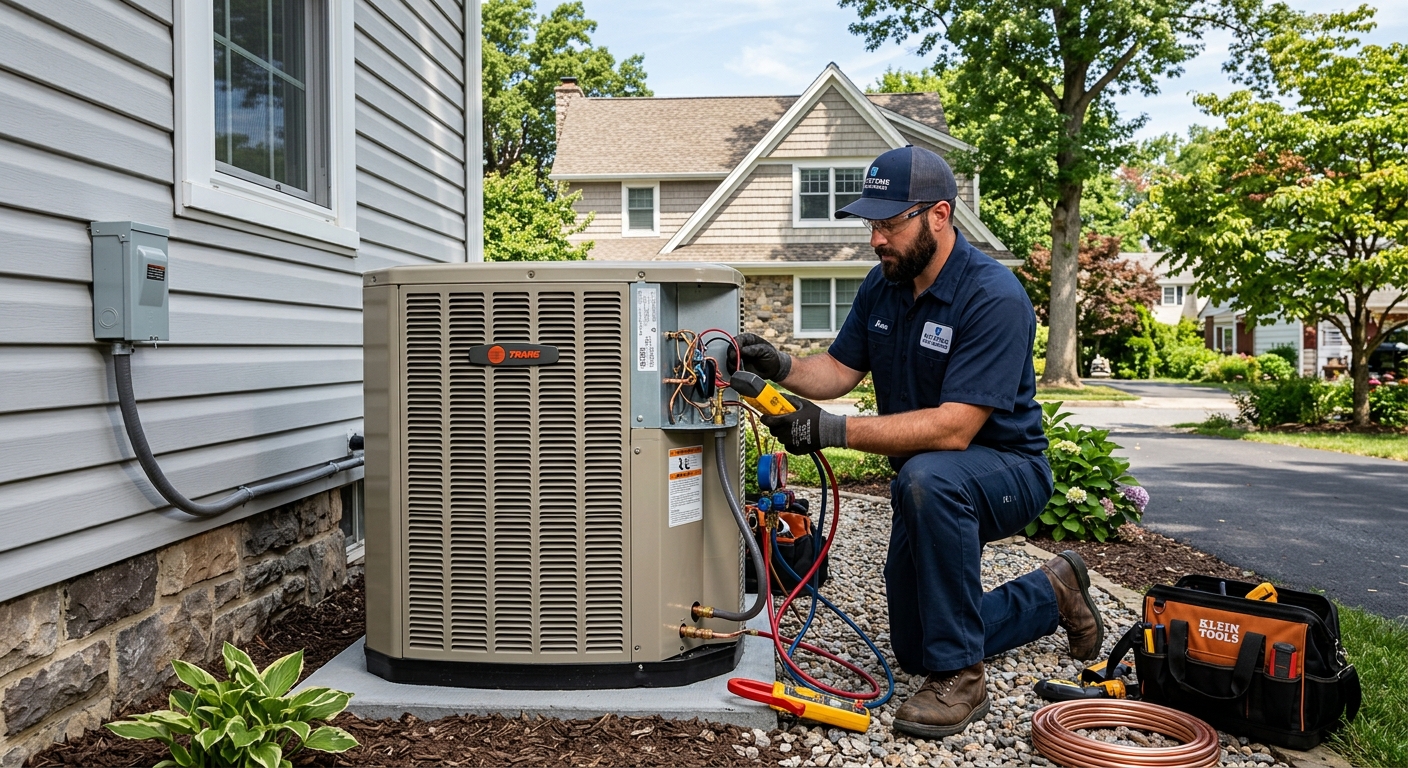
Bethel Park heating and cooling prices by system type — 2026
Bethel Park’s market for HVAC installation and replacement is shaped by its high homeownership rate of 78.3% and the fact that over three-quarters of homes were built before 1980 (U.S. Census Bureau, ACS 2024). This creates a market where replacement and retrofit jobs dominate, especially since pre-1960 homes often have older ducts and limited electrical service. Duct size and layout can be a limiting factor when installing high-efficiency central systems, and not every home will have ducts that can support modern airflow requirements without upgrades.
Our southwestern Pennsylvania climate is heating-dominated, with about 5,600 heating degree days and only 1,050 cooling degree days per year. Winters are long and cold, and summer humidity is notable but short-lived. That means your heating equipment will see much more use than cooling, and while air conditioning is valued, it’s furnace or heat pump performance that makes the biggest difference in comfort and operating cost here in Bethel Park.
Below are area-typical price ranges for installed systems in 2026.
| System |
Best for |
Efficiency |
Price range (installed) |
| Central AC replacement (existing ducts) |
homes with sound ductwork |
16–20 SEER2 |
$5,400–$13,000 |
| Air source heat pump (ducted) |
year-round heating and cooling |
8–10 HSPF2 |
$8,600–$18,500 |
| Cold-climate heat pump (ducted) |
heat pump as primary heat |
9–11 HSPF2 |
$14,000–$18,500 |
| Ductless mini-split (single zone) |
additions, rooms without ducts |
20–30 SEER2 |
$3,400–$7,500 |
| Full duct system installation |
homes with no existing ducts |
— |
$9,700–$19,500 |
Installed estimates for a typical Bethel Park home. Equipment tonnage, duct condition and electrical capacity move these more than brand.
When an HVAC repair stops being worth it
In Bethel Park, deciding whether to repair or replace your HVAC system should be practical, not guesswork. If your system is under ten years old and what failed is a single component like a capacitor, igniter, or board, repairing makes sense. Once repairs start to creep above a third of the cost of a full replacement, especially after the ten-year mark, it’s time to weigh your options. With many homes built before 1980 and older units still around, it’s common to encounter equipment well past its prime.
Replacement isn’t optional if you have a cracked heat exchanger in a furnace (a serious safety hazard), or a compressor failure in an air conditioner or heat pump past its warranty period. In both cases, the repair costs approach or exceed the price of a new system, with no guarantee that another failure isn’t just months off. If your unit uses R-22 refrigerant, parts and recharge are expensive and destined to get worse.
Don’t be upsold on efficiency for its own sake — in a climate like Bethel Park’s, where most of the annual energy cost is for winter heating, payback from “top tier” AC efficiency alone is slow. Focus instead on fixing leaky ducts or inadequate insulation if your bills are high and the system itself is working.
| Situation |
Recommendation |
Typical cost |
Reasoning |
| Under 10 years, single component failure |
Repair |
$300–$1,200 |
Part is affordable; newer unit unlikely to have further failures soon. |
| 10–15 years, repair over a third of replacement |
Consider replacing |
$5,400–$13,000 |
High repair cost and shorter remaining life make replacement practical. |
| 15+ years, any major failure |
Replace |
$5,400–$13,000 |
Old equipment is inefficient and likely to keep failing. |
| Cracked heat exchanger, any age |
Replace immediately |
$5,400–$13,000 |
Unsafe to operate. No safe repair. |
| Compressor failure past warranty |
Replace |
$8,600–$18,500 |
Repairs approach cost of new equipment with no warranty. |
| Working system, high bills |
Test ducts and envelope first |
$300–$800 |
Duct leaks and insulation can matter more than efficiency uprate here. |
Filtration, humidification and ventilation
With Bethel Park’s long heating season and short, humid summers, indoor air quality challenges here tend to break down seasonally. In the winter, dry air can leave your skin itchy and your sinuses raw. Adding a whole-house humidifier can help, but keep in mind these systems need annual cleaning and maintenance—neglect leads to mold and mineral scale. In summer, humidity flips the script. If your air conditioner is oversized for the house, it will cool quickly but leave the air clammy and uncomfortable because it doesn’t run long enough to dehumidify. Sizing the system right is more important than buying a more expensive air conditioner.
For air filtration, the default in most Bethel Park homes is a disposable MERV 8 or MERV 11 filter. Higher MERV filters can pull out finer particles, but unless your blower motor is strong enough, you risk restricting airflow. Always ask your contractor if your current furnace or air handler can handle a higher-MERV upgrade without stressing the system.
If your home is one of the few in Bethel Park that is new or tightly air-sealed, mechanical ventilation (an HRV or ERV) can improve air quality and help control both humidity and odors. For most older Bethel Park homes, add-ons like ultra-violet lights and electrostatic air cleaners are oversold—rarely worth the upcharge compared to focused duct sealing and routine filter changes.
Operating cost, not sticker price
In Bethel Park, where we see roughly 5,600 heating degree days and winter design temps can drop to 8 °F, your furnace or heat pump’s efficiency has a much bigger impact on operating cost than the SEER rating on your AC. Cooling is still necessary—a few July weeks can get sticky—but compared to those long heating months, it’s the winter performance that drives your utility bills. Most homes in the area get their electricity from Duquesne Light Company, and your actual cost per kilowatt-hour can be found right on your monthly bill—don’t guess, check the line item price.
To estimate annual energy use, multiply your home’s heat load (in BTUs) by the number of degree days, divide by your system’s efficiency, and then convert to dollars using your current rate. For example, a 60,000 BTU/hr furnace at 95% efficiency burning natural gas will cost less to operate than an older 80% unit. But if your ducts leak 30% of the heat into the attic, that high-efficiency furnace does you no good. The same goes for air conditioning: a 16 SEER2 unit will cost less to run than a 13 SEER2, but the difference in Bethel Park’s mild summers is far less important than good ductwork and insulation.
Here’s the formula to help you compare:
- Annual load (BTUs) = Design load x Heating Degree Days
- Divide by system efficiency (as a decimal) = BTUs needed from fuel
- Convert BTUs to fuel units (kWh or therms), check your bill for per-unit price
- Multiply for annual energy cost
Remember, real-world systems don’t run in a lab. A high-efficiency unit with leaky or undersized ducts may cost more to operate than a mid-grade unit installed right. If in doubt, invest in duct sealing or diagnostics before chasing top-end equipment efficiency.
Permits, licensing and inspections in Bethel Park
Pennsylvania does not have a statewide HVAC license for residential work; instead, all contractors performing jobs over $500 must be registered under the Home Improvement Contractor (HIC) program, which you can verify at hic.attorneygeneral.gov. There’s no state-issued mechanical or electrical license for residential work here—these are handled at the municipal level, if at all, and Bethel Park follows the Pennsylvania Uniform Construction Code for permits and inspections. Any installation or replacement involving new equipment or major alterations will require a local mechanical permit, with an inspection upon completion to make sure the work is safe and up to code.
Anyone handling refrigerants (installing, servicing, or decommissioning air conditioners and heat pumps) must have federal EPA Section 608 certification. That’s a non-negotiable, regardless of state or town licensing.
Your protection relies on making sure the contractor is not just registered, but also fully insured and carrying current workers’ compensation coverage, which you can check through the Workers’ Compensation Automation and Integration System (WCAIS) at wcais.pa.gov. Don’t take assurances—ask for certificates and check both systems. For older homes (pre-1978), EPA lead certification rules apply, adding one more piece of required paperwork.
Reducing the net cost of a Bethel Park installation
Many Bethel Park homeowners can cut costs with a combination of federal tax credits, local utility rebates, and occasionally state-level energy programs. A federal tax credit—such as those available for heat pumps and high-efficiency HVAC systems—directly reduces what you owe on your federal taxes for that year. Compare that to a rebate, where the utility (Duquesne Light Company for electricity or Peoples Gas for natural gas) pays you back after purchase, trimming the invoice “bottom line” up front or shortly after installation clears inspection.
Program amounts and even eligibility change every year, so don’t trust a number in an article unless it comes from your utility’s program page or the current federal IRS fact sheet. The ENERGY STAR Rebate Finder is another reliable source for finding incentives available in Allegheny County—search by your zip code for up-to-date offers. For Duquesne Light Company and Peoples Gas customers, go straight to their websites and look for “energy efficiency” or “rebates.” Not every program covers every equipment type or brand, and requirements (like proof of installation, model number, or proof of disposal for the old unit) are strictly enforced.
Bottom line: check program specifics before you buy, since old information can be worse than none at all. A rebate might only be $100–$500, but a tax credit can save up to several hundred dollars or more, depending on federal law. Always double-check with your utility and a reputable contractor before signing, and make sure all incentives are locked in writing.
Manual J and the tonnage question
In Bethel Park, the most critical decision when replacing or installing an HVAC system is sizing it for the actual heat loss and gain of your home. Many older houses in this area have tight duct runs and variable insulation—if you rely on a contractor’s “rule of thumb” (like tonnage per square foot), you’re risking serious headaches. Oversized systems will short cycle, run inefficiently, leave you with cold and hot spots, and fail to pull moisture out of the air in the summer. That means both higher bills and a less comfortable house.
The proper way to size any HVAC system—furnace, AC, or heat pump—is with a Manual J load calculation. This accounts for your home’s insulation, window types, airtightness, direction it faces, and even how much shade your roof gets. The calculation uses the local winter design temperature, which here is 8 °F, to ensure your system can actually keep you comfortable on the coldest nights and handle Bethel Park’s long heating season. In a region where heating needs far exceed cooling needs, undersizing tends to lead to frozen pipes, while oversizing causes short cycling and early failure.
The single best question you can ask your contractor is: “Did you run a Manual J load calculation, and can I see the report?” If they size the new unit off the old nameplate, they’re probably repeating someone else’s guesswork or error. A proper calculation is a few pages long—if they can’t show it, you’re better off shopping around.
Frequently asked questions — HVAC installation in Bethel Park
Is a heat pump a good choice for Bethel Park winters?
Heat pumps are becoming much more practical in Bethel Park, even with our 8 °F winter design temperature. Modern cold-climate heat pumps now operate well below freezing, and with natural gas still widely available, it’s worth weighing both options. Most Bethel Park homes are heating-dominated: you’ll run your heating system far more than your cooling. Cost-wise, a fully installed ducted cold-climate heat pump here runs $14,000–$18,500. It’s efficient, and if your ducts and insulation are in good shape, can be the only system you need. For old, leaky houses or those with limited electric service, a dual-fuel system (heat pump plus a backup furnace) is sometimes a better fit.
How long does HVAC installation take in Bethel Park?
In most Bethel Park homes, replacing a central air conditioner or furnace takes one to two days if you’re working with functioning, accessible ductwork. For complete system installs—including running new ducts in a house that never had central HVAC—expect three to five days. Older homes, which are common here, often mean tighter duct chases and challenging electrical upgrades, possibly extending timelines. Your contractor should provide a schedule up front, accounting for local inspections and any work on the electrical panel. Always figure on a day or two buffer—it’s better to be pleasantly surprised than impatient. Full duct system installs typically run $9,700–$19,500 and those jobs tend to be the most complex timing-wise.
How often should I change my filter?
For most Bethel Park homes, changing a standard 1-inch filter every 2–3 months during heating and cooling season is ideal. If you have pets or allergies, monthly is better. Our long heating season (with plenty of furnace run time) means filters clog sooner than in areas with shorter seasons. If you have a higher-MERV filter or a media cabinet (like a 4- or 5-inch filter), check it every quarter but expect it could last six months. Dirty filters can cause a well-installed system, even one costing $8,600–$18,500, to overheat and fail early. Mark your calendar or set a reminder—filter changes are the cheapest insurance against repairs.
How much does a furnace replacement cost in Bethel Park?
Most furnace replacements in Bethel Park homes cost in the range of $5,400–$13,000, depending on the efficiency rating, size, duct condition, and any needed electrical or chimney upgrades. Many houses here still have older equipment originally installed pre-1980, so you may encounter surprises like outdated wiring or tight utility rooms that add to labor. If you’re quoted below that range, double-check what’s actually being included—permits, new thermostat, duct connections, and haul-away. Better to invest in a right-sized, high-quality install than save a little up front and pay for it in repairs or discomfort.
Is natural gas available throughout Allegheny County?
In general, yes—natural gas is widely available in Allegheny County, including Bethel Park. However, some neighborhoods (especially at the outer edges of the county) still rely on propane or fuel oil, typically where adding gas lines is difficult. If your street uses Peoples Gas, it’s a good sign gas service is present, but always call to confirm before choosing or sizing equipment. Being on natural gas usually means lower winter heating bills, and can impact your payback math if you’re considering a new heat pump, which might run $8,600–$18,500 installed. Check your utility bill or ask your neighbors if you’re unsure which fuel serves your home.
What size HVAC system does my Bethel Park home need?
No responsible contractor in Bethel Park should size an HVAC system by square footage or copy the old unit’s rating, especially with so many pre-1980 homes that have variable insulation, window quality, and duct condition. Proper sizing is done through a Manual J load calculation, which factors everything unique about your house—including its specifics for our 8 °F design temperature. Your house may need a system costing $8,600–$18,500, but the right size is the one proven by calculation, not guesswork. Always ask to see the load calculation as part of your bid before agreeing to any installation work.
How much does a new HVAC system cost in Bethel Park?
A new HVAC system in Bethel Park runs from $5,400–$13,000 for basic central AC replacement when the ducts are usable, up to $18,500 or more for a fully installed ducted heat pump or full duct system in older homes. Factors driving the range include ductwork condition, energy efficiency ratings, electrical upgrades, zoning, and type of included controls or filtration. Houses built before 1980 (which make up the majority here) often have hidden costs like needing electrical panel upgrades or duct modifications. You’ll get the most accurate number only after an in-home assessment and Manual J calculation.
How do I verify an HVAC contractor's insurance?
For any Bethel Park install, always request a copy of your contractor’s general liability and workers’ compensation certificates before signing a contract. Pennsylvania requires contractors to carry workers’ comp coverage for all employees. You can verify their workers’ compensation status directly at the Workers’ Compensation Automation and Integration System (WCAIS) website—an especially important step for larger jobs (anything running $9,700–$19,500) or when multiple workers are on site. For Home Improvement Contractor (HIC) registration, check hic.attorneygeneral.gov for status and complaints. If a contractor resists sharing insurance or proof of registration, that’s a red flag.
Do I need ENERGY STAR equipment to qualify for incentives?
ENERGY STAR certification is a common requirement for many utility rebates and some federal tax credits, but not all incentives require it. For Bethel Park homeowners, Duquesne Light Company and Peoples Gas may restrict their rebates to higher-efficiency (often ENERGY STAR) models, while federal programs may also specify minimum SEER or HSPF ratings. Always read the fine print on the incentive application. Even if a unit costing $5,400–$13,000 is eligible in theory, missing that ENERGY STAR mark can mean leaving money on the table. Before purchase, check the ENERGY STAR rebate finder and your utility’s site for up-to-date eligibility and documentation requirements.