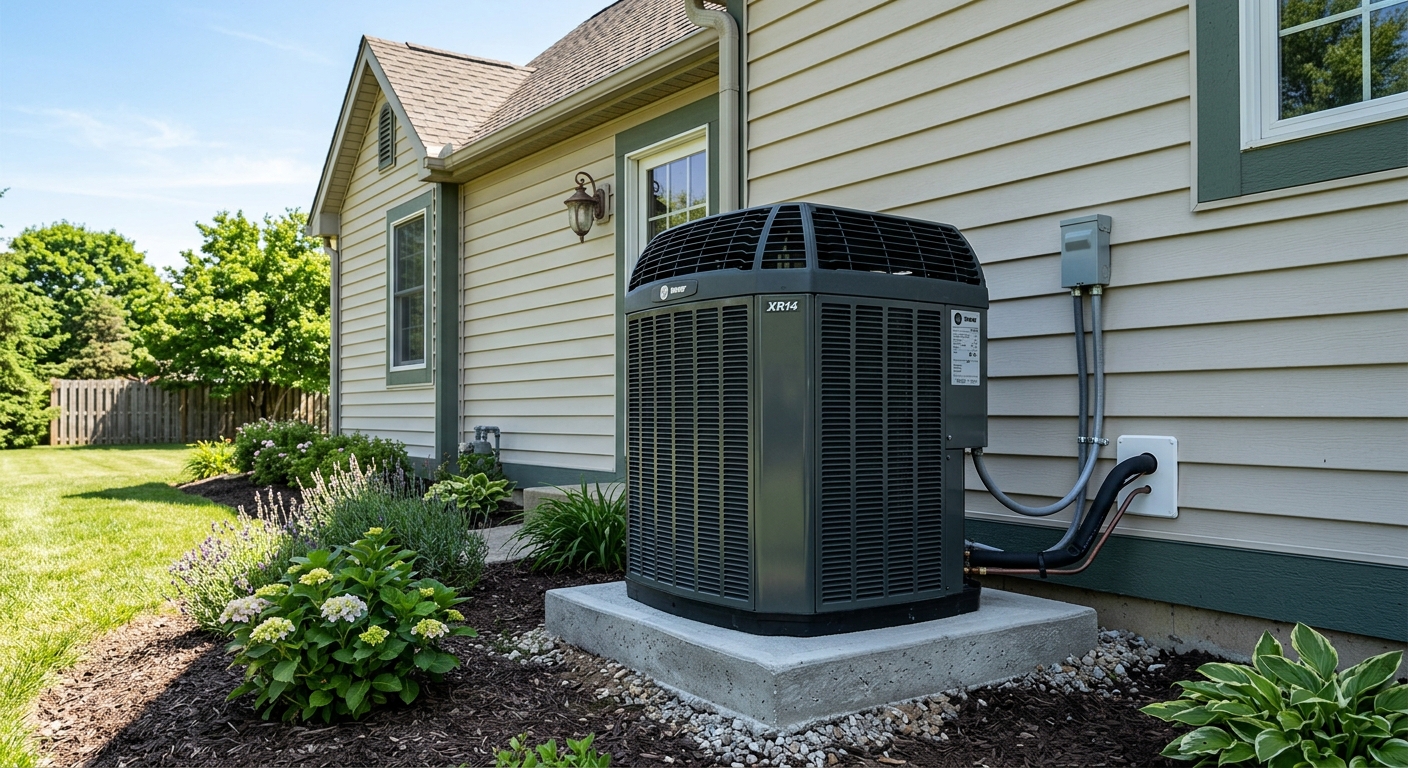
Clay heating and cooling prices by system type — 2026
Clay’s HVAC market is shaped by its high homeownership rate of 76.7% and a housing stock where 40.3% of homes were built before 1980 (U.S. Census Bureau, ACS 2024). That combination makes Clay mainly a replacement and retrofit market: many homes already have some form of central heating or cooling, but the age and diversity of construction mean system needs vary widely. In Clay, you’ll see classic ducted systems in newer single-family homes—while older homes, particularly those echoing the 1880–1930 rowhome pattern seen in Lancaster city, make ductless and high-velocity solutions much more common because conventional ductwork is often missing or hard to route.
Our region is heating-dominated: 5,200 heating degree days versus 1,250 cooling degree days. This leans most recommendations toward robust heating equipment, whether that’s a high-efficiency gas furnace or a cold-climate heat pump. While air conditioning is valued for summer comfort, payback for ultra-high-efficiency AC is slower here than in the South. If your existing ducts are in reasonable shape, a central AC or heat pump replacement is straightforward, but many older homes in Clay will need ductwork installed, repaired, or replaced. Below are typical installed costs for Clay homes:
| System |
Best for |
Efficiency |
Price range (installed) |
| Central AC replacement (existing ducts) |
homes with sound ductwork |
16–20 SEER2 |
$4,900–$12,000 |
| Air source heat pump (ducted) |
year-round heating and cooling |
8–10 HSPF2 |
$7,800–$16,500 |
| Cold-climate heat pump (ducted) |
heat pump as primary heat |
9–11 HSPF2 |
$12,500–$16,500 |
| Ductless mini-split (single zone) |
additions, rooms without ducts |
20–30 SEER2 |
$3,100–$6,900 |
| Full duct system installation |
homes with no existing ducts |
— |
$8,800–$17,500 |
Installed estimates for a typical Clay home. Equipment tonnage, duct condition and electrical capacity move these more than brand.
R-410A phase-down: repair or replace?
If you have an air conditioner or heat pump using R-410A, it’s legal to keep using, servicing, and charging that system in Pennsylvania, including Clay. The major shift is that new equipment now uses lower-GWP refrigerants like R-454B or R-32, in response to federal rules phasing down hydrofluorocarbons (HFCs) to reduce environmental impact. This affects only new units—the old one in your home isn’t suddenly obsolete or illegal.
Here’s the practical change: as the production of R-410A is scaled back, the price of the refrigerant will climb. So if you develop a refrigerant leak, the cost to top off or repair your system will increase over time. For minor service, it may not tip your decision. But if your R-410A system develops a significant leak or requires a major repair, especially as it ages, the economics can shift—sometimes enough that replacing the system makes more sense than pouring money into one with declining support.
Manufacturers are also focusing R&D and warranties on new, low-GWP models. But you do not need to rush out and replace a working R-410A system in Clay. Stay on top of maintenance, keep coil and line sets leak-free, and plan ahead if your system is more than 12 years old, since another repair in a few years could be much costlier due to tightening supply of R-410A.
Permits, licensing and inspections in Clay
In Pennsylvania, HVAC contractors working on residential homes need Home Improvement Contractor (HIC) registration from the Pennsylvania Office of Attorney General for contracts over $500, but there’s no statewide trade license for HVAC. Municipalities control permits and inspections—so the process in Clay, like elsewhere in Lancaster County, is determined locally, not by the state. Ask your contractor if your municipality requires a mechanical permit for HVAC replacement; in Lancaster city, a permit is usually triggered for any central equipment replacement, while rural and suburban areas may vary.
Anyone handling refrigerant must hold EPA Section 608 certification, regardless of municipal or state licensing. This is a federal requirement and cannot be waived. To protect yourself, you can verify contractor registration status directly at hic.attorneygeneral.gov, and confirm workers’ compensation through the state’s WCAIS portal at wcais.pa.gov. Homeowners should always ask for a copy of current insurance and compensation certificates from their HVAC company before signing any contract, especially since contractor registration and actual skills or specialty licensing are separate in Pennsylvania.
Permitting and inspection protect homeowners and are enforced by the municipality, not by the Commonwealth for most residential work. Ensure your contractor pulls the required local permits and arranges inspections after installation. This confirms code compliance and the contractor’s willingness to adhere to local standards.
Choosing an installer in Lancaster County
Choosing the right installer in Lancaster County means prioritizing skill and detail over brand name. Even the best equipment installed poorly will underperform or fail too soon. That’s especially true in places like Clay, where many homes need some customization—whether retrofitting ductwork into older structures or configuring new high-efficiency systems. Always verify the contractor’s Pennsylvania HIC registration at hic.attorneygeneral.gov, and make sure the technician handling refrigerants is EPA Section 608–certified. Ask directly whether a load calculation is included with the proposal, and insist on seeing it if possible. A proposal should also specify model numbers, not just tonnage, and explain what “commissioning” entails: at minimum, this means measuring airflow and refrigerant charge at startup and leaving written documentation for your records.
- Check HIC registration at hic.attorneygeneral.gov
- Request proof of current general liability and workers’ compensation insurance (verify at wcais.pa.gov)
- Confirm EPA Section 608 certification for any refrigerant work
- Get a written contract, required by law for jobs over $500
- Review the scope—does the estimate include duct tweaks, line set replacement, and necessary electrical upgrades?
- See model numbers in the quote, not just BTUs or tons
- Ask for a Manual J load calculation
- Ask about permit and inspection handling
- Look for documentation of start-up commissioning (airflow, charge, thermostat function)
- Get at least one local reference from the installer
- Ask about equipment warranty registration process
- Check for prompt, clear communication from office staff and field personnel
Red flag: If multiple contractors in Clay say “no permit required here,” while one insists on a permit, ask your township directly. Lancaster County’s moderate suburban market has both highly professional and less-than-diligent operators—do not let “we’ve always done it this way” outweigh paperwork and documentation. Good installers want every i dotted, since it protects both you and them.
Reading the yellow label
Every new HVAC system comes with a yellow EnergyGuide label. For air conditioners, the main number is SEER2; for heat pumps, you’ll see both SEER2 (cooling) and HSPF2 (heating). The “2” means these are the newer, more stringent test procedures that took effect recently—so if you see older articles citing SEER or HSPF without the “2,” those aren’t apples-to-apples comparisons.
SEER2 is the seasonal cooling efficiency. Higher SEER2 means less electricity consumed to cool your home, but in Clay’s climate, with just 1,250 cooling degree days, ultra-high SEER2 will take a long time to pay off unless you have unusually high summer use. HSPF2 is the heating season performance factor—critical in a county with 5,200 heating degree days. Here, paying for a model with a higher HSPF2 (9 or above) gives more return than stretching for SEER2 above 18.
Most Clay homeowners are best served by systems in the 16–20 SEER2 and 9–11 HSPF2 range. Above those numbers, costs rise quickly with little real-world savings—especially with modest cooling loads and a predominance of heating days. Don’t let marketing drive you toward ultra-high efficiency ratings that won’t pay back within the system’s typical life span.
What construction era means for your system
With 40.3% of Clay homes built before 1980, there’s no one-size-fits-all answer for HVAC installation. Many older homes, especially those echoing Lancaster’s 1880–1930 rowhome inventory, may lack ductwork entirely or have systems sized only for heating, not modern air conditioning. Duct sizing is critical—a home originally heated with a boiler or gravity furnace may require entirely new duct runs to keep room-to-room temperatures even in summer. Insulation levels and original windows in older homes are often poor, driving up both heating and cooling demands and sometimes pushing you toward higher-capacity equipment.
Panel upgrades are another sticking point. For homes eyeing all-electric conversions with heat pumps, the electrical service (often just 100 amps in older construction) may not be sufficient—plan in advance for a heavier panel, especially for cold-climate units. Meanwhile, any gas appliance replacement must consider vent sizing and chimney condition to meet code.
By contrast, Clay’s newer subdivided homes—especially those from the 1990s or 2000s—generally have builder-installed ductwork and insulation to modern standards. These homes are entering their first full system replacements now, and equipment originally sized a bit generously by builders is now likely nearing the end of its lifespan. That means you may be able to right-size new equipment more closely to actual heating and cooling loads.
What size system does a Clay home need?
Proper sizing is by far the most important factor in getting the comfort and efficiency you expect from new HVAC equipment in Clay. Oversizing is a chronic local issue: an oversized system short-cycles on and off, fails to remove summer humidity, and creates register-to-register temperature swings. It also shortens equipment life as compressors and blowers rack up more starts and stops than intended.
The only correct way to size a new furnace, AC, or heat pump is with a Manual J load calculation—taking into account your home’s insulation, air leakage, window orientation and condition, occupancy, and construction materials. Rules of thumb, like “one ton per 500 square feet,” are simply not reliable in the mix of home ages found in Clay. Have a contractor show you the load calculation for your home. If someone sizes directly off the old equipment’s nameplate, ask: “How do you know the original system was sized right?”
This part of Lancaster County uses a winter design temperature of 12°F, which load calculations use to ensure your home stays comfortable during the coldest typical nights. At the same time, our summer cooling loads are not extreme, so oversizing for comfort “just in case” actually undermines energy savings and humidity control. Always get a detailed calculation in writing before selecting new equipment.
Frequently asked questions — HVAC installation in Clay
How far ahead should I schedule in Clay?
Demand for HVAC installation in Clay tracks closely to weather swings and season changes. With most homes owner-occupied and a significant share built before 1980, the busy season hits late spring and early fall, when homeowners realize the furnace or AC is failing after sitting idle for months. For a system replacement—central AC, heat pump, or full ductwork—plan to book two to five weeks out in these peak windows. For simpler ductless mini-split installs, especially single-zone, you can often schedule within two weeks mid-season. Emergencies get priority, but proactive scheduling during off-peak months can save you money and stress. As of 2026, prices in Clay for a central AC replacement range from $4,900–$12,000, so give yourself enough time to get competing bids and check references before you need the system running next week.
Do I need a permit to replace HVAC in Clay?
In Clay and the greater Lancaster County area, permits for HVAC replacement or installation are governed at the municipal level, not by the state. For central replacements in places like Lancaster city, a mechanical permit is almost always required. In other Clay-area townships, requirements range from formal permitting and inspections to very little oversight. No permit is needed for basic tasks like changing filters or programming thermostats. When in doubt, call your township’s office directly to confirm. Any legitimate installer should be able to explain—and handle—local permit procedures as part of their bid. Even for a ductless mini-split install, costing about $3,100–$6,900 installed, don’t skip the permit step if required—it protects you, your contractor, and your investment if there’s a warranty or resale issue down the road.
What is the R-410A refrigerant phase-down?
The R-410A phase-down is a national initiative to reduce the use of high-global-warming-potential refrigerants in new residential HVAC systems. Starting a few years ago, manufacturers moved to lower-impact refrigerants such as R-454B and R-32 for new equipment. But if your current heat pump or AC in Clay uses R-410A, you can legally keep using and maintaining it—there’s no mandatory replacement requirement. The main change will be refrigerant supply: over time, as production limits increase, the price to repair a leak in an older system will climb, pushing some toward replacement rather than repair for major issues. For example, a new air source heat pump installed in Clay typically runs $7,800–$16,500, so if you’re on the fence about an R-410A repair, factor in the rising cost of refrigerant when deciding.
What does a heat pump cost installed in Clay?
The installed cost for a ducted air source heat pump in the Clay area typically falls between $7,800–$16,500. The wide range is due to equipment capacity, ductwork condition, electrical upgrades, and whether you opt for a standard or cold-climate model, which is recommended if you’re relying on the heat pump as your primary winter heat source. Most Clay homes, especially the 40% built before 1980, will need either some ductwork modification or a careful evaluation of existing runs. Going ductless for an addition or one zone is much less, usually $3,100–$6,900 per zone installed. Project costs shift more on home specifics and installation quality than on brand choice.
Should I replace the furnace and AC at the same time?
In Clay, replacing both the furnace and AC together makes sense if both are approaching end-of-life (usually 15–20 years) or if you’re upgrading to a heat pump and want to optimize system compatibility and efficiency. You often get equipment and labor discounts by bundling. For homes built before 1980, sizing and ductwork updates required for one system often mean it’s cost-effective to do both. That said, if either your furnace or AC is only a few years old and working well, there’s no need to spend on a complete replacement. A new central AC runs $4,900–$12,000 while a standalone furnace swap may be less—get a detailed, apples-to-apples quote before you commit.
How long should an HVAC system last in Clay?
Most HVAC systems in Clay, whether furnace, central AC, or heat pump, last about 15 to 20 years with proper maintenance. The large number of homes built before 1980 may stretch or shrink this lifespan depending on how ducts, insulation, and windows affect system runtime. Ductless mini-splits installed in additions or retrofits often reach 20 years because they avoid duct losses, provided the outdoor unit is clear of snow and ice in winter. System lifespan also depends on regular tune-ups: clogged filters and low refrigerant can knock years off expensive equipment. When your system hits 15 years, be prepared for repair bills to rise and efficiency to drop, especially given modern price bands—heat pump replacements here are now $7,800–$16,500 installed, which makes stretching an old system’s last year less attractive as parts age out.
Which utility serves Clay?
Most homes in Clay and greater Lancaster County are served by PPL Electric Utilities for electricity. If your home is set up for natural gas heat or appliances, UGI Utilities covers natural gas service in more centralized areas, especially Lancaster city and townships like Manheim or East Hempfield. Many rural homes in and around Clay still rely on propane or fuel oil, especially outside the direct reach of UGI. Your choice of an all-electric heat pump or a gas furnace will depend not just on initial costs (for example, $7,800–$16,500 for a ducted heat pump system here) but on whichever utility is available in your specific neighborhood.
How much does a furnace replacement cost in Clay?
A typical furnace-only replacement job in Clay, assuming existing, functional ductwork and a straightforward swap, will often fall below the complete central AC system range—more in line with the lower end of the heat pump range, but still variable. As a rule of thumb, expect to pay somewhere in the $4,900–$12,000 band for a combined furnace and AC swap. If just the furnace is being replaced, especially in homes with natural gas service from UGI and newer ductwork, costs can swing from the lower half into the mid range depending on efficiency and venting complexity. Always get a written quote spelling out what’s included—chimney liner, vent upgrade, thermostat, and permit fees—before signing off.
Are duct sealing and insulation eligible for incentives?
While there’s no statewide incentive program for duct sealing and insulation in Pennsylvania, some utilities—including PPL Electric Utilities—have periodically offered rebates for weatherization, duct sealing, and upgrades that increase heating and cooling efficiency. Eligibility and rebate amounts can shift year to year, so ask your contractor, and check the utility’s rebate site before starting work. Even if a rebate isn’t available, sealing and insulating ducts in Clay’s many pre-1980 homes is often the most cost-effective way to improve comfort and reduce utility costs, especially when considering the full duct system install cost of $8,800–$17,500. It’s smart to address leakage before sizing or replacing equipment since improved duct efficiency may allow for a smaller system at the next upgrade.