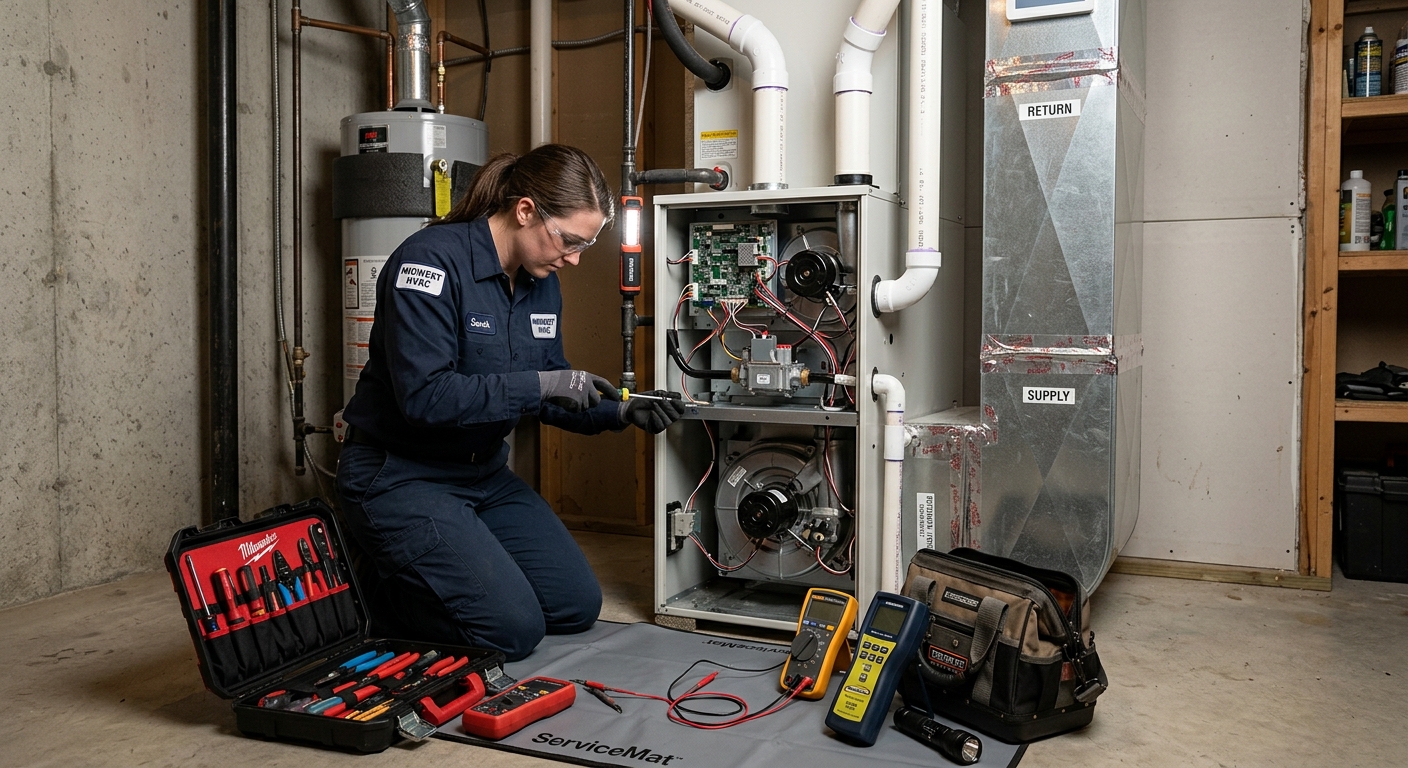
Blooming Grove heating and cooling prices by system type — 2026
Blooming Grove’s heating and cooling needs reflect the realities of Pike County’s housing and climate. With 84.7% of homes owned and 42% built before 1980 (U.S. Census Bureau, ACS 2024), most area homes are now facing the first or second replacement cycle for their central HVAC systems. Late-20th-century Pocono subdivision construction is the norm, which means central forced-air systems with existing ductwork are common but often starting to show their age. This makes replacement, not new installation, the main project for most Blooming Grove homeowners.
The region is a heavily heating-driven market—6,100 heating degree days to just 850 cooling (see FACTS). Only a handful of climates in Pennsylvania are colder. With winter design temperatures hitting 4 °F, heating is the main energy burden; summer cooling matters, but never as much as reliable, affordable heat. That shapes the local market: heat pump and furnace replacements dominate, and full duct runs are rare except in major remodels or additions.
Below you’ll find typical installed prices for the most common systems seen here. For most, existing ductwork will keep costs down. If your ducts are failing, installation cost climbs sharply. The main factors moving your price are home size, layout, duct condition, and unless your electrical panel is underpowered, electric work will usually be minor.
| System |
Best for |
Efficiency |
Price range (installed) |
| Central AC replacement (existing ducts) |
homes with sound ductwork |
16–20 SEER2 |
$5,000–$12,000 |
| Air source heat pump (ducted) |
year-round heating and cooling |
8–10 HSPF2 |
$8,000–$17,000 |
| Cold-climate heat pump (ducted) |
heat pump as primary heat |
9–11 HSPF2 |
$13,000–$17,000 |
| Ductless mini-split (single zone) |
additions, rooms without ducts |
20–30 SEER2 |
$3,200–$7,000 |
| Full duct system installation |
homes with no existing ducts |
— |
$9,000–$18,000 |
Installed estimates for a typical Blooming Grove home. Equipment tonnage, duct condition and electrical capacity move these more than brand.
Mechanical permits for HVAC work in Blooming Grove
In Pennsylvania, there is no statewide HVAC contractor license for residential work. Instead, all residential HVAC projects in Blooming Grove are controlled at the local level, following the Pennsylvania Uniform Construction Code (UCC), which is based on the IRC standards. Mechanical permits, inspections, and enforcement are handled by each municipality’s code office, not by any centralized state board.
Any contractor working on your Blooming Grove home must hold a valid Home Improvement Contractor (HIC) registration from the Pennsylvania Office of Attorney General for jobs over $500. You can — and should — verify a contractor’s HIC registration at hic.attorneygeneral.gov. If the job involves refrigerant handling (most AC and heat pump work), federal law requires EPA Section 608 certification, regardless of state or local licensing rules. If this isn't shown when you ask, move on.
Before work starts, your contractor should show proof of current workers’ compensation coverage — this is mandatory in Pennsylvania for all employers. You can check their coverage status directly at the Workers’ Compensation Automation and Integration System (WCAIS): wcais.pa.gov.
To sum up: no trade license for “HVAC” statewide, but you want to see their HIC registration, current insurance, and that the proper local permit is pulled for your township or borough. Never skip a permit — unpermitted work can lead to denied insurance claims or resale headaches.
Reading an installation proposal
Comparing HVAC installation quotes in Blooming Grove takes more than looking at a brand and a bottom-line price. Insist on a detailed proposal. You should see model numbers for both the indoor and outdoor units, as mixing unmatched equipment will never deliver its claimed efficiency or reliability. Sizing must connect to a real load calculation specific to your house — not just matching what’s on your old nameplate. Look for notes on whether the line set (the copper refrigerant piping) is being replaced or reused. Electrical upgrades, such as a new circuit or panel, should be recognized in the scope if needed; don't let it become a surprise later.
Every good proposal should mention what’s being done about condensate drainage and the thermostat (is a new one included?). The price should include the municipal permit and closeout, plus a commissioning report: a written summary of the system’s airflow and refrigerant charge upon startup. Finally, know how long the labor warranty lasts—manufacturers usually cover parts longer than contractors cover their work.
If a quote skimps on these details or skips them entirely, you can’t accurately compare it, and you could be paying for corners cut out of sight.
| Line item |
What to look for |
Red flag if… |
| Equipment |
model numbers, indoor and outdoor matched |
brand name only |
| Sizing |
load calculation attached |
matched to the old nameplate |
| Ductwork |
condition assessed, sealing scoped |
not mentioned |
| Electrical |
circuit and panel capacity confirmed |
assumed adequate |
| Line set |
replaced or documented as reused |
silent |
| Commissioning |
measured airflow and charge, documented |
no startup report |
| Warranty |
labour years stated separately |
manufacturer only |
| Permit |
included and priced |
'not needed' |
What each system actually costs to run in Blooming Grove
Running costs for HVAC in Blooming Grove depend on three numbers: equipment efficiency, how much heating and cooling you use, and what Met-Ed (the main local electric utility) charges per kilowatt-hour. For heating, start with the 6,100 annual heating degree days and the winter design temp of 4 °F—these numbers mean most homes here use much more energy for heat than for air conditioning. Cooling degree days add up only to 850 for the year, so summer bills are rarely a big concern by comparison.
To calculate, estimate your home’s annual heating load (in BTUs or kWh) from its size, insulation, and the degree days (many online calculators can help). Take your system’s rated efficiency—such as 9 HSPF2 for a standard ducted heat pump or 20 SEER2 for a top ductless mini-split—and this will tell you how much delivered heating or cooling you get per unit of electricity. Multiply your system’s seasonal use (in kWh) by the rate shown on your Met-Ed bill to get your rough annual operating cost.
For example, if your heat pump uses 10,000 kWh each winter and your all-in rate is $0.16 per kWh (check your own bill), you’ll pay $1,600 per year for heat alone. Change that to a less efficient system and you could easily add several hundred dollars a year. The catch: actual costs will swing based on how tight your home is, how well ducts are sealed and insulated, and whether your system was sized correctly. Big leaks or poor ductwork sabotage even the best system, and neither the label nor the installer’s promise will overcome a bad install. Efficiency only pays off if the rest of the system isn’t dragging it down.
Blooming Grove's housing stock and its HVAC needs
Most Blooming Grove homes are late-20th-century builds, typical of Pike County’s wave of Pocono subdivision growth. With 42% of homes built before 1980, there are still some houses needing duct retrofits or repairs, but the bulk are now seeing their original central forced-air systems reach (or pass) end of life. Ductwork is usually present, but original installs often sized for both heating and cooling, though seldom with high-efficiency or tight sealing in mind. In older stock — pre-1980 — ducts might have gaps, poor insulation, or be sized only for heating, so cooling can suffer.
Insulation and window quality are average for the era — most homes can benefit from additional air sealing and attic insulation. Electrical panels are usually sufficient for a modern AC or heat pump upgrade, but complete electric conversions sometimes press the limits on smaller panels. For gas systems, remember that many homes rely on propane or oil, and the few that can connect to natural gas are near Milford only.
If you’re in a subdivision built after the late 1990s, builder-grade HVAC equipment is often due for its first replacement now. These systems were commonly oversized “just in case,” so now is the time to right-size your replacement for comfort and efficiency, not just to match the old nameplate.
Filtration, humidification and ventilation
Blooming Grove has harsh, cold winters and humid summers, which brings common indoor air issues. Winter brings low humidity, which can dry out skin, woodwork, and sinuses. Whole-house humidifiers can help, but they come with ongoing cleaning and the risk of mold if neglected. In summer, high humidity can make even a cool home feel clammy. An oversized AC will cool the air too quickly and shut off before pulling moisture out, leaving humidity high and comfort low—this is a real risk if you allow a contractor to install a system “one size up” from what’s needed.
Air filtration matters, especially for allergy sufferers. MERV 8-11 filters are usually the sweet spot for residential blower systems, especially here, where higher-rated (MERV 13+) filters can resist flow and strain older blower motors. Don't get talked into a “hospital-grade” filter without first checking if your system can handle it. For near-airtight or newly improved homes, mechanical ventilation might be necessary to manage indoor air quality and keep humidity controlled, but very few homes in Blooming Grove were built tight enough to need advanced systems like ERVs.
Add-on air cleaners and UV lights are heavily marketed, but most Blooming Grove homes will see more benefit from addressing the basics: sealing ducts, upgrading filters, and maintaining equipment. Products promising miracles at a high price rarely deliver measurable improvement on their own.
What you can actually claim on a heat pump here
If you install a new heat pump in Blooming Grove, there are a couple of real—but limited—ways to save via incentives. First, there’s a federal tax credit for qualifying high-efficiency heat pumps and some supporting equipment. Unlike an instant rebate, a tax credit reduces the income tax you’ll owe when you file next year. So you’ll pay the full system cost up front and see the benefit only when you file your return. Second, check whether Met-Ed (the primary electric utility in Pike County) currently offers a heat pump incentive. Utility rebates, when available, reduce your out-of-pocket cost directly as a credit on your installer’s invoice or your future bill.
Actual rebate offerings change year to year and may close or open again without notice, so don’t rely on anything promised in a generic ad. The safest and most current sources are your own utility’s efficiency or rebate program webpage, the ENERGY STAR rebate finder (energystar.gov/rebate-finder), and your equipment installer. If you’re served by UGI for natural gas near Milford, check their site too, but most rural homes in Blooming Grove use propane or oil and won’t see a gas utility rebate.
Ignore any online article that promises a fixed dollar amount; what’s offered here in Pike County does change. Always confirm before you sign a contract, because incentive money can run out mid-year.
Frequently asked questions — HVAC installation in Blooming Grove
Is a high-efficiency system worth the extra cost here?
In Blooming Grove, where winters are long and cold, a high-efficiency heat pump or central AC can save more each year than you’ll see in a milder part of the state. However, the real savings depend on your existing ductwork and how well the system is sized for your house—an ultra-efficient unit in leaky, uninsulated ducts won’t deliver its promised results. High-efficiency equipment usually costs more up front (ducted heat pumps run $8,000–$17,000 installed), but if you plan to stay in your home several more years and your current system is failing, the added comfort and lower bills make sense, especially with federal tax credits available. If your energy bills are moderate and your system isn’t that old, you may be better off with a standard unit and some duct improvements instead of jumping straight to top efficiency “for the sake of it.”
How do I verify an HVAC contractor's insurance?
In Pennsylvania, and specifically Blooming Grove, every contractor must show proof of current workers’ compensation insurance if they have employees. To be thorough, ask for their certificate of insurance and check their workers’ comp status at wcais.pa.gov. Also verify their Home Improvement Contractor (HIC) registration at hic.attorneygeneral.gov, as this is required by law for any job $500 or more. No proper installer will ever balk at handing these over. If a contractor dodges your request or gives an excuse, it’s a red flag—move on. Responsible pros know insurance isn’t optional. Do not rely on “word of mouth” or business cards alone; demand state-insured proof for every installation you consider, whether it costs $3,200–$7,000 or far more.
Why are my Blooming Grove energy bills high with a new system?
If your new HVAC system was installed recently but your monthly bills are still high, you’re not alone in Blooming Grove. Total energy cost depends on more than just new equipment. If your ducts are leaking or poorly insulated—and this is common in Pike County’s older homes—much of your heated or cooled air may never make it to the rooms you use. Oversizing is another culprit: an improperly sized system can short-cycle, missing both comfort and efficiency marks. Double-check that your installer performed a real load calculation and sealed or upgraded your ductwork. Even a system costing $5,000–$12,000 won’t save you money if the rest of the home is wasting energy. Also, review your utility bill—rates can change without warning, which makes annual costs swing more than you’d expect.
How long does HVAC installation take in Blooming Grove?
Most standard HVAC replacements—in homes with accessible ductwork and no major surprises—can be completed in one to two days in Blooming Grove. If you’re installing a full new duct system or upgrading electrical panels in addition to the main equipment, you could be looking at two to four days minimum. Always request a realistic schedule as part of your quote. Weather, part availability, and code inspections can all delay completion. In more rural parts of Pike County, travel from Milford or Bushkill service hubs sometimes adds a half day to the timeline. Don’t trust a crew that promises to “rush through” the job; attention to detail matters more than speed, especially when you’re investing $9,000–$18,000 in new ducts or a whole system.
Should I repair or replace my HVAC system in Blooming Grove?
If your system is approaching 15–20 years old—typical for late-1990s Pocono subdivision homes—and repairs are starting to pile up, replacement is usually the better value. For Blooming Grove homes, frequent repairs or a failed compressor on equipment this old usually signal it’s time for a new installation, particularly if your system uses R-22 refrigerant (now obsolete). If repairs are infrequent, relatively cheap, and total less than a few hundred dollars, repair may still be worth it. But pouring money into a failing system rarely pays off. New systems run $5,000–$17,000 depending on what you need, and rebates or tax credits can help soften the cost. Always ask your contractor for a fair opinion; a good one will tell you honestly when a repair is still the right move.
Does my utility offer a heat pump rebate in Blooming Grove?
Met-Ed is the primary electric utility in Blooming Grove and occasionally offers rebates for qualifying heat pumps. These rebate programs change from year to year, so always check the current offerings on your utility’s website under their energy efficiency or rebate section. For the latest updates, the ENERGY STAR rebate finder (energystar.gov/rebate-finder) is another good place to look. Utility rebates, when available, are applied as a credit to your invoice or future bill—unlike a tax credit, you don’t wait until tax time to benefit. Typical rebate amounts won’t upend your decision—expect a few hundred dollars, sometimes more for cold-climate models in the $13,000–$17,000 range. Always confirm eligibility and availability before you commit.
What does a heat pump cost installed in Blooming Grove?
For a typical home in Blooming Grove with existing ductwork, installing a new air-source heat pump ranges from $8,000–$17,000 depending on capacity, efficiency, duct condition, and whether your existing electrical panel has enough room. A true “cold-climate” model, sized and set up for primary winter heat (which we need here), runs on the high side—usually closer to $13,000–$17,000. Smaller heat pumps or ductless mini-split systems for rooms or additions can start as low as $3,200–$7,000. Price swings come mostly from the work involved, not just brand. Always have your installer inspect your ductwork and home to avoid costly surprises.
Is natural gas available throughout Pike County?
No, natural gas is extremely limited across Pike County. The only homes with access to utility gas are in pockets near Milford; the rest—including most of Blooming Grove—depend on propane or fuel oil. If you’re planning a furnace replacement, assume propane unless you know your street has UGI natural gas service. This affects both your installation options and operating cost math. It also explains why so many area homeowners are shifting to electric heat pumps, despite the higher upfront investment (usually $8,000–$17,000). Propane and oil costs are subject to market swings, and installing a new natural gas line—assuming it’s even available—rarely makes sense in rural Pike County.
What size HVAC system does my Blooming Grove home need?
The right size system for your Blooming Grove house comes down to more than just square footage. Builders installing in the late-20th-century housing boom often oversized equipment “just to be safe,” but modern practice uses a Manual J load calculation. This factors windows, insulation, climate (including our 6,100 heating degree days), and home layout. Improper sizing causes comfort problems and higher bills—don’t settle for a contractor who simply replaces “like for like.” For most area homes, a common split is 2.5–3.5 tons for central AC or heat pump, but this is only a ballpark—yours could be outside that range. Ductless systems are even more sensitive to sizing. Since a new system can run $5,000–$12,000 or more, insist that your installer performs a real load calculation before proposing equipment.