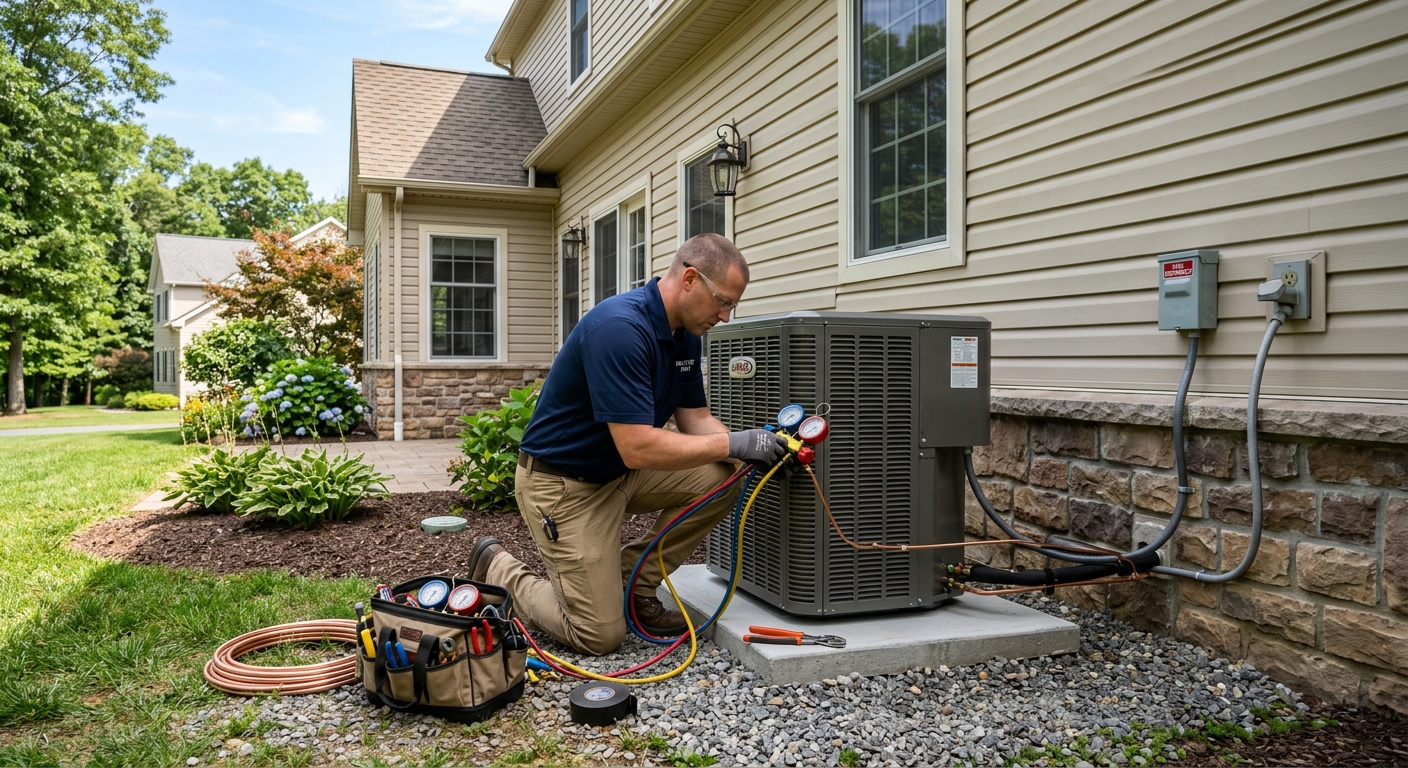
Chester heating and cooling prices by system type — 2026
Chester is an older city, with 85.6% of its homes built before 1980 (U.S. Census Bureau, ACS 2024), and only 8.5% of residences are single-family homes. The modest homeownership rate of 38.0% means a good portion of the housing here is either rental or multifamily, so a huge share of HVAC work is retrofit—not simple replacement. Many houses, especially in nearby Upper Darby and Haverford, are dense 1920–1950 rowhouses and twins, which were never built with central AC in mind. For cooling, this means that ductless mini-splits and high-velocity or compact duct systems are the norm, not the exception. Most of the traditional ducted options come into play only where previous upgrades happened or the original home had forced-air heat.
Chester’s climate is decidedly heating-driven. With 4,800 heating degree days versus just 1,450 for cooling, the main challenge is winter comfort, not beating the summer heat. Summers are humid and sticky but short, so cooling investment only pays off when chosen for reliability and targeted comfort, not for battling weeks of triple-digit weather. Reliable year-round solutions—heat pumps in particular—make more sense here than pure-cooling options if your goal is a single system for both seasons.
| System |
Best for |
Efficiency |
Price range (installed) |
| Central AC replacement (existing ducts) |
homes with sound ductwork |
16–20 SEER2 |
$4,800–$11,500 |
| Air source heat pump (ducted) |
year-round heating and cooling |
8–10 HSPF2 |
$7,700–$16,500 |
| Cold-climate heat pump (ducted) |
heat pump as primary heat |
9–11 HSPF2 |
$12,500–$16,500 |
| Ductless mini-split (single zone) |
additions, rooms without ducts |
20–30 SEER2 |
$3,100–$6,800 |
| Full duct system installation |
homes with no existing ducts |
— |
$8,700–$17,500 |
Installed estimates for a typical Chester home. Equipment tonnage, duct condition and electrical capacity move these more than brand.
What each system actually costs to run in Chester
Operating cost starts with climate: Chester sees about 4,800 heating degree days (HDD) and 1,450 cooling degree days (CDD) each year. More heating means your winter bills matter more than summer cooling, especially with a winter design temperature of 14 °F—not the coldest in Pennsylvania, but more demanding than many parts of the country. Your actual annual energy use depends on the efficiency of the HVAC system you install, the size and insulation of your home, your thermostat settings, and how tight (or leaky) your ductwork and building envelope are.
Here’s how to compare systems: Each unit’s efficiency rating—SEER2 (cooling) or HSPF2 (heating)—tells you how many BTUs of heat or cool you get per unit of electricity. Higher numbers are better. To estimate annual cost, take your system’s annual load (which is a function of those degree days and your home size), divide by the efficiency rating, and multiply by your electric rate, which you’ll find on your bill from PECO Energy Company. For example: Say your home needs 48,000,000 BTU of heating in a typical winter. If your heat pump is rated at 9 HSPF2 (meaning you get 9 BTUs for every watt-hour used), you’d use about 5,333 kWh for heat over the year. Multiply that by your current PECO rate (check your bill; rates change yearly) to get your dollar figure.
It’s honest to say these calculations are only as good as your ductwork: leaky or poorly insulated ducts can bleed so much conditioned air into crawlspaces and attics that a high-efficiency heat pump still wastes money. Similarly, an oversized or poorly installed furnace or central AC will perform worse than a moderate unit sized and installed right. Utility rates move, and no two homes are exactly alike, so these are starting points—not promises.
Gas, electric or both in southeastern Pennsylvania
With winter design lows around 14 °F and 4,800 heating degree days, Chester’s climate can challenge the limits of older all-electric systems. The good news is that today’s cold-climate heat pumps reliably heat down into the teens without much drop-off, so the “heat pumps don’t work here” talking point is outdated. That said, as temperatures fall, any heat pump’s capacity will drop, so the coldest weeks are precisely why many homes keep a gas furnace as either the main or backup heat source—especially where gas service is easy, as it is across most of Delaware County.
PECO Energy Company delivers both gas and electric to most neighborhoods, but there are pockets in outer areas where only oil or propane are available. In Chester itself and similar townships, natural gas is common, so if you already have gas, a furnace is still the simplest and most robust path for some households—especially big homes or those where “set it and forget it” is the only comfort strategy. The dual-fuel (heat pump with gas furnace backup) setup is a best-of-both-worlds choice: electric efficiency most of the year, seamless switch to gas when the deep freeze hits.
| Option |
Installed cost |
Operating cost here |
Best when |
Incentive eligible |
| Gas furnace + central AC |
$4,800–$11,500 |
moderate; lower with existing gas service |
existing gas service, coldest zones |
sometimes |
| Ducted heat pump (cold climate) |
$7,700–$16,500 |
lower with good envelope |
good envelope, all-electric goal |
usually |
| Dual fuel (heat pump + gas backup) |
$12,500–$16,500 |
lowest in deep cold, gas on site |
gas on site, deep cold spells |
yes |
| Ductless multi-zone |
$8,700–$17,500 |
lowest for zone control |
no ductwork, zone control |
yes |
When ductless is the right answer
Ductless systems—usually called mini-splits—really shine in the kinds of homes Chester and Delaware County are full of: older rowhouses, twins, and brick homes built before central air was ever a thought. Installing new ductwork means ripping and patching finished plaster, dealing with tight floorplans, and navigating what decades of small renovations have left behind. That’s why ductless dominates additions, attic conversions, basements, sunrooms, and anywhere the existing system either never reached or never performed.
Single-zone systems (one outdoor, one indoor “head”) are the lowest hassle, excellent for single rooms or hard-to-heat/cool spaces. Multi-zone setups let you run several heads from one outdoor unit, but the drawbacks are real: If you need high output in all zones at once, the system may split capacity unevenly, and you sacrifice some efficiency compared to single-head setups. Good head placement is about more than comfort; it’s about electrical access, how the condensate (water) drains, and whether you can live with the look. Not everyone loves an indoor head on the living room wall—but if the alternative is cutting into plaster or giving up a coat closet for a duct chase, mini-splits win on economics and speed every time.
Given that many Upper Darby and Haverford homes fall into the 1920–1950 build era, these houses are simply not ducted, and that makes a ductless mini-split the common-sense option—whether or not the owners started out shopping for one.
Choosing an installer in Delaware County
Good installation is more important than what brand you buy. Two identical systems, one fitted with care, tight refrigerant charge, and proper sizing; the other rushed in by whoever was available—these deliver totally different comfort, reliability, and bills. Delaware County is a crowded Philadelphia metro market with more HVAC contractors than you might ever need; the right move is to use that competition to demand quality.
Check any company’s Home Improvement Contractor (HIC) registration through the registry listed by the Pennsylvania Office of Attorney General. Refrigerant handling requires a technician with EPA Section 608 certification; don’t be afraid to ask. Require a true load calculation, not just a “rule of thumb,” and make sure your quote specifies not just tonnage but actual make and model numbers. Commissioning—documented airflow and refrigerant measurements—should be part of the final paperwork, not something you have to ask for.
- Verify HIC registration at hic.attorneygeneral.gov
- Ask if load calculations are performed for your home (not “rules of thumb”)
- Request copies of EPA Section 608 certification for refrigerant techs
- See equipment model numbers and efficiencies on your proposal
- Insist on a written, itemized contract for jobs over $500
- Discuss whether existing ductwork will be pressure tested or inspected
- Ask for manufacturer start-up forms showing refrigerant charge and airflow
- Confirm proof of workers’ compensation insurance (via WCAIS portal)
- Look for clear project timelines and total costs in writing
- Understand change order policies before you sign anything
- Make sure warranty terms are spelled out, including labor coverage
- Ask about post-completion service or tune-up policy
Red flag: Delaware County’s saturated contractor density means you’ll see plenty of door-hangers, flyers, and “one-day install” specials. If you’re getting pressure to sign on the spot or being told permitting isn’t needed when you know it is for your township, walk away.
Mechanical permits for HVAC work in Chester
Pennsylvania does not issue a state HVAC trade license. For residential projects above $500, the Home Improvement Contractor (HIC) registration is required, but this is consumer protection, not a trade license. Actual technical oversight—mechanical permits and code compliance—happens at the municipal level. For instance, Upper Darby Township requires a mechanical permit for most new or replacement central HVAC systems; Haverford Township does not require one for thermostat swaps, but typically does for full system installs.
Whoever installs or replaces your AC, furnace, or heat pump must have EPA Section 608 certification if they’re touching refrigerants—this is a federal, not a state, requirement. Inspection is usually by a township code officer; check with your own municipality before work begins, because skipping permits can risk failed sales, warranty invalidation, or future headaches.
You can independently verify contractor HIC registration at the state registry (hic.attorneygeneral.gov) and check workers’ compensation coverage through Pennsylvania’s WCAIS system (wcais.pa.gov). Insist on seeing proof before you sign a contract—especially in a dense market like Delaware County where you can afford to make it a requirement.
Why your ducts may be the real problem in Chester
In older Chester homes, ductwork can be the hidden liability sabotaging comfort—and efficiency. Typical 1920–1950 rowhouses and twins in Upper Darby and Haverford were often retrofitted for forced-air heat decades after construction, with whatever duct sizes would fit, never really engineered for central air. Leaky, uninsulated, or undersized ducts can lose 20% or more of heated or cooled air into unconditioned attics, crawlspaces, or inside walls. That loss is enough to erase the supposed savings of any high-efficiency system.
A duct blaster test can tell you how many cubic feet per minute your system leaks at a set pressure—enough to guide whether sealing, repairing, or full replacement is justified. Sealing is the first step, especially where accessible in basements or mechanical rooms. In many older Chester houses, returns are undersized or shoehorned into wall cavities, creating chronic airflow problems you’ll never see but will feel every month in uneven temperatures and noisy grilles. Duct runs outside conditioned space (up in the attic or through crawlspaces) are especially vulnerable, wasting the most by losing heat or picking up humidity in summer.
If your ductwork has never been tested—or is original to the house—test it before replacing or upsizing your equipment. Sometimes a moderate, well-installed system on tight ducts will outperform a premium system forced to push air through fifty-year-old, leaky pipes.
Frequently asked questions — HVAC installation in Chester
What does a heat pump cost installed in Chester?
In Chester, the installed price for a ducted air source heat pump typically ranges from $7,700–$16,500. This price includes both equipment and labor, but the actual number will swing depending on how much new ductwork or electrical your home needs. For many older Chester homes without existing ductwork—or where the only ducts are for old radiators—a ductless mini-split system makes much more sense, and those start at $3,100–$6,800 for a single zone. Always get a load calculation and make sure installation includes any needed upgrades to wiring or panel before you commit.
How far ahead should I schedule in Chester?
Demand in Chester and all of Delaware County spikes alongside heat waves and cold snaps—everyone calls at once when systems fail. For non-emergency installs, expect to schedule 1–3 weeks out in the off-season and 3–5 weeks at peak times. If you’re considering a full replacement or new installation (in the $4,800–$11,500 range for central AC), start the scheduling process as early as you can, especially if permitting or electrical upgrades are required. In older Chester homes, surprises are common behind walls, so allow room in your calendar.
Do I need dual fuel in southeastern Pennsylvania?
For many Chester homes, a dual fuel system—a heat pump with a gas furnace backup—makes sense if you want the year-round efficiency of electric heating but also want protection against extreme winter cold. With a winter design temperature of 14 °F, a modern cold-climate heat pump alone will serve most of the season, but the coldest days may call for that gas backup. You’ll pay more up front ($12,500–$16,500), but if gas is already on site and you want lower bills in both seasons, dual fuel is a serious option. Not every home needs it; tight envelopes and south-facing rooms can often ride out the cold with a quality standalone pump.
How long should an HVAC system last in Chester?
A well-installed system in Chester should reliably last 12–18 years, sometimes longer if it’s maintained. Heating-first climates with high annual use—like Chester’s 4,800 degree days on average—will wear parts faster than in milder locations. Cheap installs often fail sooner due to duct leaks or missed maintenance, regardless of brand. When weighing current replacement costs ($7,700–$16,500 for a heat pump), look for a warranty that covers labor as well as parts, and don’t skip regular tune-ups. In our area, humidity and freeze-thaw cycles stress both indoor and outdoor components.
How cold does it get in Chester and does that affect heat pumps?
Winter design temperature in Chester is 14 °F. That’s not subarctic, but it’s cold enough that heating system performance really matters. Modern cold-climate heat pumps now deliver full output into the teens, so they work well here—but older models or base-spec units drop capacity as temperatures fall. That’s why sizing, load calculations, and whether your home is drafty or tight mean more than the equipment sticker. A cold-climate unit ($12,500–$16,500 installed) with backup strategies is now the standard for Chester if you’re going heat pump only.
Who inspects HVAC work in Chester?
In Chester, mechanical and code inspections are performed by the city or township code office, depending on where you live. For central air or full HVAC installations, you’ll almost always need a permit, and it will be reviewed and then inspected by your local authority under the Pennsylvania Uniform Construction Code. Permitting fees are part of the process, and work must pass inspection before it’s considered complete. Make sure your chosen installer includes permit fees in their proposal; for jobs in the $8,700–$17,500 range (new duct systems), inspection is not optional, and skipping permits can cause issues when selling your home.
Is a high-efficiency system worth the extra cost here?
In Chester’s heating-heavy climate, a higher-efficiency system can pay off, but only if your ducts and insulation are up to par. Moving from a standard to a higher-tier heat pump or central AC (up to $16,500) does cut operating bills when the home is tight, but leaky ductwork and poor insulation will erase much of those gains. Spend on tightening up the home first, or, at the very least, get ducts sealed during installation. For oversized systems or sloppy installs, you’ll never see a return.
Are duct sealing and insulation eligible for incentives?
Duct sealing and insulation improvements can sometimes qualify for rebates or incentives in Pennsylvania, especially when installed alongside a new system (for example, a central AC or heat pump in the $7,700–$16,500 band). Check with PECO Energy Company and local programs before starting work; available incentives may depend on whole-home energy audits or combining several improvements together in one project. Any incentive paperwork should be provided by the contractor or clearly included in your written contract.
What does HSPF2 measure?
HSPF2, or Heating Seasonal Performance Factor 2, measures the heating efficiency of heat pumps under updated testing standards. It represents how many BTUs of heat your system provides per watt-hour of electricity consumed across an entire heating season, capturing real-weather performance in Chester’s winter rather than just lab conditions. Higher HSPF2 means a more efficient system: for example, a cold-climate heat pump installed here (costing $12,500–$16,500) might rate at 10 HSPF2, so you can compare that directly to the annual electric use—and your bill from PECO—to estimate cost to operate and savings compared to less efficient models.