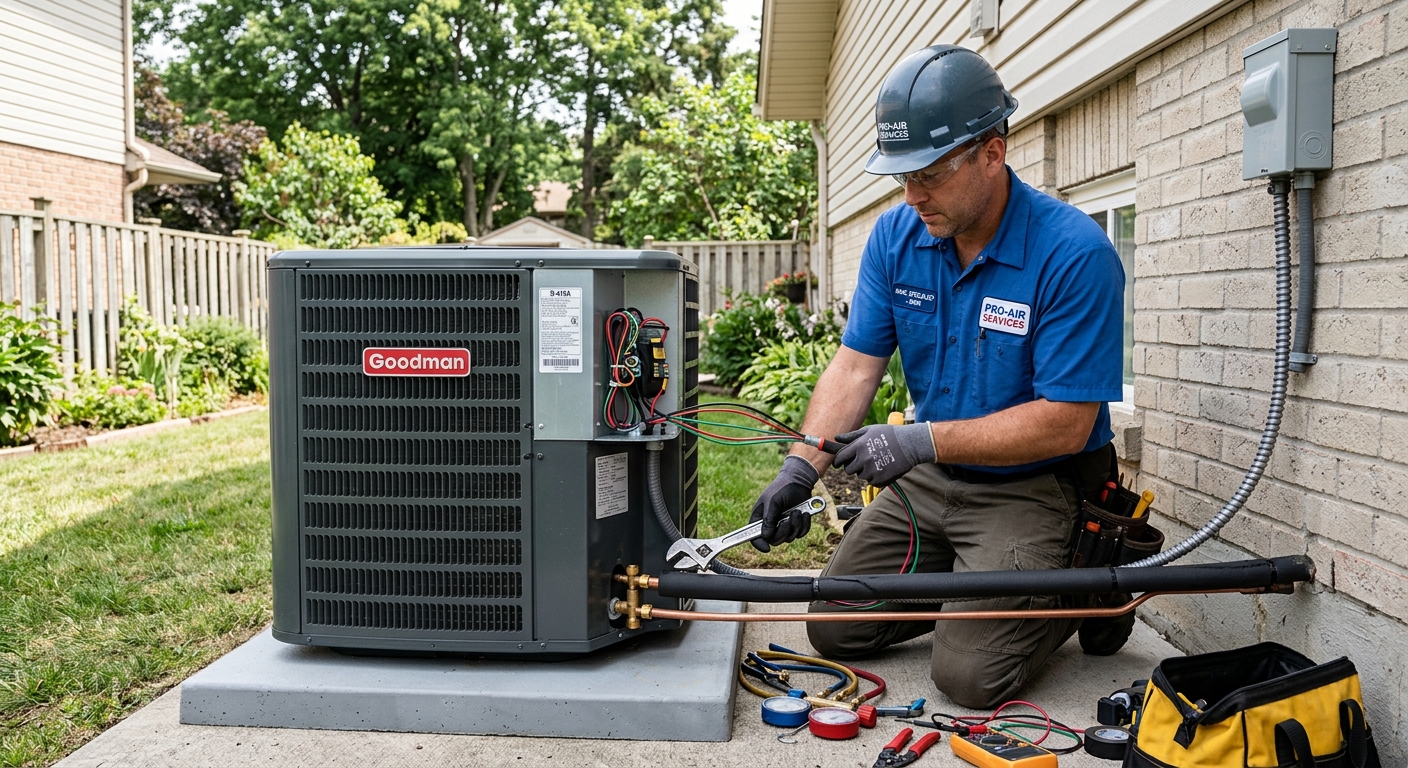
What a new HVAC system costs in Fairview
In Fairview, nearly 91% of homes are owner-occupied and over two-thirds were built before 1980 (U.S. Census Bureau, ACS 2024). That makes this area a classic retrofit market, not just simple replacements — many systems still run on original ductwork that often needs improvement or even total replacement. Postwar Erie housing stock means we frequently correct or upgrade old ducts, especially if past installations cut corners. So, prices here often reflect more than just new equipment; duct repair or replacement is part of the overall project for many homes.
Heating dominates the equation here. Fairview sees about 6,200 heating degree days a year — nearly eight times as many as the 800 cooling degree days — which is typical for areas in the Lake Erie snow belt. That heavily favors investing in reliable heating, such as ducted heat pumps or high-efficiency furnaces. Cooling is not as demanding, but summers still bring enough humidity and heat that central air or ductless systems make sense for comfort.
| System |
Best for |
Efficiency |
Price range (installed) |
| Central AC replacement (existing ducts) |
homes with sound ductwork |
16–20 SEER2 |
$5,400–$13,000 |
| Air source heat pump (ducted) |
year-round heating and cooling |
8–10 HSPF2 |
$8,600–$18,500 |
| Cold-climate heat pump (ducted) |
heat pump as primary heat |
9–11 HSPF2 |
$14,000–$18,500 |
| Ductless mini-split (single zone) |
additions, rooms without ducts |
20–30 SEER2 |
$3,400–$7,500 |
| Full duct system installation |
homes with no existing ducts |
— |
$9,700–$19,500 |
Installed estimates for a typical Fairview home. Equipment tonnage, duct condition and electrical capacity move these more than brand.
Rebates and tax credits for Fairview homeowners
In Fairview, most HVAC projects qualify for incentives that can lower your costs, but it pays to understand the difference between a rebate and a tax credit. Federal tax credits for energy-efficient HVAC systems reduce what you owe on next year’s tax return, but you pay the contractor up front and recoup the credit later. Rebates, on the other hand, come directly from utilities or state programs and can reduce your invoice sooner — but these require proper paperwork and proof of energy-efficient installation.
For Fairview, your electric utility is Pennsylvania Electric Company and if you have natural gas, it’s National Fuel Gas. Both typically offer incentive programs for qualifying new HVAC installations — heat pumps, air conditioners, and sometimes even ductwork improvements. However, these programs change every year. That’s why I tell my clients to check directly with their utility’s energy efficiency or rebate page for accurate, up-to-date information. The ENERGY STAR rebate finder is also a good first step to see what’s available nationally and locally.
State-level programs in Pennsylvania are less directly advertised or consistent, and most run through utilities or short-term funding windows rather than a fixed program. Any cash value you see listed in an article is a ballpark and not a guarantee; always trust the current utility website or call them for the real numbers. Doing your homework on these incentives can sometimes trim thousands from an install, but qualifying requirements are strict — especially for older homes.
What each system actually costs to run in Fairview
The biggest chunk of your utility bill in Fairview is heating. With about 6,200 heating degree days and a winter design temperature down to 5 °F, the math behind your operating cost starts with how much energy it takes to keep your home comfortable. Here’s how you can compare options using your actual electricity rate from Pennsylvania Electric Company (or propane/natural gas if you heat that way).
First, figure the total amount of heat needed, which is based on heating degree days and your home's size and insulation. Next, the efficiency rating — for example, a heat pump with an HSPF2 of 10 produces 10 BTUs of heat per watt-hour used. If you use a 40,000 kWh load for a winter (a made-up figure for demonstration), divide that by HSPF2 to find the real electricity needed. Multiply by your actual rate per kWh (which you’ll find on the electric bill) to see the annual cost.
For cooling, use the SEER2 rating — higher SEER2 means less electricity for the same cooling. Remember: for most in Fairview, cooling is a minor part of the bill compared to heating. Air leaks or bad ducts will always blow up your utility costs, even if you have top-tier equipment.
The wild cards are your own utility rate (which does change) and your house’s envelope. You can repeat this math with your real rate and past bills. A high-efficiency unit on old, leaky ducts often ends up costing more to run than a basic unit on solid, sealed ducts. Efficiency upgrades make sense, but only if the basics aren’t broken.
The refrigerant change and what it means for repairs
Fairview homeowners with newer HVAC systems should know there’s been a recent shift in refrigerants used across the industry. Newly manufactured residential air conditioners and heat pumps now generally come with lower global warming potential (GWP) refrigerants, such as R-454B or R-32. This follows a federal mandate to phase down high-GWP HFCs like R-410A. However, your existing R-410A system is still legal and can continue to be serviced as usual.
The difference shows up if your older system develops a refrigerant leak or needs a major repair. With the supply of R-410A shrinking, the cost of this refrigerant will trend upward in coming years, so recharging a leaky system may become more expensive. This shifts the repair-versus-replace equation if you face an expensive fix on an older unit, especially if the system is already on borrowed time.
It’s important to know: you are not required to replace a working R-410A system. Existing equipment is not being banned or made obsolete — you can still get service and maintenance. The refrigerant transition only affects new equipment and the long-term economics of running (or repairing) older systems. There’s no reason to replace for refrigerant reasons alone, but if you’re considering a major repair, factor in that refrigerant costs on older models will steadily increase as the supply fades.
Mechanical permits for HVAC work in Fairview
Pennsylvania does not issue a statewide HVAC license for residential contractors. In Fairview and the rest of Erie County, regulation falls at the municipal level, not the state. That means mechanical permits and inspections are handled by the local municipality — if you live within the City of Erie, this is through their Bureau of Permits and Inspections for any HVAC installation or replacement that adds new equipment or ductwork.
Every contractor in Pennsylvania working on residential jobs over $500 must have a Home Improvement Contractor (HIC) registration from the Office of Attorney General — this is how you know they're legal to work and bound by consumer protection laws. You can verify this at hic.attorneygeneral.gov. On top of registration, anyone handling refrigerant must have EPA Section 608 certification, which is federal and non-negotiable for legal installation or service.
Insurance is equally important. All employers in Pennsylvania are required to carry workers’ compensation, which you should check yourself at the state’s WCAIS system (wcais.pa.gov). Always ask for insurance proof and look it up — it protects you from being on the hook if someone is injured during your job. Permits and inspections are not just red tape: they help ensure your project meets safety and code requirements before you sign off.
SEER2, HSPF2 and AFUE decoded
SEER2 stands for Seasonal Energy Efficiency Ratio 2, which measures how efficiently an air conditioner cools your home during an average season. HSPF2 is Heating Seasonal Performance Factor 2, the equivalent for heat pumps — it tells you how much heat you get out for every unit of electricity you put in. AFUE (Annual Fuel Utilization Efficiency) is for furnaces and measures how much of each fuel dollar turns into heat for your home. Ratings have changed — old articles cite SEER and HSPF, but new equipment is rated by SEER2 and HSPF2, which are slightly tougher tests.
In Erie County, heating matters much more than cooling. With 6,200 annual heating degree days but just 800 for cooling, paying for a top-end HSPF2 on a heat pump (or a high AFUE on a furnace) is a solid investment; you’ll see real savings every winter. On the cooling side, seeking the absolute highest SEER2 is rarely worth the upcharge — the air conditioning season is short and mild here, so a midrange efficiency is much more cost-effective than a high-end unit.
The upshot: focus your premium efficiency dollars on heating, and go midrange for cooling unless someone in your home has special comfort needs. And don’t fret if SEER2 or HSPF2 numbers seem lower than older SEER/HSPF labels — regulatory changes made the ratings more realistic for all brands.
Keeping a Fairview system running
Most of what keeps an HVAC system running in Fairview is unglamorous but essential: regular filter changes (the right size and MERV rating), keeping outdoor coils and indoor blower coils clean, and making sure the condensate drain stays open. For homes with ductwork dating before 1980, clogged filters and dirty coils can quickly get expensive, especially if you have an older blower.
Refrigerant doesn’t get “topped off” as routine maintenance. If your system keeps needing refrigerant, it has a leak, and just adding more is wasting money without fixing the real issue. Insist on finding and repairing the leak, not just charging it up.
Annual service plans can be a fair deal if they include no-travel diagnostics and honest labor rates, but skip any plan that locks you into inflated filter prices or covers only “inspection” without real maintenance. Saving emergency calls with a preseason visit — for cooling, aim for April or early May; for heat, September is ideal — gives you the best shot at a technician who isn’t already tied up with urgent repairs.
Frequently asked questions — HVAC installation in Fairview
Do I need to be home during installation?
Most reputable HVAC contractors in Fairview will require you to be home at the start of the job. Initial access, walk-through, and system orientation are best done with the homeowner present so any questions are handled up front and you can confirm what’s being installed. For larger projects, such as a full duct system installation (typically $9,700–$19,500), being available during and after the process avoids surprises and lets you approve major changes if hidden issues are found behind walls or in crawl spaces. For single-day jobs, you may be able to leave after the first hour if you’re comfortable, but plan to be present at the end for system startup and a demonstration of controls and maintenance basics.
What does HSPF2 measure?
HSPF2, or Heating Seasonal Performance Factor 2, measures the total heat output a heat pump provides over a season compared to the total electricity it uses, adjusted for a newer, more realistic testing protocol. For Fairview’s long, cold winters, a higher HSPF2 means better heating performance per dollar spent on electricity. Since we see about 6,200 heating degree days annually, this rating is far from just a technicality — it can realistically separate a heat pump system that’s up to the job here from one that underperforms and leaves you stuck with high bills. For example, moving from 8 to 10 HSPF2 cuts your heating energy use by about 20%, which adds up in a climate like northwestern Pennsylvania’s.
Is a high-efficiency system worth the extra cost here?
In most Fairview homes, where heating is the main driver of energy bills, it’s usually worth paying for higher efficiency on the heating side but not overpaying for the highest possible cooling rating. For instance, a cold-climate heat pump at $14,000–$18,500 gives greater long-term savings than its midrange cousin if you plan to stay in the home and have good insulation and ductwork. On the cooling side, top SEER2 units are costly yet our mild summers don’t justify the premium. The exception is if your home is unusually leaky or drafty, in which case tackling envelope improvements will yield bigger savings than the fanciest HVAC system.
How do I verify an HVAC contractor's insurance?
In Pennsylvania, including Fairview, every employer must have workers’ compensation insurance, and reputable HVAC contractors readily provide proof. You can (and should) check this yourself on the state’s official system at wcais.pa.gov. For residential projects over $500, contractors need a Home Improvement Contractor (HIC) registration, and you can verify this instantly at hic.attorneygeneral.gov. Always ask for a copy of their general liability insurance as well, which most legitimate contractors carry. If a contractor won’t provide this paperwork up front, don’t let them start any work in your home. Good contractors expect to be checked—it means you know what you’re doing.
How does northwestern Pennsylvania's climate affect system sizing?
Fairview’s climate, with its 6,200 heating degree days and winter lows down to 5 °F, demands careful attention to sizing for heating. Systems undersized for this area will leave your home cold and run nonstop through January, while oversized equipment short cycles (turning on and off rapidly), which wears out parts and lowers comfort. Old postwar ductwork can also restrict airflow, influencing both furnace and heat pump sizing. Most modern systems are sized using “Manual J” calculations, which account for home insulation, window quality, and layout. If your contractor is quoting a one-size-fits-all system instead of performing these calculations, look elsewhere. Getting the size right matters even more than brand or extra features.
Why does my system short cycle?
Short cycling—where your system turns on and off in rapid bursts—can be a sign of several problems often seen in older Fairview homes. The most common are oversized equipment, poorly sized or leaking ductwork, or issues like a clogged filter, dirty coil, or faulty thermostat. In postwar homes with original or poorly modified ducts, airflow restrictions force the equipment to shut off prematurely. Not only does this reduce system lifespan, but it wastes energy and means your home will never reach a steady, comfortable temperature. The fix could be as simple as replacing a filter or as involved as correcting ductwork flaws—a professional assessment is usually needed.
How much does a new HVAC system cost in Fairview?
For most Fairview homeowners, a standard central AC replacement with existing ductwork runs $5,400–$13,000, and a ducted air source heat pump ranges from $8,600–$18,500. If your home needs a full duct system installed—which is common in houses built before 1980 or those with only partial or failing ducts—you’re looking at $9,700–$19,500 all-in. These ranges reflect not just the equipment but the reality of working in older Erie housing stock, where duct corrections and electrical panel upgrades are often needed. The specific number will depend on your home’s quirks, not just your system wish list.
Does my utility offer a heat pump rebate in Fairview?
Both Pennsylvania Electric Company and National Fuel Gas run incentive programs that frequently include rebates for heat pump installations. The actual amount and the program requirements change every year, so it’s important to check directly with your utility’s website or contact their customer efficiency line. For a recent heat pump install in Fairview, rebates can be a real help—sometimes shaving hundreds or even thousands off a project that might otherwise cost $8,600–$18,500. Don’t rely on an article’s example numbers; always seek the latest rules and forms to avoid missing out by a technicality or outdated information.
Do I need dual fuel in northwestern Pennsylvania?
Dual fuel systems, which run a heat pump and a backup gas furnace, can make sense in the Fairview area, given the winter lows and 6,200 heating degree days. They let you heat efficiently with electricity most of the year and automatically switch to gas when it becomes more cost-effective (or when the heat pump can’t keep up). For rural homes on propane or oil, the calculation can be even more favorable. However, dual fuel adds upfront cost—usually more than a straight heat pump ($8,600–$18,500) or furnace—and isn’t always necessary in Erie’s climate, especially if your home is well insulated and your ducts are in good shape. A professional can compare both approaches based on your real heating needs and utility rates.