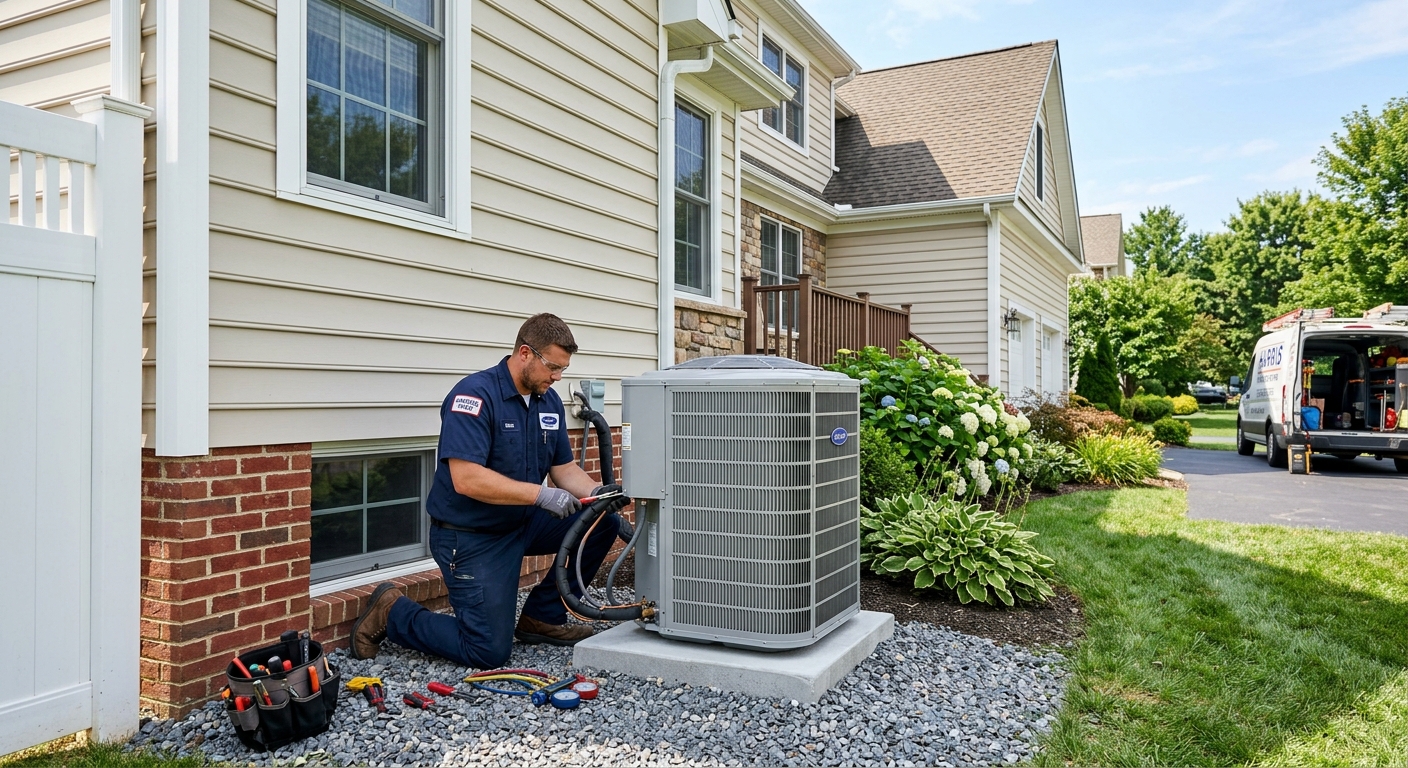
HVAC costs in Corry — 2026
Corry homeowners see different HVAC installation costs than larger metro areas. With a 67.4% homeownership rate and 88.3% of homes built before 1980 (U.S. Census Bureau, ACS 2024), this is mainly a market of older houses needing retrofits rather than new installations. Most homes already have some form of existing ductwork, but postwar Erie housing stock involved fast, inexpensive construction—meaning original ductwork may be undersized, leaky, or poorly sealed. That puts duct correction and replacement squarely on the table, especially when moving away from legacy heating systems or adding central air for the first time.
Erie County is a heating-dominated climate, with 6,200 heating degree days and just 800 cooling degree days. Winter lows routinely reach 5 °F, and the Lake Erie snow belt brings additional challenges. For most of the year, heating loads outweigh cooling, which affects both what type of system delivers real value and how efficiency improvements pay back.
| System |
Best for |
Efficiency |
Price range (installed) |
| Central AC replacement (existing ducts) |
homes with sound ductwork |
16–20 SEER2 |
$4,600–$11,000 |
| Air source heat pump (ducted) |
year-round heating and cooling |
8–10 HSPF2 |
$7,300–$15,500 |
| Cold-climate heat pump (ducted) |
heat pump as primary heat |
9–11 HSPF2 |
$12,000–$15,500 |
| Ductless mini-split (single zone) |
additions, rooms without ducts |
20–30 SEER2 |
$2,900–$6,400 |
| Full duct system installation |
homes with no existing ducts |
— |
$8,300–$16,500 |
Installed estimates for a typical Corry home. Equipment tonnage, duct condition and electrical capacity move these more than brand.
What each system actually costs to run in Corry
Corry’s climate—6,200 heating degree days but only 800 cooling degree days—means that almost all of your annual HVAC spending goes toward heating. How much you’ll spend depends on the system’s efficiency rating, your home’s insulation, and how much you actually use it. A high-efficiency system underperforms dramatically if ductwork leaks or insulation is lacking—proven by utility bills that don't go down after a major upgrade. That's why an honest HVAC contractor starts with the whole system, not just the equipment.
Here’s roughly how the math works. Take a ducted heat pump rated 9 HSPF2: that stands for Heating Seasonal Performance Factor, and means 9 BTUs of heat delivered per watt-hour of electricity. Multiply your annual heating load (based on those heating degree days and your home’s square footage/insulation) by your utility’s kilowatt-hour rate. In Corry, electricity from Pennsylvania Electric Company shows up as “price to compare” on your bill—use that actual cents-per-kWh number for the most accurate projection.
- Example: House needs 50 million BTUs of heat in a typical Erie County year.
- At 9 HSPF2: 50,000,000 ÷ 9 = 5,555,555 watt-hours = 5,556 kWh.
- At $0.15/kWh: 5,556 × $0.15 = $833 in annual heating electricity.
Furnace, boiler, or older heat pump? Adjust for their AFUE (furnace efficiency) or HSPF2 (heat pump). The same logic applies to cooling, but with only 800 cooling degree days, summertime cost barely dents most annual budgets here.
The big wild cards: utility rate changes, insulation, and especially duct quality. A leaky or uninsulated duct system can waste 20–40% of delivered heating or cooling. Fixing ducts often beats replacing your equipment on cost recovery, especially in aging Corry homes.
The decision point on an aging system
When your system acts up, the question is always: Repair or replace? In Corry, where the average home is over 40 years old (U.S. Census Bureau, ACS 2024), that usually means evaluating legacy furnaces, air conditioners and heat pumps. If your system is under 10 years old and fails from a single component—blower motor, capacitor—it usually makes sense to repair, especially if parts aren’t obsolete. Once you’re past 10 but under 15 years, look at repair cost: if it’s over a third of what a new system would run, replacing starts to make sense, particularly if efficiency improvements will move the needle on winter bills.
Two situations require replacing, no question: a cracked heat exchanger (a carbon monoxide hazard at any age) or a failed compressor outside warranty on an old AC or heat pump. Don't forget to consider the type of refrigerant too; a repair on an older, phased-out system may not be money well spent.
| Situation |
Recommendation |
Typical cost |
Reasoning |
| Under 10 years, single component failure |
Repair |
$300–$1,200 |
Parts are available, likely under or near warranty |
| 10–15 years, repair over a third of replacement |
Consider replacing |
$4,600–$11,000 |
Approaching end of life—efficiency and reliability gains possible |
| 15+ years, any major failure |
Replace |
$4,600–$11,000 |
Unit is obsolete, newer systems far more efficient |
| Cracked heat exchanger, any age |
Replace immediately |
$4,600–$11,000 |
Safety hazard—CO risk, cannot be patched safely |
| Compressor failure past warranty |
Replace |
$7,300–$15,500 |
Compressor is most expensive part, likely matches cost of new system |
| Working system, high bills |
Test ducts and envelope first |
$300–$800 |
Air sealing and duct repair often brings bills down cheaper than new equipment |
Refrigerant rules and your existing system
Corry homeowners with systems installed in the last 10–15 years usually have R-410A in their central air or heat pump. Newer systems are moving to lower-GWP refrigerants (like R-454B and R-32) as part of a nationwide phase-down of high-global-warming-potential HFCs. The change means all newly manufactured equipment uses these new refrigerants, but it does not suddenly make existing R-410A illegal to use or to service.
The practical effect? If your R-410A system is working, you can still have it serviced, recharged, or repaired. However, as supplies of R-410A tighten (since it is no longer being produced for new equipment), the cost of repairs that require new refrigerant is likely to rise—especially for larger leaks or major rebuilds. This won’t force an immediate replacement, but it does mean that fixing an older, leaking system could quickly approach the cost of a new unit using the latest refrigerant technology.
If you’re facing a minor, non-refrigerant failure and your system is otherwise sound, repairing is typically a smarter move. If a major refrigerant leak occurs and refilling it puts you within a few thousand dollars of new equipment, then replacement becomes the better long-term call. The refrigerant phase-down shifts this break-even point, but routine service will continue on R-410A units for years to come.
SEER2, HSPF2 and AFUE decoded
SEER2 (Seasonal Energy Efficiency Ratio 2) measures the cooling output of air conditioners per unit of electricity under updated, stricter test procedures. HSPF2 (Heating Seasonal Performance Factor 2) does the same for heat pumps’ heating mode, and AFUE (Annual Fuel Utilization Efficiency) rates how effectively gas or oil furnaces turn fuel into heat.
For Erie County—with 6,200 heating degree days and only 800 cooling degree days—heat-related efficiency (HSPF2 or AFUE) delivers far more value than squeezing out another point or two of SEER2 on your AC. Spending for the highest SEER2 (20 or above) rarely pays back here unless you’re extremely sensitive to summer humidity. The real savings in this region come from a heat pump with an HSPF2 above 9 or a high-efficiency gas furnace (95%+ AFUE).
It’s worth noting that the rating systems changed recently from SEER and HSPF to SEER2 and HSPF2, with tougher testing involved. If you’re comparing older articles or estimates, be sure you’re looking at the new (2) numbers, as they’re not directly comparable with the old values.
Permits, licensing and inspections in Corry
Pennsylvania does not run a statewide HVAC licensing program for residential contractors. Instead, Corry homeowners should know that regulation for home HVAC installation happens at the municipal level, following the Pennsylvania Uniform Construction Code (UCC), based on the IRC. In Erie County, city permits are required for HVAC installations or replacements that involve new equipment or ductwork. The City of Erie Bureau of Permits and Inspections is the authority for projects within city limits.
Contractors must hold Home Improvement Contractor (HIC) registration for contracts over $500; you can verify this via the hic.attorneygeneral.gov website. Any business with employees is also required to carry workers’ compensation insurance, which you can check at the WCAIS system (wcais.pa.gov). For refrigerant handling—including any AC or heat pump service—EPA Section 608 certification is federally required.
Always insist on written contracts, as required by the Home Improvement Consumer Protection Act for jobs over $500. Watch for any contract language waiving your homeowners’ insurance deductible; Pennsylvania law prohibits this. If your house was built before 1978 and work might disturb paint, the EPA Lead RRP Rule applies and renovators must be properly certified.
Filtration, humidification and ventilation
With Corry’s cold winters (6,200 heating degree days) and short but humid summers, homeowners feel both problems: dry indoor air from heating, and muggy air when the AC can’t keep up. Winter dryness is best managed with a whole-house humidifier, but be aware these units require annual cleaning and maintenance to prevent mold or scale buildup—many are oversold for homes with moderate humidity concerns.
Summer dehumidification depends on equipment sizing. An oversized air conditioner chills the air too quickly, shutting off before it can properly dehumidify—leaving sticky, damp conditions inside. When replacing AC or heat pumps, always size for the house and not by old rules-of-thumb.
Higher MERV-rated filters capture more dust and allergens, but can restrict airflow if your blower isn’t strong enough. In older Erie County homes, jumping to a very high MERV filter without checking blower performance can reduce system life. MERV 8–11 is a reasonable range for most homes here.
Homes built or retrofitted to be airtight occasionally need mechanical ventilation (like an ERV or HRV), but for most Corry homes the real problem is excessive leakage rather than stuffiness. If someone’s selling you an add-on indoor air quality device, ask for local measurements or skip it—most don’t show much benefit in typical northwest PA housing.
Frequently asked questions — HVAC installation in Corry
Is a heat pump a good choice for Corry winters?
Heat pumps are much more effective than they once were, and modern cold-climate models can absolutely keep up in Corry’s winters, where the design temperature dips to 5°F. With 6,200 heating degree days, you do need a model rated for cold-weather operation—look for a cold-climate ducted heat pump with an HSPF2 of 9 or better. Expect to pay $12,000–$15,500 installed for these. If your home’s insulation or windows are poor, supplementing with a backup heat source makes sense, but in a well-sealed home, a high-efficiency heat pump delivers reliable, efficient comfort year-round in Erie County.
What does a ductless mini-split cost in Corry?
For a single-zone ductless mini-split system—perfect for an addition, finished attic, or a room where you can’t easily run ductwork—expect installed costs in the range of $2,900–$6,400 in the Corry area. Most homeowners land around $4,600. These prices reflect moderate labor costs and typical travel surcharges in Erie County. Multi-zone systems, covering several rooms, will cost more depending on layout and unit sizing. Ductless is a good retrofit option in older Corry homes with challenging interiors, especially where adding or repairing ductwork doesn’t make sense.
Do I need a permit to replace HVAC in Corry?
Yes, if your project involves installing new equipment or new ductwork, the City of Erie requires a permit. This applies to any major HVAC installation in Corry that is within city limits. The residential code is enforced locally, following the Pennsylvania Uniform Construction Code. Permitting adds a layer of inspection and protects you as the homeowner, ensuring work meets code. Expect to see clear permitting requirements when receiving a quote, especially for projects over $4,600. If you’re outside city limits, rules may differ, but reputable contractors will know the correct process for your township.
Should I close vents in unused rooms?
In older Corry homes, it’s a common myth that closing vents in unused rooms will save you money. Doing this actually increases air pressure in the system, which can boost duct leakage—already a problem in much of Erie County’s postwar housing stock. It may reduce total airflow and stress your blower, potentially shortening the system’s lifespan. If saving energy in little-used rooms is your goal, talk to a contractor about zone ductwork (a larger investment, typically $8,300–$16,500 in a retrofit) or focus on air sealing and insulation instead for a better return on investment.
How much does ductwork add to an HVAC installation?
If you’re adding a full new duct system to a home that previously used only radiators, baseboards, or space heaters, expect to budget $8,300–$16,500 on top of the equipment cost. This range reflects Corry’s typical older construction—lots of unexpected framing and tight runs. Ductwork corrections or partial replacements (if your existing ducts are leaky or undersized) may be hundreds to a few thousand dollars. It’s common in Corry’s postwar homes to need at least some ductwork repairs during an HVAC replacement.
What is the R-410A refrigerant phase-down?
The federal government is phasing down R-410A and other high global-warming-potential refrigerants, so new residential systems now use alternatives like R-454B or R-32. For Corry homeowners, your existing R-410A system remains legal and can still be serviced. However, as supplies tighten, the cost of replenishing R-410A will rise. If you need a major repair involving refrigerant, especially on an older system, replacement costs start at $4,600–$11,000 and may be a smarter long-term bet than pouring money into expiring technology. You do not have to replace a working system just because the refrigerant is being phased out.
Do older Corry homes need ductwork replaced?
Many homes in Corry were built before 1980, which often means original ductwork is undersized, leaky, or poorly sealed. Full duct replacement is rarely required unless switching from a non-ducted system, but partial duct repair or sealing is extremely common, especially when replacing your HVAC system. Expect minor corrections in the $300–$800 range for sealing, with full replacement or major retrofits running as high as $8,300–$16,500. If your contractor never inspects your ducts, get a second opinion—good airflow is essential for system performance in Corry’s demanding winter climate.
When is the best time of year to replace HVAC in Corry?
The best time to schedule an HVAC replacement is usually in the spring or fall, before busy season hits. Summer and winter mean long waits as contractors respond to emergency calls across Erie County. Scheduling off-season may net you faster installation and occasionally lower labor rates. If your replacement involves ductwork or a switch to a new heat pump system (costing $7,300–$15,500), you’ll want several weeks’ flexibility, which is easier before extreme temperatures hit. Plan ahead to avoid rushed decisions during a cold snap.
Does my utility offer a heat pump rebate in Corry?
Rebates change year-to-year, so you’ll want to check directly with Pennsylvania Electric Company. Some years, incentives are substantial—shaving $500–$2,000 off the installed price of qualified air source heat pumps or cold-climate models. Requirements vary: most programs require a certain HSPF2 rating and installation by a registered contractor. Ask your installer about current rebate paperwork (they usually handle submission for you). Double-check eligibility and deadlines, as Corry homeowners sometimes miss out by waiting until funds run low.