HVAC costs in South Strabane — 2026
South Strabane sits in a classic retrofit market: over half of homes here were built before 1980, and 68.8% are owner-occupied (U.S. Census Bureau, ACS 2024). That means most homeowners are working with existing systems and ductwork in a mix of postwar split-levels and ranch construction. In particular, a lot of split-level homes in Peters and North Strabane were built with minimal or outdated ductwork, so modernizing often means adding or altering ducts along with the equipment itself.
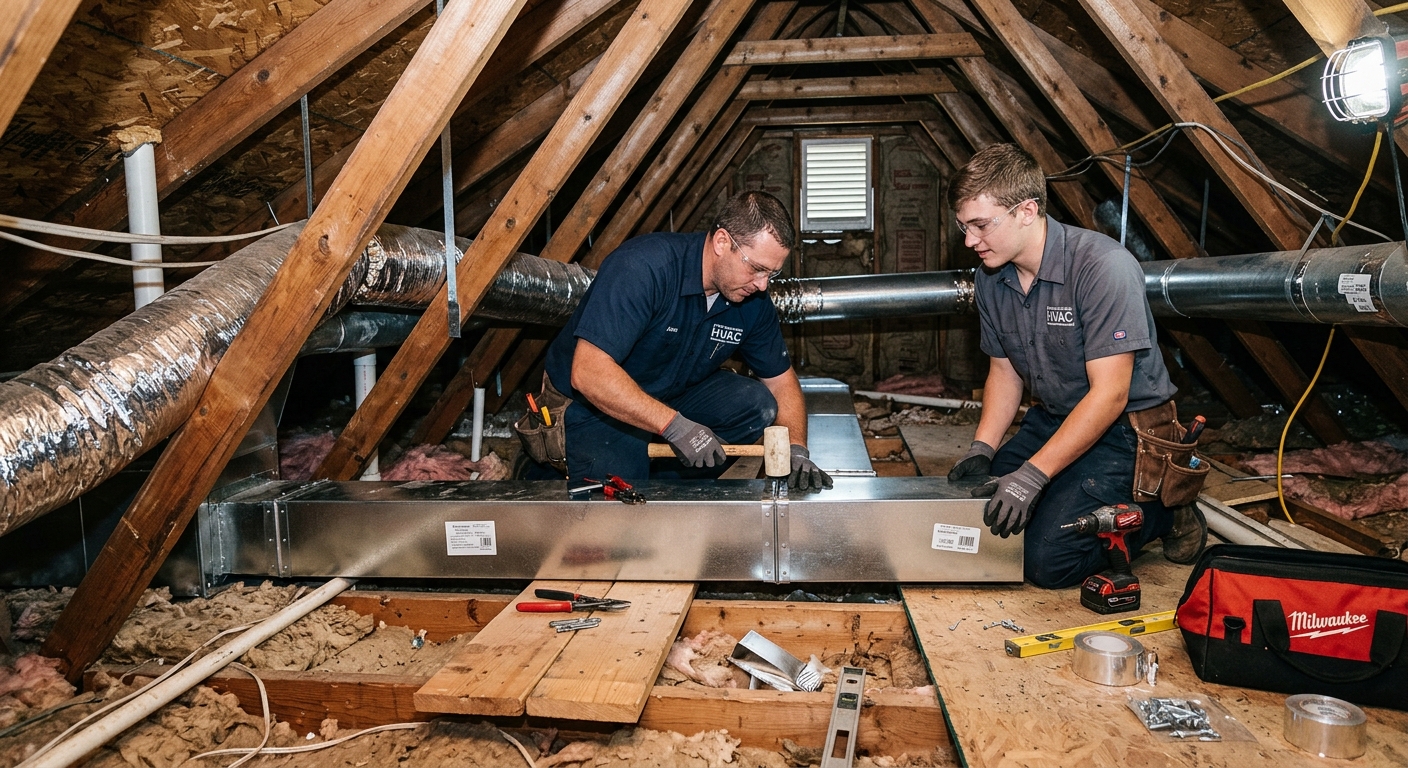
Climate drives the decision: southwestern Pennsylvania sees about 5,600 heating degree days versus just 1,050 cooling degree days. Heating needs here outweigh cooling almost five-fold, so the system you pick (especially if all-electric) should be planned for reliable performance in cold weather—not just summer comfort. If your ducts are in good condition, a central AC or heat pump swap can be straightforward. But poorly sealed or undersized ductwork in older homes can lead to comfort problems, and the cost and disruption of a full duct retrofit are real. If you’re adding AC where it never existed, most of your expense may be in the ducts, not the box outside.
| System |
Best for |
Efficiency |
Price range (installed) |
| Central AC replacement (existing ducts) |
homes with sound ductwork |
16–20 SEER2 |
$5,100–$12,000 |
| Air source heat pump (ducted) |
year-round heating and cooling |
8–10 HSPF2 |
$8,100–$17,500 |
| Cold-climate heat pump (ducted) |
heat pump as primary heat |
9–11 HSPF2 |
$13,000–$17,500 |
| Ductless mini-split (single zone) |
additions, rooms without ducts |
20–30 SEER2 |
$3,300–$7,100 |
| Full duct system installation |
homes with no existing ducts |
— |
$9,200–$18,500 |
Installed estimates for a typical South Strabane home. Equipment tonnage, duct condition and electrical capacity move these more than brand.
Rebates and tax credits for South Strabane homeowners
In South Strabane, HVAC incentives exist at three levels. First, federal tax credits (such as for installing a high-efficiency heat pump or air conditioner) directly reduce what you owe when filing next year’s taxes—they don’t save you up front, but they do cut your actual tax bill. Second, local rebate offers may be available through West Penn Power for electric upgrades or Columbia Gas of Pennsylvania for qualifying gas equipment. A rebate means a check or account credit, typically paid weeks or months after you verify installation.
It’s important not to assume you qualify or to bank on a specific dollar figure. Rebate programs, just like their names and rules, change regularly. Your best step is to check your utility’s own energy efficiency page and use the federal ENERGY STAR rebate finder for the current options. Don’t trust a generic “up to $1,000 rebate” claim—what actually applies depends on your utility, equipment specs and when you apply. Pennsylvania’s state and local programs also change periodically, so using utility and ENERGY STAR sources is more reliable than a year-old article.
Remember the distinction: a tax credit is money off your income taxes the following year; a rebate reduces what you pay or refunds you after installation. Either way, make sure your contractor gives you the model numbers, documentation and forms you need to claim it. Ask about paperwork up front to avoid disappointed surprises.
Mechanical permits for HVAC work in South Strabane
Pennsylvania does not issue a statewide HVAC trade license for residential work. Instead, HVAC contractors in South Strabane must register with the state as a Home Improvement Contractor (HIC) if the contract is over $500, which is most replacements. Always verify a contractor’s HIC registration at hic.attorneygeneral.gov before you sign anything. In addition, municipalities in Washington County—South Strabane included—enforce building and mechanical permits under the Pennsylvania Uniform Construction Code (UCC) for central HVAC equipment and ductwork installation or replacement. This means your contractor (not you) must secure permits, arrange for inspection, and show the job complies with code.
Working with refrigerants (as in air conditioners and heat pumps) requires EPA Section 608 certification, which is a federal mandate. Every installer who touches those lines should be certified—don’t be afraid to ask. To protect yourself if something goes wrong, check your contractor’s workers’ compensation insurance status via WCAIS (wcais.pa.gov) and review their liability insurance certificate. These are not mere formalities: accidents happen, and uninsured work puts you at risk.
To recap: only hire someone with the right HIC registration, ask for evidence of permits, and verify insurance before work begins. It isn’t red tape—it’s your protection as a South Strabane homeowner.
Filtration, humidification and ventilation
With roughly 5,600 heating degree days, South Strabane homes run the heat far more than the AC. Winter dryness is the first comfort problem: cold outside air, once heated, drops indoor humidity uncomfortably low. Whole-house humidifiers can help, but only if they’re kept clean—stagnant water leads to mineral buildup and even mold inside the ductwork. If you’re not willing to rinse the unit every few weeks and follow annual maintenance, you’ll likely get more hassle than benefit.
In summer, humidity is the real foe—not just heat. An oversized air conditioner or heat pump can cool the house rapidly but won’t run long enough to pull moisture from the air, leaving everything clammy. That’s why correct sizing matters more than gadget add-ons.
Filtration is important, but higher MERV ratings (meaning finer dust capture) come with a catch in older systems: too dense a filter can actually choke airflow and damage the blower. For most South Strabane homes, MERV 8–11 balances dust capture and system health. Leave the MERV 13+ filters for newer, high-static systems built for them.
Ventilation is a real concern in modern, airtight homes—some level of mechanical fresh air system (HRV/ERV) can help, but unless your house was built with tight air-sealing in mind, it’s rarely a top priority. Beware anyone who insists you need every possible add-on; each comes with cost, maintenance, and limited impact for typical area homes.
Manual J and the tonnage question
System sizing is where most installation mistakes begin. In South Strabane, oversizing is more common than undersizing: a contractor guesses big “just in case” or sizes off the old equipment, not the actual house. The result? Your AC or heat pump short cycles (turns on and off too quickly), never dehumidifies properly, wears out faster, and makes you less comfortable—and colder or hotter in some rooms. An oversized system is a flaw, not a safety margin.
The only correct way to size is with a Manual J load calculation. This involves measuring your home’s walls, windows, insulation, orientation, ducts and even the direction it faces, then factoring in the winter design temperature (8 °F here) and summer peaks. Square footage “rules of thumb” miss all these details and produce wild guesses. If a contractor can’t or won’t show you their load calculation—or if they size to match the old nameplate—press pause. You’re paying for their expertise, not a copy of past mistakes.
The question to ask directly: “Did you run a Manual J load calculation, and can I see it?” For Washington County’s climate, with long, cold winters, correct sizing keeps you warm without blowing money on a system that is too large. Insist on it, and you’ll avoid 90% of long-term comfort and reliability problems with your new HVAC install.
Reading an installation proposal
When comparing HVAC quotes in South Strabane, it pays to look beyond the brand and cost. Real proposals should specify both indoor and outdoor unit model numbers—only a matched pair delivers the efficiency and performance you’re actually quoted. Make sure the quoted size (tonnage) ties back to a load calculation, not just a guess or the old system’s label.
Your proposal should spell out whether the refrigerant line set is being replaced or reused—reusing old lines is only safe if they’re tested, flushed and guaranteed compatible. Electrical work matters too: older homes often need a panel upgrade or dedicated circuit, especially when switching systems. Every proposal should address condensation drainage, thermostat (new or reusing your existing one), include all required permits, and provide both equipment and labor warranties with details.
A one-liner—just a brand and bottom-line number—can’t be compared to anything. Make every contractor show you what’s included and why. The checklist below can help cut through the noise:
| Line item |
What to look for |
Red flag if… |
| Equipment |
model numbers, indoor and outdoor matched |
brand name only |
| Sizing |
load calculation attached |
matched to the old nameplate |
| Ductwork |
condition assessed, sealing scoped |
not mentioned |
| Electrical |
circuit and panel capacity confirmed |
assumed adequate |
| Line set |
replaced or documented as reused |
silent |
| Commissioning |
measured airflow and charge, documented |
no startup report |
| Warranty |
labour years stated separately |
manufacturer only |
| Permit |
included and priced |
'not needed' |
Heat pump or furnace: what makes sense in South Strabane
For South Strabane homeowners, the classic HVAC decision is whether to stick with a gas furnace plus central AC or switch to a heat pump. The winter design temperature here—8 °F—along with 5,600 heating degree days means this is a heat-dominated climate, pushing any system hard for months at a time.
Modern cold-climate heat pumps have changed the landscape; they hold substantial capacity well below freezing, so “heat pumps don’t work in Pennsylvania winters” is yesterday’s thinking. However, output still drops as temperatures approach the lowest design specs, so it’s not a blanket answer. That’s why “dual fuel” systems (heat pump plus gas backup) are gaining ground—efficient electric heating for three seasons, seamless gas for deep cold snaps.
Gas utility coverage tells the rest of the story. In the City of Washington, Canonsburg, and Peters Township, Columbia Gas is widely available, so a gas furnace remains a reliable, cost-effective solution, especially for big homes or where you’ve already got a sound gas line. But in outlying rural townships lacking natural gas, homeowners are often comparing heat pumps to propane—propane is more expensive per BTU, so the value tilts toward an electric heat pump, especially in a well-insulated house.
If you want the lowest up-front cost and already have gas, a furnace and AC combo is still hard to beat. For new builds, major remodels, or where energy costs or fuel delivery are unpredictable, a heat pump (possibly dual fuel) is well worth considering.
| Option |
Installed cost |
Operating cost here |
Best when |
Incentive eligible |
| Gas furnace + central AC |
$5,100–$12,000 |
lowest w/ existing gas |
existing gas service, coldest zones |
yes for high-efficiency |
| Ducted heat pump (cold climate) |
$8,100–$17,500 |
comparable to gas, lower with good envelope |
good envelope, all-electric goal |
yes |
| Dual fuel (heat pump + gas backup) |
$13,000–$17,500 |
lower than propane, flexible |
gas on site, deep cold spells |
yes |
| Ductless multi-zone |
$9,200–$18,500 |
zone by zone, higher in big homes |
no ductwork, zone control |
yes |
Frequently asked questions — HVAC installation in South Strabane
Do I need ENERGY STAR equipment to qualify for incentives?
In South Strabane, most rebate programs through West Penn Power or Columbia Gas of Pennsylvania require your HVAC equipment to meet or exceed certain ENERGY STAR or other efficiency criteria, but not always the blue label specifically. Federal tax credits for HVAC systems are usually tied to ENERGY STAR Most Efficient levels or equivalent, which means higher performance—and sometimes higher upfront price. For a ducted air-source heat pump, a model in the $8,100–$17,500 range should present qualifying options, but check the fine print for each program. Don’t take a contractor’s word; use the ENERGY STAR rebate finder and your utility’s website for up-to-date lists, since these requirements can change year by year. Buying a high-efficiency system is smart for long-term savings, but double-check what paperwork you’ll need for your credit or rebate before installation.
What MERV filter rating should I use?
For most older homes in South Strabane, a MERV filter in the 8–11 range is an effective balance—trapping common dust and pollen without straining the blower. Higher-MERV filters (12 and up) catch more, but they can cut airflow dramatically if your furnace or AC isn’t built for the extra restriction, leading to potential coil freezing or blower damage. If you’ve invested in a newer high-static system or have allergy sensitivity, you might be able to use a higher-MERV filter, but it should be checked with your contractor. On older duct systems, stick with MERV 8–11 and change it regularly for best performance. Don’t waste money on “hospital grade” filters if your HVAC wasn’t designed for it—they often do more harm than good.
Is natural gas available throughout Washington County?
No—Columbia Gas of Pennsylvania provides natural gas service in South Strabane, Canonsburg, and Peters Township, but not in every part of the county. In more rural or outer townships, many homeowners rely on propane (delivered by truck) or, in some cases, heating oil. This matters for HVAC choices: if you don’t have gas, a heat pump (in the $8,100–$17,500 installed range) can be much more cost-effective than sticking with propane. Always check with Columbia Gas for lines on your street before investing in a new furnace.
Do I need to be home during installation?
It’s a good idea to be present when your contractor arrives to start work—at minimum, to walk through the plan, review access concerns and confirm what’s being replaced. For a full HVAC replacement or a new ducted heat pump install, which can cost $8,100–$17,500 or more, expect workers to be in and out of different parts of the house for a day or two. After that, it’s possible to check in remotely as long as you’re reachable for questions, but someone responsible should be available for the final walkthrough and system test. If you can’t be there all day, arrange to be present for start, finish, and commissioning.
Is it worth switching from oil or propane to a heat pump?
In rural Washington County homes without natural gas, swapping out oil or propane for a high-efficiency heat pump is often the most cost-effective move. Propane prices are volatile, and delivery can be unpredictable. A modern, cold-climate heat pump (in the $13,000–$17,500 installed range for a robust system) will provide year-round heating and cooling—often cutting annual energy bills, especially if your house is well insulated. The upfront cost is higher than just replacing an old fuel furnace, but available utility rebates and possible federal tax credits can help close the gap. Most importantly, you’re removing the risk of running out of delivered fuel in the dead of winter.
What is EPA Section 608 certification?
EPA Section 608 certification is a federal requirement for anyone who installs, services, or disposes of equipment that could release refrigerants (like air conditioners and heat pumps). In Pennsylvania—including South Strabane—your installer must hold this certification to legally handle refrigerant lines. It’s about safe, legal refrigerant management—not state licensing. Ask to see the tech’s card if in doubt. This won’t directly affect your price (whether you’re quoted $5,100–$12,000 for an AC replacement or otherwise), but it’s a non-negotiable standard for professional work. Never hire a contractor who shrugs this off.
How often should I change my filter?
Most South Strabane homes get best results changing HVAC filters every 2–3 months, but it depends on filter type, system run-time, pets and whether you smoke or burn wood indoors. If you’re running a high-MERV filter (11 or above) or have lots of activity, check monthly for build-up. Newer, tightly-sealed homes tend to see more dust accumulation. Changing on schedule keeps your system’s efficiency up—protecting equipment that can cost $8,100–$17,500 or more to replace. Don’t wait until the filter “looks dirty;” clogged filters are a primary cause of poor comfort, costly service calls and even equipment failure.
How much does a new HVAC system cost in South Strabane?
Installed price in South Strabane depends on system type and whether ductwork is already in place. For central AC replacement where ducts are usable, budget $5,100–$12,000. Adding a new air-source heat pump runs $8,100–$17,500. If you need a complete new duct system, expect $9,200–$18,500, with split-level and older homes at the higher end. Always demand a line-by-line proposal, as extras like electrical upgrades or complex ductwork can swing total cost by thousands. Equipment brand matters less than proper sizing and installation.
What does a heat pump cost installed in South Strabane?
A ducted air-source heat pump installation in South Strabane typically runs $8,100–$17,500. The wide range covers differences in equipment (standard or cold-climate models), sizing, duct condition, and any electrical work required to support the new system. A single-zone ductless mini-split for an addition or problem room is less—about $3,300–$7,100—but a whole-house ductless or multi-zone system can reach the $9,200–$18,500 bracket. Always include permit, commissioning, and labor warranty in your proposal. Don’t just price the box—price the total job.