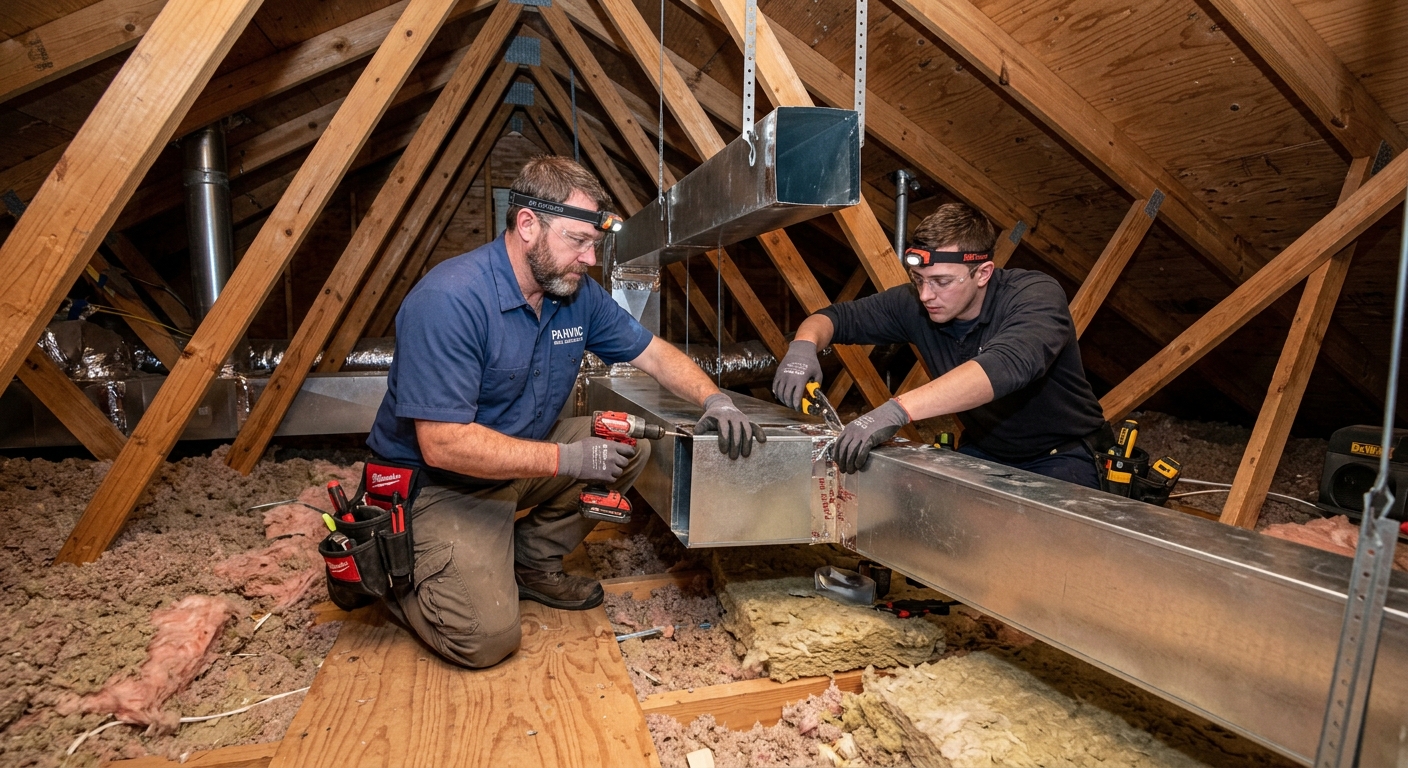
Uniontown heating and cooling prices by system type — 2026
Uniontown, situated in Fayette County’s outer Pittsburgh fringe, is a replacement market at its core. With a homeownership rate of 52.1% and a whopping 91.9% of homes built before 1980 (U.S. Census Bureau, ACS 2024), much of the housing stock here is still rooted in the coal and steel era. That means many homes have uninsulated masonry walls and, in many cases, original ductwork—or none at all. Systems were often added as afterthoughts, and it’s common to see older ducts barely sealed, if ever, and sized for coal or oil furnaces, not modern HVAC loads.
The climate keeps heating front and center. With 5,600 heating degree days against only 1,050 cooling degree days, Uniontown is firmly a heating-dominated market. This pushes the value equation: you invest in year-round comfort, but the lion’s share of your bill goes to heat, not cooling.
If you have decent ductwork, central AC replacements and air source heat pumps are straightforward, but tearing out plaster and running new ducts is a non-starter for most budgets in these old, solid-walled homes. Mini-splits step in as a practical choice for additions or rooms never reached by ductwork. Here’s where typical prices land for a professionally installed system in Uniontown:
| System |
Best for |
Efficiency |
Price range (installed) |
| Central AC replacement (existing ducts) |
homes with sound ductwork |
16–20 SEER2 |
$4,400–$10,500 |
| Air source heat pump (ducted) |
year-round heating and cooling |
8–10 HSPF2 |
$7,000–$15,000 |
| Cold-climate heat pump (ducted) |
heat pump as primary heat |
9–11 HSPF2 |
$11,500–$15,000 |
| Ductless mini-split (single zone) |
additions, rooms without ducts |
20–30 SEER2 |
$2,800–$6,100 |
| Full duct system installation |
homes with no existing ducts |
— |
$7,900–$15,500 |
Installed estimates for a typical Uniontown home. Equipment tonnage, duct condition and electrical capacity move these more than brand.
Heat pump or furnace: what makes sense in Uniontown
Uniontown’s heating needs overshadow cooling by a wide margin—5,600 heating degree days each year and a design winter temperature of just 8 °F leave little doubt that this is a market where winter performance makes or breaks your system choice.
The good news: modern cold-climate heat pumps don’t quit when the temperature drops. Today’s best models keep useful capacity at or below 0 °F, largely answering the old objection that “heat pumps can’t handle Pennsylvania winters.” Still, the laws of physics hold—capacity and efficiency do taper off as the mercury drops. That’s why dual fuel systems (a heat pump paired with a gas furnace) remain a solid choice, letting you run on heat pump down to near the design temperature, then switching to gas when the heat pump loses steam.
Natural gas is common in Uniontown, Connellsville, and the bigger townships. Homeowners with existing gas lines usually stick with furnaces, especially if their envelope is leaky or the ductwork is original and undersized. On the flip side, rural Fayette County moves into oil or propane territory. Here, the running costs of fossil fuel often make a cold-climate heat pump much more competitive—even if you have to give up a little comfort in the deepest cold snaps.
If you have good gas service and your house is drafty or you just want failproof backup in extreme cold, sticking with a gas furnace makes sense. Otherwise, most homeowners should at least compare heat pump options before replacing an aging furnace.
| Option |
Installed cost |
Operating cost here |
Best when |
Incentive eligible |
| Gas furnace + central AC |
$4,400–$10,500 |
lower with gas line |
existing gas service, coldest zones |
yes (select utility programs) |
| Ducted heat pump (cold climate) |
$7,000–$15,000 |
lower than oil/propane, higher than gas |
good envelope, all-electric goal |
yes (federal and state) |
| Dual fuel (heat pump + gas backup) |
$11,500–$15,000 |
optimized |
gas on site, deep cold spells |
yes |
| Ductless multi-zone |
$7,900–$15,500 |
zone by zone |
no ductwork, zone control |
yes |
Why your ducts may be the real problem in Uniontown
In Uniontown’s older homes—especially those built from 1900–1940—you’re often dealing with original ducts that weren’t sized for forced air or may not exist at all. When ducts are present, they tend to be leaky, poorly insulated, or jammed into spots that were never designed for them, like crawlspaces or unconditioned attics. These leaks are more than a small waste: testing with a duct blaster routinely shows 20–40% of heated or cooled air escaping before ever reaching your rooms.
A duct blaster test seals all supply and return registers, then pressurizes the system to measure actual leakage. The result shows where you’re losing money—through gaps, failed joints, or disconnected runs hidden from sight. If your returns are undersized, your furnace or air handler works overtime for not much reward, and air quality can suffer from backdrafting or drawing dusty air from attics and basements.
For many Uniontown retrofits, duct sealing is worth every penny before replacing equipment. In some cases, especially with old round or asbestos-lined ducts, complete replacement may have a payback, but for most homeowners, targeted sealing and adding returns in key rooms solves more problems for less money. Always test and evaluate your ducts before you replace or upsize your system; otherwise, you may simply blow more air into the same leaks—and feel no difference on your bill or your comfort.
When ductless is the right answer
Ductless mini-split systems thrive in homes where traditional ductwork is impractical—think additions, attic or basement conversions, sunrooms, or those thick-walled Uniontown houses built before “central air” meant anything. Running new ducts through 1900–1940’s masonry walls or intact plaster ceilings is rarely worth the mess or expense, and that’s where these systems earn their keep.
Single-zone systems install quickly with just a 3-inch wall sleeve. They’re perfect for one room out of reach of your main system, or for stabilizing temperature swings in places with big glass exposures. Multi-zone setups—one outdoor unit feeding 2–5 indoor heads—can serve the whole house, but unlike single-zones, all heads are tied to the same compressor. That trade-off: if everyone’s doors are open, or two rooms have very different loads, the performance isn’t quite as sharp as with separate single zones. You also need to think about where the heads go—they’re visible, and careful placement matters. Condensate management is another detail that can’t be overlooked; the line needs a legit drain or condensate pump.
With so much of Fayette County’s housing pre-dating ducted air, many homeowners are discovering ductless solutions not just for spot cooling, but as the only practical way to retrofit comfortable heating and cooling into old homes—without busting apart the historical plaster or dragging ductwork through crawlspaces that barely fit a child.
Mechanical permits for HVAC work in Uniontown
Pennsylvania doesn’t issue a statewide HVAC license—so in Uniontown, residential HVAC regulation is local, not state-driven. Any installation or replacement of central HVAC equipment requiring new electrical or mechanical connections needs a permit from the Uniontown Code Enforcement Office. This local approach means you can’t assume a contractor from another part of the state knows Uniontown’s requirements, which are strictly enforced for mechanical work. That’s a real protection—an unpermitted install here will trip you up at resale or on a service call.
For any contract over $500, the installer must have Home Improvement Contractor (HIC) registration, issued by the Pennsylvania Office of Attorney General—you should always verify this at their public site. Anyone handling refrigerant, whether for air conditioning installation or replacement, needs federal EPA Section 608 certification, which is non-negotiable. If you have a pre-1978 home, an additional EPA Lead Renovation, Repair and Painting (RRP) certification is required due to the risk of lead paint.
Worker’s compensation coverage is mandatory for all employers in Pennsylvania. Always verify proof of coverage through the state’s WCAIS system before letting work begin, even for a small crew. Written contracts are required for any home improvement job over $500, and you have a three-day right to cancel under state law.
Service plans: worth it or not?
Annual HVAC service plans are popular sales pitches in and around Uniontown, but not all are worth the cost. Here’s what really matters: filters should be changed at the right interval—usually every 1–3 months—and should match the blower’s MERV rating, not just a “higher is better” impulse (too restrictive a filter can reduce airflow and leave rooms cold or humid). Coil cleaning and clearing the condensate line are genuinely important, especially given our heavy heating seasons when coils can gather dust, lint, or even mold if water sits too long.
The only real check for refrigerant is a pressure and temperature test; if yours ever “needs topping off,” that’s a sign of a leak, and reputable techs will find and fix it, not simply add more and kick the can. Annual service plans might make sense if they guarantee priority scheduling during cold snaps and include a deep cleaning of both coils and drains.
Skip any plan that’s just a “discounted tune-up” or doesn’t spell out exactly what’s included. Uniontown’s busiest periods are the first heavy freeze (October–November) and the first June heat wave. Schedule maintenance off-peak in early fall or late winter if you want more attention and less waiting.
Reading the yellow label
When comparing HVAC systems, you’ll see yellow EnergyGuide labels listing SEER2 (Seasonal Energy Efficiency Ratio 2) for cooling and HSPF2 (Heating Seasonal Performance Factor 2) for heat pumps. SEER2 and HSPF2 are new, tougher efficiency standards that replaced SEER and HSPF in recent years, so numbers from older guides don’t directly compare with new models. AFUE (Annual Fuel Utilization Efficiency) is used for furnaces and indicates how much fuel actually gets turned into usable heat.
In a heating-driven market like Uniontown (5,600 heating degree days and a design temperature of 8 °F), HSPF2 is the real deciding factor—higher numbers pay for themselves quicker. SEER2 matters for the 1,050 cooling degree days, but paying for premium 20–30 SEER2 models almost never recoups the cost unless you have big solar or need whisper-quiet performance.
As a practical rule: Premium HSPF2 (9–11 for cold-climate heat pumps) deserves the upgrade cost. For SEER2, 16–20 is sensible; above that, you’re hitting diminishing returns in Uniontown’s climate. Don’t chase the absolute top of the label unless you’ve already sealed your house and ducts.
Frequently asked questions — HVAC installation in Uniontown
What does a ductless mini-split cost in Uniontown?
A professionally installed single-zone ductless mini-split in Uniontown typically ranges from $2,800–$6,100, depending on capacity, brand, and installation complexity. If you’re considering a system for more than one room or zone, multi-zone installations start closer to $7,900 and can reach up to $15,500 if you’re serving a large, multi-story home or require several indoor heads. With much of Uniontown’s housing stock built before central air was standard, many older homes use mini-splits for additions, finished attics, or spaces that were never ducted. While some homeowners are tempted by off-the-shelf internet options, proper sizing and condensate handling are critical, so most find local installation worth it for peace of mind and warranty protection.
Should I repair or replace my HVAC system in Uniontown?
In Uniontown—where 91.9% of homes were built before 1980—repair versus replacement hinges on age and layout. Major repairs (like replacing a compressor) on equipment older than 12–15 years rarely make sense, especially if your ductwork is original or you’re seeing uneven temperatures. Given the region’s harsh winters (5,600 heating degree days), reliability matters. New central AC or heat pump replacements start around $4,400–$7,000 with existing ductwork, so if you’re quoted half that for a repair on an aging system, replacement is often the safer bet. But if your system is under 10 years old, running efficiently, and the issue is minor, a targeted repair is almost always worth it.
Why do HVAC quotes in Uniontown vary so much?
HVAC quotes swing widely in Uniontown, mainly because installation conditions range from wide-open attics in newer homes to tight crawlspaces and unpredictable electrical service in 1900–1940 coal-era houses. Labor costs can also reflect travel, since Fayette County’s market is thin and some contractors add surcharges outside Uniontown and Connellsville. Equipment is only part of your quote—complex ductwork or upgrades to old electrical panels can move a central system by $2,000–$5,000. Real quotes should detail every aspect: equipment model, ductwork changes, electrical work, permits, and cleanup. Always compare apples to apples—some contractors use stripped-down systems and skip things like duct sealing or proper permits.
Do I need a permit to replace HVAC in Uniontown?
Yes, in Uniontown, any replacement or new installation of central HVAC equipment that adds or modifies electrical or mechanical connections absolutely requires a permit from the City of Uniontown Code Enforcement Office. Skipping this step can mean headaches at sale, when you go for home insurance claims, or if you need a manufacturer warranty honored. For minor work like filter changes or basic thermostat swaps, mechanical permits usually aren’t needed unless the wiring or equipment is being upgraded. Expect contractors to include permit fees in their bid, which can add several hundred dollars to a central AC replacement ($4,400–$10,500). Always ask to see permit paperwork before work starts.
How cold does it get in Uniontown and does that affect heat pumps?
Uniontown regularly sees winter lows around 8 °F—its official “winter design temperature”—with more than 5,600 heating degree days each year. These cold snaps matter because older heat pumps struggled at temperatures below freezing. However, modern cold-climate models (especially those with variable speed compressors) keep delivering useful heat even at 0 °F, though their efficiency drops. In deep Fayette County rural areas relying on propane or oil, a quality heat pump can be the economical choice. Just be ready to supplement with electric resistance or a furnace in unusual arctic blasts. Cold-climate ducted systems here run from $11,500–$15,000 installed, often with incentives available if you’re moving away from oil or older electric heat.
Can I service my R-410A system after the refrigerant change?
Yes—if you already have a system running on R-410A, you can still have it serviced or recharged in Uniontown for years to come. While new federal rules are slowly phasing in lower-GWP refrigerants, R-410A remains fully supported for maintenance work. Just be aware that topping off refrigerant should only happen after finding and repairing leaks; repeated charging without a fix suggests poor workmanship. Local pros must have EPA Section 608 certification when handling any refrigerant, regardless of how old your house is. With installations ranging from $4,400–$10,500 for AC replacements, it’s wise to maintain what you have until it’s time for a full system upgrade.
Should I close vents in unused rooms?
Closing HVAC supply vents in Uniontown homes seems thrifty, but it often backfires—especially in the rigid uninsulated masonry houses built before 1940. Blocking airflow raises system pressure, which can stress your blower or even create leaks in old ductwork. In the heating-heavy climate here, closing off vents can also lower return airflow and make some rooms more prone to mold or condensation. If a room is truly unused for months, consider a ductless mini-split ($2,800–$6,100) to zone only the rooms you need, rather than forcing an old system to work harder. For most homeowners, gently adjusting vents or install balancing dampers is safer than shutting them entirely.
Are duct sealing and insulation eligible for incentives?
In Uniontown and the rest of Pennsylvania, duct sealing and insulation often qualify for utility or federal energy incentives—especially when bundled with heat pump or high-efficiency system upgrades. These improvements can cut heating and cooling losses by 20–40% in typical older Uniontown homes. Many rebate programs require pre- and post-testing (like a duct blaster test) for eligibility. Even if you’re not replacing equipment, spending a portion of your budget—often less than $2,000—on duct sealing will often produce more savings and comfort than going for the highest-SEER unit. Always check requirements with your electric or gas utility before starting work.
How far ahead should I schedule in Uniontown?
In Uniontown, demand for HVAC installation spikes with the first cold snap in October and the first heat wave in June—when most contractors are booked solid, sometimes 2–4 weeks out for replacements ($7,000–$15,000 for ducted heat pumps). For planned work, especially complex duct replacements or multiple ductless zones, schedule at least a month in advance in shoulder seasons (late winter or early fall). Last-minute emergency jobs may come with travel surcharges, since the Fayette County market is thin and many pros travel from larger towns. If you need a new system before heating season, line up service before mid-September for the best flexibility.