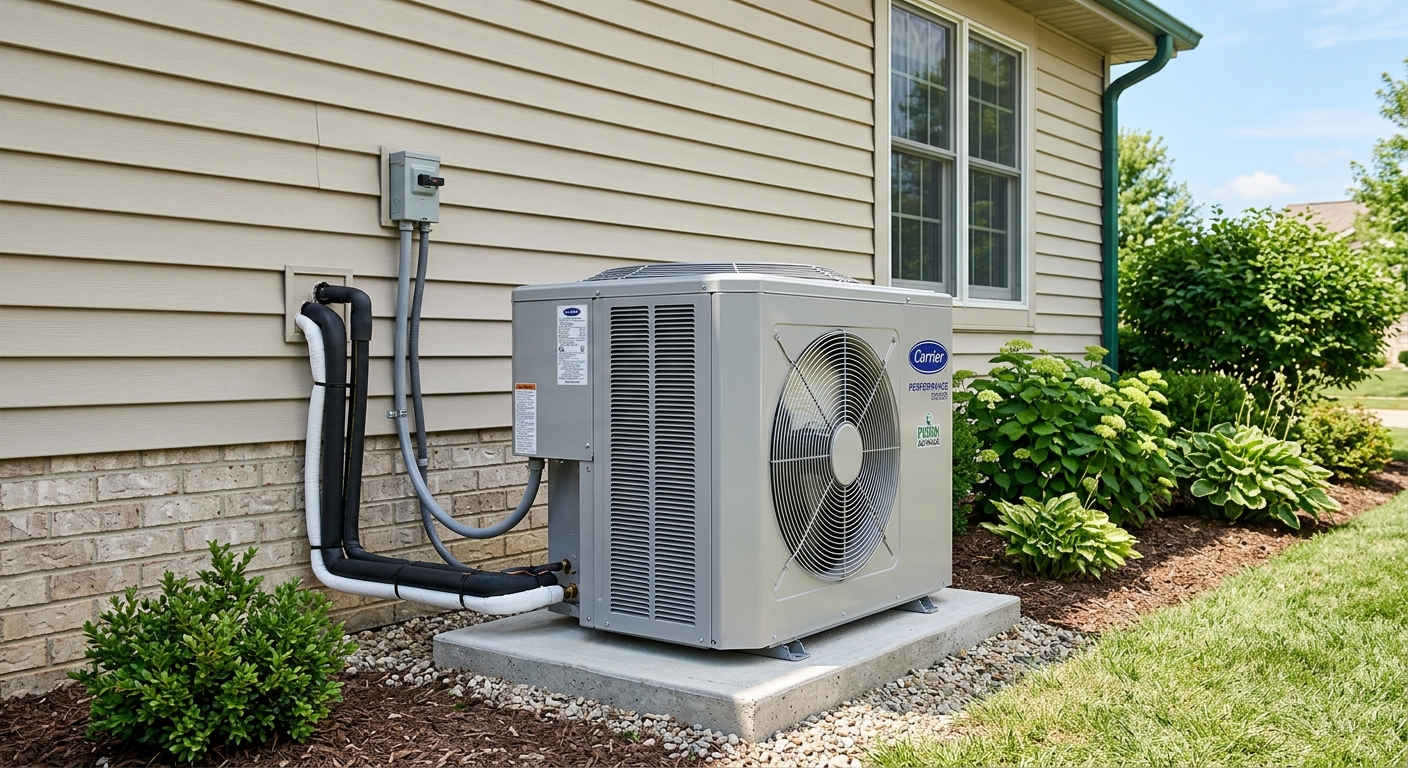
Harborcreek heating and cooling prices by system type — 2026
Harborcreek’s HVAC costs are shaped by the area’s housing stock and climate. With a homeownership rate of 78.9% and nearly 60% of homes built before 1980 (U.S. Census Bureau, ACS 2024), replacement and retrofit work make up the bulk of jobs here—not new construction. Postwar Erie County homes often need ductwork adjustments or fixes, which can drive costs above generic national averages. Many houses have aging or undersized ductwork, especially if they predate central air or haven’t been updated since the 1970s and 80s.
This is a heating-dominated region: 6,200 heating degree days dwarf the 800 cooling degree days. That means heating performance and reliability should lead your equipment decision—systems sized or selected for southern climates are a poor fit here. Air conditioning is important but secondary; your winter build quality and system type matter most. Air source heat pumps (especially cold-climate models) and gas furnaces are the key options, but ductless systems are increasingly common for older homes, additions, and rooms previously underserved by ductwork.
| System |
Best for |
Efficiency |
Price range (installed) |
| Central AC replacement (existing ducts) |
homes with sound ductwork |
16–20 SEER2 |
$4,900–$11,500 |
| Air source heat pump (ducted) |
year-round heating and cooling |
8–10 HSPF2 |
$7,800–$16,500 |
| Cold-climate heat pump (ducted) |
heat pump as primary heat |
9–11 HSPF2 |
$12,500–$16,500 |
| Ductless mini-split (single zone) |
additions, rooms without ducts |
20–30 SEER2 |
$3,100–$6,900 |
| Full duct system installation |
homes with no existing ducts |
— |
$8,800–$17,500 |
Installed estimates for a typical Harborcreek home. Equipment tonnage, duct condition and electrical capacity move these more than brand.
Repair or replace your Harborcreek system?
Most Harborcreek homeowners are best served by a practical, situational approach to HVAC repairs. Replacement isn’t always the right call, especially given the solid bones of many postwar Erie County houses. A repair is justified when the system is younger than 10 years and the issue is a single, non-critical component. Once the unit is older, or the repair cost approaches a third of total replacement (which, in Harborcreek, usually means $4,900–$11,500 for a new AC or furnace), it’s time to compare against replacement. Key points: if the compressor (on AC/heat pump) or heat exchanger (on a furnace) fails after warranty, replacement is prudent. Also, older systems running R-22 refrigerant can make even minor repairs uneconomical, as supply dwindles and costs rise. Notably, our local climate doesn’t provide huge savings from today’s extreme-efficiency upgrades; most of your operating cost is dictated by envelope and duct condition, not just the equipment’s rating. There are only two must-replace cases: a cracked heat exchanger (it’s a carbon monoxide risk), and a compressor failure past its expected lifespan.
| Situation |
Recommendation |
Typical cost |
Reasoning |
| Under 10 years, single component failure |
Repair |
$300–$1,200 |
Most parts still available; low risk of chain failures. |
| 10–15 years, repair over a third of replacement |
Consider replacing |
$4,900–$11,500 |
$1,800+ repair is hard to justify on depreciated equipment. |
| 15+ years, any major failure |
Replace |
$4,900–$11,500 |
Near end of service life—new unit brings efficiency, warranty. |
| Cracked heat exchanger, any age |
Replace immediately |
$4,900–$11,500 |
Carbon monoxide is an immediate hazard. |
| Compressor failure past warranty |
Replace |
$7,800–$16,500 |
Core of the system failed; repairs rarely make sense. |
| Working system, high bills |
Test ducts and envelope first |
$300–$800 |
Leaks and insulation gaps are the easier win in Harborcreek. |
Sizing: why bigger is worse
In Erie County, the single biggest mistake with HVAC installation is oversizing the equipment. In Harborcreek’s heating-heavy climate, bigger is not safer—it’s a guaranteed headache. When a furnace, air conditioner, or heat pump is oversized, it cycles on and off rapidly (“short cycling”), which leaves rooms unevenly heated, wears parts prematurely, and fails to control humidity properly in summer. Some homeowners believe a larger unit means more power in reserve, but with 6,200 heating degree days and a 5°F winter design temperature here, the right approach is precision, not guesswork.
The correct method is a Manual J load calculation. This process accounts for insulation, window type, floorplan, orientation, duct losses, and air leakage—not just square footage. If a contractor tells you they use a “rule of thumb” or just match the old unit’s BTUs, ask plainly: “Did you run a load calculation, and can I see the results?” Sizing from an old, possibly oversized unit only repeats past mistakes, especially in the postwar homes of Harborcreek where insulation, windows, and energy standards have improved over decades. Valid sizing will use the winter design temperature of 5°F as the foundation, ensuring the equipment reliably heats (or cools) during our worst days, without constant cycling. Proper sizing extends equipment life, saves on operating cost, and avoids uneven room temperatures—a win every way you look at it.
What a Pennsylvania HVAC contractor must hold
Pennsylvania does not issue a statewide trade license specifically for residential HVAC work. Instead, residential HVAC installation and replacements are regulated at the municipal level—each town or city may set its own permit and inspection process. In Erie County, for example, the City of Erie requires mechanical permits for new equipment or ductwork changes. Any contractor must carry a Home Improvement Contractor (HIC) registration from the Pennsylvania Office of Attorney General for jobs over $500; this is your baseline credential for legal contracting, not evidence of technical skill.
Anyone handling refrigerant in Pennsylvania needs current EPA Section 608 certification, as this is a federal requirement regardless of state or local rules. For replacement or installation jobs, municipal mechanical permits and inspections are often necessary—do not skip these to save money, as it can void your insurance or warranty. To protect yourself, verify a contractor’s HIC registration at hic.attorneygeneral.gov and check their workers’ compensation coverage status via WCAIS at wcais.pa.gov. This is your reassurance that the company has both compliance and insurance in place. If your home was built before 1978, ask about EPA Lead RRP certification, as federal law covers lead-safe practices. For almost every residential project, your due diligence matters more than the license—because in Pennsylvania, local enforcement and consumer protection statutes are what matter most.
Gas, electric or both in northwestern Pennsylvania
Few decisions matter more in Harborcreek than choosing between a heat pump and a gas furnace, or combining both. Our region sees 6,200 heating degree days and common lows to 5°F, so heating is the primary challenge—air conditioning will rarely dictate system choice except on renovation. Old advice that heat pumps “don’t work” in cold climates no longer holds: modern cold-climate models deliver steady heat well below freezing. The catch is that their capacity drops as the temperature plummets towards our design lows, which is why the dual fuel (heat pump with gas backup) option is increasingly popular here. If your insulation and air sealing (“envelope”) are good, an electric heat pump can serve year-round, but older, leakier Erie County homes often still lean on gas in deep winter.
Natural gas is widely available throughout suburban Harborcreek, but in rural zones propane or oil is common—there, the economics of switching to a heat pump improve dramatically due to the high and volatile price of delivered fuels. If you have easy access to mains gas and crave the security and recovery speed of a modern furnace, a gas furnace is still king for the coldest weeks. For anyone pursuing electrification, or those with no gas service, a ducted cold-climate heat pump is a now-viable primary system; just expect higher upfront cost. In vintage homes with no ducts, ductless mini-split systems are the answer, especially when retrofitting ductwork is disruptive or cost-prohibitive.
| Option |
Installed cost |
Operating cost here |
Best when |
Incentive eligible |
| Gas furnace + central AC |
$4,900–$11,500 |
lowest with gas service |
existing gas service, coldest zones |
partial, AC upgrades |
| Ducted heat pump (cold climate) |
$7,800–$16,500 |
competitive if envelope is good |
good envelope, all-electric goal |
full (federal + utility) |
| Dual fuel (heat pump + gas backup) |
$12,500–$16,500 |
lowest in deep cold |
gas on site, deep cold spells |
partial, heat pump upgrade |
| Ductless multi-zone |
$8,800–$17,500 |
varies by number of zones |
no ductwork, zone control |
full (federal + utility) |
What you can actually claim on a heat pump here
In Harborcreek, homeowners considering a heat pump can tap into several layers of incentives: federal, utility, and sometimes state-level programs. The federal tax credit is a reduction applied to your taxes owed for the year—meaning the benefit comes when you file, not as a discount off the invoice. By contrast, utility rebates cut the net price at the time of installation and are handled through your electric provider’s efficiency program. The key difference for your cash flow: tax credits are post-payment, rebates are up front. The main electric and gas utilities in this area are Pennsylvania Electric Company and National Fuel Gas, respectively. Both periodically offer rebates for high-efficiency heat pumps and supporting upgrades like duct sealing.
Because rebate amounts and program rules change annually, the best way to find current deals is to visit your utility’s efficiency program website or check the ENERGY STAR rebate finder. Do not rely on static numbers from articles—use these tools for up-to-date eligibility and amounts before contracting work. Federal incentives are a constant, but utility rebates can expire or change every year, so double-check before you sign. If a contractor quotes a rebate, always validate it yourself for your exact address. This approach keeps you from missing out—or planning on a discount that’s no longer available.
When ductless is the right answer
Ductless mini-split systems shine in Harborcreek where the ductwork is missing, impossible to thread, or too costly to repair. Common situations: additions above garages, attics or basements repurposed as living space, sunrooms, or older Erie County homes where the central system never truly reached every room. Postwar Erie housing stock means many Harborcreek homes still lack modern ducting or have had central air tacked on as an afterthought—making retrofits with new ducts expensive and messy.
Single-zone mini-split systems are ideal for conditioning isolated spaces: a new bedroom suite, an in-law apartment, or a finished basement. Multi-zone systems (with several indoor heads on one outdoor unit) look neater outdoors but often deliver lower efficiency than separate single-zone setups. Interior unit placement and visible lineset covers are the #1 objection—good planning can minimize the “equipment on the wall” look, but some compromise is required. Don’t overlook drainage: every head needs a clear path for condensate. For single rooms or tight retrofits, ductless usually beats running new ducts in both price and disruption. Many Harborcreek homeowners discover ductless only when a contractor explains how invasive full duct installation would be in a plaster-walled, postwar home.
Frequently asked questions — HVAC installation in Harborcreek
What does a heat pump cost installed in Harborcreek?
In Harborcreek, the installed cost of a ducted air source heat pump typically ranges from $7,800–$16,500, depending on system size, efficiency level, and whether existing ductwork is usable. For basic single-zone ductless heat pumps, it’s often $3,100–$6,900. Factors that impact cost most here are whether you need duct upgrades or electrical updates, both of which are common in local homes built before 1980 (U.S. Census Bureau, ACS 2024). Cold-climate models for primary heating usually sit closer to the upper end, especially for larger homes or projects requiring several indoor heads. Utility rebates and federal tax credits can offset these costs, but always get a contractor’s line-item estimate for your address—not an online average.
How does northwestern Pennsylvania's climate affect system sizing?
Our heating season is long and severe, with 6,200 heating degree days and an official design temperature of 5°F. This means systems must be sized for deep cold, not just average winter nights. In practical terms, a “right-sized” heat pump, furnace, or central system will cycle longer at low temperature, keeping rooms even and providing reliable output even on the worst days. Oversized units, which are common in postwar Harborcreek homes, tend to short cycle, use more energy, and wear out faster. Manual J calculations are a must—you want a system sized for local conditions, not a southern or mid-Atlantic climate. This can make a system cost more up front, but prevents the much bigger expense of uneven comfort or premature failure. For example, a system in Harborcreek might land at $7,800–$16,500 because of these higher specs.
Are duct sealing and insulation eligible for incentives?
Yes, in most cases, both duct sealing and duct insulation qualify for utility rebates in Harborcreek, because both electric and gas utilities serving Erie County participate in these programs from time to time. While federal tax credits generally favor full system replacements or upgrades (like a new heat pump at $7,800–$16,500), utilities often separate rebates for envelope improvements—including duct sealing, which is a frequent weak point in Harborcreek’s postwar homes. Always check your utility’s program website before scheduling, as rebate availability and amounts can change each year. Well-sealed and insulated ducts can deliver real comfort gains and lower operating costs, so incentives on these “invisible” upgrades are worth hunting down.
How do I verify an HVAC contractor's insurance?
In Pennsylvania—including Harborcreek—HVAC contractors must carry general liability insurance and, if they have employees, workers’ compensation coverage. You should always ask for a certificate of insurance before work begins. For an extra layer of verification, Pennsylvania maintains a workers’ compensation insurance system you can check—WCAIS at wcais.pa.gov—where you can look up a contractor’s coverage status. This protects you from liability in the event a worker is injured on your property. HIC registration (from the PA Office of Attorney General) is another legal requirement for projects over $500, including system installations that often run $4,900–$11,500 or more. Both verifications are your direct protection—never skip this step.
How often should I change my filter?
For most Harborcreek homes, changing your HVAC filter every one to three months is the right rule of thumb. Our heating-dominated climate means the blower often runs for long stretches from October through April—and older Erie County homes can kick up more dust. If you have pets, allergies, or significant renovation dust, check your filter more often. Clogged filters put extra strain on your system, shortening its life and degrading performance, which could mean needing a new system at $4,900–$11,500 much sooner than expected. Mark your calendar or set a reminder on your phone—clean filters pay for themselves in lower bills and fewer repairs. Always match the filter to your system’s blower rating, as some high-MERV filters can reduce airflow if not designed for your setup.
What is the R-410A refrigerant phase-down?
R-410A, the most common refrigerant in air conditioners and heat pumps sold in Pennsylvania for the past two decades, is being phased down under federal climate regulations. This means new models are increasingly switching to lower global-warming-potential refrigerants—especially if you’re installing a heat pump at $7,800–$16,500. Existing Harborcreek systems running R-410A can still be serviced, but prices for refrigerant and compatible equipment could rise over the years ahead. If your current system is still working well, there’s no need to rush a replacement. Just know that future repairs involving refrigerant may be more expensive or involve new protocols. Ask your contractor which refrigerant will be used in any new installation.
How far ahead should I schedule in Harborcreek?
It’s wise to start the conversation with a contractor several weeks before you need the work done, especially before peak seasons. In Harborcreek, the spring rush for air conditioning replacements (at $4,900–$11,500) and the fall scramble for new furnaces can mean booking out two to four weeks for installation. Emergency replacements can sometimes be fit sooner, but expect added travel surcharges in some areas of Erie County, particularly for after-hours calls. Early booking gives you more leverage in choosing dates and ensures proper permit and inspection processes, which Harborcreek’s enforcement offices can be strict about. Planning ahead avoids last-minute decisions and gets you the best pricing and service options.
Is a high-efficiency system worth the extra cost here?
For many Harborcreek homeowners, jumping from minimum to mid-efficiency gains you the best return—super-premium ultra-high-efficiency units often cost much more up front (closer to $16,500 for heat pumps), and in a region where most operating cost comes from our long heating season rather than humidity control, the payback can be slow. If you have leaky ductwork or an old, uninsulated crawlspace, sealing those can offer bigger year-to-year savings than chasing top-tier equipment ratings. High-efficiency is absolutely worth it in leaky, large, or poorly insulated homes, or if you plan to stay for a decade or more. For newer or better-sealed homes, stick with ENERGY STAR–rated or “sweet spot” models—don’t pay extra for efficiency you’ll never use.
Is it worth switching from oil or propane to a heat pump?
In rural parts of Harborcreek and Erie County where natural gas isn’t available, switching from oil or propane to a cold-climate heat pump nearly always lowers your long-term operating costs—even though the upfront install can reach $16,500 for a high-end system. Oil and propane prices are volatile and often much higher per BTU delivered compared to electricity. With today’s cold-climate models, heat pumps now perform well down into the low single digits, which matches our area’s 5°F design minimum. If your home is reasonably well-insulated and you want to get away from fuel deliveries, a heat pump can be a smart move. Add in incentives and rebates, and for many families, it makes more sense now than ever before.