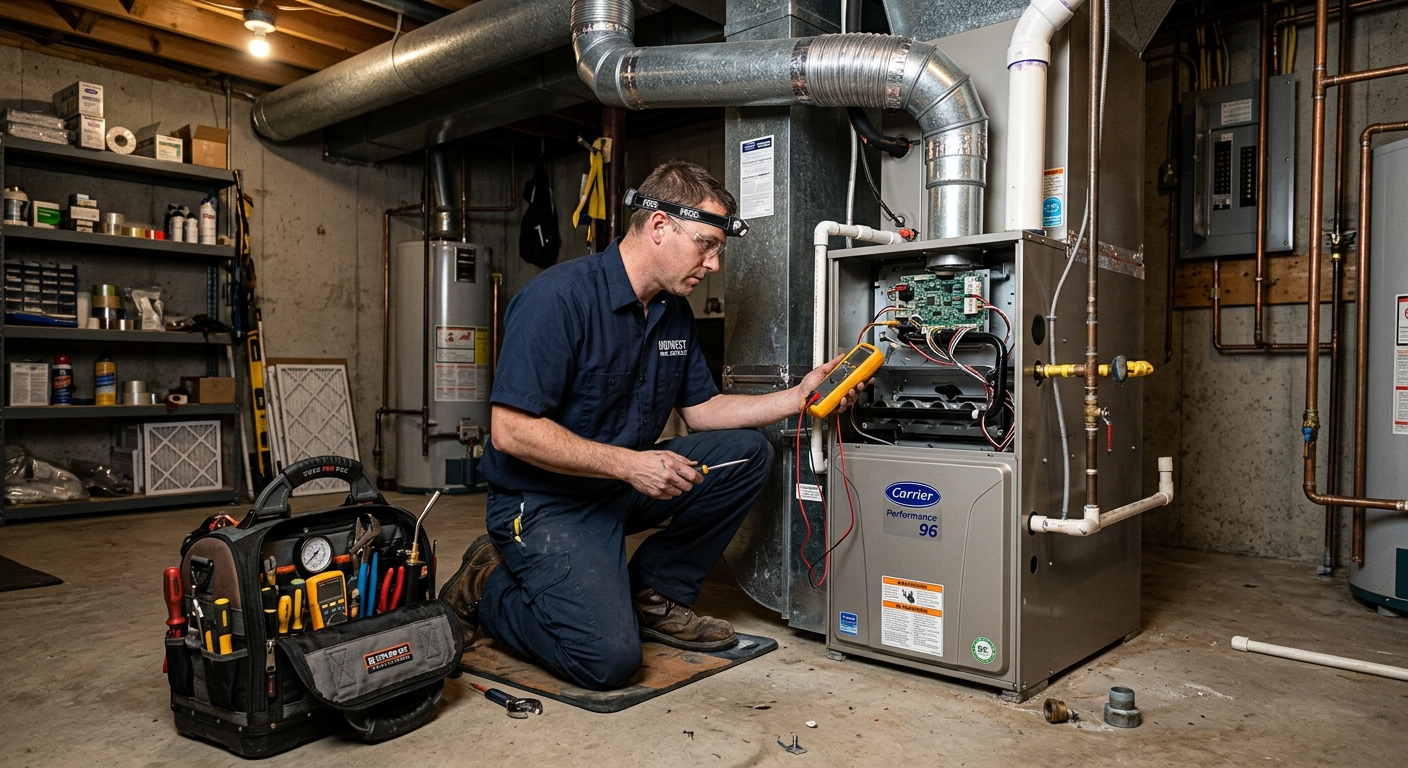
HVAC costs in Kennedy — 2026
If you own a home in Kennedy, you’re part of a market where 78.2% of residents are homeowners and 61.7% of homes were built before 1980 (U.S. Census Bureau, ACS 2024). That puts most Kennedy HVAC work squarely into the retrofit and replacement category, not new construction. Pre-1960 homes often mean tighter duct chases and electrical services that weren’t sized for modern loads, so central air upgrades, ductless systems, and ductwork improvements are common projects. Many existing houses here have older duct systems—if major duct repairs or full new ductwork are needed, that will weigh more in your job cost than brand selection will.
Kennedy’s climate is heating-dominated, with 5,600 heating degree days versus only 1,050 cooling degree days. Winters can get cold and demand consistent heat, while the hot spells are real but relatively short compared to much of the country. That’s why decisions here tilt toward robust heating—heat pumps need to be cold-climate capable to be a true furnace replacement, and central AC systems are most often found where ductwork already exists.
| System |
Best for |
Efficiency |
Price range (installed) |
| Central AC replacement (existing ducts) |
homes with sound ductwork |
16–20 SEER2 |
$5,000–$12,000 |
| Air source heat pump (ducted) |
year-round heating and cooling |
8–10 HSPF2 |
$7,900–$17,000 |
| Cold-climate heat pump (ducted) |
heat pump as primary heat |
9–11 HSPF2 |
$13,000–$17,000 |
| Ductless mini-split (single zone) |
additions, rooms without ducts |
20–30 SEER2 |
$3,200–$6,900 |
| Full duct system installation |
homes with no existing ducts |
— |
$8,900–$18,000 |
Installed estimates for a typical Kennedy home. Equipment tonnage, duct condition and electrical capacity move these more than brand.
R-410A phase-down: repair or replace?
The refrigerant transition now underway means that newly manufactured HVAC systems no longer use R-410A, replacing it with lower-GWP options like R-454B and R-32. But if your current system uses R-410A, there’s no legal requirement to replace it. You can still repair, maintain, and operate these units here in Kennedy for many years to come.
That said, as R-410A production and import are reduced, the price of the refrigerant itself is likely to inch up. This mainly affects you if your system develops a leak—paying for a recharge gets more expensive each year. For working units with no leaks, you won’t notice much day-to-day impact, aside from higher prices for refrigerant-related repairs. The real tipping point comes if you’re faced with a major leak or a compressor failure; the cost to repair may start to overlap with the cost of a modern, higher-efficiency replacement system—especially if the system is over 10 years old.
The key takeaway: there’s no push from code or regulation forcing replacement of a good R-410A system in Kennedy. Keep yours serviced and don’t replace just due to the phase-down. But, if faced with a large repair bill and a refrigerant leak, that’s when replacement becomes more financially sound in the current environment.
What you can actually claim on a heat pump here
If you install a heat pump in Kennedy, you can usually layer a federal tax credit, a local utility rebate, and in some years, a state-level program. The federal tax credit for qualifying heat pumps directly reduces what you owe in federal income tax the following year—think of it as a refund you have to wait for. A utility rebate, by contrast, is often included as a discount up front or issued as a check after installation, lowering your out-of-pocket cost right away.
Since Kennedy is served by Duquesne Light Company as the electric utility and Peoples Gas for natural gas, start your search for rebates on each of their official energy efficiency program pages. These rebate amounts and eligibility criteria change year by year. The best move is to check your utility’s current residential rebate offerings and cross-search them on the ENERGY STAR rebate finder, which aggregates offers by zip code. Do not rely on rebate numbers in advertisements or general articles—you want the application form and the fine print from your own provider.
While some years bring extra state-level incentives, in Allegheny County there isn’t a standing state rebate for heat pumps. Double-check just before you commit; these programs frequently change with funding cycles. The only thing standardized is the process: federal credits follow your tax filing, utility rebates reduce your immediate invoice, and both require compliance paperwork to claim.
Mechanical permits for HVAC work in Kennedy
Pennsylvania doesn’t issue statewide HVAC trade licenses for residential contractors. Instead, you need to check that your contractor has a valid Home Improvement Contractor registration issued by the Pennsylvania Office of Attorney General if your project is over $500. Mechanical permit requirements are set at the municipal level for residential work in Kennedy, enforced according to the Pennsylvania Uniform Construction Code (UCC), which is based on the IRC. For projects within the City of Pittsburgh, any new HVAC system installation, replacement, or major alteration requires a permit and inspection from the city’s Department of Permits, Licenses, and Inspections.
Any technician working with refrigerants must carry a federal EPA Section 608 certification. This is non-negotiable no matter where you are in Pennsylvania. You can check for active workers’ compensation coverage for any HVAC contractor through WCAIS (wcais.pa.gov) and verify their Home Improvement Contractor registration at the Attorney General’s online portal. Always require a written contract for projects over $500, in line with Pennsylvania’s Home Improvement Consumer Protection Act, which also provides a three-day cancellation window. If your home was built before 1978, EPA Lead RRP rules apply for any work that may disturb paint surfaces—contractors should supply proof of their renovator certification if your project falls into that category.
Keeping a Kennedy system running
The basics that keep an HVAC system in Kennedy working: change your filter on time, at the right MERV rating. Most older blowers in Allegheny County don’t do well with ultra-high MERV filters—unless your installer says otherwise, stick with MERV 8, swapped out every 2–3 months. Keep outdoor condenser coils and indoor evaporator coils clean. Clear your condensate drain before cooling season, since clogged lines are a top cause of summer service calls in this region.
One thing that isn’t real maintenance: “topping off” refrigerant. If your system needs refrigerant every year, there’s a leak. A qualified contractor in Kennedy will pressure test, find, and fix the leak—not just add more.
Annual “tune-up” plans can be good value if they promise real maintenance—filter changes, coil cleaning, charge checks, and drain clearing. If it’s only a basic visual inspection, you’re paying for a feel-good visit. Avoid plans locking you into expensive emergency rates. Schedule your tune-up for spring or early fall, before the first real heat or cold snap. That’s when you’re least likely to be stuck waiting during a busy period filled with emergency break-fix calls.
When an HVAC repair stops being worth it
You don’t need to replace every aging HVAC system in Kennedy at the first sign of trouble. The deciding factors are age, repair cost, and the type of failure. For a system under 10 years old with a single faulty component, repair is usually the sensible decision. If a repair will cost a third or more of a full replacement and your system is already 10–15 years old, it pays to compare replacement costs—especially if you’re facing rising utility bills or the refrigerant is growing expensive.
The two situations where replacement isn’t negotiable: a cracked heat exchanger (for safety reasons), or a failed compressor on an out-of-warranty system past its expected life. Otherwise, weigh whether higher efficiency will realistically pay back the investment in Kennedy’s climate. With 5,600 heating degree days and just 1,050 for cooling, bigger efficiency gains make sense on the heating side, much less so on just AC upgrades.
| Situation |
Recommendation |
Typical cost |
Reasoning |
| Under 10 years, single component failure |
Repair |
$300–$1,200 |
Most parts are still available and the system has usable life left. |
| 10–15 years, repair over a third of replacement |
Consider replacing |
$5,000–$12,000 |
Major repairs make less sense as a system ages near end-of-life. |
| 15+ years, any major failure |
Replace |
$5,000–$12,000 |
Older systems lose efficiency and reliability; parts may be obsolete. |
| Cracked heat exchanger, any age |
Replace immediately |
$5,000–$12,000 |
Safety issue: risk of carbon monoxide, cannot be repaired. |
| Compressor failure past warranty |
Replace |
$7,900–$17,000 |
Repairs are rarely cost-effective on older, out-of-warranty compressors. |
| Working system, high bills |
Test ducts and envelope first |
$300–$800 |
Many times, leaks in ducts or the house envelope are the bigger culprits. |
Sizing: why bigger is worse
Getting the right size HVAC system is life or death for comfort and reliability in a Kennedy home. Oversized systems are not a bonus—they’re a problem. Too large a furnace or air conditioner short cycles, never runs long enough to dehumidify in summer, causes uneven temperatures from room to room, and actually shortens equipment lifespan. Bumping up a half-ton “for peace of mind” is a myth; it’s a design flaw.
The only proper way to size a new system is with a Manual J load calculation, which accounts for insulation, window area, house orientation, duct quality, and much more. Rules of thumb based on square footage miss key local realities. In Kennedy—with many homes built before 1980 and insulation levels all over the map—relying on rules of thumb or what the old unit was rated for means repeating someone else’s guess, not right-sizing for today’s conditions.
The Manual J calculation is always referenced against local extremes—here, the winter design temperature is 8 °F, so your new system must be able to heat your house reliably into single digits without oversizing. If you’re considering a new install or replacement, always ask: “Did you run a Manual J load calculation, and can I see it?” If not, you’re risking both comfort and hundreds of dollars in wasted energy or unneeded repairs down the road.
Frequently asked questions — HVAC installation in Kennedy
How long does HVAC installation take in Kennedy?
Most standard HVAC replacements in Kennedy—like swapping out a central AC on good existing ducts—take a day or less for a seasoned crew. When ductwork modifications are needed, plan for two to three days, especially in pre-1960 homes where tight spaces and unforeseen wiring surprises slow things down. Full duct system installations stretch out to three to five days. If you’re adding a ductless mini-split in one zone, that’s usually done in a half-day. Permitting from Pittsburgh’s Department of Permits, Licenses, and Inspections can add a few days or a week, since sign-off is needed before the final start-up. Budgeting a realistic timeline helps prevent frustration. Remember, a full duct install or complicated retrofit might land in the $8,900–$18,000 range in this part of Allegheny County.
Is a heat pump a good choice for Kennedy winters?
In Kennedy’s heating-dominated climate—where winter design temperatures can reach 8 °F—a standard air-source heat pump can work, but only if it’s cold-climate rated. Modern cold-climate heat pumps maintain usable heat output below freezing and right through those bitter cold snaps. Historically, older models would “give up” and needed backup heat. Now, properly sized ducted units can be a true primary heat source for most homes, especially if you have decent insulation. Upfront, a quality ducted cold-climate heat pump here will likely run $13,000–$17,000 installed, but the year-round performance and efficiency gains, plus federal and utility incentives, make them a real contender against gas and oil heat. If you’re unsure, ask for a Manual J load and check whether the unit keeps your house warm even at those local lows.
How much does a new HVAC system cost in Kennedy?
For most Kennedy homeowners, the installed cost of a new HVAC system ranges from $5,000–$12,000 for central AC replacement (if ducts are in good shape), and from $7,900–$17,000 for a fully installed ducted heat pump system. Ductless mini-split systems (single zone) are typically $3,200–$6,900. Full new ductwork adds considerably—often another $8,900–$18,000 if you’re starting from scratch. Factors that shape your price: age and condition of existing ductwork, electrical upgrades, equipment efficiency, and any unique retrofit challenges common in Kennedy’s older housing stock.
How is a tax credit different from a rebate?
In Pennsylvania and for Kennedy homeowners, a tax credit is an amount that directly reduces the federal tax you owe when you file next year. For example, if you install a qualifying heat pump system for $13,000 and qualify for a $2,000 tax credit, your tax bill is reduced by $2,000, but you pay full price up front. A rebate, at least from the utility, is taken off your install price or paid to you soon after by check—in most cases, you see the benefit right away. That’s why it’s smart to check Duquesne Light Company and Peoples Gas rebate webpages and the ENERGY STAR rebate finder before you start your project. Tax credits and rebates together can help offset a significant portion of your initial investment, but their timing and process are different.
How long should an HVAC system last in Kennedy?
Most central air conditioners, heat pumps, and furnaces in Kennedy can be expected to last 12–18 years, depending on system quality, proper sizing, and regular maintenance. The region’s heavy freeze-thaw cycles and older ducts in pre-1980 homes place extra strains on systems. If you keep up with filter changes, coil cleaning, and drain checks, you’ll usually get the high side of that range. When you’re looking at major repairs on systems 15 years or older—repairs that reach into the $5,000–$12,000 bracket—it’s often smarter to replace, especially as new equipment can offer better efficiency and comfort.
Does Pennsylvania license HVAC contractors?
Pennsylvania does not issue a trade license specifically for HVAC at the statewide level for residential work. Instead, residential HVAC in Kennedy is regulated by municipal mechanical permit requirements and the Pennsylvania Uniform Construction Code (UCC). Any contractor working on your job for more than $500 must have a valid Home Improvement Contractor registration, which you can verify at the state Attorney General’s portal. In Pittsburgh and surrounding municipalities, always make sure your contractor pulls the proper permits. A typical central AC replacement here runs $5,000–$12,000, so you want it installed to code and properly inspected.
Is a high-efficiency system worth the extra cost here?
High-efficiency systems—such as 20 SEER2 central AC units or heat pumps with HSPF2 above 10—can be worth the investment for Kennedy homeowners, but only if your home is reasonably tight and your utility bills are high from older, inefficient equipment. With just 1,050 cooling degree days per year and much more heating needed, upgrading for cooling efficiency alone won’t always pay back quickly. For heating, high-efficiency options like a heat pump might cost you $13,000–$17,000, but if you’re replacing outdated oil or electric resistance heat, the utility savings over time justify the added cost. Always have your ducts and insulation assessed to get the real value from premium systems.
What is a Manual J load calculation?
A Manual J load calculation is a detailed engineering process that measures how much heating and cooling your specific Kennedy home requires at peak conditions—8 °F for winter in this area. It factors in home size, insulation, window area, orientation, occupant load, and duct losses. This mathematical approach is the only way to reliably size a system—estimating by square footage or using the old equipment size often leads to oversizing, which causes short cycling and comfort problems. If you’re investing $7,900–$17,000 in a system, always insist on seeing the Manual J report before signing the contract. It’s your best insurance against a lifetime of noisy, unreliable, or expensive heating and cooling.
How cold does it get in Kennedy and does that affect heat pumps?
Kennedy’s winter design temperature is 8 °F—meaning we size heating equipment to keep you warm even when it’s just above zero outside. This matters for heat pumps, since older models struggled to deliver usable heat at those temps. Today’s cold-climate heat pumps are rated to produce heat efficiently even down to and below 8 °F, making them a genuine alternative to gas or oil heat for most homes in Allegheny County. Expect to pay $13,000–$17,000 for a high-performing ducted heat pump that delivers at low temps. Always ask about cold-weather performance data, not just “nominal” efficiency, to be sure it will suit a Kennedy winter.