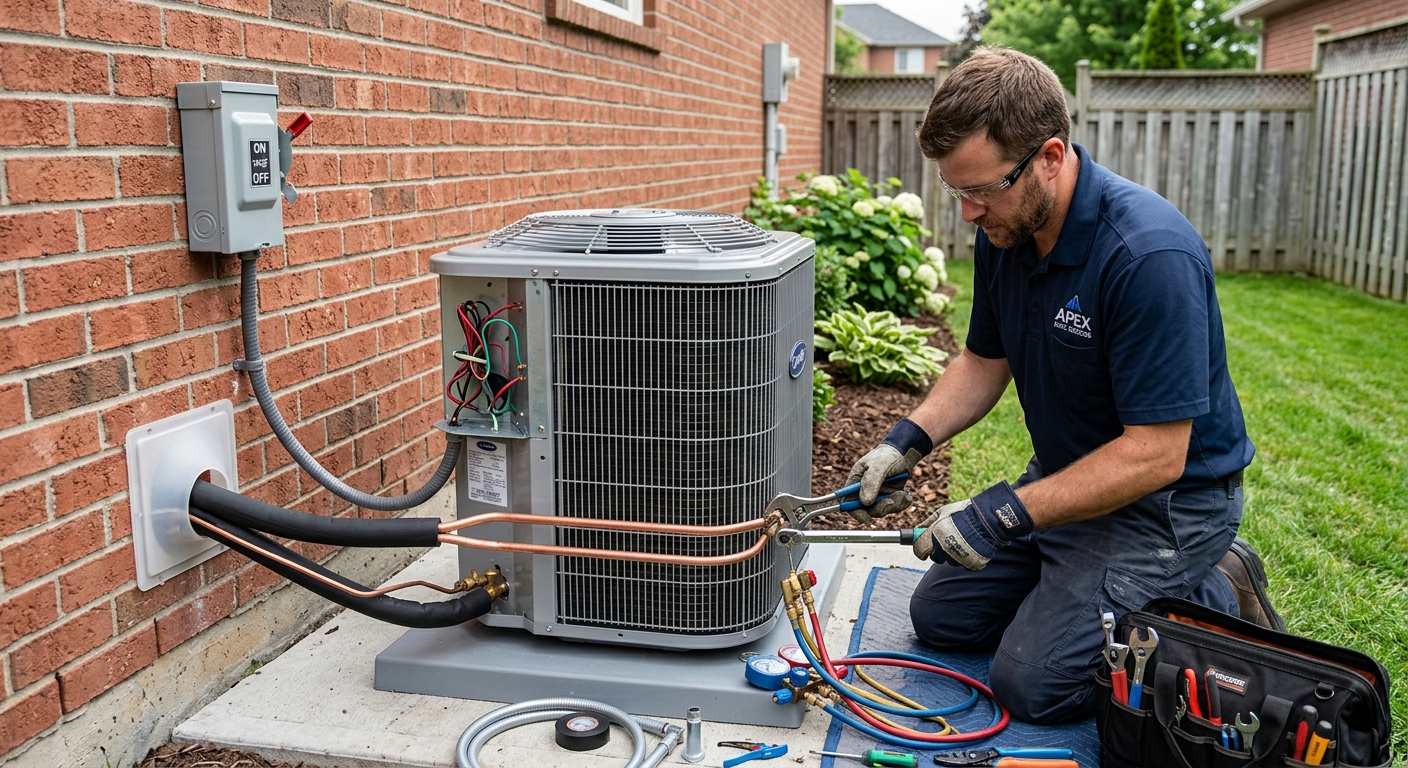
Carroll heating and cooling prices by system type — 2026
Carroll’s heating and cooling prices reflect two key facts: nearly 83% of homes are owner-occupied, and just under 70% were built before 1980 (U.S. Census Bureau, ACS 2024). This means most projects here are system replacements or ductwork retrofits, not first-time installs. Post‑1960 split-level homes in Peters and North Strabane, which make up a large share of the area, often have older or makeshift ductwork that doesn’t meet today’s standards for airtightness or airflow—making duct assessment a real driver of total project cost.
With 5,600 heating degree days versus just 1,050 cooling degree days, southwestern Pennsylvania’s climate is heating-dominated. Winter temperatures averaging 8 °F for design mean that any central system—furnace or heat pump—must primarily answer for heating performance and reliability, not just summer comfort. In many Carroll homes, especially those with older ducts or no gas service, these numbers tilt the favor toward heat pumps if the envelope is tight enough and the electric panel can handle the load.
| System |
Best for |
Efficiency |
Price range (installed) |
| Central AC replacement (existing ducts) |
homes with sound ductwork |
16–20 SEER2 |
$4,800–$11,500 |
| Air source heat pump (ducted) |
year-round heating and cooling |
8–10 HSPF2 |
$7,700–$16,500 |
| Cold-climate heat pump (ducted) |
heat pump as primary heat |
9–11 HSPF2 |
$12,500–$16,500 |
| Ductless mini-split (single zone) |
additions, rooms without ducts |
20–30 SEER2 |
$3,100–$6,700 |
| Full duct system installation |
homes with no existing ducts |
— |
$8,700–$17,500 |
Installed estimates for a typical Carroll home. Equipment tonnage, duct condition and electrical capacity move these more than brand.
What each system actually costs to run in Carroll
To figure operating costs in Carroll, you need three things: efficiency, climate, and your real electric rate. West Penn Power serves most households in this area, so start with your “price per kWh” from your bill (usually listed as “total charges divided by total kWh”).
First, let’s talk efficiency ratings. SEER2 and HSPF2 measure seasonal performance for cooling and heating—higher is better. For heating, HSPF2 tells you how much heat energy you get per unit of electricity used. For example, a heat pump rated at 9 HSPF2 delivers 9 BTUs of heat per watt-hour. If your home needs 30,000,000 BTUs (about what 5,600 heating degree days mean for a well-insulated Carroll home), and your heat pump is 9 HSPF2, you’d need about 3,333,333 watt-hours, or 3,333 kWh, for the year.
If you pay $0.15 per kWh (use your own bill), that’s 3,333 kWh × $0.15 = $500 for heating. Compare that to a gas furnace: multiply your annual BTU need by the efficiency of your furnace (say 90%), and divide by the BTU value of natural gas. Then multiply by your “cost per therm” from the gas bill. If your ducts are leaky, both numbers get worse in a hurry—by 10% to 30% or more lost to attics, basements, or crawlspaces.
A high-efficiency system installed on poorly sealed or undersized ductwork loses its advantage: money spent on a top-tier unit is wasted if the delivery system leaks it straight out. Check duct sealing and insulation before counting on published system ratings to deliver savings in Carroll.
Mini-splits and zoning in Carroll homes
Ductless mini-splits solve real problems in Carroll’s housing stock, especially in homes built before central air was common. Many split-levels and older homes in the area have additions, attic rooms, or converted basements where extending old ductwork is costly—or simply doesn’t work. For these cases, a single-zone mini-split, at $3,100–$6,700 installed, delivers targeted heating and cooling without turning the rest of the house into a construction site.
Multi-zone systems allow several indoor heads to run off one outdoor unit. While that looks tidy, efficiency often suffers—each zone can’t ramp as low as a separate single-zone system, and the system may short-cycle. Placement of the indoor heads matters for comfort and aesthetics; some hate the look of the wall unit, but there are low-profile floor and ceiling cassettes. Condensate drainage needs to be planned so you aren’t left with a line running halfway across your finished basement wall.
Carroll’s housing—much of it split-level or retrofit-heavy—makes mini-splits a real contender for spot conditioning. Retrofitting ducts often costs more and gives less control than ductless. Many homeowners here don’t realize their house is a natural fit for a ductless system until they see the cost and disruption of redoing old ducts from the 1960s or ‘70s.
Mechanical permits for HVAC work in Carroll
Pennsylvania does not issue a statewide HVAC contractor license for residential work. Residential regulation is handled at the municipal level, not by the state, so check with your local township or borough in Washington County. For central HVAC installs and ductwork in Carroll, a mechanical or building permit is typically required—especially in Washington and neighboring townships.
All contracts over $500 must be done by a contractor registered with the state’s Home Improvement Contractor system, so always verify HIC registration before work begins. Proper workers’ compensation insurance is mandatory for all employers in Pennsylvania; you can confirm coverage through the WCAIS system. EPA Section 608 certification is a federal requirement: anyone who handles refrigerant must hold it, regardless of experience or business size—so if someone proposes installing or repairing a heat pump or AC, ask for this credential.
Permits trigger inspections, which protect you as a homeowner and ensure your system meets local code for safety, electrical, and venting. Skipping this step leads to headaches during resale or a warranty claim—not worth the risk for the cost involved.
Heat pump or furnace: what makes sense in Carroll
Carroll’s winter design temperature of 8 °F and a hefty 5,600 heating degree days mean heating is the main event every year. Modern cold-climate heat pumps can heat efficiently even below freezing, and their useful capacity drops slower than old units—though it still falls with the mercury. The “heat pumps don’t work here” line that was true decades ago just isn’t these days. But at deep-winter lows, gas furnaces and dual fuel systems (which switch seamlessly from electric to gas) still offer more capacity per dollar—especially in parts of Carroll where natural gas is widespread, like Washington, Canonsburg, and Peters Township.
In rural areas without gas mains, propane and oil remain options, but at much higher and less stable prices. Here, a heat pump—especially if paired with envelope improvements—may win on both cost and comfort. If you have old, leaky ducts or a poorly insulated house, neither system runs at its published efficiency, and dollars are lost to the crawlspace in either case.
Furnaces are still the right call if your system must deliver full heat during polar vortex spells, or where gas is cheap and reliable. For most others, a cold-climate heat pump—possibly with emergency electric or gas backup—is a serious contender.
| Option |
Installed cost |
Operating cost here |
Best when |
Incentive eligible |
| Gas furnace + central AC |
$4,800–$11,500 |
lower with existing gas |
existing gas service, coldest zones |
sometimes |
| Ducted heat pump (cold climate) |
$7,700–$16,500 |
lower if house is tight |
good envelope, all-electric goal |
often |
| Dual fuel (heat pump + gas backup) |
$12,500–$16,500 |
lowest in mixed-use, deep cold spells |
gas on site, deep cold spells |
often |
| Ductless multi-zone |
$8,700–$17,500 |
varies by zoning and insulation |
no ductwork, zone control |
sometimes |
The decision point on an aging system
Most Carroll homeowners are in homes old enough that replacements are common, not the exception. Still, “repair” is the right call much of the time. If your system is under 10 years old and the failure is a single part—like a blower motor or board—a repair in the $300–$1,200 range makes sense. Once a unit hits 10–15 years, if the repair estimate is over one-third of a new system—say, north of $4,800–$11,500—it’s time to weigh efficiency gains and risk of future big failures. Beyond 15 years, especially with anything major like a compressor or heat exchanger, replacement becomes likely.
Some repairs just aren’t optional. A cracked heat exchanger is a safety issue—carbon monoxide risk—and if your compressor fails after warranty, replacement is almost always the better value. Don’t let “high bills” drive a replacement decision automatically—bad ducts or attic insulation can mimic a dying system’s symptoms, and they cost far less to fix. Only replace for efficiency if you’ll recoup the difference in a reasonable time, considering our heating-dominated climate and moderate electric rates.
| Situation |
Recommendation |
Typical cost |
Reasoning |
| Under 10 years, single component failure |
Repair |
$300–$1,200 |
Part cost is low; system has life left |
| 10–15 years, repair over a third of replacement |
Consider replacing |
$4,800–$11,500 |
Older unit, replacement can be smarter investment |
| 15+ years, any major failure |
Replace |
$4,800–$11,500 |
Long-term reliability not worth the patch |
| Cracked heat exchanger, any age |
Replace immediately |
$4,800–$11,500 |
Carbon monoxide hazard makes usage unsafe |
| Compressor failure past warranty |
Replace |
$7,700–$16,500 |
Repair cost nears or exceeds new system |
| Working system, high bills |
Test ducts and envelope first |
$300–$800 |
Duct leakage or poor insulation is a cheaper fix |
Humidity and air quality in Carroll homes
Carroll sits in a climate where winters are dry, thanks to 5,600 heating degree days, and summers bring sticky air that needs real dehumidification. The most common air quality and comfort issues here aren’t addressed with expensive add-ons: it’s poorly sized or leaky ducts, or an oversized air conditioner that short-cycles without fully dehumidifying.
For winter dryness, a whole-house humidifier can help, but it comes with maintenance—standing water left in the system leads to mineral buildup and, in worst cases, mold. Properly sized and set up, they add comfort, but many are sold to solve problems that actually trace to air leaks or insulation gaps. For summer, a right-sized cooling system pulls both heat and humidity. Oversized units finish cooling before pulling out enough moisture, leaving the house feeling clammy on humid Carroll nights.
Air filters rated MERV 8–11 are a good balance—higher ratings can choke airflow, especially on older blowers (common in homes from the ‘60s and ‘70s). New, tightly sealed homes may need mechanical ventilation to avoid stale air—but most in Carroll don’t qualify as “tight” unless recently remodeled. Skip pricey purification add-ons and instead invest in duct sealing and routine filter changes.
Frequently asked questions — HVAC installation in Carroll
What is a Manual J load calculation?
Manual J is the industry-standard method for determining the heating and cooling load of a home in Carroll or anywhere else. It factors in the square footage, insulation levels, window quality, air leakage, orientation, and even occupancy. Why does this matter in Carroll? Many homes here, especially those built before 1980, have insulation or window upgrades—or sometimes, none at all. Without a load calculation, you risk oversizing: for example, picking a 4-ton unit instead of a 2.5-ton, which costs more to run and dehumidifies poorly on humid summer days. A reliable contractor will perform a Manual J or equivalent before recommending new equipment. It’s the best way to make sure you’re not spending $4,800–$11,500 on a system that’s the wrong size and will underperform from day one.
How long should an HVAC system last in Carroll?
In Carroll, the expected service life for a central HVAC system is usually 15–20 years with routine maintenance. Our heating-dominated climate (lots of hours running the system deep into March and even April) can be harder on components than in a milder region. Older equipment, especially those installed before energy code improvements, may only reach the lower end of that range. If your system works reliably past 18 years, you’re beating the local odds. When repairs start to stack up close to $4,800–$11,500, it’s time to look at replacement. Keeping up with filter changes, annual professional maintenance, and prompt small repairs can all help you get the most from your HVAC investment in Carroll.
Do I need to be home during installation?
It is recommended, though not strictly required, to be home for at least the start of an HVAC installation in Carroll. You’ll likely need to review the placement of equipment, discuss any concerns with the crew chief, and sign key documents for permits and warranties. Many Carroll homeowners prefer to be present for the initial walk-through and again during final inspection—especially when making decisions about things like thermostat location or confirming that a mini-split head won’t be an eyesore in your bedroom. Most jobs, like a central AC replacement in the $4,800–$11,500 range, take one full day; larger projects can stretch to two or more. Secure pets, clear access to work areas, and make arrangements for children’s safety.
Do older Carroll homes need ductwork replaced?
Many Carroll homes, especially those built before 1980, have ductwork that was never designed for modern high-efficiency systems. Leaky, undersized or poorly insulated ducts waste a significant share of heating and cooling energy—sometimes up to a third. That said, outright duct replacement isn’t always required. Often, professional sealing, minor resizing, and insulation (costing $300–$800) is enough to bring airflow and efficiency up to par. Full ductwork replacement, which runs from $8,700–$17,500, makes sense if your ducts are inaccessible for repair, made of asbestos-lined materials, or simply can’t deliver enough air for a new central system. An honest contractor will test duct tightness before recommending full replacement.
Should I repair or replace my HVAC system in Carroll?
You should generally repair if the fix is under a third of replacement cost and your system is under 12 years old—say, a $500 control board on a five-year-old AC. Replace if the unit is past 15 years and the repair is big (compressor or heat exchanger failures). In Carroll’s climate, payback on high-efficiency equipment isn’t always fast, especially if your ducts and insulation are poor—those should be addressed before sinking $7,700–$16,500 into new gear. Two situations demand immediate replacement: a cracked heat exchanger, which is a carbon monoxide risk, and a major refrigerant leak from an obsolete system. Otherwise, prioritize repairs and upgrades that solve airflow or energy loss first.
How is a tax credit different from a rebate?
A tax credit reduces your federal or state tax owed dollar-for-dollar, but you won’t see that until you file your tax return—sometimes as much as 12 months later. Rebates, by contrast, are cash-back offers (from manufacturers, utilities, or government programs) that usually arrive within weeks of installation. Carroll homeowners installing a new cold-climate heat pump ($12,500–$16,500) may qualify for both, but they’re separate and stack differently. Always file the paperwork for both, but don’t count rebates in your contractor payment—they come after. Credits may be subject to income restrictions or lifetime limits; your installer won’t have control over IRS rules or state policy shifts.
Is a high-efficiency system worth the extra cost here?
Sometimes. In Carroll, heating is more important than cooling due to our 5,600 heating degree days. A high-efficiency furnace or heat pump (16+ SEER2 or 9+ HSPF2) will cut bills the most if your house is tight and your ductwork sealed—especially if you expect to stay at least 7–10 years. If your ducts leak or your insulation is poor, the benefits shrink fast. Spending an extra $2,000–$4,000 on an ultra-high-SEER AC makes less sense given our mild cooling season; for heating, however, payback can be faster, especially with rising electric or propane rates. Ask your contractor for estimated savings based on your real utility bills to judge return-on-investment.
What is EPA Section 608 certification?
EPA Section 608 certification is a federal requirement for anyone handling refrigerants—in Carroll and across the country. It’s not an optional credential, and Pennsylvania recognizes its authority. The EPA issues different types for appliance categories; your HVAC installer should have Type II or Universal for central systems. This certification ensures technicians know how to safely reclaim, recycle, and dispose of refrigerants, which are potent greenhouse gases. If your installer lacks this, they’re working illegally and you risk voiding warranties or triggering insurance problems. Ask to see proof—especially if you’re investing $7,700–$16,500 in a new AC or heat pump replacement.
Why do HVAC quotes in Carroll vary so much?
Quotes in Carroll can swing widely—sometimes from $4,800–$11,500 for the same-looking AC system. The reasons come down to duct condition, permit requirements, equipment brand and features, and especially the quality of installation. Many homes here have retrofit ductwork needing repair or sealing, which some contractors include and others skip. Smaller operators might bid low but leave out crucial work (like new disconnects or deeper warranty coverage). In Carroll’s moderate-competition market, it also pays to look for established contractors with HIC registration, proper insurance, and EPA certification—even if the price is higher. Outlying townships might add travel or permit fees. Always read scopes of work closely and ask what’s included.