HVAC Contractor
Pennsylvania
For Moon homeowners needing heat pump installation, our contractor partners provides licensed PA technicians. Central air systems — AC from $4871. No-obligation quote available.
Several HVAC estimates requested this week in Moon
Moon Housing Data — ACS 2024
Homeowners
7,943
owner-occupied units
Ownership rate
78%
of households own their home
Single-family homes
70%
of housing units
Median household income
$101,047
annual (ACS estimate)
COST RANGE
Estimates based on home size, system type, efficiency rating and installation complexity
Insurance tip: Most homeowner policies cover sudden damage. Ask your contractor about documentation to maximize your claim.
* Estimates for Moon, Pennsylvania. Final pricing after on-site assessment.
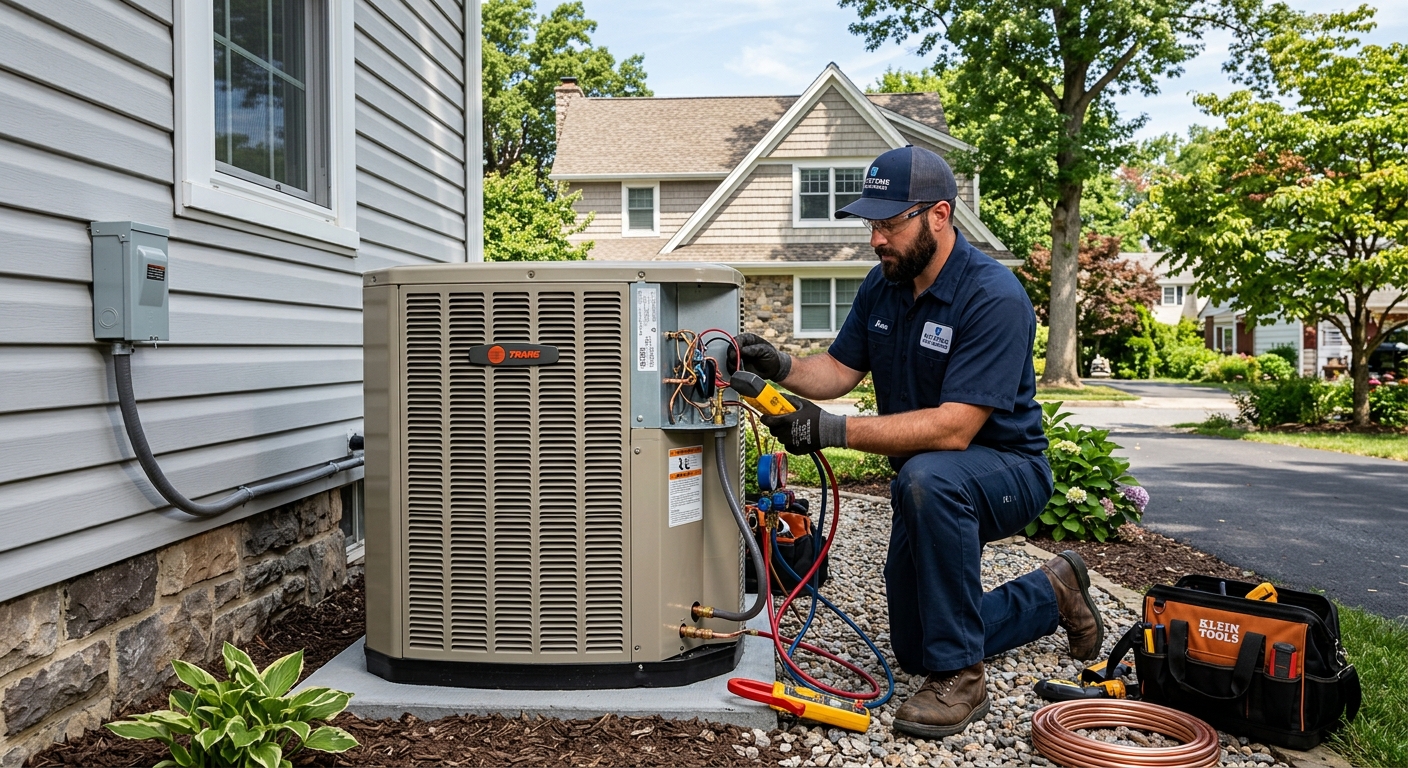
Modern heat pump systems provide efficient heating and cooling for Moon homes. Our contractors install top-brand systems with proper refrigerant charging, electrical connections and thermostat setup. Cold-climate heat pumps rated for PA winters now available.
Complete central air conditioning installation for Moon homes. Our licensed HVAC contractors size and install the right system for your home — outdoor condenser, air handler, refrigerant lines, thermostat and ductwork connections. Most jobs completed in 1 day.
Emergency and scheduled AC repair for Moon homeowners. Our technicians diagnose refrigerant leaks, compressor issues, thermostat failures and electrical problems. Same-day service available during heat emergencies.
Ductless mini-split installation for Moon homes without existing ductwork, room additions, garages and home offices. Multi-zone systems available — heat and cool specific areas independently.
High-efficiency gas furnace replacement by licensed Moon HVAC contractors. Proper sizing (Manual J load calculation), venting, thermostat installation and permit pulling. 96%+ AFUE models available for maximum savings on PA heating bills.
Ductwork installation, sealing and replacement by licensed Moon HVAC contractors. Properly designed and sealed duct systems improve efficiency by 20-30% and eliminate hot/cold spots throughout your home.
Whole-home air purifiers, humidifiers, dehumidifiers and UV germicidal lights installed by licensed Moon HVAC contractors. Improve air quality, reduce allergens and protect your HVAC equipment.
Annual HVAC tune-up and maintenance by certified Moon technicians. AC tune-up before summer, furnace check before winter — extends equipment life, improves efficiency and catches problems before costly breakdowns.
Moon is a predominantly homeowner community, with a homeownership rate of 78.1% and a median household income that supports long-term property investments (U.S. Census Bureau, ACS 2024). Over half of homes in Moon were built before 1980, and that usually means either retrofitting older ductwork or working around tight mechanical spaces. If you live in a pre-1960 house, it’s common to find undersized or poorly sealed ducts and older electrical service panels. These realities make replacements and retrofits more involved and sometimes more expensive than in newer builds.
The climate here is clearly heating-dominated, with 5,600 heating degree days and only 1,050 cooling degree days per year. That’s why the bulk of HVAC spending in Moon goes toward heating solutions or systems that prioritize cold-weather performance. Cooling is important, but never the primary design factor—your system selection and sizing should reflect those priorities. For many Moon homes, investing in heating performance pays off far more than maximizing cooling efficiency.
| System | Best for | Efficiency | Price range (installed) |
|---|---|---|---|
| Central AC replacement (existing ducts) | homes with sound ductwork | 16–20 SEER2 | $5,400–$13,000 |
| Air source heat pump (ducted) | year-round heating and cooling | 8–10 HSPF2 | $8,600–$18,000 |
| Cold-climate heat pump (ducted) | heat pump as primary heat | 9–11 HSPF2 | $14,000–$18,000 |
| Ductless mini-split (single zone) | additions, rooms without ducts | 20–30 SEER2 | $3,400–$7,500 |
| Full duct system installation | homes with no existing ducts | — | $9,600–$19,500 |
Installed estimates for a typical Moon home. Equipment tonnage, duct condition and electrical capacity move these more than brand.
Not all HVAC quotes are meaningful for comparison. In Moon, a detailed quote should break down both the equipment and the work itself. Insist on model numbers for both indoor and outdoor units—a mismatched pair may not deliver its advertised efficiency or comfort, and can affect warranties. The quote should state the system tonnage and attach a load calculation, not just pick the size of your old equipment. It must cover ductwork inspection, with details on sealing or modifications required. Any line set replacement or documented reuse should be included. Electrical work, especially in older homes, must be specific: will they upgrade the breaker or the panel if needed?
You should see a section on the condensate drain, new or existing thermostat, and confirmation that the municipal permit cost is included if required. Once installed, a proper commissioning with documented airflow and refrigerant charge—called a startup report—proves the install was done right. Finally, clarify the labor warranty, since it's different from the manufacturer's equipment warranty.
A quote that names only a brand and a price is not really a quote—it's a placeholder and impossible to compare meaningfully.
| Line item | What to look for | Red flag if… |
|---|---|---|
| Equipment | model numbers, indoor and outdoor matched | brand name only |
| Sizing | load calculation attached | matched to the old nameplate |
| Ductwork | condition assessed, sealing scoped | not mentioned |
| Electrical | circuit and panel capacity confirmed | assumed adequate |
| Line set | replaced or documented as reused | silent |
| Commissioning | measured airflow and charge, documented | no startup report |
| Warranty | labour years stated separately | manufacturer only |
| Permit | included and priced | 'not needed' |
Most new residential HVAC systems installed in 2025 and beyond use lower-GWP refrigerants like R-454B or R-32, instead of the old standard R-410A. This has nothing to do with immediate safety or legality; it's about federal requirements to phase down higher-impact greenhouse gases. If you have a working R-410A system in Moon, nothing makes it illegal or even unserviceable. Service technicians can and do add R-410A to existing systems, and plenty stock it for repairs. However, the reality is that as these refrigerants become less common, supply tightens, and prices climb. So, if you spring a refrigerant leak several years from now, topping up or repairing that older R-410A system will likely be costlier than it is today.
This factors into repair-versus-replacement decisions mostly for older units nearing their normal service life or those that need major refrigerant-related repairs. Repairing a significant refrigerant leak, especially if it involves replacing a coil or compressor, might tip the balance toward replacement when the labor and refrigerant cost stacks up. Bottom line: keep your R-410A system running if it’s otherwise healthy, but know that when big refrigerant repairs crop up after a decade or more, the economics look different than they did five years ago.
Deciding to repair or replace your HVAC in Moon comes down to a few clear factors. First, consider age: if your system is under 10 years old and suffers a single component failure, repair is almost always your best move. Once you’re into the 10–15 year range, weigh the repair cost against a new system. If one repair is more than a third of a new unit, especially if it involves coils or circuit boards, start considering replacement—these costs will not reverse with age.
Efficiency is a factor but don't overestimate its impact. In a heating-dominated market like Moon, a super-efficient system only pays back if your ductwork and home envelope are tight—and many in pre-1980 homes are not. A system with R-22 refrigerant absolutely should be replaced if it develops a leak, but R-410A systems remain legal to service (see above). The two non-negotiable cases are a cracked heat exchanger or a compressor failure on an old system. These carry safety or cost thresholds where replacement is required, not optional.
| Situation | Recommendation | Typical cost | Reasoning |
|---|---|---|---|
| Under 10 years, single component failure | Repair | $300–$1,200 | Most parts are available and affordable; system life left. |
| 10–15 years, repair over a third of replacement | Consider replacing | $5,400–$13,000 | Not wise to over-invest in an aging unit. |
| 15+ years, any major failure | Replace | $5,400–$13,000 | Out of warranty, parts costly, more breakdowns likely. |
| Cracked heat exchanger, any age | Replace immediately | $5,400–$13,000 | Carbon monoxide hazard—repair is not an option. |
| Compressor failure past warranty | Replace | $8,600–$18,000 | Major cost; new system is often similar price with warranty. |
| Working system, high bills | Test ducts and envelope first | $300–$800 | Leaky or undersized ducts are common in pre-1980 homes and cause inefficiency. |
In Pennsylvania, there’s no statewide license for HVAC contractors; instead, residential HVAC is regulated locally. The Pennsylvania Uniform Construction Code (UCC), based on the International Residential Code (IRC), is enforced by either your municipality or, if they opt out, by the PA Department of Labor & Industry. In Allegheny County, permits for new installations, replacements, or major alterations are required in the City of Pittsburgh, but Moon itself may handle permitting differently depending on municipal enforcement.
To legally contract for HVAC work over $500, contractors must register as a Home Improvement Contractor (HIC) with the Pennsylvania Office of Attorney General. Always verify this registration at hic.attorneygeneral.gov. Workers’ compensation insurance is mandatory for any employer, and you can check a contractor’s status via the WCAIS system (wcais.pa.gov) before hiring. Beyond the state and local rules, any tech handling refrigerants must hold EPA Section 608 certification—a federal requirement, so don’t ignore it.
Permits and inspections for residential HVAC are almost always required for major installs or replacements. You should see permit fees and processes spelled out directly in your contractor’s quote or contract. Never skip them; doing so can create issues during home sales or insurance claims.
With long, cold winters and a decent share of heating degree days, dryness becomes a problem for most Moon homes. In contrast, warm and humid spells hit in summer, but not for as long as in southern states. That split means you might need a whole-house humidifier for comfort in January but a properly sized and installed AC to manage stickiness in July. Avoid oversized AC units—if your system’s too big, it’ll cool but fail to dehumidify, making summer air feel clammy.
For older homes, be careful with adding higher MERV air filters. High filtration adds resistance that not every old blower can handle. For most Moon homes, a MERV 8–11 strikes a reasonable balance between particle capture and system airflow. As more homes are air-sealed and insulated, mechanical ventilation (ERV/HRV) becomes increasingly useful, but these systems aren’t necessary in most leaky, older houses common north of the river.
Add-ons—UV lights, room ionizers, very high-MERV filters—are often oversold for typical Moon air quality concerns. They can be maintenance headaches for limited real-world gain. Focus first on duct sealing, appropriate filter upgrades, and keeping your humidifier clean and serviced.
Moon’s climate is heating-driven, so any payback math for new HVAC focuses on heating efficiency. With 5,600 heating degree days (HDD) and only 1,050 cooling degree days (CDD), almost all your energy dollars go to heat. The local electric utility is Duquesne Light Company, and your electricity rate is listed right on your bill. Here’s how to think it through:
Suppose you’re deciding between a standard (8 HSPF2) and a high-efficiency (10 HSPF2) heat pump. Say your house needs 40 million BTUs of heat per year (figure based on size, insulation, and degree days). First, divide the load by the HSPF2 rating to estimate energy used:
At this point, check your Duquesne Light bill for your “per kWh” rate. Multiply by 1,000-kWh increments for yearly heating cost. The difference (about 1,000 kWh/year in this example) is what the higher-efficiency system saves you yearly. If your electric rate is $0.13 per kWh, that’s $130 saved per year. Compare that to the installed price difference—typically $8,600–$18,000 for heat pumps here—and you can figure a simple payback timeline.
But there’s a big catch: leaky ductwork or poor insulation can erase these gains. A high-efficiency system on bad ducts won’t outperform a middle-tier system on well-sealed ones. Building envelope and duct condition matter just as much as equipment ratings for savings in the real world.