What a new HVAC system costs in Richland
Richland’s homeowners face a market shaped by a high homeownership rate of 86.8% and a significant share of homes (30%) built before 1980. That means system upgrades are typically replacements, not first-time installs—a retrofit and replacement market, not so much new construction. This is familiar territory in Bucks County, where post-1960 suburban development in areas like Bensalem and Middletown produced thousands of homes with forced-air ductwork already present, driving frequent full-system HVAC replacements along with ductwork upgrades.
Richland sits in a region with about 4,800 heating degree days and 1,450 cooling degree days per year. Southeastern Pennsylvania is firmly a heat-dominated climate—your system’s ability to keep up with winter’s 14 °F design temperature is what sets the bar, even as hot, humid summers make air conditioning essential. This pushes most recommendations toward robust heating, whether that’s a gas furnace or a cold-climate heat pump. Many older homes already have some form of ductwork, and for those that don’t, the cost to add it is substantial.
| System |
Best for |
Efficiency |
Price range (installed) |
| Central AC replacement (existing ducts) |
homes with sound ductwork |
16–20 SEER2 |
$5,400–$13,000 |
| Air source heat pump (ducted) |
year-round heating and cooling |
8–10 HSPF2 |
$8,600–$18,500 |
| Cold-climate heat pump (ducted) |
heat pump as primary heat |
9–11 HSPF2 |
$14,000–$18,500 |
| Ductless mini-split (single zone) |
additions, rooms without ducts |
20–30 SEER2 |
$3,500–$7,600 |
| Full duct system installation |
homes with no existing ducts |
— |
$9,700–$19,500 |
Installed estimates for a typical Richland home. Equipment tonnage, duct condition and electrical capacity move these more than brand.
How to vet an HVAC contractor in Richland
When hiring in Richland, installation quality is far more important than brand name. The same equipment—installed by a careful tech, with measured airflow and proper refrigerant charge—will run quieter, last longer, and use less energy. Poor workmanship, on the other hand, turns any name-brand system into a gamble.
Start with the basics: verify Home Improvement Contractor (HIC) registration through the Pennsylvania Office of Attorney General for any job over $500. For refrigerant work, your installer must have a federal EPA Section 608 certification—ask to see it, since this is required everywhere, not just Pennsylvania. Check if their quote includes a Manual J load calculation, which tailors the system to your house, not just a guess based on square footage. Model numbers (not just tonnage) should be written on the proposal. At turnover, you want measured airflow and refrigerant charge in writing, showing the system was actually commissioned and not guesswork.
- Verify HIC registration at hic.attorneygeneral.gov
- Ask for the EPA Section 608 certification for the refrigerant tech
- Confirm workers’ compensation via the WCAIS system (wcais.pa.gov)
- Require a load calculation (Manual J or equivalent)
- Check that model numbers—not just “3 ton”—are listed in the quote
- Will you get measured airflow and charge readings at startup?
- Does the contract include needed mechanical permits?
- Who will handle permit inspections with your local code office?
- References from recent Bucks County jobs—not far-off suburbs
- No estimate over $500 without a written contract (required by law)
- No “free” work or deductible waivers (a red flag for fraud)
- Are they familiar with common duct upgrades here?
Red flag: in the Philadelphia metro, Bucks County’s saturated HVAC market means you’ll find everything from pros to smooth-talking handymen. Anyone who glosses over permitting, wants cash up front, or can’t show registration is not worth your risk.
R-410A phase-down: repair or replace?
With the industry-wide transition away from R-410A toward lower-global warming potential refrigerants like R-454B and R-32, Richland homeowners with an existing R-410A system are right to have questions. The reality: your current system remains legal and can still be serviced. There is no mandate to replace a functioning R-410A system. However, newly manufactured central ACs and heat pumps now use different refrigerants that are not backward-compatible.
What’s changed: over the next few years, the cost of R-410A will increase as production and imports drop under federal phase-down rules. For a homeowner, this mainly matters if your system springs a refrigerant leak. A minor repair might remain reasonable, but a system with a major leak—or one that needs frequent top-offs—could get much pricier to keep running, as the refrigerant becomes more expensive.
In short: keep a well-running R-410A system. Don’t replace just to “get ahead.” But if you’re facing a major refrigerant issue, weigh the cost closely: at some point, especially as parts and refrigerant become less available, a repair may no longer make financial sense compared to replacement with a new, compliant unit. Make the decision based on the real numbers, not just headlines.
Sizing: why bigger is worse
In Richland, one of the most expensive mistakes you can make is letting a contractor oversize your new HVAC system. Oversized heating and cooling equipment short-cycles: it turns on and off in fast bursts, never running long enough to properly dehumidify during Bucks County's humid summers, and creating uncomfortable temperature swings in your home. Not only does this waste power and increase wear and tear, but an oversized unit simply won’t last as long—replacing it sooner than necessary.
Proper sizing means a Manual J load calculation—an engineering method that models your home's heat loss and gain based on insulation, window quality, ductwork, air leakage, and more. Square footage rules of thumb miss crucial factors in older and newer homes alike. Always ask, “Did you run a load calculation, and can I see it?” If a contractor sizes your system just by reading the label on your old unit, they’re repeating someone else’s guess (or mistake). That’s especially problematic since original equipment in post-1960 Richland homes was often generously sized, but your insulation or windows may have improved since.
Sizing is done against the winter design temperature—which here is a chilly 14 °F. That means your system must keep up during the coldest Bucks County snap, where undersizing puts your comfort at risk. But oversizing is far more common—and easily avoided with a real calculation.
Permits, licensing and inspections in Richland
Pennsylvania does not issue a state HVAC contractor’s licence for residential work. Instead, all contractors doing jobs over $500—including in Richland—must hold a Home Improvement Contractor (HIC) registration from the Office of Attorney General. This covers residential HVAC installs, repairs, replacements, and service. Municipal code offices, not the state, enforce building and mechanical permits: in places like Bensalem Township and across Bucks County, your local township issues and inspects mechanical permits for new installations or replacements, while minor thermostat swaps normally do not require a permit.
EPA Section 608 certification is non-negotiable for anyone handling refrigerant; every crew must have at least one 608 card holder. Insurance and workers’ compensation are required for all employers in Pennsylvania. Always check workers’ compensation coverage through the WCAIS system.
Enforcement of the Pennsylvania Uniform Construction Code (UCC) falls to your local municipality unless they’ve opted out—then responsibility reverts to the state. Always ensure your contractor includes the mechanical permit and arranges inspections. If they skirt this, you’ll be left holding the bag if there’s a later claim or problem. It’s not just technical—it’s legal protection for you.
What construction era means for your system
The age of Richland’s homes tells you what to expect: with about 30% built before 1980 and the rest from suburban growth since the 1960s, there’s a good chance your house already has some kind of ductwork—and usually enough space for modern forced air. In post-1960 builds, original ductwork was often sized with winter heating in mind and may or may not be efficient for today’s AC, especially in the high-humidity Bucks County summers. Duct upgrades are common with replacements, given the push for better airflow and quieter operation.
Insulation and window standards improved greatly after 1980, so homes from the earlier wave may need targeted weatherization to get peak performance from a new heat pump or high-efficiency furnace. Electrical service is another sticking point—a panel from the 1970s or older may need upgrades to safely support larger all-electric systems like heat pumps, especially if you’re adding a modern air handler or mini-split zones.
For gas furnaces, chimney liners and flues installed 40+ years ago can pose problems. Have the venting checked before replacement. If you’re on the first swap from builder-grade equipment, you’re right on schedule—two to three decades is a normal life, and it’s wise to expect the original sizing may have been generous, not optimal.
Heat pump or furnace: what makes sense in Richland
In Richland and southeastern Bucks County, your HVAC choice is shaped by a winter design temperature of 14 °F and roughly 4,800 heating degree days—a region with long, brisk winters and humid summers. Deciding between a heat pump or a furnace isn’t just efficiency or preference; it’s about what fits your home and fuel situation.
Modern cold-climate heat pumps can deliver strong heating even well below freezing, making “heat pumps don’t work in cold climates” outdated—especially for homes with decent insulation and newer windows. Still, all heat pumps lose output as temperatures drop; by zero degrees, a standard model may not keep up alone, which is why some households use a dual fuel system: a heat pump for spring, fall, and mild winter days, with a backup gas furnace for deep cold spells.
Natural gas is widely available in more developed parts of Bucks County, so if you’ve already got gas, a high-efficiency furnace plus new AC remains common for those wanting the lowest first cost and proven cold-weather performance. For homes in rural north Bucks without gas, it’s a different choice—here, it’s heat pump versus fuel oil or propane. In that case, an all-electric cold-climate heat pump is often the clear winner for operating cost, comfort, and air quality.
A furnace might still be the right choice if you have existing gas service, are in a drafty old house, or want maximum output during the worst weather. But for many, a modern heat pump can anchor both comfort and efficiency—even through a Richland winter.
| Option |
Installed cost |
Operating cost here |
Best when |
Incentive eligible |
| Gas furnace + central AC |
$5,400–$13,000 |
lowest with gas service |
existing gas service, coldest zones |
furnace rarely qualifies; AC may |
| Ducted heat pump (cold climate) |
$8,600–$18,500 |
competitive—electric rates + insulation matter |
good envelope, all-electric goal |
usually yes |
| Dual fuel (heat pump + gas backup) |
$14,000–$18,500 |
lower than full-electric or gas alone in deep cold |
gas on site, deep cold spells |
yes, often for the heat pump only |
| Ductless multi-zone |
$9,700–$19,500 |
varies with usage, high efficiency in zones |
no ductwork, zone control |
yes |
Frequently asked questions — HVAC installation in Richland
How much does ductwork add to an HVAC installation?
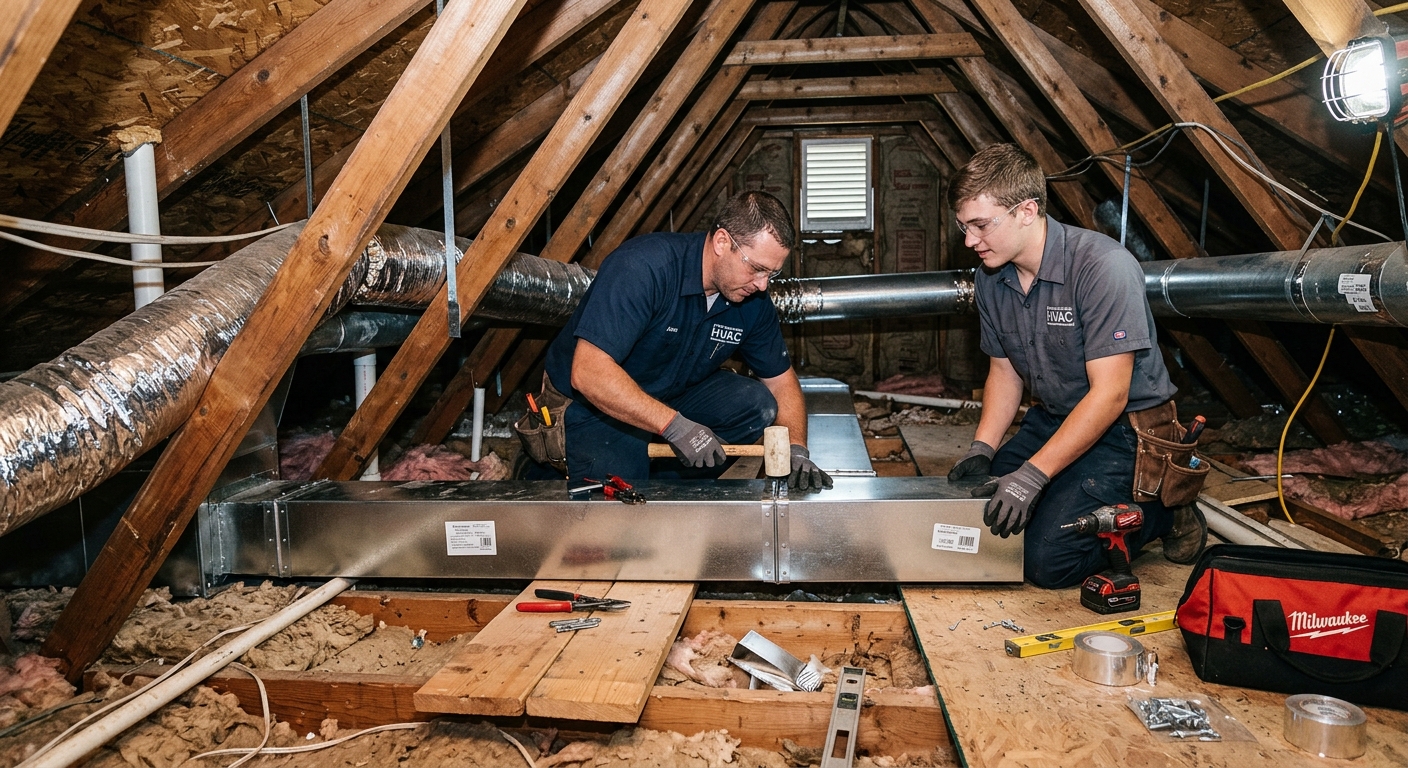
For a Richland home that doesn’t have existing ductwork, you’ll need to budget for both the new HVAC equipment and full duct system installation. The cost to add ducts—sizing, running, sealing, insulating, and installing registers—typically runs $9,700–$19,500 on top of the equipment price. Many post-1960 homes in Bucks County already have ductwork that can sometimes be reused with modifications, but homes built before 1980 may need upgrades for airflow or sealing. Always get a thorough duct assessment before work begins and avoid “one price fits all” bids. The total project can be substantial, but when installed right, it solves both heating and cooling comfort for the long term.
Does my utility offer a heat pump rebate in Richland?
In Richland, PECO Energy Company serves as the primary electric utility for most residents. PECO often runs heat pump rebate programs that can lower the upfront cost by several hundred to over a thousand dollars, depending on system type and efficiency, though specifics change year by year. Confirm current rebate details on PECO’s website before you sign a contract. As of 2026, all-electric cold-climate heat pumps in the $8,600–$18,500 installed price range frequently qualify for incentives, plus some mini-split systems. Rebates typically require that your installer is a registered contractor and that the system meets efficiency standards—so it pays to ask about both before you commit.
Do I need to be home during installation?
For an HVAC installation in Richland, you should be available at least at the start and finish of the work. Installers often need access to every room for duct runs or thermostat wiring, and your presence helps clarify questions or last-minute decisions. You don’t have to be on-site every minute—a central AC swap or heat pump replacement can take a day or two, while full duct systems can take longer and involve attic or crawlspace work. Make arrangements for pets and security. Having a written contract—as Pennsylvania requires for anything over $500—means both sides know the schedule. Plan to review the finished work, get any required start-up info, and receive your permit inspection notice in person.
How long should an HVAC system last in Richland?
Most systems installed in Richland will serve 15 to 25 years—less if incorrectly sized or maintained, longer if they’re well cared for and professionally installed. Post-1990 homes in Bucks County are hitting their first or second replacement cycle, especially if original equipment was builder grade. A modern central AC in the $5,400–$13,000 range should give you at least 15 years, provided you maintain it with regular filter changes and annual checks. Systems can fail earlier if ductwork is poor or refrigerant leaks go unaddressed. If your old unit is working but near the end, start planning before it fails so you’re not forced into a quick, unvetted decision.
Who inspects HVAC work in Richland?
HVAC inspections in Richland are handled by the local municipal code office, which enforces the Pennsylvania Uniform Construction Code (UCC) for residential work. If you’re in Bensalem or another Bucks County township, that township will require and conduct mechanical inspections for most HVAC replacements or new installations. (Swapping a thermostat with existing wiring is usually exempt.) The inspector checks for safe installation, code compliance, and proper permits. Your contractor should pull the mechanical permit and coordinate all inspections—if they suggest skipping this, that’s a red flag. Passing your inspection is also required to close out the job and maintain your home’s insurance and future resale value.
Which utility serves Richland?
Most Richland homeowners get their electricity and natural gas from PECO Energy Company, which covers Bensalem, Bristol, Middletown, and other developed Bucks County townships. PECO provides both electric and gas service in these areas, so making upgrades to electric heat pumps or high-efficiency AC is straightforward. In some rural parts of northern Bucks County, gas is less available and heating oil or propane may be the norm. Knowing which utility you’re connected to determines what kind of equipment (gas or all-electric) makes both practical and financial sense for your home upgrade.
What does a heat pump cost installed in Richland?
The installed cost for a heat pump in Richland ranges from $8,600–$18,500 for a ducted air-source model and $3,500–$7,600 for a basic single-zone ductless mini-split. Most complete replacements for typical homes—especially post-1960 builds with existing ductwork—wind up near the $14,000 midpoint if you’re going cold-climate, variable-speed, and high efficiency. The major factors are the size of your home, quality of the ductwork, and whether electric service needs upgrading. Ask your contractor to break out equipment, duct, and electrical costs. Don’t pay extra for branding; the labor and sizing make the biggest difference.
Should I repair or replace my HVAC system in Richland?
The decision comes down to age, performance, and now the phase-down of refrigerants like R‑410A. If your system is 15–20 years old, facing costly repairs, or hard-to-source refrigerant, replacement is often wise—especially as R‑410A prices rise and new equipment becomes more cost-effective per year of service. For minor repairs—like a simple capacitor, thermostat, or control board—repairing still makes sense, even for older equipment. But once you start facing major parts, leaks, or compressor failures, weigh the repair cost versus a new system, which in Richland typically runs $5,400–$13,000 for AC and $8,600–$18,500 for a ducted heat pump. Never let a contractor pressure you—ask if the repair brings it back to “like new” or just buys a little time.
What is a Manual J load calculation?
A Manual J load calculation tells you exactly how much heating or cooling your Richland home needs, based on insulation, window type, direction it faces, air leakage, and more—not just square footage. It’s the gold standard for sizing new systems under Pennsylvania codes and ensures your investment isn’t wasted on oversized or undersized equipment. If your contractor can’t show the load calculation, they’re guessing, not engineering. This matters: in Bucks County’s humid, heating-dominated climate, the right size system means comfort, lower bills, and longest possible life. The extra cost of a Manual J is almost always paid back through avoiding mistakes that could force an early replacement in the $5,400–$18,500 range.