What a new HVAC system costs in Skippack
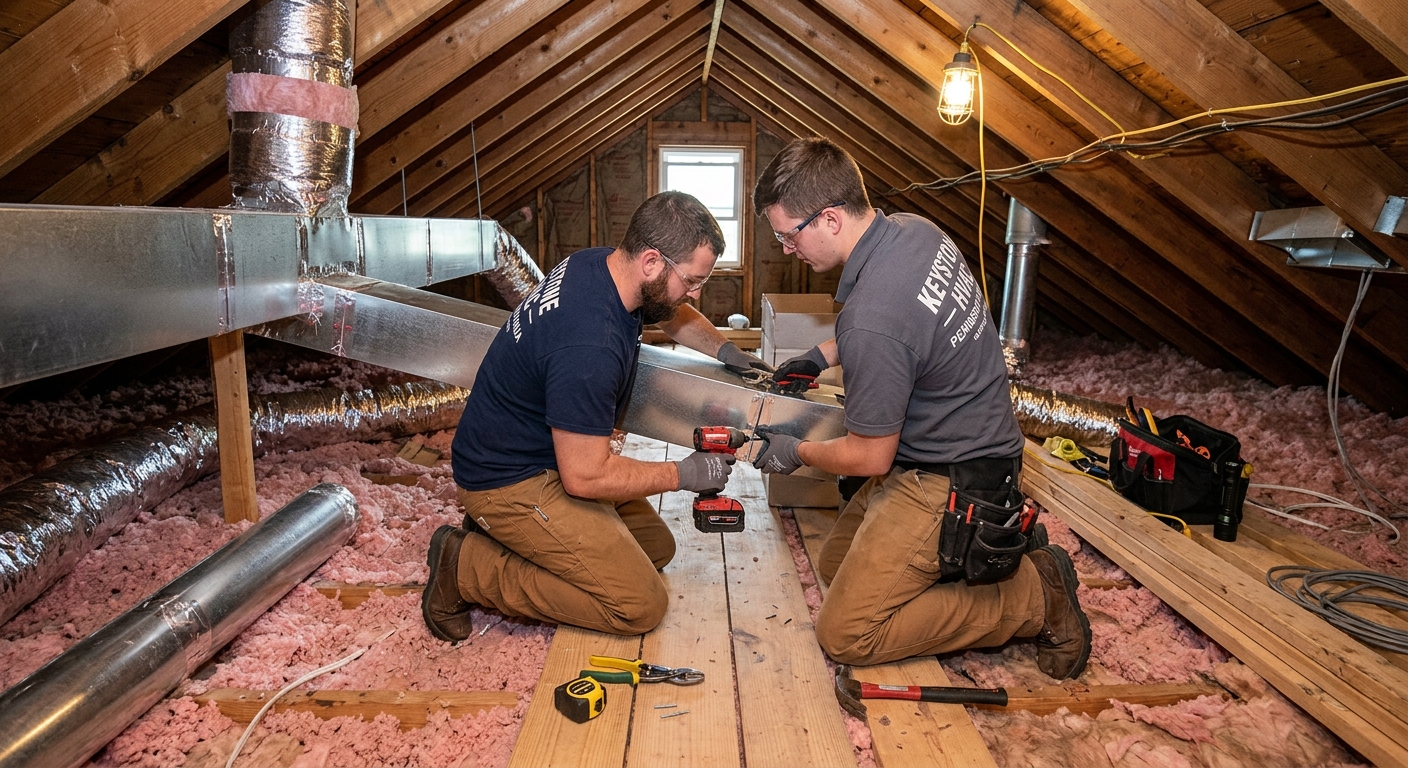
For Skippack homeowners, system cost depends heavily on the type of home and its age. With a homeownership rate over 94.9% and 25.3% of homes built before 1980 (U.S. Census Bureau, ACS 2024), most installations here fall into the “replacement and retrofit” category. Many homes in Skippack are single-family dwellings with older infrastructure—especially when compared to newly built developments. This means HVAC work often requires updates to ductwork or electrical systems, echoing challenges found in other post-war suburbs like Abington or Upper Dublin, where improving legacy ducts is routine.
Montgomery County’s climate skews toward longer, colder winters than hot summers—with 4,800 heating degree days and just 1,450 cooling degree days. The upshot: heating needs outweigh cooling by roughly threefold. This matters when considering HVAC options. Heat pumps, once rare in our area, now fill a growing role as technology catches up with our winter lows. However, the majority of Skippack replacements are still high-efficiency gas furnaces and central AC paired with existing ductwork, unless you’re in a home where retrofitting ducts is cost-prohibitive.
| System |
Best for |
Efficiency |
Price range (installed) |
| Central AC replacement (existing ducts) |
homes with sound ductwork |
16–20 SEER2 |
$5,900–$14,000 |
| Air source heat pump (ducted) |
year-round heating and cooling |
8–10 HSPF2 |
$9,500–$20,000 |
| Cold-climate heat pump (ducted) |
heat pump as primary heat |
9–11 HSPF2 |
$15,500–$20,000 |
| Ductless mini-split (single zone) |
additions, rooms without ducts |
20–30 SEER2 |
$3,800–$8,300 |
| Full duct system installation |
homes with no existing ducts |
— |
$10,500–$21,500 |
Installed estimates for a typical Skippack home. Equipment tonnage, duct condition and electrical capacity move these more than brand.
Choosing an installer in Montgomery County
In Montgomery County, picking the right installer matters much more than picking the “right” equipment brand. Two systems with the same label can perform very differently depending on installation quality—airflow, charge, and ductwork are what separate a trouble-free install from years of aggravation.
Always verify that your contractor is registered for home improvement with the Pennsylvania Office of Attorney General; for refrigerant work, ensure the technician on-site has EPA Section 608 certification. Expect the quote to specify actual equipment model numbers—not just generic sizes. A trustworthy contractor will include a load calculation (not just square footage or a glance at your old unit) and explain the system’s startup procedure: proper commissioning means airflow, charge, and controls are measured and documented.
- Check the contractor’s HIC registration at hic.attorneygeneral.gov
- Ask to see Section 608 EPA certification for anyone working with refrigerants
- Request proof of workers’ compensation coverage (verify with WCAIS)
- Read the written contract—required by Pennsylvania law for jobs over $500
- Ask if the quote includes Manual J load calculation documentation
- Confirm equipment model numbers are specified in the proposal
- Get warranty terms in writing—labor and manufacturer parts
- Find out who will do the actual work (employees, not just subcontractors)
- Require documented commissioning at system startup
- Scrutinize payment schedule—watch for heavy upfront deposits
- Ask about local code permitting—ensure the contractor pulls required permits
- Get at least two written quotes when possible
Skippack sits within the Greater Philadelphia HVAC market, which is crowded and competitive—beware low bids with vague details or contractors eager to skip permits. In dense markets, good work stands out because it’s rarely the cheapest proposal on the table.
What a Pennsylvania HVAC contractor must hold
Pennsylvania does not issue a statewide HVAC contractor’s trade license for residential jobs. Instead, regulation happens at the municipal level. Contractors installing HVAC in homes must be registered under the state’s Home Improvement Contractor (HIC) program if the project exceeds $500. You should verify HIC registration using the official lookup service cited by the Attorney General’s office. For homes in municipalities with their own permitting offices—common in Montgomery County—mechanical or building permits are required for replacement or new installation that involves electrical or mechanical work.
Federal law requires any technician handling refrigerants (charging, recovering, or disposing of AC and heat pump systems) to have an EPA Section 608 certification. This applies in Pennsylvania regardless of local licensing requirements. Always ask to see a 608 card for anyone working with your system’s refrigerant.
Insurance is another must—Pennsylvania requires all employers (and most contractors you’d hire for HVAC work) to carry workers’ compensation insurance, which you can verify through the WCAIS system. This isn’t just paperwork: it protects you from liability if a worker gets injured on your property. Always confirm current coverage before work begins. For added peace of mind, ask for a certificate of insurance for general liability as well.
Mini-splits and zoning in Skippack homes
Ductless mini-split systems are a good solution for Skippack homes where running new ducts is impractical—think bonus rooms, converted basements, finished attics, or additions never connected to your main system. Older single-family homes, where central AC wasn’t always standard, are natural territory for ductless—especially as seen in the post-war suburbs of nearby Abington and Cheltenham, which often need ductwork retrofits or workarounds.
Mini-splits offer “zoning” by assigning a wall-mounted indoor head to each room or space. Single-zone systems (one head, one outdoor condenser) are more efficient and cost less than multi-zone setups that rely on one outdoor condenser to serve several indoor heads at once. While a multi-zone mini-split reduces the need for multiple outdoor units, it can sacrifice some efficiency and has less control over temperature between areas. Head placement matters: wall units are visible, and some homeowners object to the aesthetic. Ceiling cassettes are less obtrusive but cost more to install. Remember, each head needs to drain condensate, which could mean a visible drain line or a condensate pump—think about where these will run.
In housing stock that predates central air—common in Skippack and much of Montgomery County—mini-splits often save walls and ceilings from invasive ductwork. If the only way to reach a problem room is to tear open finished plaster, ductless is usually the less destructive long-term solution. Single-zone setups win on efficiency, but if you need to serve the whole house, get a clear comparison of cost, control, and future service complexity before committing.
Reducing the net cost of a Skippack installation
When budgeting for new HVAC in Skippack, look at incentives on three levels: federal, utility, and (occasionally) state program support. The federal government frequently offers tax credits for qualifying high-efficiency heat pumps and air conditioners—these apply when you file taxes the following year and reduce what you owe, but they don’t lower your upfront invoice. In contrast, rebates from your utility (PECO Energy Company supplies both electric and gas for most of Montgomery County) usually come as an instant discount or a check in the mail after installation—and they put money back in your pocket sooner.
Exactly which incentives apply—and in what amount—can change by the year or even the season. Rather than chasing outdated numbers, start with two sources: your utility’s “energy efficiency” or “rebates” web page (for Skippack, that’s PECO), and the ENERGY STAR Rebate Finder tool. These sources are up to date and reflect current program terms, including whether you must use a participating contractor or submit paperwork within a specific time window.
Statewide incentive programs are rare and always subject to annual funding cycles. Remember the distinction: a tax credit lowers next year’s tax bill, while a rebate reduces the cost or pays you back directly. Before signing a contract, clarify which specific incentives your system will qualify for and who handles the paperwork—some contractors include this as a service, others leave it to the homeowner.
The comfort problem that isn't temperature
In Skippack and across Montgomery County, the HVAC conversation starts with heating and AC—but comfort is also about humidity and air quality, especially because our region’s winters (4,800 heating degree days) bring dry indoor air, and humid summers drive sticky indoor climates. An oversized AC, which cycles on and off too quickly, will cool a house but won’t run long enough to pull out moisture—leaving you clammy in July. Proper sizing and system selection do more for humidity control than most upgrades.
Whole-house humidifiers can help with wintertime dryness but require regular maintenance, including cleaning and (often) replacing the water pad or canister. Neglect leads to mold growth or mineral scale. For filtration, higher MERV filters capture smaller particles but restrict airflow—a standard furnace blower can only handle so much before static pressure rises and efficiency drops. Tightly sealed newer homes may need mechanical ventilation for fresh air, but it’s rarely the “must-have” some installers claim unless you’re experiencing stale or stuffy conditions.
Add-ons like duct-mounted air cleaners and UV lights are commonly oversold; most homes see little measurable health benefit unless you have specific allergies or respiratory needs. Before buying extra gadgets, address sizing, filtration, and basic humidity control first.
What size system does a Skippack home need?
The biggest and most common mistake in Skippack HVAC installs is oversizing the equipment. It seems safer—“more is better”—but running a system larger than you need means short cycling, humidity problems, uneven temperatures, and equipment that wears out faster. Oversizing is not a margin for error; it makes your comfort and bill worse, not better.
Proper sizing starts with a Manual J load calculation, which takes into account your home’s actual square footage, insulation levels, window sizes and direction, infiltration, and more. Rules-of-thumb based on square footage or what the old system’s label says just repeat past mistakes and rarely fit houses built before 1980, as found in Skippack. The load calculation in our region uses the winter design temperature—14 °F—to ensure the system will keep up even on unusually cold nights, not just average days. The calculation also covers cooling loads for peak summer highs.
The right question for your contractor is, “Did you run a Manual J, and can I see the printout?” If they can’t or won’t share this, move on. A trustworthy installer will know that replacing a unit sized by the sticker on your old one is just copying history forward, not planning for your home’s current needs.
Frequently asked questions — HVAC installation in Skippack
What is SEER2 and how is it different from SEER?
SEER2 stands for Seasonal Energy Efficiency Ratio 2, an updated test procedure for rating air conditioner and heat pump efficiency. It became the standard in 2023. The difference is in how equipment is tested—SEER2 uses higher static pressure to simulate real-world duct conditions, which means lower (but more realistic) efficiency numbers than SEER. If you see an older unit with a high SEER, that doesn’t mean it’s more efficient than a new one with a slightly lower SEER2. For Skippack homeowners replacing existing systems, you’ll want to compare SEER2 for anything new. Many central AC replacements fall in the 16–20 SEER2 range, with prices from $5,900–$14,000 installed. Don’t get hung up chasing the highest SEER2—correct installation and sizing matter more to your electric bill than one more efficiency point on paper.
What does a heat pump cost installed in Skippack?
In Skippack, a ducted, air-source heat pump installation typically costs between $9,500–$20,000, with a regional average close to $15,500 for a full system replacement or upgrade. This price includes equipment, labor, and the basics of code-required installation, but it doesn’t cover major ductwork modifications. If your home already has good ducts, you’re likely in the lower half of that range. Cold-climate rated heat pumps, which are designed to provide more dependable heating during our 14 °F winter design nights, run at the higher end—from $15,500–$20,000. Always make sure to get a quote that accounts for your home’s specific needs; price bands are a solid guideline, not a guarantee.
Do I need to be home during installation?
For most HVAC replacements in Pennsylvania, a homeowner doesn’t strictly have to be home for the full installation, but someone should be present at the start and end of the job to answer any questions and inspect work. Installers may need access to indoor equipment, your thermostat, and attic or crawlspace if ductwork is being replaced. In Skippack, full system installs usually take one day for AC or furnace-only jobs, but may stretch to two days or more if there are electrical upgrades or ductwork changes—especially if the house was built before 1980. It’s a good practice to be around during system startup and commissioning. You’ll sign off on the job, and it’s your chance to ask questions about new controls or maintenance routines before the crew leaves.
How do I verify an HVAC contractor's insurance?
To confirm insurance for a Pennsylvania HVAC contractor—especially important in Skippack and Montgomery County—ask for a certificate of liability insurance (“COI”) before work begins. Under Pennsylvania law, workers’ compensation insurance is mandatory for contractors with employees. You can independently verify workers’ comp coverage through the WCAIS database, which is public and easy to use. This step protects you: if a worker is injured and your contractor isn’t insured, you could end up liable as the homeowner. A reputable installer should provide up-to-date insurance documents without hesitation, showing both general liability (damage) and workers’ comp. Don’t accept “we’re covered” as an answer—actually confirm coverage. It’s as basic as checking that their Home Improvement Contractor (HIC) registration is current for contracts over $500.
Is it worth switching from oil or propane to a heat pump?
Switching from oil or propane to a heat pump in Skippack is increasingly worthwhile, especially as energy prices shift and high-efficiency cold-climate heat pumps have become reliable, even for our 14 °F winter design lows. While up-front costs range from $9,500–$20,000 installed, ongoing operating costs are usually lower because heat pumps move heat rather than burning fuel. Before you commit, take a good look at your home’s insulation and ductwork; without decent air-sealing and efficient ducts, you lose much of the expected savings. Factor in the possibility of utility and federal incentives, which can help narrow the cost gap. If your oil or propane equipment is near end-of-life or costly to maintain, it may make financial and comfort sense to upgrade rather than replace in kind.
How does southeastern Pennsylvania's climate affect system sizing?
Our climate in southeastern Pennsylvania has much colder winters than many realize, with a winter design temperature of 14 °F that shapes how heating systems are specified—especially for heat pumps and furnaces. Cooling needs are significant in July and August, but not year-round like in the Deep South. That puts a premium on accurate sizing; oversized systems will short-cycle and struggle to dehumidify during the moderate but humid summer, and unnecessarily run up costs. A properly done Manual J load calculation reflects Skippack’s specific heating and cooling degree days, not just a national average. Most homes here land with central AC replacements between $5,900–$14,000 installed, but more insulation and air sealing often does more to trim equipment size than anything else.
What HVAC tax credits are available to Skippack homeowners?
Federal tax credits for Skippack homeowners are the biggest incentive currently on the table, generally covering a portion of the cost for qualifying high-efficiency heat pumps and central AC systems. Unlike rebates, credits reduce your tax bill when you file next year; they don’t cut your upfront invoice. The exact amount changes—so check official government and ENERGY STAR resources before signing a contract. Utility rebates (from PECO) may stack on top for eligible equipment, returning part of your outlay after installation. For example, a ductless mini-split might qualify for both, with installed cost between $3,800–$8,300. Always confirm eligibility and paperwork requirements with your contractor and get every promise in writing. Incentives don’t move as fast as prices, so recent info is your best guide.
Why do HVAC quotes in Skippack vary so much?
The range between HVAC quotes in Skippack can be wide—sometimes spanning several thousand dollars, especially for full system replacements that run from $5,900–$14,000 for central AC. First, confirm whether each bid includes the same work: some skip duct replacements or electrical upgrades, while others bury startup commissioning or warranty details in the fine print. Bigger, busier contractors often have overhead reflected in the total, but bare-bones bids may skip important details like proper permits or insurance. There’s also a crowding effect in the Greater Philadelphia market—lots of contractors competing for homeowner jobs. For the best value, match “apples to apples” by comparing written scopes of work and never feel rushed to pick the least expensive just to save a week or two of wait time.
Is an annual maintenance plan worth it?
If you’re the type to remember seasonal filter changes and basic preventive steps, you may not need to pay for an annual maintenance plan—especially if your system is new and still under warranty. That said, in Skippack’s older housing stock (25.3% built before 1980), some recurring service can catch small issues before they become expensive repairs. Annual tune-ups may also be required to keep your equipment warranty valid—so read the fine print. Typical plans cost less than a service call and prioritize you for emergencies, but you can do just as well by scheduling an independent check-up before peak seasons. Unless your agreement spells out specific covered items and value, avoid long-term plans bundled into installation contracts for thousands of dollars; basic tune-ups are not expensive next to a new system price of $5,900–$14,000.