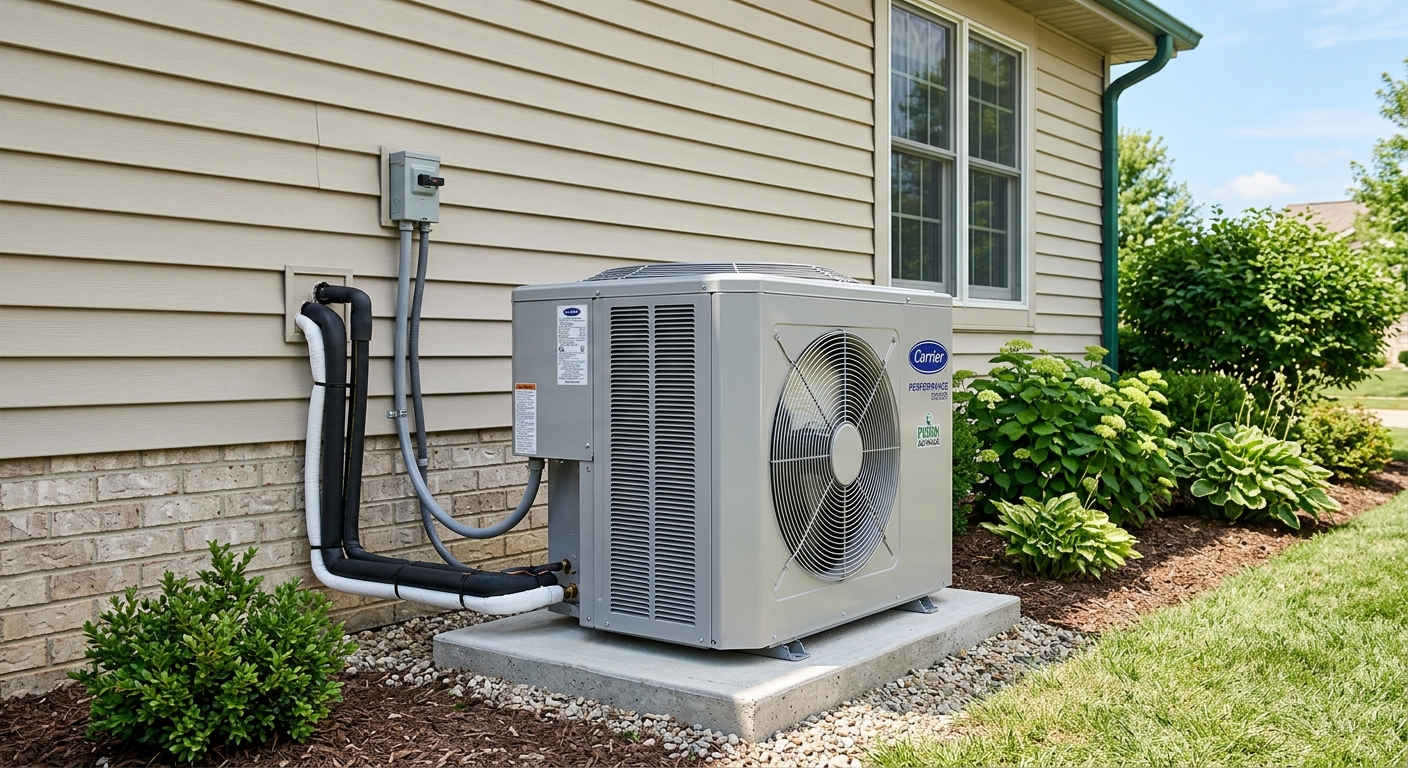
Delaware heating and cooling prices by system type — 2026
Delaware’s heating and cooling habits mirror those of Pike County, Pennsylvania, and understanding local trends helps avoid the most expensive mistakes. With 88.5% homeownership (U.S. Census Bureau, ACS 2024), most houses here have a single-family layout and a majority were built in the late 20th century, as seen in the Pocono subdivisions that dominate Pike County’s housing stock. As a result, most installations are replacements for aging central split systems—generally with usable ductwork, though some duct systems need serious repair or replacement thanks to age and lack of sealing.
What moves prices here isn’t luxury brands—it’s labor, ductwork condition, and the size or “tonnage” of the equipment your home actually needs. Northeast Pennsylvania’s winters—6,100 heating degree days but just 850 for cooling—make this a heating-dominated market. That pushes many homeowners to consider heat pumps or dual-fuel setups to handle those long, cold spells, but if your ducts are in good shape and you mainly use AC, a central AC replacement is the most direct, least-cost option.
Because most homes were built after 1980, high-snow-load roof clearances and correctly sized ductwork are common, but there’s still plenty of pre-1980 stock to contend with unique duct or insulation challenges. Full duct installations—needed mostly in homes that were heated by baseboard or have converted from oil or propane—remain rare, but expensive when needed.
| System |
Best for |
Efficiency |
Price range (installed) |
| Central AC replacement (existing ducts) |
homes with sound ductwork |
16–20 SEER2 |
$4,900–$12,000 |
| Air source heat pump (ducted) |
year-round heating and cooling |
8–10 HSPF2 |
$7,900–$17,000 |
| Cold-climate heat pump (ducted) |
heat pump as primary heat |
9–11 HSPF2 |
$13,000–$17,000 |
| Ductless mini-split (single zone) |
additions, rooms without ducts |
20–30 SEER2 |
$3,200–$6,900 |
| Full duct system installation |
homes with no existing ducts |
— |
$8,900–$18,000 |
Installed estimates for a typical Delaware home. Equipment tonnage, duct condition and electrical capacity move these more than brand.
Comparing HVAC estimates in Delaware
A Delaware homeowner deserves more than a brand name and a lump-sum price. The details determine how long your new system lasts and whether it works as promised. Insist on written quotes that lay out both indoor and outdoor equipment model numbers—they’re a matched set, and efficiency ratings like SEER2 are true only if the pair is correctly matched. Check for the proposed tonnage alongside a load calculation; sizing a new unit by old nameplates often leads to an oversized (or undersized) system. Ductwork condition and sealing should be listed clearly, since aged Pike County ducts often leak or are undersized for high-efficiency equipment.
Line sets—the copper pipes carrying refrigerant—should be replaced or documented as suitable for reuse, especially with today's transition to new refrigerants. Any electrical upgrade, such as a new circuit or panel work, needs to be scoped in detail (not just assumed adequate). Ask how condensate removal is handled, what thermostat is included, and whether permit fees are rolled in. Most importantly, demand a commissioning report: measured airflow, startup pressures, and charge testing. Labor warranties should be stated separately from the manufacturer’s part warranty.
If a contractor’s estimate in Delaware mentions only a brand and a price, it’s impossible to compare against other bids. Meaningful, apples-to-apples comparison comes down to what’s in writing.
| Line item |
What to look for |
Red flag if… |
| Equipment |
model numbers, indoor and outdoor matched |
brand name only |
| Sizing |
load calculation attached |
matched to the old nameplate |
| Ductwork |
condition assessed, sealing scoped |
not mentioned |
| Electrical |
circuit and panel capacity confirmed |
assumed adequate |
| Line set |
replaced or documented as reused |
silent |
| Commissioning |
measured airflow and charge, documented |
no startup report |
| Warranty |
labour years stated separately |
manufacturer only |
| Permit |
included and priced |
'not needed' |
Separating installers from equipment sellers
In Delaware and Pike County, installation quality—not brand—sets apart a reliable HVAC system from a frustrating money pit. A well-installed system with careful duct sealing and proper startup outperforms the fanciest equipment if it's slapped in without testing. Anyone can buy name-brand units, but few contractors use load calculations, pressure balancing, and commissioning reports as standard practice.
Start vetting your installer with Pennsylvania’s Home Improvement Contractor (HIC) registry for contracts over $500. You can verify HIC registration directly. Refrigerant work always needs a technician with EPA Section 608 certification—you’re entitled to ask for proof, because this is a federal law. Meaningful quotes spell out both indoor and outdoor model numbers, include the load calculation results, and note exactly how your ducts and electrical panel are to be handled. Ask for documented commissioning—measured airflow and refrigerant charge readings on paper, not just a handshake.
- Check HIC registration via the Attorney General’s registry
- Ask for proof of EPA Section 608 certification
- Require attached load calculations, not just guessed tonnage
- Get both indoor and outdoor model numbers in writing
- Confirm the plan for duct inspection, repair, or replacement
- Insist on a commissioning/startup report
- See written documentation of labour and parts warranties
- Have contractor show workers’ compensation insurance confirmation (WCAIS)
- Request evidence of permit fees and municipal filings
- Ask for a detailed scope on electrical work, including panel
- Expect full breakdown on refrigerant line sets and drain lines
- Require clarity on thermostat and controls included
In east Pennsylvania’s thin rural HVAC market, it’s common for chain sellers to travel in from outside service hubs like Milford or Bushkill. The more general and vague the estimate, the more likely you’re dealing with a sales-first operation—not a hands-on installer.
Permits, licensing and inspections in Delaware
Residential HVAC licensing in Pennsylvania works differently than most homeowners expect: there’s no statewide HVAC trade license for residential work. Instead, the Pennsylvania Uniform Construction Code (UCC) provides the framework, but permitting and enforcement are managed at the municipal level. So if you’re in Milford Borough, you deal with the Milford Borough Code Enforcement Office, but the neighboring township has its own code office.
Any work handling refrigerant requires EPA Section 608 certification, regardless of state rules—that’s federal law and applies to anyone installing or repairing split systems or heat pumps. In addition, mechanical permits are standard for most HVAC replacements or new installations and always require inspection by local authorities before and after the work.
Contractors performing HVAC work over $500 must have Home Improvement Contractor (HIC) registration. Violating this rule means you lose legal protections under the Home Improvement Consumer Protection Act (HICPA), including your right to a written contract and a three-business-day cancellation period. Always get a certificate of insurance and verify workers’ compensation coverage directly using Pennsylvania’s WCAIS system—not just a printed slip from your installer.
You won’t find a state-issued HVAC or plumbing license outside major cities or commercial work. Local regulatory offices and federal standards determine who’s actually legal—and who’s not.
The decision point on an aging system
Most Pike County homeowners aren't looking to spend money for the sake of newness. Here, you weigh repair vs. replacement by age, repair cost as a part of the full install price, whether it’s a part or a major failure, the refrigerant used (old or current), and whether projected energy savings are real in a climate with long heating seasons and mild summers.
If your system is under 10 years old and suffers a basic electrical or control issue, repair makes the most sense—especially given Delaware’s prevalence of sturdy 1980s-2000s systems. When facing repairs costing more than a third of replacement—especially in a system 10–15 years old—replacement deserves real consideration, especially with refrigerant prices rising for phased-out types. Efficiency upgrades only make sense if you can use them: in Pike County’s 6,100 heating and just 850 cooling degree days, a high-SEER AC won’t pay itself off unless your current unit is ancient and inefficient.
Replacement is not optional in two situations: a cracked heat exchanger is a carbon monoxide hazard, and a failed compressor outside warranty means the heart of your system is dead, with repairs almost always nearing the price of new.
| Situation |
Recommendation |
Typical cost |
Reasoning |
| Under 10 years, single component failure |
Repair |
$300–$1,200 |
Most parts are available, and service life remains |
| 10–15 years, repair over a third of replacement |
Consider replacing |
$4,900–$12,000 |
Costly repairs approach new system value |
| 15+ years, any major failure |
Replace |
$4,900–$12,000 |
Low remaining life, rising refrigerant and parts cost |
| Cracked heat exchanger, any age |
Replace immediately |
$4,900–$12,000 |
Safety hazard, cannot legally repair |
| Compressor failure past warranty |
Replace |
$7,900–$17,000 |
Core component; repair nearly cost of new system |
| Working system, high bills |
Test ducts and envelope first |
$300–$800 |
Air leaks often cost more than equipment efficiency |
The comfort problem that isn't temperature
Pike County’s climate turns comfort into a moisture problem almost as often as a temperature one. Our cold, dry winters mean cracked skin and static shock, while humid summers lead to sticky discomfort indoors. With only 850 cooling degree days, cooling load is moderate, but dehumidification still matters—especially in those mid-century subdivision homes built tight against winter cold.
A common culprit for summer stickiness is an oversized air conditioner. Bigger isn’t better: an AC that cycles on and off too quickly won’t run long enough to pull moisture from the air. On the flip side, whole-house humidifiers solve winter dryness, but only if maintained; many collect scale and bacteria that can hurt air quality if ignored.
Filter upgrades (higher MERV) sound attractive, but running a MERV 13 in a blower designed for MERV 8 can restrict airflow, leading to less comfort and higher energy costs. In newer, tightly sealed homes, mechanical ventilation often makes sense, but “air scrubbers,” UV lights, and ozone generators rarely pay their installation cost in actual health gains in Pike County’s housing stock.
Before spending money, ask: Can you actually measure a persistent problem (humidity, dryness, dust)? If not, stick to sealed ducts and right-sized equipment—most paid add-ons won’t fix what the basics missed.
The refrigerant change and what it means for repairs
Delaware and Pike County homeowners are seeing a refrigerant transition in real time. Newly manufactured systems are moving to lower-GWP refrigerants like R-454B and R-32, part of the phasedown of higher-GWP types such as R-410A. Here’s the bottom line: if you have a working R-410A system, you are not required to replace it—and reputable Pennsylvania contractors are still legally servicing these systems.
R-410A supply remains, but as more manufacturers shift to alternatives, the price for topping off or recharging older systems increases—especially if yours springs a leak. For a minor repair or if the system is young, it can be worth servicing. But as costs mount, particularly once compressors or coils fail, the math in repair-vs-replace decisions shifts, because refrigerant and compatible parts become less available and more expensive.
It’s important to note: no one is forcing you to replace a working system simply because of its refrigerant. But in Pike County’s rural market, delay in switching to new equipment is a choice—not a legal hurdle. The effect you’ll notice most is in the bill for major refrigerant-based repairs, not in any change to home comfort or day-to-day use.
Frequently asked questions — HVAC installation in Delaware
Does my utility offer a heat pump rebate in Delaware?
Heat pump rebates in Delaware typically depend on your electric utility. Pike County is primarily served by Met-Ed, a FirstEnergy utility, which often runs seasonal rebates for energy-efficient heat pumps. These rebates can take $250–$750 off eligible installations, but requirements change from year to year. They generally apply to air source heat pumps in the $7,900–$17,000 installed range if you meet efficiency criteria and use participating contractors. Always check the current utility website or call their energy efficiency program line before signing a contract. Not all contractors process rebates for you, so clarify early if paperwork is included.
How do I verify an HVAC contractor's insurance?
In Delaware and Pike County, you should request both the certificate of liability insurance and proof of workers’ compensation coverage. Contractors performing jobs over $500 require HIC registration and must carry valid insurance; you can confirm workers’ compensation through Pennsylvania’s WCAIS system online. Don’t settle for a paper copy—verify directly, since Pike County’s thin contractor market sees occasional gaps in coverage. This is especially important for larger or higher-risk installs, such as a full duct system in the $8,900–$18,000 band, where liability matters most. If your contractor hesitates or won’t show proof, choose another.
How much does ductwork add to an HVAC installation?
Ductwork is the wild card in Delaware’s HVAC pricing, especially in Pike County’s mix of older and newer homes. If you have aging or leaky ducts, replacing or adding a new full system typically adds $8,900–$18,000, with the install cost driven by home access, story count, and insulation. Duct sealing and minor repairs might fall closer to the $1,000–$3,000 range, but a full install for a house without existing ductwork is the priciest part of a new HVAC system. Always insist on a duct assessment during the quote stage; it’s the only way to avoid nasty surprises.
Do I need to be home during installation?
While you don’t need to be home for the entire process, it’s very helpful—especially at the start and finish. In Delaware and Pennsylvania, reputable contractors want you present for a walk-through, to confirm access and to ensure pets and belongings are secure. For a standard central AC or heat pump install in the $7,900–$17,000 range, expect one to three days of work. Being available means faster answers to questions about thermostat placement, electrical panel access, or venting. Your installer should also hand you written startup and commissioning records at the end; don’t skip the final review, so nothing is missed.
Is it worth switching from oil or propane to a heat pump?
Switching from oil or propane to a heat pump is common in Pike County (Delaware Township especially), given limited natural gas service. Fuel costs typically drive the switch, and a ducted heat pump has an installed price of $7,900–$17,000. Heat pumps offer stable electricity rates and reduce fuel deliveries, but your insulation and ductwork must be up to par to see full savings in our cold winter climate. If your home’s envelope needs work, consider weatherization first. For homes with electric backup or supplemental heating, payback is faster; with older propane or oil tanks, it can take longer to break even.
Should I close vents in unused rooms?
In most Delaware and Pike County homes, closing vents isn’t recommended—even for rooms you use infrequently. Modern HVAC systems in this area, especially those priced between $4,900–$12,000, are designed for whole-home airflow. Closing vents can create pressure imbalances, increase duct leakage, and force your system to work harder, shortening equipment life. If you’re finding some rooms less comfortable, talk to your contractor about proper zoning or balancing dampers during installation, or consider a ductless mini-split for single-zone control. Save money with smart controls, not blocked vents.
How much does a furnace replacement cost in Delaware?
For a typical single-family home in Delaware or Pike County, a furnace replacement with existing ductwork typically lands between $4,900–$12,000. Your exact cost depends on system size, fuel type (propane, oil, or in rare cases, natural gas), and duct condition. Additional factors—like electrical upgrades or limited access in split-level homes—can move you to the higher end. Always verify if your quote covers permits and commissioning. For best value, aim to replace your furnace before it fails in the coldest months, when demand (and emergency labor rates) spike.
What is SEER2 and how is it different from SEER?
SEER2 is the updated federal rating standard for cooling efficiency, replacing the older SEER metric. Used throughout Delaware and Pennsylvania, SEER2 is tested under higher external pressures, making it a more accurate reflection of typical real-world performance. For example, a system with a SEER2 rating of 16–20 (as you'd find in a new install costing $4,900–$12,000) may perform differently than a similar system rated only with SEER. When comparing estimates, check that efficiency ratings are SEER2—not just SEER—so you know you’re seeing honest and up-to-date data.
Which utility serves Delaware?
In Pike County—including most of Delaware Township—Met-Ed, a FirstEnergy company, provides the primary electric utility service. Natural gas is much less available, limited to certain pockets close to Milford. Most rural homes rely on propane or fuel oil instead. This utility landscape often shapes HVAC choices; for example, in areas with electricity only, heat pumps (priced $7,900–$17,000) or ductless mini-splits are more common, since they avoid the need for fuel storage and regular deliveries.