HVAC costs in Sunbury — 2026
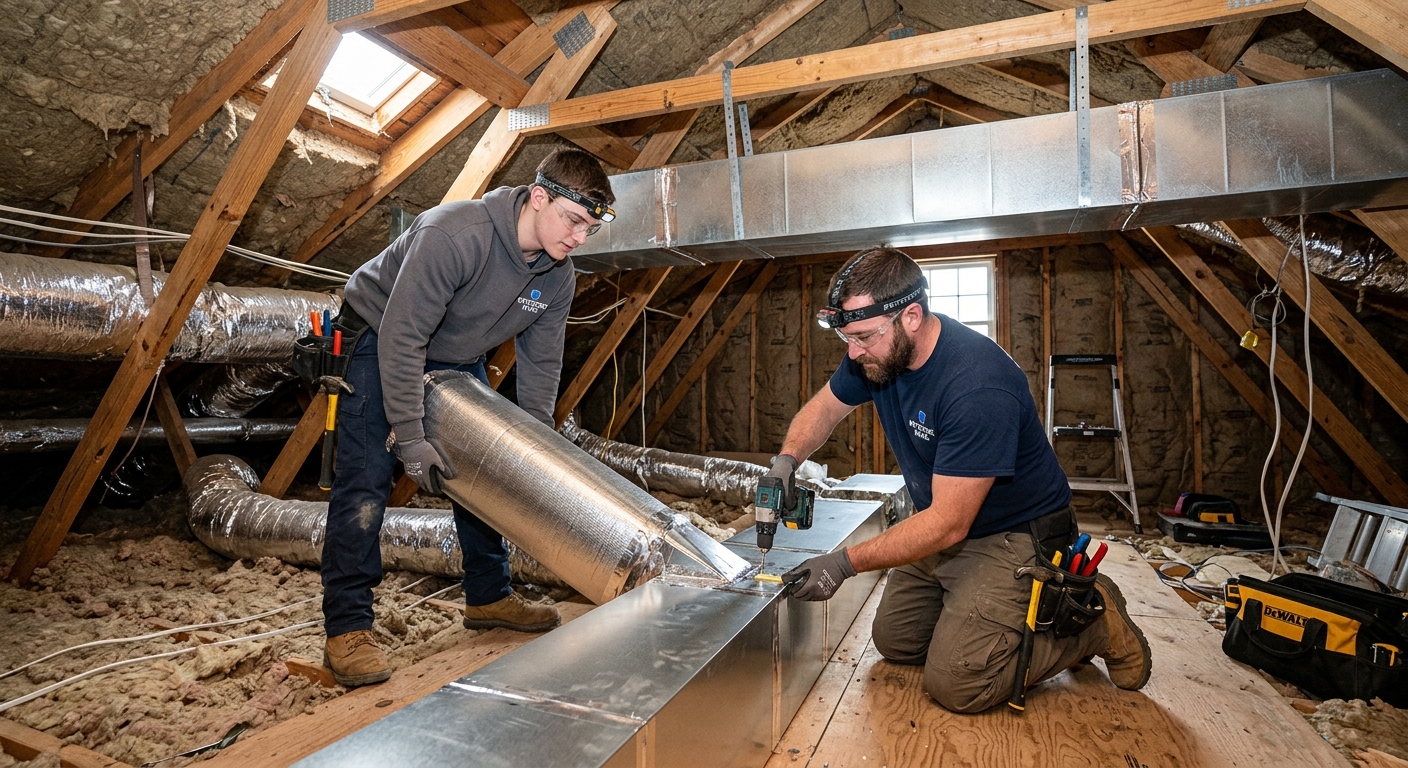
In Sunbury, HVAC work is shaped more by the homes themselves than by national trends. Just 48.8% of Sunbury households own, and with 88.6% of houses built before 1980, installers here face a retrofit-driven market. Many Sunbury and Shamokin houses date 1900–1930, driving frequent retrofits to accommodate modern ducted systems in tight framing. In practice, this means that fresh ductwork can be just as common as swapping out old furnaces or central ACs—especially since many homes were never built with central air in mind. If you’re in an older rowhome or single-family house, odds are your installer will need to get creative with ducts or suggest a ductless mini-split.
Northumberland County is a heating-dominated climate. With 6,300 heating degree days and only 750 cooling degree days, efficient heating is far more important than premium cooling. Your winter design temperature is 2°F—harsh enough that any system has to handle true cold snaps. That’s why most recommendations here focus less on top-tier cooling efficiency and more on reliable, efficient heat delivery—whether by heat pump, gas furnace, or dual-fuel setups.
| System |
Best for |
Efficiency |
Price range (installed) |
| Central AC replacement (existing ducts) |
homes with sound ductwork |
16–20 SEER2 |
$4,300–$10,500 |
| Air source heat pump (ducted) |
year-round heating and cooling |
8–10 HSPF2 |
$6,900–$14,500 |
| Cold-climate heat pump (ducted) |
heat pump as primary heat |
9–11 HSPF2 |
$11,000–$14,500 |
| Ductless mini-split (single zone) |
additions, rooms without ducts |
20–30 SEER2 |
$2,800–$6,000 |
| Full duct system installation |
homes with no existing ducts |
— |
$7,700–$15,500 |
Installed estimates for a typical Sunbury home. Equipment tonnage, duct condition and electrical capacity move these more than brand.
Efficiency ratings and what they mean for your bill
Every air conditioner or heat pump you’ll consider in Sunbury will show SEER2 (cooling) and HSPF2 (heating) numbers. SEER2, or Seasonal Energy Efficiency Ratio 2, measures cooling output per unit of electricity over a season. HSPF2 is its heating-season counterpart—the higher the number, the less electricity used for the same amount of heat. These “2” ratings are new and tougher than the previous SEER/HSPF system, so don’t compare numbers from older articles directly.
In our part of Pennsylvania, with 6,300 heating degree days and only 750 cooling degree days, you’ll run the heat far more than the AC. That means HSPF2 will have a much bigger impact on your annual energy bill than pushing SEER2 from 16 to 20. A SEER2 rating of 16–18 is already efficient for our short, mild cooling season. The jump to a premium 20 SEER2 unit costs more and doesn’t pay back unless you run the AC almost nonstop—with just 750 cooling degree days, very few homes in Sunbury do.
For heating, though, it’s a different story—especially if you’re considering an all-electric setup. Investing in a heat pump with HSPF2 of 9–11 makes sense here. Below that, you’re paying for energy waste every winter. Above, you’ll want to weigh the extra upfront cost against your spot in the county: if you live in a drafty home or plan major envelope upgrades, the top end can pencil out.
What a Pennsylvania HVAC contractor must hold
Pennsylvania doesn’t issue a statewide HVAC license for residential work. Instead, regulation happens locally. In Sunbury, installation or replacement of central HVAC equipment that involves new electrical or gas work requires a mechanical permit from the Sunbury Code Enforcement Office, while surrounding boroughs and townships in Northumberland County handle their own enforcement. Commercial and residential work are handled the same way in this market—through municipal code offices, not state boards.
Any contractor you hire for a contract over $500 must be registered as a Home Improvement Contractor; you can verify them at hic.attorneygeneral.gov. For handling refrigerants (so, basically any air conditioner or heat pump), federal law demands EPA Section 608 certification regardless of state licensing—ask to see proof, especially if you’re considering a mini-split or refrigerant recharge.
Insurance matters too. Pennsylvania requires all employers to carry workers’ compensation, which you can verify at WCAIS (wcais.pa.gov). For consumer protection, make sure you get a written contract—this is required by the Home Improvement Consumer Protection Act, and you have the right to cancel within three business days. Don’t work with anyone who suggests waiving a deductible or shortcutting these steps.
Gas, electric or both in north-central Pennsylvania
In north-central Pennsylvania, the heating question is dead serious. Our winter design temperature is 2°F and we see 6,300 heating degree days a year, so any system must perform reliably in long, cold stretches. Modern cold-climate heat pumps do much better in freezing weather than they used to—they can keep producing usable heat down into the low teens or even single digits. Still, their efficiency and output drop off as the temperature falls, which is why you sometimes see heat pumps partnered with gas furnaces in “dual fuel” systems.
In Sunbury and Shamokin, natural gas is common, making gas furnaces a straightforward, cost-effective solution for the coldest nights. But in rural Northumberland County townships, many homes rely on propane or fuel oil. There, a ducted heat pump or ductless mini-split can easily beat the operating costs and convenience of propane—especially in a well-sealed house. If your home is old and drafty, or your ducts are in rough shape, a furnace (whether gas or oil) may be more forgiving. Gas backup is wise for those deep winter snaps, especially if you already have gas service on site.
| Option |
Installed cost |
Operating cost here |
Best when |
Incentive eligible |
| Gas furnace + central AC |
$4,300–$10,500 |
lowest with existing gas service |
existing gas service, coldest zones |
depends on local utility |
| Ducted heat pump (cold climate) |
$6,900–$14,500 |
lower than propane/oil, varies with home efficiency |
good envelope, all-electric goal |
yes, in many cases |
| Dual fuel (heat pump + gas backup) |
$11,000–$14,500 |
optimized for both seasons |
gas on site, deep cold spells |
yes, if heat pump is qualifying |
| Ductless multi-zone |
$7,700–$15,500 |
efficient on a room-by-room basis |
no ductwork, zone control |
usually yes for qualified models |
Humidity and air quality in Sunbury homes
Sunbury’s long, cold winters (6,300 heating degree days) mean the most common complaint is dry air from January through March. Central heating dries indoor air below comfortable levels—if your home feels itchy or you see static shocks, this is why. A whole-house humidifier can help, but it’s not “set and forget”—they need regular maintenance to prevent mold or mineral buildup, especially in older homes with tightly retrofitted ductwork.
In summer, it’s the opposite—older homes with cheap or oversized window air conditioners often fail to dehumidify properly, leaving clammy rooms despite running the AC. The reason? An oversized AC short-cycles, cooling the air quickly but never running long enough to pull out moisture. Properly sized central AC or heat pumps work much better for stable, dry comfort during the 750 local cooling degree days we get each year.
For filtration, higher MERV-rated filters do trap more particulate matter but also restrict airflow if your blower isn’t strong enough—a real concern in older, retrofitted systems. In tightly sealed newer homes, mechanical ventilation (like energy recovery ventilators) may be necessary for air quality, but the average pre-1980 Sunbury house almost never needs them. The simplest upgrades—like better filters—pay off faster here than expensive add-on air cleaners or UV lights, which are oversold for routine residential use.
Operating cost, not sticker price
To really compare HVAC options in Sunbury, you need to look past the upfront price and do a little math. Here’s how: efficiency ratings (SEER2 for cooling, HSPF2 or AFUE for heating) tell you how much delivered heating or cooling you get per unit of energy. Then the number of degree days (6,300 heating, 750 cooling per year) translates local climate into how hard that system will work annually. Last, your actual per-kilowatt-hour or per-therm rate—look for PPL Electric Utilities on your bill—tells you how much you’ll pay to run it.
Suppose you have two heat pumps—one at HSPF2 9 and one at HSPF2 11. The higher number is about 22% more efficient. Multiply this by the local heating degree days: that adds up to substantial savings over a 10–15 year system lifespan. Same logic if comparing an 80% AFUE furnace to a 95% model. But results also depend on your envelope—old windows and poor insulation can make any system run harder and longer. Duct leaks are silent wallet-drainers and are very common in Sunbury’s retrofitted homes.
Don’t ignore ducts: a top-end 20 SEER2 heat pump loses half its advantage if 30% of its airflow leaks into an 80-year-old crawl space. Equipment is only as good as the install. Remember, rates can—and do—change, so these calculations are about rough payback, not locked-in savings. Your real-world costs will ride your particular house, habits, and usage.
Retrofit versus replacement in Sunbury
Sunbury’s housing stock is old—88.6% built before 1980—so most installs are retrofits, not straight replacements. Many older homes never had ductwork at all, or only basic supplies sized for a coal or oil furnace that never anticipated cooling. If your ductwork is original, it’s likely undersized for air conditioning, and your installer will need to evaluate whether it can handle modern airflow. Insulation and window quality in these homes are often below current standards, making heating system sizing critical.
Electrical panels can also limit your options. All-electric conversions (like switching to heat pumps) may require a panel upgrade, especially if your current service tops out at 100 amps or less—common in pre-1950 houses. Meanwhile, if you’re sticking with gas, check the chimney or flue condition—these can be compromised in old masonry stacks.
If your home is one of the rare post-1980 builds (about 11% in town), you may be in straightforward “first replacement” territory—expect to replace builder-grade gear sized generously but not always installed with modern energy costs in mind. For most Sunbury owners, retrofitting ducts, adding returns, and insulating trouble spots are as important as choosing the equipment itself.
Frequently asked questions — HVAC installation in Sunbury
Does my utility offer a heat pump rebate in Sunbury?
In Sunbury, your electric utility is PPL Electric Utilities, which has often offered rebates for high-efficiency heat pumps and ductless mini-sports. The rebates tend to vary by the year and the efficiency level of the equipment you install. Generally, ducted heat pumps or ductless mini-splits at HSPF2 9–11 are eligible, especially when installed to displace electric baseboard or propane systems. For example, a typical ducted heat pump installation costs $6,900–$14,500 here; a rebate can off-set some of that investment. Always check directly with PPL Electric Utilities or your contractor for the latest program rules before making a final decision—rebate offerings can change without much notice and often require proof of professional installation and permitting in Sunbury.
What is EPA Section 608 certification?
EPA Section 608 certification is a federal requirement for anyone who installs, maintains, or disposes of equipment containing ozone-depleting refrigerants—like almost every air conditioner or heat pump sold in Sunbury. Pennsylvania doesn’t have its own refrigerant license, so the Section 608 credential is the law everywhere, including Sunbury and all of Northumberland County. Ask your installer for their 608 card, especially for ductless mini-splits (which start at $2,800–$6,000). If a contractor can’t show this certification, they aren’t legally allowed to handle refrigerants; skipping this step risks system leaks and voided warranties. Always verify that anyone working with refrigerant in your home is Section 608 certified before signing a contract.
Do I need to be home during installation?
For most HVAC installs in Sunbury, someone needs to be present to allow access and answer questions, especially at the start and end of the job. Installers regularly need access to your electrical panel, ductwork, and any utility meters—areas homeowners typically keep locked. Many installs, like central AC (from $4,300–$10,500), can take a full day or two, while ductless mini-splits often finish in one. Technicians may need to clarify thermostat location or verify equipment placement in older homes with tight framing. If you can’t be present the entire time, coordinate with your contractor in advance on how to access needed spaces. For Sunbury permit inspections, someone must be there to let the inspector in at the finish.
How cold does it get in Sunbury and does that affect heat pumps?
Sunbury’s winter design temperature is 2°F, with long spells dipping well below freezing. Many older beliefs about heat pumps “not working in the cold” are now out of date. Modern cold-climate heat pumps are engineered to keep heating even as the temperature drops into the single digits. However, their output and efficiency decline the colder it gets, which can require a backup heat source for the coldest nights in Sunbury. This is why dual fuel systems—like a heat pump paired with a gas furnace (installed cost $11,000–$14,500)—are popular here. Single-system electric heat is possible in a well-insulated house, but check with your installer regarding backup plans for deep winter spells.
How much does a new HVAC system cost in Sunbury?
New HVAC system pricing in Sunbury depends on your house’s age, ductwork, and fuel options. For a central air conditioner replacement (using existing ducts), expect $4,300–$10,500 installed. Ducted air-source heat pumps range $6,900–$14,500. Adding or replacing a full duct system, which is common in Sunbury’s pre-1930 houses, is typically $7,700–$15,500. Single-zone ductless systems are the cheapest full installations at $2,800–$6,000. Prices move with the size of your house, condition of existing ducts, and whether electric or gas service is available. Always request a site visit and written estimate—retrofit work in Sunbury is rarely “one size fits all.”
Should I repair or replace my HVAC system in Sunbury?
In Sunbury, the average home is over 40 years old, and most systems are long past their original warranty. If your system is over 15 years old, lacks modern safety features, or needs a repair over half the cost of a new system (for example, more than $2,200 on a $4,300–$10,500 AC), replacement is usually smarter—especially since older ductwork often needs updating, too. But if your furnace or AC is under 10 years old and the repair is minor, a fix is still cost-justified here. In Sunbury’s retrofit-heavy market, sometimes upgrading ducts or controls gives a better payback than just swapping equipment. Have a qualified contractor inspect both system and ducts before deciding.
How long should an HVAC system last in Sunbury?
Typically, well-installed HVAC equipment in Sunbury lasts 12–20 years. Older systems in historic homes often face early retirement due to duct rust, electrical issues, or controls that no longer match new thermostats. Air-source heat pumps and furnaces last around 15–18 years if maintained regularly, but neglect shortens life—especially in retrofitted duct systems that aren’t sealed or insulated. Central ACs can reach 15 years, while ductless units sometimes go 20 years. Remember, our heating loads are higher than average—so heating systems here do more work per season than in milder states. When you’re budgeting, expect to replace a full system in the $6,900–$14,500 range every 15 years or so, not counting any ductwork that needs attention.
Is a high-efficiency system worth the extra cost here?
In Sunbury, spending more for high HSPF2 on a heat pump is justified, but paying for ultra-high SEER2 cooling is rarely cost-effective. With 6,300 heating degree days, you’ll see the quickest payback from an efficient heating system—think HSPF2 9–11, especially if you’re moving away from propane or oil. AC efficiency above 16–18 SEER2 makes little difference on your annual bill since cooling demand is low. The price premium to jump from a standard to a high-end model can be $2,000 or more on an install (putting total cost at $11,000–$14,500), and often only returns its investment in extra-urban climates. Put your money in heating upgrades and duct sealing—not deluxe AC—if you want the best ROI in Sunbury.
What is a Manual J load calculation?
A Manual J load calculation is a room-by-room analysis that determines how much heating or cooling your home really needs. In Sunbury’s older homes—most built before 1980—installer “guesstimates” based on square footage can lead to oversized or undersized equipment. Proper Manual J calculations weigh insulation, window quality, orientation, and air leakage, crucial in homes that went through multiple retrofits. Your city’s code enforcer may ask to see a Manual J before issuing a mechanical permit, especially for duct changes or replacements (which range $7,700–$15,500). Demand this calculation during the quoting process—it’s the difference between a comfortable house and throwing money at higher bills or premature repairs.