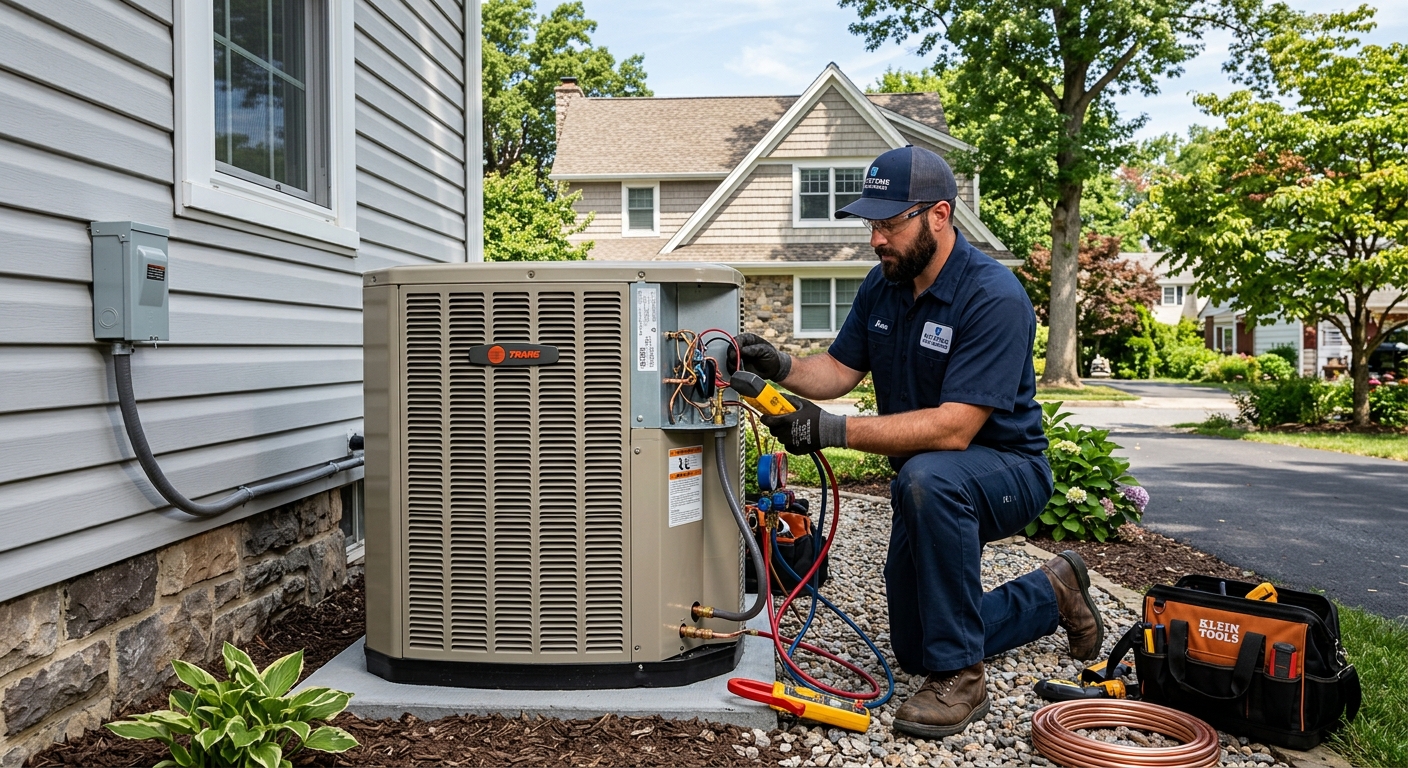
What a new HVAC system costs in Bushkill
Bushkill, with its high homeownership rate and an older housing stock (94.3% of homes are owner-occupied and 42.3% were built before 1980), is a market where system replacement and retrofit work dominate over first-time new installations. Homeowners here are more likely to be upgrading outdated or failing equipment, sometimes working within the constraints of original ducts that may not be sized for central air—especially in Bethlehem and Easton’s swath of early-1900s rowhomes. In those areas, limited outdoor space can restrict condenser placement, and retrofitting ductwork can be a challenge in tightly packed homes with plaster walls and small basements.
Our climate in northeastern Pennsylvania is heating-dominated, with 6,100 heating degree days versus only 850 for cooling. That means most HVAC decisions here should prioritize reliable, efficient heat as the central concern, especially if you’re considering a heat pump as your home’s primary heat source. Cooling needs are real—summers bring humidity and spikes—but the winter lows and demanding design temps require systems built for cold.
| System |
Best for |
Efficiency |
Price range (installed) |
| Central AC replacement (existing ducts) |
homes with sound ductwork |
16–20 SEER2 |
$5,500–$13,500 |
| Air source heat pump (ducted) |
year-round heating and cooling |
8–10 HSPF2 |
$8,900–$19,000 |
| Cold-climate heat pump (ducted) |
heat pump as primary heat |
9–11 HSPF2 |
$14,500–$19,000 |
| Ductless mini-split (single zone) |
additions, rooms without ducts |
20–30 SEER2 |
$3,500–$7,800 |
| Full duct system installation |
homes with no existing ducts |
— |
$10,000–$20,000 |
Installed estimates for a typical Bushkill home. Equipment tonnage, duct condition and electrical capacity move these more than brand.
Manual J and the tonnage question
The biggest error a contractor can make isn’t in the brand or even the efficiency rating—it’s in sizing your system incorrectly. In Bushkill and the wider Lehigh Valley region, many replacements are still sized by rule of thumb or by copying the old unit’s sticker, and that’s a shortcut that carries real costs. Oversized systems short cycle (turning off and on too quickly), fail to properly dehumidify, create temperature swings, and wear themselves out years before their time. This isn’t caution—it’s a design flaw.
A proper load calculation—called Manual J—accounts for insulation, window quality, air leakage, orientation, and square footage. It’s tailored to your actual house, not just an average size. With a winter design temperature here of 4 °F, any system installed needs to match our coldest days, not just keep up in milder weather. Manual J calculations are built specifically around worst-case temps like this, so you’ll know if your equipment can carry your home through real Pennsylvania winters. Don’t accept a quote that doesn’t put this in writing.
If you’re evaluating contractors, ask directly: "Did you run a load calculation, and can I see it?" Be cautious if the answer is vague or if they point to your old system as the reference. That’s someone copying yesterday’s mistake into tomorrow’s bill. In Bushkill, your home is unique. Avoid shortcuts. Ask for the science, not the guesswork.
What a real HVAC quote contains
A solid HVAC quote in Bushkill goes far beyond a brand name and a single price. For any installation—replacement or new—insist on clear model numbers for both the indoor and outdoor units. Only a matched set is rated for efficiency and reliability; a mismatched pair won’t perform as promised. The quote should list equipment tonnage, attach the load calculation, and detail whether the existing line set is being replaced or reused (with documentation on why reuse is safe). Your quote also needs to address electrical work—will your panel handle the new system, or is a panel upgrade required?
Complete scopes include the thermostat, all condensate work, mechanical permit with a clear cost, a commissioning report (verifying refrigerant charge and airflow), and specific warranty terms (labor versus parts). A contractor should break out their labor warranty, which is separate from the manufacturer’s equipment warranty. In Bushkill, a one-line quote with a brand and price isn’t something you can truly compare. If they skip the details, you’re taking all the risk.
| Line item |
What to look for |
Red flag if… |
| Equipment |
model numbers, indoor and outdoor matched |
brand name only |
| Sizing |
load calculation attached |
matched to the old nameplate |
| Ductwork |
condition assessed, sealing scoped |
not mentioned |
| Electrical |
circuit and panel capacity confirmed |
assumed adequate |
| Line set |
replaced or documented as reused |
silent |
| Commissioning |
measured airflow and charge, documented |
no startup report |
| Warranty |
labour years stated separately |
manufacturer only |
| Permit |
included and priced |
'not needed' |
Bushkill's housing stock and its HVAC needs
With 42.3% of Bushkill homes built before 1980, there’s a high chance you’re dealing with some combination of original ducts, limited insulation, and older windows. Many homes from that era received ductwork sized for a furnace only, not central AC, which can restrict summer airflow or hamper any future heat pump installation. Electrical panels might lack the spare amperage for an all-electric system, particularly when paired with electric water heaters or ranges. If you’re still using a masonry chimney for venting, its condition and lining have to be checked any time you swap a furnace or boiler.
For the remaining (mostly newer suburban) homes—think post-1990s builds—it’s usually a first replacement situation. The original builder’s equipment, often undersized on insulation and oversized on system tonnage, is likely at the end of its useful life. These homes usually have adequate ductwork and electrical service for a modern AC or heat pump, but that’s never something to assume until checked. Whether older or newer, the age and construction of Bushkill’s homes drive every sensible recommendation for HVAC sizing and replacement.
Permits, licensing and inspections in Bushkill
Pennsylvania does not have a statewide HVAC trade license for residential work. Instead, Bushkill and municipalities throughout Northampton County regulate mechanical permits and inspections locally. In Bethlehem, for example, replacing or installing central HVAC equipment requires a mechanical permit, while tasks like thermostat replacement in boroughs such as Nazareth are typically permit-free. As a homeowner, these local rules affect timing and your project’s legal compliance, not just costs.
Every contractor working in Bushkill must have Home Improvement Contractor (HIC) registration through the Pennsylvania Office of Attorney General for contracts over $500—check credentials at hic.attorneygeneral.gov. Anyone handling refrigerants must hold EPA Section 608 certification, which is federal and applies to all refrigerant work regardless of local licensure. For insurance, confirm that your contractor carries valid workers’ compensation via the WCAIS system at wcais.pa.gov. These checks protect you from liability and ensure that whoever you hire is meeting both state-required consumer protections and all relevant federal safety standards.
Zone control without ductwork
Ductless mini-splits solve problems that conventional HVAC can’t in Bushkill’s patchwork of older homes, additions, and rooms where ducts are missing or impossible to add. If you’re converting an attic, finishing a basement, or simply have a room that never gets warm or cool enough, ductless is hands-down the best path. In dense areas like Bethlehem and Easton, where early-1900s rowhomes restrict both interior wall space and outdoor placement, ductless heads can deliver targeted comfort without reconstructive surgery on your house.
Single-zone ductless systems are the lowest cost ($3,500–$7,800 installed) and the simplest to maintain. Multi-zone systems let you run several indoor heads off one outdoor condenser, but be aware: a multi-zone heat pump can’t deliver full rated capacity to every room simultaneously, and performance often drops compared to a set of single-zone units. Placement matters—not just for aesthetics, but to manage condensate effectively and avoid improper wall penetrations. Some homeowners don’t like the look of wall-mounted evaporators; in tight Bushkill homes, ceiling or floor models can work, but will add complexity and cost. If your home predates central air, ductless is already a market reality—even if you haven’t priced it yet.
Why your ducts may be the real problem in Bushkill
In Bushkill homes—especially anything built before the Reagan era—leaky or undersized ductwork is often the silent culprit behind comfort and efficiency issues. Duct leakage can waste a quarter or more of your conditioned air before it ever reaches a vent. A duct blaster test precisely measures just how much air is escaping; it’s a test worth running before you put money into replacing your furnace, AC, or adding a heat pump.
Many original duct systems in this area were sized for a furnace only, with minimal consideration for cooling airflow or multi-stage heat pump operation. Undersized return ducts are a chronic, invisible problem, choking off airflow and causing noisy operation, coil freeze-ups, or premature compressor failure. Older homes may have duct runs through unconditioned attics or crawlspaces—locations prone to heat loss in winter and heat gain in summer—making any leaks far more costly.
The tight confines of Bethlehem and Easton rowhomes mean retrofitting larger ducts or adding returns may not be practical. But sealing and insulating even limited ductwork can pay immediate dividends in comfort and running costs. Bottom line: test your ducts before you replace your system. Otherwise, you may end up solving the wrong problem and missing out on half your new system’s potential efficiency.
Frequently asked questions — HVAC installation in Bushkill
What is SEER2 and how is it different from SEER?
SEER2 is the updated efficiency standard for air conditioners and heat pumps starting in 2023. It stands for Seasonal Energy Efficiency Ratio 2, using stricter test conditions to better reflect real-world performance—more exterior static pressure is applied to capture the effect of actual ductwork, which matters in Bushkill’s mix of older and newer homes. Classic SEER ratings can exaggerate how efficient a system is once it’s installed in the field. SEER2 values are lower for the same equipment compared to SEER, but this doesn’t mean your system is less efficient—it means you’re seeing a more honest number. For example, many ductless systems achieve 20–30 SEER2 in this market, so when comparing new quotes for Bushkill homes, make sure you’re seeing SEER2 and not the old SEER rating.
Do I need ENERGY STAR equipment to qualify for incentives?
ENERGY STAR equipment is often a baseline requirement for many federal, state, or utility rebates or tax credits, but check the exact program criteria. In Pennsylvania and specifically Bushkill, most meaningful incentives require systems to meet or exceed ENERGY STAR—especially for high-efficiency heat pumps or air conditioners. However, some programs focus on the actual efficiency rating (like 16 SEER2 or above), not just the ENERGY STAR logo. For typical ducted AC replacements, prices start around $5,500–$13,500 before credits or rebates. Always check your eligibility and keep printed documentation from your contractor about the qualifying efficiency—don’t rely on verbal promises.
What does a heat pump cost installed in Bushkill?
For a standard ducted air source heat pump in Bushkill, you can expect to pay in the range of $8,900–$19,000 installed, with the wide range mostly reflecting equipment size, brand, duct condition, and local electrical service. Cold-climate models that can function as your primary heat source year-round will land toward the upper end of that range or slightly above. Homes with tight spaces, older ductwork, or electrical panels in need of upgrades can see higher labor costs. The important thing is that a heat pump sized for our winter design temperature (4 °F) is a true central heating solution—not just a glorified AC with a small backup heater.
Is a high-efficiency system worth the extra cost here?
Because Bushkill’s heating season is long (6,100 heating degree days), payback on high-efficiency systems can be meaningful—especially for heat pumps or furnaces serving as your primary heat. If you’re choosing between a base model and a premium 20 SEER2 or a cold-climate heat pump, the difference in comfort and running costs over a decade can outweigh the price difference. For central AC, higher efficiency is nice but may take longer to pay back, since our cooling season is modest compared to the need for quality heat. For instance, a ductless mini-split’s premium price ($3,500–$7,800) is easier to justify in a hard-to-cool space or addition. Think long-term comfort, not just upfront price.
Why does my system short cycle?
Short cycling—where your equipment starts and stops suddenly and often—usually traces to a system that’s oversized for your Bushkill home, poor duct design, or a thermostat in the wrong location. In this market, it’s common to find that a previous installer simply looked at the old equipment’s size rather than performing a Manual J calculation. The impacts are real: higher bills, poor dehumidification, temperature swings, and a unit that wears itself out early. Before paying for replacement, ask for a complete load calculation and have your ductwork inspected. Upgrading to a perfectly sized system may cost $8,900–$19,000 for a ducted heat pump, but you’ll recapture the difference in longevity and comfort.
Is a heat pump a good choice for Bushkill winters?
A well-selected modern heat pump—especially a cold-climate model—can handle Bushkill’s winters, when the design temperature falls to 4 °F. Unlike older technology, today’s variable-speed inverter heat pumps maintain capacity and comfort even when the mercury drops. Make sure your installer runs a proper load calculation and picks equipment with published capacity at or below our winter lows. The price is in the range of $14,500–$19,000 for a cold-climate heat pump fully installed. If you’re on propane or oil, switching to a heat pump can also shield you from fuel price shocks, but electrical panel upgrades can bump costs.
When is the best time of year to replace HVAC in Bushkill?
The shoulder seasons—spring and early fall—are the ideal times to replace your HVAC system in Bushkill. Demand is lighter, crews are less booked, and most supply chain issues are handled before the true weather extremes hit. Top contractors in the Lehigh Valley (which includes Bushkill) also tend to run their best non-emergency pricing then. Replacing a central AC or heat pump in the quieter season can cost between $5,500–$19,000, depending on system type and scope. Also, you’ll have more scheduling flexibility and less risk of sweating or freezing through a gap in coverage.
How does northeastern Pennsylvania's climate affect system sizing?
Bushkill’s climate, with 6,100 heating degree days and a winter design temperature of 4 °F, means heating is your number one sizing priority. Sizing for our conditions takes real calculation—Manual J accounts for actual insulation, duct leaks, window types, and draftiness common in older Bushkill homes. Oversizing for cooling often happens as an accident, but it wastes money and comfort here. Expect the best contractors to show you detailed calculations and tonnage justified by local weather data. Incorrect sizing leads to systems that cost $8,900–$19,000 and still underperform when the real cold sets in.
What is EPA Section 608 certification?
Section 608 certification is a federal requirement for anyone handling refrigerants—your installer cannot legally work with AC or heat pumps in Bushkill or anywhere else without it. No matter how Pennsylvania or Northampton County regulates contractors, this EPA certification ensures your tech understands safe handling, recovery, and environmental protection when installing, servicing, or disposing of HVAC systems. Before you sign a contract—especially for something as costly as a $5,500–$19,000 system—always ask your contractor for proof of current Section 608 certification. It’s a basic but crucial consumer safeguard.