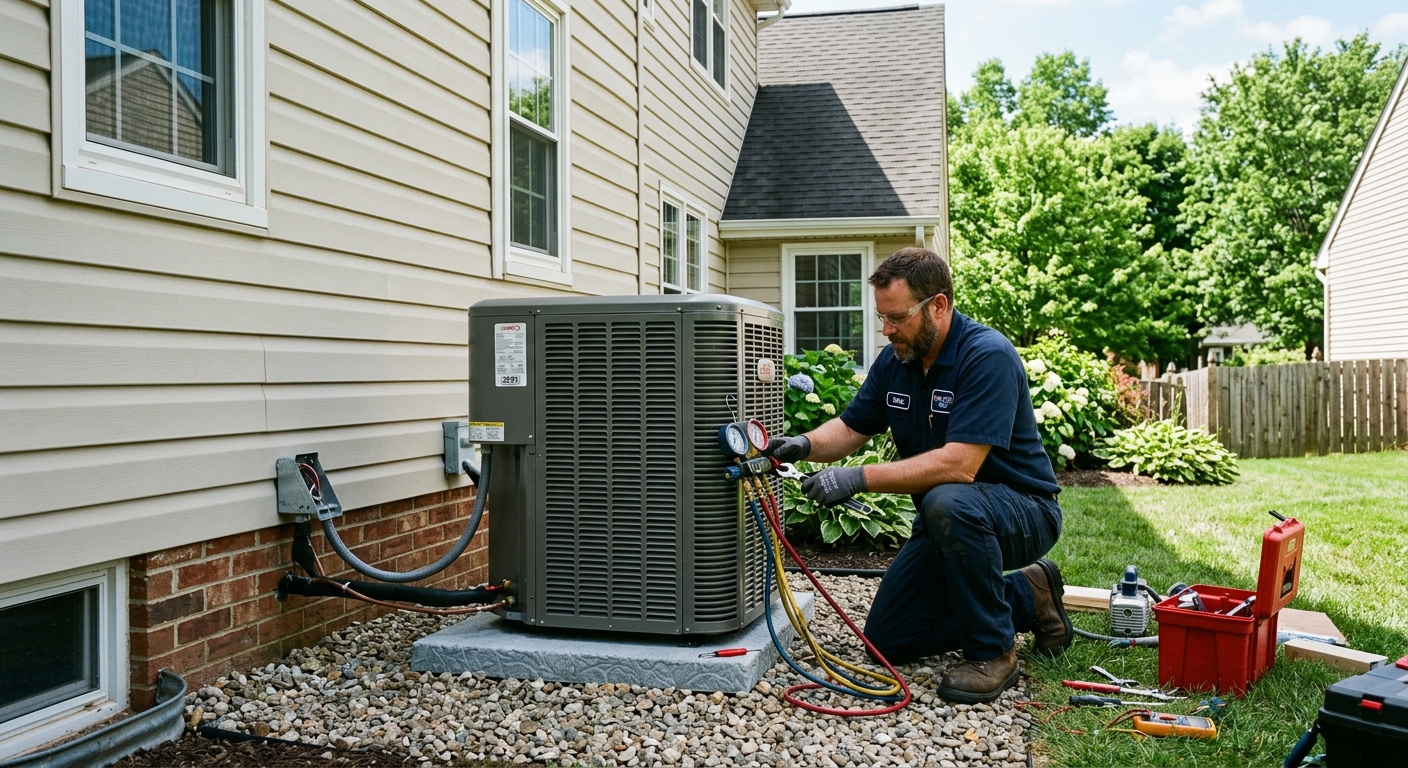
HVAC costs in Upper Dublin — 2026
Upper Dublin homeowners face a unique HVAC landscape shaped by its high homeownership rate and the age of its housing stock. With 84.7% of households owning their homes and 64.2% of properties built before 1980 (U.S. Census Bureau, ACS 2024), most projects here are retrofits or replacements rather than first-time installations. In Abington, Cheltenham, and Upper Dublin, many post‑1945 houses were designed before central air was the norm, leading to widespread retrofitting—especially upgrades to ductwork and electrical to accommodate modern systems. This means many homes have older or non-existent ductwork, requiring careful evaluation before installing new central AC or heat pump systems.
The local climate plays a major role in equipment choices and costs. Southeastern Pennsylvania averages 4,800 heating degree days and 1,450 cooling degree days annually—a clear heating-dominated climate. For Upper Dublin, this shifts the recommendation toward systems that handle low winter temps (design temp 14 °F) efficiently. Heat pumps and efficient furnaces tend to deliver more value over time than systems sized just for summer cooling. Ductless mini-splits, meanwhile, are well-suited for targeted upgrades in rooms untouched by original ductwork.
| System |
Best for |
Efficiency |
Price range (installed) |
| Central AC replacement (existing ducts) |
homes with sound ductwork |
16–20 SEER2 |
$6,100–$14,500 |
| Air source heat pump (ducted) |
year-round heating and cooling |
8–10 HSPF2 |
$9,700–$20,500 |
| Cold-climate heat pump (ducted) |
heat pump as primary heat |
9–11 HSPF2 |
$16,000–$20,500 |
| Ductless mini-split (single zone) |
additions, rooms without ducts |
20–30 SEER2 |
$3,900–$8,500 |
| Full duct system installation |
homes with no existing ducts |
— |
$11,000–$22,000 |
Installed estimates for a typical Upper Dublin home. Equipment tonnage, duct condition and electrical capacity move these more than brand.
Zone control without ductwork
Ductless mini-splits make practical and financial sense in Upper Dublin’s housing mix, especially for areas that have never been properly served by central HVAC. Whether it’s an addition, finished basement or attic, or a part of the house left out by the original ductwork, a ductless system adds heating and cooling without the mess and cost of tearing into plaster or running new ducts. In homes built before central air was standard—common in post‑1945 builds around Abington, Cheltenham, and Upper Dublin—these systems fill in the blanks left by older infrastructure.
The simplest and often most efficient layout is a single-zone mini-split: one outdoor condenser paired with one indoor head. These perform better, and usually last longer, than combining several heads on a single outdoor unit. Multi-zone setups do look cleaner outside, but indoor heads are less effective when several run off one condenser, especially when only one or two zones are calling for cooling or heat. Factor in where the heads will sit—some find them visually intrusive on living room or bedroom walls, and slim-duct models cost more. Condensate must be drained, which means you’ll need a route out of the living space. Single-zone systems in Upper Dublin typically run from $3,900–$8,500; each added zone increases cost and complexity.
So, while traditional central systems still dominate, Upper Dublin’s era of housing quietly makes it prime territory for ductless—especially when you want to control temperature in rooms the old system just can’t reach.
Reading an installation proposal
A solid Upper Dublin HVAC quote spells out exactly what you’re buying. Start with model numbers for both indoor and outdoor units—this is how you know you’re getting an efficiency-rated pair, not mismatched parts. Tonnage matters, but a three-ton unit that’s too big or small for your home won’t deliver the savings or comfort you expect—so the proposal should have a load calculation, not just a guess based on your old equipment. Line-sets (the copper tubing for refrigerant) should be replaced, or at least inspected and documented if reused. Electrical work varies by home—if your panel is maxed out (not rare in post‑1945 homes), the quote must spell out upgrades. A drain for condensate, new thermostat, the necessary township permit, and a commissioning/startup report should be itemized.
Labor warranty is separate from the manufacturer’s parts coverage. Some quotes combine the two, but push for clarity here—ask for years on labor and years on equipment. If the quote just names a brand and a price, you can’t compare it to anything. You shouldn’t have to guess what’s included, or find out later you’re paying extra for code-required work.
| Line item |
What to look for |
Red flag if… |
| Equipment |
model numbers, indoor and outdoor matched |
brand name only |
| Sizing |
load calculation attached |
matched to the old nameplate |
| Ductwork |
condition assessed, sealing scoped |
not mentioned |
| Electrical |
circuit and panel capacity confirmed |
assumed adequate |
| Line set |
replaced or documented as reused |
silent |
| Commissioning |
measured airflow and charge, documented |
no startup report |
| Warranty |
labour years stated separately |
manufacturer only |
| Permit |
included and priced |
'not needed' |
Operating cost, not sticker price
In Upper Dublin, sticker price is only half the story—annual operating cost, driven by our climate and utility rates, is where the real differences show up. Southeastern Pennsylvania dishes out 4,800 heating degree days versus 1,450 for cooling, so you’ll spend more on heating than on cooling most years. Our winter design temperature is 14 °F, meaning a system has to deliver steady heat in real cold. PECO is the electric utility for Upper Dublin, so your bill is the source for your actual rate—usually shown in cents per kWh for electric or per CCF/therm for gas.
Here’s the calculation: for a heat pump, multiply your home’s estimated load (in BTUs, based on degree days and house size) by the inverse of efficiency (COP or HSPF2). That gives you kilowatt-hours, which you then multiply by your kWh rate. Say your heat pump delivers 9 HSPF2 and your heating load is 36 million BTUs for the year. That’s about 4,000 kWh annually (36,000,000 / 3,413 BTU/kWh ÷ 9). At a hypothetical example rate of 16¢ per kWh, that’s $640/year to heat. Do exactly the same for cooling, using SEER2 and your cooling load in BTUs.
Duct leaks undo this math—if you’re losing 20% of your airflow in an unsealed attic or crawl, your bills jump and “high-efficiency” ratings mean little. For this reason, a mid-tier system on tight, well-sealed ducts can cost less to run than a brand-new, premium-efficiency unit blowing air through leaky trunks. When comparing quotes, use your actual PECO rate from your bill for clean math—and use the highest winter bill you’ve got for a safe estimate.
The refrigerant change and what it means for repairs
If you have a working R-410A HVAC system in Upper Dublin, you don’t need to worry about it becoming obsolete overnight. The big change in 2025–2026 is that all new residential systems are switching to lower-GWP refrigerants like R-454B and R-32 due to federal requirements—these don’t affect existing equipment. Technicians can still legally service and recharge R-410A units, but as supply tightens, the refrigerant itself may become more expensive, especially for units with leaks or after a major part failure.
The real impact is on repair-versus-replace decisions for aging R-410A systems. If your system develops a significant leak, the rising price of R-410A refrigerant may push the cost of repair higher than it once was, narrowing the economic gap between repairing and replacing with a new, modern refrigerant system. But you are not forced to replace a system that works, and there is no legal cut-off for servicing old systems. The refrigerant transition is about future-proofing new equipment and reducing greenhouse gas impact. Awareness is key—know that in a few years, getting R-410A may cost more, which changes the math on repairs if your system develops problems as it gets older.
Separating installers from equipment sellers
In Upper Dublin and the broader Montgomery County market, installation quality trumps equipment brand every time. The best system installed badly won’t reach its potential—or its rated efficiency. With dozens of contractors serving the Greater Philadelphia suburbs, distinguishing those who do proper installation from pure equipment dealers is the key to long-term comfort and operating costs.
Start by confirming a contractor’s Home Improvement Contractor (HIC) registration, which you can check before any contract over $500. Ask directly whether the technician handling refrigerant is EPA Section 608 certified—every legal installer will answer yes and provide proof. Look for evidence of a manual J load calculation, not just a handshake guess based on old equipment size. The proposal needs equipment model numbers for both indoor and outdoor units. Ask for details on ductwork inspection, electrical upgrades if your panel is tight, and commissioning: did they measure airflow and refrigerant charge at startup, and will you get a copy of a startup/commissioning report?
- Check HIC registration online before signing.
- Home Improvement Consumer Protection Act (HICPA) applies to all jobs above $500—written contract and 3-day right of cancellation.
- EPA 608 refrigerant certification for all refrigerant work.
- Load calculation attached to proposal.
- Model numbers for both indoor and outdoor units noted in proposal.
- Scope for ductwork inspection and sealing.
- Electrical panel and circuit upgrade included if needed—specified, not assumed.
- Clear itemization of labor warranty years, separate from equipment warranty.
- Startup commissioning report—measured airflow and refrigerant charge.
- Mechanical permit and inspection included, not left to the homeowner.
- Proof of general liability and workers’ compensation insurance (check via WCAIS).
- References in Upper Dublin or Montgomery County—not just generic reviews.
Red flag: In a saturated market like Montgomery County, a low bid that brushes past documentation, skips the load calculation, or avoids panel and permit upgrades is usually money wasted—quality work stands out on paper before you ever sign.
Permits, licensing and inspections in Upper Dublin
Pennsylvania does not issue a statewide HVAC trade license for residential work. Instead, Upper Dublin (like other Montgomery County townships) regulates HVAC contractors locally, with municipal mechanical permits required for most HVAC installations or replacements. The Pennsylvania Uniform Construction Code, based on the IRC, sets the technical bar, but enforcement is handled by each municipality, not the state directly. HVAC contractors performing residential work must hold an active Home Improvement Contractor (HIC) registration with the Pennsylvania Office of Attorney General for contracts over $500; you can look up this registration before hiring at the state site listed in your contract paperwork.
For refrigerant work—a federal concern—EPA Section 608 certification is mandatory, regardless of local licensing. All new installations or replacements triggering new electrical/mechanical connections in places like Upper Dublin will require a mechanical permit and, after installation, municipal inspection for code compliance. When reviewing proposals, ask for proof of general liability and workers’ compensation insurance. The latter is legally required for all employers in Pennsylvania; you can verify coverage through WCAIS (wcais.pa.gov).
You do not need a permit for minor servicing, filter changes, or thermostat battery swaps, but any job that touches major equipment or runs new wiring/ducts in Upper Dublin’s code-enforced environment will need official sign-off.
Frequently asked questions — HVAC installation in Upper Dublin
What does a ductless mini-split cost in Upper Dublin?
For homeowners in Upper Dublin, a single-zone ductless mini-split typically falls in the $3,900–$8,500 installed range, with most jobs at or just above the midpoint depending on the zone’s size and how difficult the indoor head and outdoor unit are to run lines for. Upper Dublin’s post‑1945 homes often have rooms or additions never reached by original ductwork, making these systems a cost-effective way to add targeted heating and cooling without major renovations. Adding more zones increases the system price for each head—by the time you approach three or four heads, it can make sense to consider a ducted solution if you’re after whole-house comfort. Still, mini-splits remain the obvious upgrade for spaces where running new ducts would mean major wall or ceiling repairs.
How long does HVAC installation take in Upper Dublin?
In Upper Dublin, most central AC replacements or ducted heat pump installations are completed in one to two working days, sometimes stretching to three if full ductwork upgrades or electrical panel changes are required. Ductless mini-split installations, especially single-zone setups, are often finished in a single day. Full duct system installations in homes with no existing ductwork can take several days to a week, due to careful layout and patching in established post‑1945 homes. Factors that add time include obtaining a mechanical permit (which your contractor should handle), electrical upgrades, and unforeseen issues in older walls and ceilings. Planning ahead and verifying that the contract covers all municipal requirements can help prevent project delays—and those delays can matter if you’re without heat or cooling in extreme weather. For reference, a ducted heat pump typically falls between $9,700–$20,500, with some additional time for inspection and startup tuning.
Why do HVAC quotes in Upper Dublin vary so much?
Quotes for the same job can range widely in Upper Dublin thanks to the variety in home ages, ductwork condition, and electrical capacity across neighborhoods. A typical central AC replacement lands between $6,100–$14,500, but differences in duct condition, electrical panels, line-sets, and the thoroughness of the proposal all move the price. Some contractors skip proper load calculations or assume the old ductwork is fine, while others recommend the upgrades necessary for the system to work as designed. Market saturation in Montgomery County also means some companies cut corners to win bids, quoting only equipment instead of the full installation. Always compare quotes line-by-line: a price without details on model numbers, warranty, permit, and commissioning won’t get you an apples-to-apples comparison—often, it’s a shortcut that costs more down the line.
How is a tax credit different from a rebate?
A tax credit, such as those sometimes available for high-efficiency HVAC upgrades in Pennsylvania, is a dollar-for-dollar reduction of your federal or state income tax owed for the tax year the system is installed. You claim it when you file, not when you purchase, regardless of who installs the system. By contrast, a rebate reduces the price up front or pays you back after installation, often from PECO or a manufacturer. For example, installing a cold-climate heat pump (typical installed cost $16,000–$20,500) may qualify you for a tax credit but also a local rebate—separately. Credits require tax liability to be useful; rebates are processed after purchase, sometimes requiring documentation your contractor should provide. Read fine print or check with your installer—credits and rebates don’t stack automatically, and some are subject to funding limits or change year-to-year.
What is the R-410A refrigerant phase-down?
The R-410A phase-down is a federal requirement to lower the use of high global-warming-potential (GWP) refrigerants in new residential HVAC systems. Starting in 2025 and continuing into 2026, all newly manufactured central air conditioners and heat pumps sold in places like Upper Dublin have switched to lower-GWP options such as R-454B or R-32. If your existing system runs on R-410A, you are still allowed to keep, maintain, and repair it; there’s no “ban” or forced swap. However, as supply tightens and prices for R-410A increase, you may eventually face higher repair costs if there’s a major leak. For new system installations—say, a new central AC in the $6,100–$14,500 range—you’ll be getting next-generation refrigerant, which is better for the environment and can affect how systems are serviced in the future. But for now, continued service for R-410A systems remains legal and available.
How long should an HVAC system last in Upper Dublin?
In Upper Dublin, a well-installed central HVAC system—meaning properly matched, sized, and commissioned for your home—typically lasts 12 to 18 years. The actual span depends on regular maintenance, the quality of installation, and whether the ductwork delivers full airflow as designed. The region’s moderate freeze-thaw and humid summers (common in Montgomery County) put more wear on outdoor units and ductwork than in very mild climates. Systems like ducted heat pumps or high-efficiency central ACs (typical replacement cost $6,100–$14,500) often reach the upper end of that range, while budget systems or those installed with shortcuts tend to fall short. Pay attention to annual tune-ups, change filters frequently, and address small problems early—regular maintenance extends the lifespan in our climate.
Should I replace the furnace and AC at the same time?
It often makes sense in Upper Dublin to replace both furnace and air conditioner when one reaches end-of-life, especially if they are more than ten years old or not matched for efficiency. Most homes here have integrated systems—shared ductwork and blower fans—especially in post‑1945 houses, so replacing one component can expose others’ weaknesses or inefficiencies. Contractors can sometimes offer bundled pricing, which moves the numbers closer to the sum of a typical central AC job ($6,100–$14,500) and a furnace replacement, but always ask for separate breakdowns. If your furnace is still young and efficient or your AC failed very early, there’s no reason to rush both. But combining replacements minimizes disruption, insures matched efficiency, and usually gets you the full benefit of modern two-stage or variable-speed systems designed to work together.
Does Pennsylvania license HVAC contractors?
Pennsylvania does not issue a statewide HVAC license for residential contractors. In Upper Dublin and the rest of Montgomery County, HVAC work is regulated and permitted at the municipal level. All home improvement jobs over $500—including HVAC replacement or new installation—require the contractor to have active Home Improvement Contractor (HIC) registration with the Pennsylvania Office of Attorney General. Always verify your contractor’s registration online, and confirm that the permit process with your township is included in your quote. For refrigerant handling, all technicians must hold federal EPA Section 608 certification—state licensing doesn’t override this requirement. A typical full duct system installation in this context will run $11,000–$22,000, and that fee should include all code-required permitting and inspections, not just the equipment.
How does southeastern Pennsylvania's climate affect system sizing?
Upper Dublin’s climate—featuring about 4,800 heating degree days and only 1,450 for cooling—shapes every aspect of HVAC sizing and selection in your home. With a winter design temperature of 14 °F, systems here must provide reliable heating for long stretches below freezing, making oversizing for summer cooling a common and costly mistake. Too large a system cycles on and off, leaving rooms clammy and utility bills high. A proper load calculation for our climate will point toward right-sized heat pumps, furnaces, or AC units to match actual demand, not just nameplate tonnage. In many post‑1945 Upper Dublin homes, existing ductwork can be under- or oversized—a ducted central AC install at $6,100–$14,500 is worth little if the ductwork doesn’t support airflow throughout the house. Always push for a load calculation based on your home and local weather data—not a guess based on similar-sized houses.