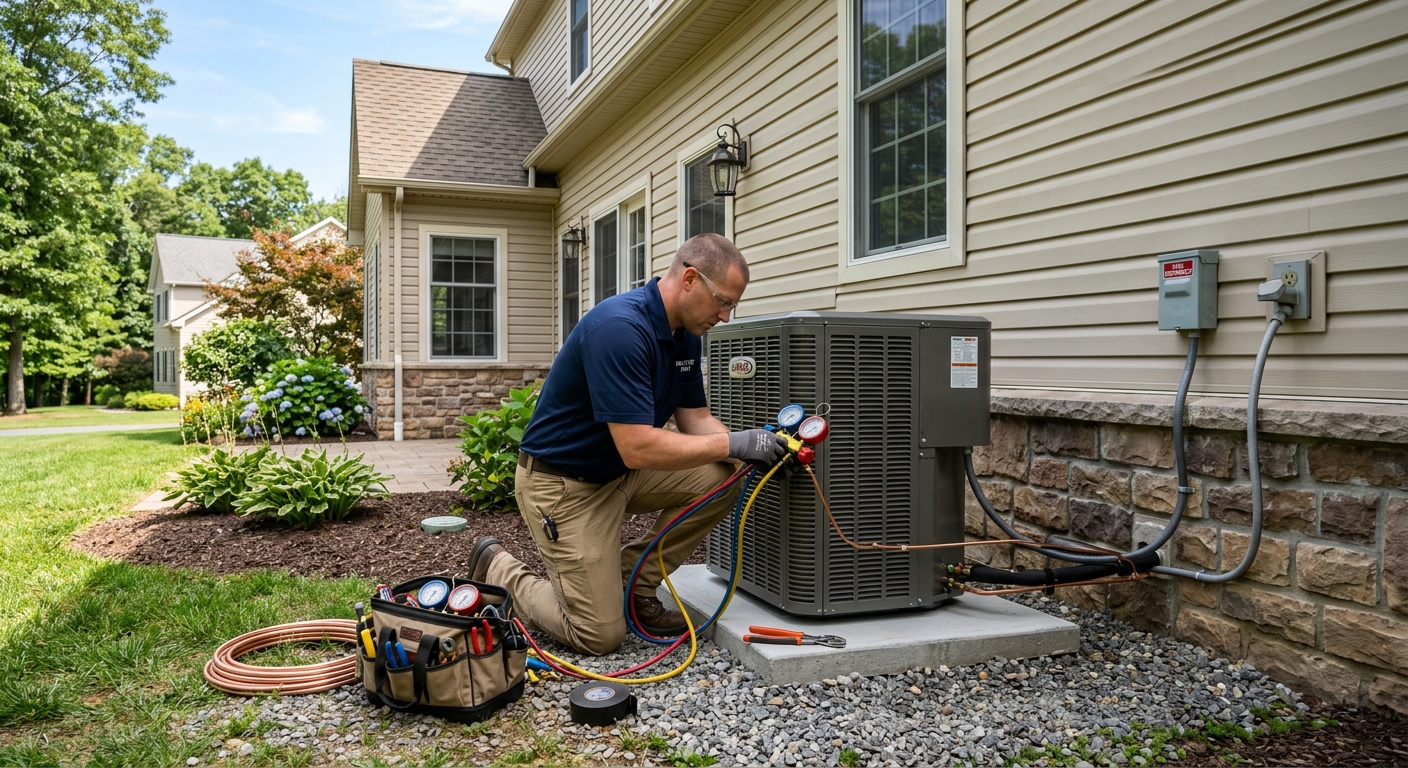
HVAC costs in Martic — 2026
Martic stands out for its high homeownership rate and older single-family housing stock, with over 91% owner-occupied homes and more than a third built before 1980 (U.S. Census Bureau, ACS 2024). That means most HVAC investments are made by owners who plan to live in their homes, not by short-term landlords. While replacement of central air and forced-air systems is common in many parts of Lancaster County, homes without any existing ductwork—or with limited space for new ducts, given the era of construction—often turn to ductless or high-velocity solutions. Many of the county's prewar homes lack large chases and are a poor fit for conventional duct runs, which rules out most budget-level ducted retrofits.
Martic’s climate profile tips the scales toward efficient heating: with 5,200 heating degree days to just 1,250 cooling degree days, we are a heating-dominated market. That means the heating side of your system will work hardest and last the longest, so decisions about system type, sizing, and ductwork are crucial—more so than in a southern market where cooling is the main cost. For homes with sound, existing ducts, a new central AC or ducted heat pump is straightforward. But with so many older homes, plenty of jobs in Martic still require new ductwork or a ductless mini-split when ducts just aren’t practical.
| System |
Best for |
Efficiency |
Price range (installed) |
| Central AC replacement (existing ducts) |
homes with sound ductwork |
16–20 SEER2 |
$5,100–$12,500 |
| Air source heat pump (ducted) |
year-round heating and cooling |
8–10 HSPF2 |
$8,200–$17,500 |
| Cold-climate heat pump (ducted) |
heat pump as primary heat |
9–11 HSPF2 |
$13,500–$17,500 |
| Ductless mini-split (single zone) |
additions, rooms without ducts |
20–30 SEER2 |
$3,300–$7,200 |
| Full duct system installation |
homes with no existing ducts |
— |
$9,200–$18,500 |
Installed estimates for a typical Martic home. Equipment tonnage, duct condition and electrical capacity move these more than brand.
The refrigerant change and what it means for repairs
Most homeowners in Martic have a system using R-410A, which is still legal to service and repair, but the story is changing. Under the federal HFC phase-down, new residential air conditioners and heat pumps are using lower global warming potential (GWP) refrigerants like R-454B and R-32. This change is aimed at reducing greenhouse gas impact, but for those with R-410A systems already installed, no part of this transition makes your equipment illegal or unserviceable.
Here’s what does change: As manufacturers focus on the new refrigerants, R-410A will become less available and more expensive over time. If your system develops a refrigerant leak, the repair bill might climb faster than you expect—not because the work is harder, but because the refrigerant itself could cost much more. This moves the calculation for repairing versus replacing: for a healthy, leak-free system, keep it running. But if you’re facing a major leak, it can tip the scales toward replacement, especially as your system ages.
If you’re installing a new system, you’ll be getting one built for the new refrigerants from the start. For those with an existing R-410A unit in good shape, there’s no forced upgrade, just an economic edge for early adoption if repair costs soar down the line. This federal change reaches every home—urban or rural, town or township—so every contractor you talk to in Martic should be prepared for both systems during this transition.
What a Pennsylvania HVAC contractor must hold
Pennsylvania does not issue a statewide HVAC contractor license for residential work. Regulation happens at the municipal level, which means each city or township in Lancaster County—including Martic—sets its own permitting requirements for mechanical work like heating or air conditioning installation. For any major job, expect a mechanical permit and city or township inspection—especially if you’re adding or replacing central HVAC components.
There are, however, state rules every residential contractor must follow. For contracts over $500, a contractor has to be registered with the state as a Home Improvement Contractor. You should verify this registration at hic.attorneygeneral.gov before signing anything. This registration triggers consumer protection rules as well, including a requirement for a written contract and a three-day right to cancel.
On the technical side, handling refrigerant is a federal matter: all installers and technicians working on your HVAC system should have EPA Section 608 certification. Always ask to see this—the law requires it whenever refrigerant lines are opened, whether for a heat pump or air conditioner.
To confirm a contractor carries valid workers’ compensation, check through the PA Department of Labor & Industry’s WCAIS system at wcais.pa.gov. Most reputable local companies will have their insurance and registration numbers available up front, so there’s no reason to proceed without checking. Permits, insurance and certification are your protection if anything goes wrong on-site.
Heat pump or furnace: what makes sense in Martic
With a winter design temperature of 12°F and 5,200 heating degree days each year, Martic sits squarely in a heating-dominated region. That tips the cost-benefit toward any system that can deliver heat reliably and efficiently through long stretches of cold weather. The old objection that “heat pumps don’t work in the cold” is largely outdated—modern cold-climate heat pumps retain useful capacity at and below freezing—but it’s still the case that their output drops significantly on the lowest few nights of the year. That is why backup heat or dual-fuel systems exist: so you’re not left cold if a deep January snap hits.
Gas service tells the rest of the story. In Lancaster city and the larger townships, natural gas is available and often the most cost-efficient way to heat. But out in Martic and other rural townships, most homes are beyond the reach of the gas grid and rely instead on propane or fuel oil. This matters: modern cold-climate heat pumps now offer operating costs that are highly competitive—and in many cases lower—than propane or oil, especially when paired with a tight home envelope and current electric rates.
A gas furnace is often still the right fit when: (1) you already have reliable ductwork sized for forced air; (2) natural gas is on site; and (3) your home’s envelope is typical—without deep weatherization. If you’re off the gas line or want the option to go all-electric, heat pumps shine here, delivering both heating and cooling in one system and slicing carbon output. Dual-fuel systems make sense for homeowners who want the best-case operating cost even in the deepest cold.
| Option |
Installed cost |
Operating cost here |
Best when |
Incentive eligible |
| Gas furnace + central AC |
$5,100–$12,500 |
low (with gas on site) |
existing gas service, coldest zones |
typically no (AC only) |
| Ducted heat pump (cold climate) |
$8,200–$17,500 |
moderate (depends on insulation/electric rates) |
good envelope, all-electric goal |
yes |
| Dual fuel (heat pump + gas backup) |
$13,500–$17,500 |
lowest (automatic switchover) |
gas on site, deep cold spells |
yes |
| Ductless multi-zone |
$9,200–$18,500 |
lower (no ducts, only use what you need) |
no ductwork, zone control |
yes |
What you can actually claim on a heat pump here
If you’re installing a new heat pump in Martic, you may be eligible for three layers of incentives: (1) a federal tax credit, (2) a utility rebate, and (3) sometimes a state-level program. The federal tax credit is applied when you file your taxes— it reduces the amount you owe the IRS the following year, not your up-front invoice. Utility rebates usually show up as a check or discount directly from your electric provider, after you submit required paperwork post-installation.
PPL Electric Utilities is the main electric provider and UGI Utilities serves most natural gas in larger Lancaster County towns. Both have run efficiency programs offering rebates for qualified heat pump installations in the past. These programs do change—sometimes annually—so you’ll need to check PPL’s energy efficiency program page and plug your ZIP code into the ENERGY STAR rebate finder. Don’t rely on any figure in an article; treat it as a ballpark, never a quote. Rebate amounts, eligibility requirements, and qualifying equipment lists all change more often than most websites update.
Some homeowners in Martic may qualify for incentives if the system and install are done to ENERGY STAR specifications and paperwork is filed properly. A diligent contractor will know where to check and how to handle the documentation, but it’s always wise to visit your utility’s efficiency or rebate page yourself before committing. No one wants to miss out on money by skipping a form or missing a deadline.
Manual J and the tonnage question
One of the most expensive mistakes a contractor makes is oversizing your HVAC equipment. In Martic’s climate, with a 12°F winter design temperature, you need a system sized for the single coldest week of winter—not just the square footage of your home. Oversized units short cycle, causing uneven temps, humidity issues, and much faster wear on expensive parts. It’s not a safety margin; it’s a way to guarantee poor comfort and early breakdowns.
The right way is to have a Manual J load calculation performed for every new install or major replacement. This calculation is a detailed analysis that considers the exact orientation, insulation levels, window type and area, air leakage, and occupancy patterns unique to your home—not a “per square foot” guess. If your contractor never measures windows, doesn’t ask about insulation or air leakage, or simply looks at your old unit’s data tag and matches the size, that’s a red flag. All they’re doing in that case is copying someone else’s (possibly decades-old) error into your new system.
The single most important question to ask is: “Did you run a load calculation, and can I see it?” Anyone serious should have a copy to show. A reputable contractor in Martic will be ready for this as part of their proposal, and if they’re not, they are not taking your comfort or long-term costs seriously.
Duct condition, leakage and sealing
In older Martic homes, especially those from the early 20th century, duct leakage can waste 20% or more of your conditioned air before it ever reaches a vent. This is especially true if your ductwork runs through unconditioned spaces—crawlspaces or attics—or if returns were undersized by earlier standards. Many Lancaster city rowhomes (1880–1930) simply weren’t built with room for modern, insulated ductwork, which is why so many retrofits here use ductless systems or high-velocity ducts run inside small chases.
A duct blaster test is the gold standard for measuring how leaky your system really is. It seals the registers and pressurizes your system, showing exactly how much air is escaping on the way. That tells you if you can get meaningful gains from duct sealing (using mastic, foil tape, or an aerosolized sealant) or are looking at a full replacement. Sealing is often a good investment if your ducts are basically sound but leaky, while replacement or a complete re-design is needed if the runs are too small, disconnected, or run through hot/cold attic corners they were never meant for.
Don’t just size new equipment to the old ducts and hope for the best, especially in a pre-1980 Martic home. Test first. Fix the leaks and restrictions before investing thousands in new equipment, or you’ll never get the comfort and energy savings you paid for. Ask your HVAC contractor what testing will be done on your distribution system, not just the equipment.
Frequently asked questions — HVAC installation in Martic
How long does HVAC installation take in Martic?
For most Martic homes, a standard replacement of a central AC or heat pump with existing ducts typically takes one to three days. If your project involves full duct system installation—common in the area’s older homes that were built before forced air became standard (over a third were built before 1980)—expect the work to stretch over three to seven days, depending on access and any unforeseen repair needs. Ductless mini-split installations, especially single-zone units, can often be completed in a single day. More complex, multi-zone ductless systems may need two to four days. Keep in mind that local permitting and municipal inspection requirements can sometimes add a half day of scheduling, but most contractors in Martic are familiar with the township process and can handle that quickly. No job should ever feel rushed; a proper install is more important than speed. For reference, full duct system installs in the area typically run $9,200–$18,500.
What does a heat pump cost installed in Martic?
Installed costs for a ducted air source heat pump in Martic range from $8,200–$17,500 depending on equipment size, features like variable-speed compressors, and most importantly, the condition and layout of your home’s ductwork. For homes without existing ducts, expect a multi-zone ductless mini-split system to fall between $9,200–$18,500. Installation in a smaller ranch or rowhome with just a single ductless head can be as affordable as $3,300–$7,200. Some contractors offer “typical” prices, but always get a tailored quote after an in-person evaluation, since older construction, existing ductwork, or electrical upgrades can move the price up. Every proposal should spell out both the scope of work and the included equipment model numbers.
What is EPA Section 608 certification?
EPA Section 608 certification is a federal requirement for anyone who installs, maintains, or repairs HVAC equipment that could release refrigerants such as R-410A, R-454B, or R-32. Every HVAC technician working in Martic—no matter which company they work for—must have this certification before legally handling refrigerants. This protects you and the environment by ensuring that technicians are properly trained in safe handling, leak detection, and responsible disposal or recovery procedures. You can (and should) ask to see your technician’s Section 608 card before any work begins, especially with repairs that involve opening up refrigerant lines. Most reputable Martic contractors are used to providing this on request. If your system is being replaced with a new heat pump or AC (with a typical installed price of $8,200–$17,500 for ducted heat pumps), rest assured the crew is covered if you see that certification.
Do older Martic homes need ductwork replaced?
Many older homes in Martic—especially those built before 1980—were never designed for forced-air systems, or have ductwork that’s undersized, leaky, or routed through unconditioned spaces. Whether full replacement is needed depends on a duct blaster test and a thorough inspection, rather than appearance or age alone. In some cases, professional sealing and a few sizing corrections can make old ducts serviceable for new equipment. In others, especially where returns are severely undersized or disconnected, replacement is needed to get proper airflow and top-notch comfort. New full-duct installation usually runs in the $9,200–$18,500 range. If your home is especially tight on space (as many rowhomes are), a ductless solution may ultimately be simpler and cheaper than forcing new ducts into place.
Should I repair or replace my HVAC system in Martic?
The repair-or-replace choice depends on system age, efficiency, repair cost, and refrigerant. If your equipment is under 10 years old, was properly installed, and hasn’t seen recurring problems, a targeted repair is usually the best option. For older systems running R-410A, keep in mind that refrigerant costs are rising as supply tightens due to federal phase-downs. If you’re quoted a repair close to half the cost of a new system—say, more than $4,000–$6,000 out of a possible replacement range of $8,200–$17,500 for a ducted heat pump—it’s wise to consider investing in new equipment. For equipment over 15 years old, especially if it has a refrigerant leak, replacement often delivers better comfort, lower bills, and fewer headaches.
How often should I change my filter?
In most Martic homes, a standard 1-inch fiberglas furnace filter should be replaced every 30–60 days, with the frequency depending on factors like pets, dust, and whether you’re in a rural or more suburban setting. Pleated filters may last up to 90 days, but the best rule is still to check monthly and change when you see visible buildup. If you recently installed a new system—whether a central AC ($5,100–$12,500) or heat pump—delaying filter changes can lead to airflow problems, shorten equipment life, and void the warranty. Many contractors in Martic will offer a filter change as part of annual maintenance, but you’ll save money and avoid service calls by keeping up with it yourself. And don’t forget: filter changes are one of the only maintenance jobs that do not require a mechanical permit in Lancaster County.
What is the R-410A refrigerant phase-down?
R-410A has been the standard refrigerant in central air and heat pumps for nearly two decades, but under federal law, it’s being phased down in favor of lower global warming potential alternatives like R-454B and R-32. In Martic and all of Pennsylvania, this does not make your existing system illegal or unserviceable. You can continue to run and repair your R-410A unit, but as supply drops, the cost of repairs involving refrigerant will go up, nudging some homeowners toward replacement when major leaks happen. New systems, like ducted heat pumps (with typical installed costs of $8,200–$17,500), now ship with the new refrigerants by default. Always discuss refrigerant type with your contractor before signing any contract for installation or repair.
Why do HVAC quotes in Martic vary so much?
Bids for HVAC work in Martic can span several thousand dollars. Major factors include existing ductwork condition (replacement could add $9,200–$18,500), differences in installer experience, equipment efficiency ratings, and whether electrical upgrades are necessary. Older homes also complicate jobs; tight chases, code minimum clearances, and unexpected ductwork or wiring issues can all increase both labor and material costs. Some contractors issue all-inclusive quotes, while others price labor and equipment separately or leave off permits in the initial estimate. Always ask for a full breakdown, including model numbers and details on electrical, refrigerant, and permit work. Cheap up-front jobs often leave out important details that lead to expensive fixes down the line.
Do I need ENERGY STAR equipment to qualify for incentives?
For most heat pump rebates and the federal tax credit in Pennsylvania, equipment must meet or exceed ENERGY STAR specifications. In Martic, that typically means both the heat pump and the installation must be certified—not just the unit’s label. Your utility (like PPL Electric Utilities) and the ENERGY STAR rebate finder will specify exact eligible models and efficiency ratings, which change year to year. If you plan to claim local or federal incentives—sometimes up to 30% of cost on ducted heat pumps in the $8,200–$17,500 range—you’ll want your contractor to submit the paperwork with verified product IDs. Non-certified equipment usually isn’t eligible, and “close enough” doesn’t work on the application. Always double-check before signing, as these rules do change and each program has its own fine print.