HVAC costs in Adams — 2026
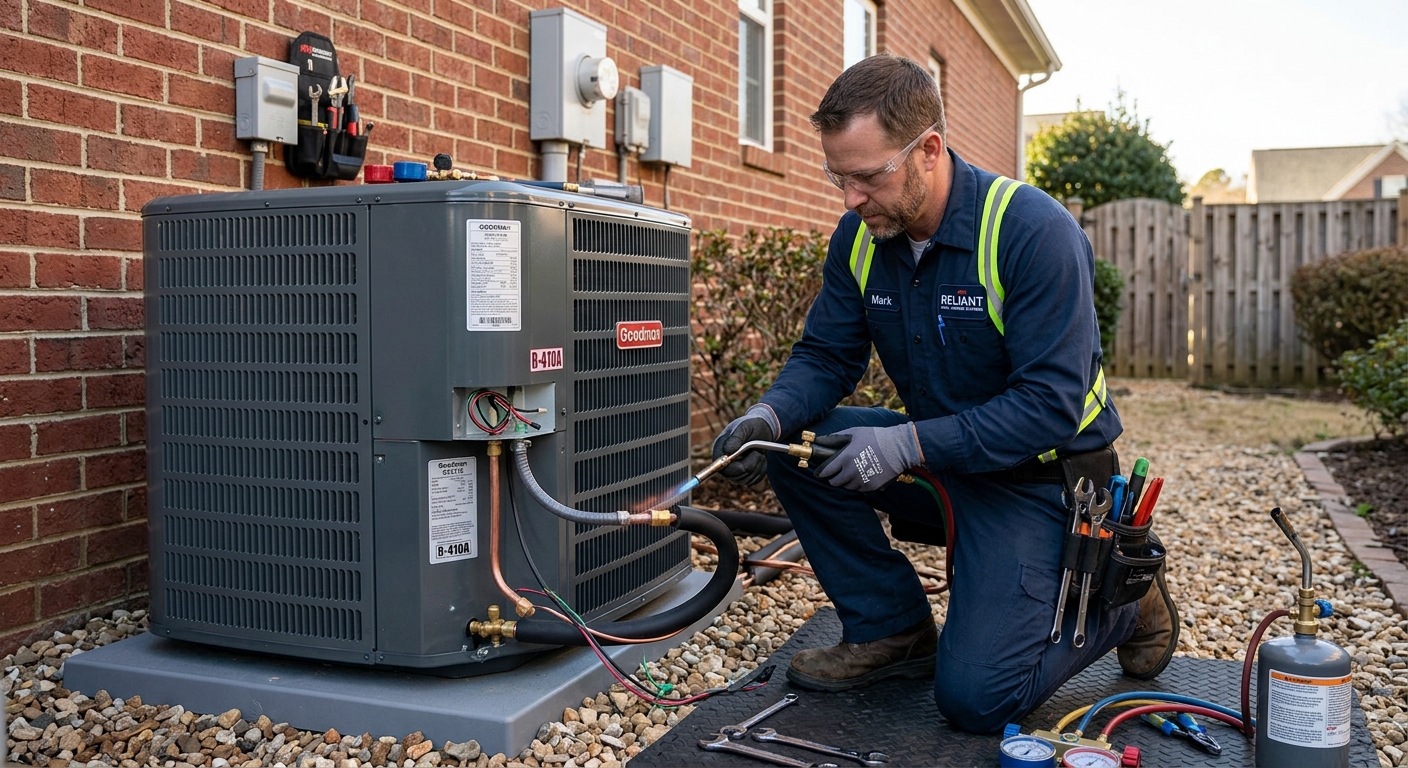
Adams sits in Butler County, a part of the Pittsburgh area where the vast majority of homes—nearly 89%—are owner-occupied (U.S. Census Bureau, ACS 2024), and much of the local housing was built from the 1990s through 2010. That means homeowners today are contending less with the challenges of retrofitting, and more with the first-time replacement of 20- to 25-year-old forced-air systems installed when these subdivisions took off. Most Adams homes already have central ductwork, and unless the house predates 1980 (15.3% do), replacing the central AC or adding a heat pump is usually a matter of swapping equipment onto existing ducts, not gutting and rebuilding.
Our local climate is heating-dominated, with 5,600 heating degree days and just 1,050 cooling degree days per year. Heating performance takes priority in system choices, and the efficiency premium pays back faster on the heating side than the cooling side. If you’re considering a system upgrade or replacement, keep in mind utility availability: natural gas is widely available, but some outlying homes rely on propane or fuel oil.
| System |
Best for |
Efficiency |
Price range (installed) |
| Central AC replacement (existing ducts) |
homes with sound ductwork |
16–20 SEER2 |
$5,600–$13,500 |
| Air source heat pump (ducted) |
year-round heating and cooling |
8–10 HSPF2 |
$9,000–$19,000 |
| Cold-climate heat pump (ducted) |
heat pump as primary heat |
9–11 HSPF2 |
$14,500–$19,000 |
| Ductless mini-split (single zone) |
additions, rooms without ducts |
20–30 SEER2 |
$3,600–$7,900 |
| Full duct system installation |
homes with no existing ducts |
— |
$10,000–$20,500 |
Installed estimates for a typical Adams home. Equipment tonnage, duct condition and electrical capacity move these more than brand.
The decision point on an aging system
Replacing a system in Adams is not a quick decision, especially in a heating-dominated market where the winter stretches equipment to its limits. Most local owners should weigh the age of the equipment first: if your central AC or heat pump is under 10 years old and faces a single failed part, repair it and don’t overthink. If it’s over 15 years, any major failure (compressor, heat exchanger, or full refrigerant leak) means you’re gambling on borrowed time. The largest repairs are often half or more of the cost of a full replacement, without the warranty or modern efficiency. Adams homes seeing frequent repairs at 15–20 years are textbook candidates for replacement, especially if utility costs stay high.
Two situations leave no safe choice but replacement: a cracked heat exchanger (fire hazard and carbon monoxide risk), and a compressor failure in a system at end of life. Pay attention to your refrigerant type—systems running R-22 (phased out) are rarely worth keeping. Lastly, don’t assume that high energy bills mean your equipment is shot; badly sealed ducts or air leaks are a much cheaper fix that pays back faster in our climate.
| Situation |
Recommendation |
Typical cost |
Reasoning |
| Under 10 years, single component failure |
Repair |
$300–$1,200 |
Most parts still under warranty; best ROI |
| 10–15 years, repair over a third of replacement |
Consider replacing |
$5,600–$13,500 |
String of smaller failures often follows |
| 15+ years, any major failure |
Replace |
$5,600–$13,500 |
Unit at end of service life |
| Cracked heat exchanger, any age |
Replace immediately |
$5,600–$13,500 |
Safety hazard—cannot repair safely |
| Compressor failure past warranty |
Replace |
$9,000–$19,000 |
Majority of system cost, no warranty |
| Working system, high bills |
Test ducts and envelope first |
$300–$800 |
Air sealing and duct repair often solve it |
Reading the yellow label
Each HVAC system is tagged with numbers like SEER2 (cooling efficiency) and HSPF2 (heating efficiency). The higher the SEER2, the less electricity it takes to provide cooling; HSPF2 tells you how efficiently a heat pump provides heat. This is critical in our county because Butler’s climate is heating-dominated, with five times as many heating degree days as cooling degree days. Here, HSPF2 means more to your wallet across a year than SEER2 ever will.
Paying for the very top SEER2—above 18 or 20—will not pay back for most Adams homes, given our milder summers and relatively short cooling season. By contrast, bumping HSPF2 from the minimum (about 8) up toward 10 or 11 has real payback during our long winter. It’s also worth knowing that recent rating changes mean SEER2 and HSPF2 ratings are stricter than the old SEER and HSPF numbers, so don’t compare new systems to old yellow labels. If your installer tries to upsell you on ultra-high cooling efficiency, know that, in this part of Butler County, that money is better spent tightening up ducts or improving heating performance.
Retrofit versus replacement in Adams
The housing in Adams, like much of Butler County, skews newer suburban, with less than 16% predating 1980. That tips the balance toward replacement (rather than deep retrofit) for most jobs. Most Adams homes will have central ductwork already in place, sized for both heating and cooling—especially if built since the 1990s. This is a best-case scenario for equipment swap-outs: ductwork is usually sufficient in both size and layout, and builder-grade units from the late-90s subdivision boom are now at their end-of-life mark after 20–25 years.
If your home is one of the few built before 1980, you’ll want to check that ducts exist (some older homes ran baseboard or boiler heat only), and that they’re properly sized for cooling—older designs sometimes sized only for heat and lack return air from bedrooms. Many homes built since the 1990s still have basic insulation and average window quality, which keeps replacement costs predictable. Upgrading to a high-efficiency heat pump may require a quick check on electrical panel capacity, but most Adams homes have adequate service. Gas furnace replacements need a solid, lined chimney or compatible PVC venting—again, more often an issue in the older segment.
Choosing an installer in Butler County
Brand matters far less than workmanship—two identical central ACs installed by different contractors can differ wildly in efficiency, reliability, and life span. In Butler County, always verify a company's Home Improvement Contractor registration for contracts over $500, and make sure the technician handling refrigerant has active EPA Section 608 certification. A trustworthy installer will perform a Manual J load calculation specific to your home and document exact model numbers, not just “3-ton unit.” Ask whether startup commissioning—measured airflow and refrigerant charge—is included and if you’ll get the report. Good contractors here will know the codes in your municipality, not just “state code,” and won’t cut corners around duct sealing or insulation.
- Verify HIC registration at the official state registry before signing anything
- Ask for proof of EPA 608 for the refrigerant tech
- Request references with recent jobs in Adams or nearby
- Insist on a Manual J load calculation, not a “rule of thumb” sizing
- Ensure the bid includes model numbers, SEER2/HSPF2 specs
- Check whether measured commissioning is standard practice
- Confirm written warranty terms—parts and labor, not just manufacturer
- Ask if they’ll seal or repair existing ductwork as needed
- Require documentation of liability and workers’ compensation insurance (see WCAIS)
- If old unit is R-22, ask about safe removal and EPA compliance
- Check if permit and inspection are included in the price
- Never accept a “sign today” or “no permit needed” pitch in a regulated township
With Cranberry Township full of larger HVAC contractors and rural Adams seeing fewer, don’t assume the slickest sales pitch equals quality. One-man shops here do some of the best work—but only if they back it up with insurance, documentation, and transparent bidding.
Permits, licensing and inspections in Adams
Pennsylvania does not have a statewide HVAC trade license for residential work—contractor registration is handled through the Home Improvement Contractor (HIC) program for jobs over $500, which is mandatory for both large and small companies. Mechanical permits and code enforcement are administered by local municipalities, not the state: Cranberry Township, for instance, requires a permit for all new and replacement HVAC systems, while neighboring Butler City does not require a permit for window ACs. Always ask your installer if they are pulling the correct mechanical permit for your specific township.
Handling refrigerants (like R-410A and R-32) requires EPA Section 608 certification—this is a federal requirement and applies everywhere. To be sure your installer is legitimate, verify their workers' compensation insurance through the WCAIS system. Insurance and proof of registration protect both parties in the event of an injury or dispute. Homeowners in Pennsylvania are protected under the Home Improvement Consumer Protection Act, which requires a written contract, prohibits waiving your deductible, and gives you three business days to cancel.
Mini-splits and zoning in Adams homes
Ductless mini-splits are a smart fit in Adams for rooms the duct system never reached—finished attics, additions, basements and that one home office always five degrees off. In the older segments of housing stock, where ductwork is difficult or impossible to snake through finished walls and plaster, a well-placed ductless head avoids the mess and cost of major renovation. Mini-splits are also unbeatable when you want true zoning—control over temperature in each space. For additions or garage conversions, installing a single-zone mini-split at $3,600–$7,900 is usually far less intrusive and disruptive than hacking the main ductwork.
In contrast, trying to tie multiple zones to a single outdoor unit can fail to deliver comfort if rooms have different usage or sun exposure—a pair of single-zone units may cost more up front but work better than one large multi-zone. Head placement is part utility, part aesthetics; many Adams homeowners object to the look, but the tradeoff is little to no wall or ceiling repair. Don't forget about draining condensation: proper handling avoids mold and drywall damage. With Adams dominated by forced-air systems from the late-1990s onwards, most homeowners turn to ductless systems only for “problem” rooms, but in older homes, a mini-split may solve heating and cooling better than any retrofit with ducts.
Frequently asked questions — HVAC installation in Adams
Do I need a permit to replace HVAC in Adams?
In Adams and most parts of Butler County, whether you need a permit comes down to your municipality’s requirements. For example, if you live in Cranberry Township, any new or replacement HVAC system requires a mechanical permit issued by the township. Skipping this step could mean the township won’t inspect the job, which may become a problem if you ever sell your home or have warranty or insurance claims. In less regulated areas like Butler City, portable room ACs won’t require a permit, but any permanent replacement—especially new ductwork or a heat pump—should still be permitted for safety and resale value. Permit fees are usually a few hundred dollars, on top of project costs like $5,600–$13,500 for an AC replacement. Ask your installer to handle permits; reputable contractors in Adams routinely include this.
What does a ductless mini-split cost in Adams?
For a single-zone ductless mini-split in Adams, installed costs run between $3,600–$7,900. That typically covers a single head, an outdoor unit, line set, wall penetration, mounting, and electrical hookup. Costs land near the high end if you have a challenging installation—like a finished attic with no easy exterior access—or if you opt for a premium-brand system. Multiple heads on a single outdoor unit will add to the project total. In Adams, most ductless systems are used to solve for additions or spaces without ductwork, and it’s rare to see a whole-house mini-split except in older homes with boiler heat. Always make sure the installer includes the electrical work in the quote, as some Adams homes may need a panel upgrade if power is tight.
What is commissioning and why does it matter?
Commissioning is the step where your installer verifies that the HVAC system wasn't just installed, but installed right. In Adams, commissioning means a technician takes measurements for airflow, refrigerant pressure, electrical draw, and temperature split after turning the system on for the first time. They document those numbers—ideally giving you a printout—so you know the equipment is operating to manufacturer spec. It’s easy for an unscrupulous or rushed installer to skip this, which can lead to years of higher bills or early system failure. In Butler County’s climate, especially, correct refrigerant charge and airflow ensure efficient, reliable heating in deep winter. Getting this documentation up front protects your investment—whether you spent $9,000–$19,000 on a heat pump or just replaced a coil.
How is a tax credit different from a rebate?
In Adams, you might see rebates advertised by local utilities or manufacturers, and hear about federal tax credits for high-efficiency HVAC. A rebate is typically a cash-back offer—say, from West Penn Power or the equipment maker—delivered after you submit paperwork post-installation. It’s a direct reduction in what you pay, often applied quickly. A tax credit, by contrast, reduces your income tax owed; you claim it when you file your federal return for the year the equipment (like a $14,500–$19,000 cold-climate heat pump) was installed. You may get both for the same job. Credits are more predictable but depend on your tax situation; rebates can run out or start and stop during the year, especially in Adams where demand is high during peak replacement seasons.
Why are my Adams energy bills high with a new system?
A new HVAC system should bring energy bills down, but in Adams, there are a few reasons why that doesn’t always happen. First, duct leakage is common even in homes built during Cranberry Township’s 1990–2010 boom, especially where builder-grade ductwork wasn’t sealed or insulated well. Second, heat loss through older windows or minimal attic insulation can cancel out new equipment gains. If your energy use is high after spending $9,000–$19,000 on a new heat pump, the culprit is often outside the equipment—test for duct leaks, and consider attic air sealing before blaming your installer. Fuel type matters too: propane and fuel oil are pricier here than natural gas. Your installer—or a local energy auditor—can pinpoint leaks and suggest the cheapest fixes.
Do older Adams homes need ductwork replaced?
In Adams, most homes were built since the 1990s and their ducts are usually in good shape for a second generation of equipment. However, in the 15% of houses that predate 1980, ductwork may be poorly sized, uninsulated, or even missing entirely—especially if the original heating was by boiler or baseboard. Where accessible, replacing all ductwork runs $10,000–$20,500, but for most Adams homes, spot repair, sealing, and adding insulation accomplishes nearly as much for much less money. Full replacement only makes sense if ducts are asbestos-lined, rusted through, or can’t deliver enough air for new high-efficiency equipment. Your installer should show you pressure and airflow numbers—not just guess—before recommending “rip and replace.”
What is a Manual J load calculation?
A Manual J load calculation is a room-by-room, computer-modeled estimate of how much heating and cooling your home requires. In Adams, with varied home sizes and insulation levels, a Manual J prevents over- or undersizing—a common problem with builder-grade replacements from the pre-2010 boom. Instead of guessing based on square footage, the calculation considers window type, insulation, orientation, local design temps (like our 8 °F winters), and even your lifestyle. This ensures you don’t put in a $9,000–$19,000 system when a smaller or larger one is needed. A reputable Adams contractor should always include a Manual J in their bid, and you’re entitled to see the calculation.
Do I need dual fuel in southwestern Pennsylvania?
Dual fuel means pairing a heat pump with a gas furnace as backup. In Adams, where winters are cold but not arctic, some homeowners benefit from dual fuel, especially if on propane or fuel oil—since electric rates with a cold-climate heat pump may be lower than fossil fuels down to a certain outdoor temperature, but not when the mercury drops below design temp. For most Adams homes with natural gas, a high-efficiency furnace alone or a newer cold-climate heat pump is enough. But if your existing equipment is aged, consider dual fuel if your bids for a heat pump alone approach $19,000; the small upcharge for keeping or upgrading your furnace gives you backup and control over utility costs as seasons change.
Is a high-efficiency system worth the extra cost here?
In Adams, a high-efficiency system—especially for heating—often justifies its extra upfront cost. Cold winters mean you’ll see more return on higher HSPF2 heat pumps or 95%+ AFUE furnaces than you would in milder climates. That said, there’s a limit: you rarely recoup the jump to ultra-premium cooling (SEER2 above 20) because Butler County gets only 1,050 cooling degree days. A central AC or heat pump in the range of $14,500–$19,000 for high-end equipment makes sense if your old unit is 20+ years old, you plan to stay in the house, and you seal your ducts and envelope. Don’t overspend for cooling efficiency that you’ll rarely use—put your budget toward insulation and airtightness where it counts.