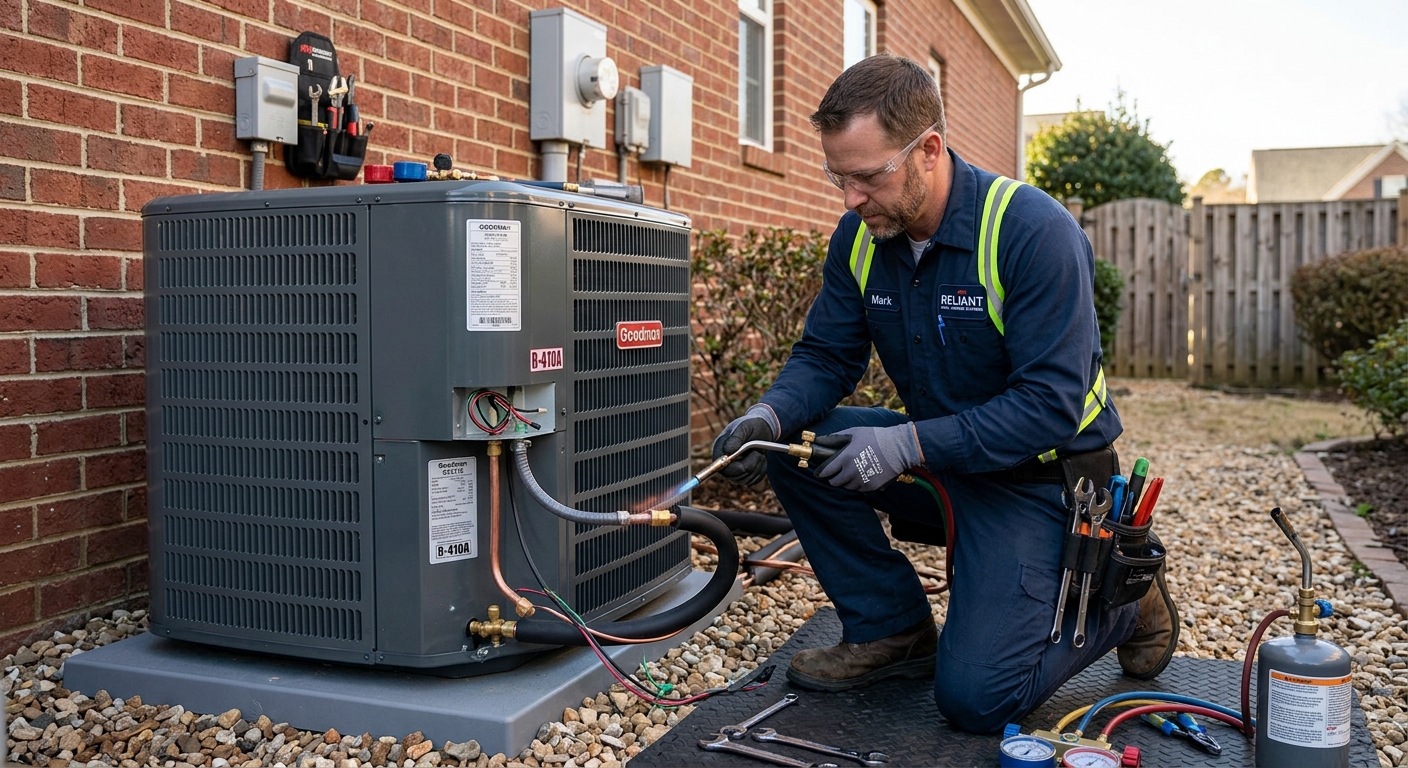
What a new HVAC system costs in Adams
Adams, like much of Cambria County, is a market where replacement and retrofit HVAC jobs far outnumber installations in new builds. With a homeownership rate of 88.6% and over 72% of homes built before 1980 (U.S. Census Bureau, ACS 2024), homeowners here are often upgrading out-of-date systems or installing central heat and cooling for the first time. Johnstown’s older, smaller homes rarely have modern ductwork, so adding central air or heat can mean new duct installation on top of equipment costs. If your Adams home has solid existing ductwork, central air replacement runs lower, but many homes require extensive retrofits or turn to ductless solutions for additions or rooms that can’t be reached by ducts.
This region’s climate is heating-dominated, with 6,300 heating degree days and just 750 cooling degree days. That means heating is the major expense and comfort driver—not cooling. When you’re weighing a system upgrade or replacement, it’s vital to choose equipment that can handle a long, tough heating season and a few muggy summer weeks.
| System |
Best for |
Efficiency |
Price range (installed) |
| Central AC replacement (existing ducts) |
homes with sound ductwork |
16–20 SEER2 |
$4,800–$11,500 |
| Air source heat pump (ducted) |
year-round heating and cooling |
8–10 HSPF2 |
$7,800–$16,500 |
| Cold-climate heat pump (ducted) |
heat pump as primary heat |
9–11 HSPF2 |
$12,500–$16,500 |
| Ductless mini-split (single zone) |
additions, rooms without ducts |
20–30 SEER2 |
$3,100–$6,800 |
| Full duct system installation |
homes with no existing ducts |
— |
$8,700–$17,500 |
Installed estimates for a typical Adams home. Equipment tonnage, duct condition and electrical capacity move these more than brand.
What a real HVAC quote contains
A legitimate HVAC quote in Adams should break down far more than just a brand name and a bottom-line price. Insist on seeing model numbers for both the indoor and outdoor units—mixing brands or models can tank efficiency. The quote should include the equipment’s tonnage, with an attached Manual J or equivalent load calculation that matches the system size to your house’s specifics, not just what’s sitting there now. Check if line sets (the copper refrigerant pipes) are being replaced or reused—old lines can harbor contaminant or size mismatch. Any significant electrical work, up to and including a panel upgrade, should be detailed with costs. Thermostats, condensate drains or pumps, and a mechanical permit (where required) must show on the document.
Crucially, compare labor warranty (the installer's part) separately from the manufacturer's equipment warranty. And you want a commissioning report—a summary showing that airflow and refrigerant charge were measured and dialed in after install. Quotes missing these details can't be compared apples-to-apples. If you get a one-liner—“Install Brand X, $6,500”—you don’t have a real quote, and probably aren’t dealing with a reliable contractor.
| Line item |
What to look for |
Red flag if… |
| Equipment |
model numbers, indoor and outdoor matched |
brand name only |
| Sizing |
load calculation attached |
matched to the old nameplate |
| Ductwork |
condition assessed, sealing scoped |
not mentioned |
| Electrical |
circuit and panel capacity confirmed |
assumed adequate |
| Line set |
replaced or documented as reused |
silent |
| Commissioning |
measured airflow and charge, documented |
no startup report |
| Warranty |
labour years stated separately |
manufacturer only |
| Permit |
included and priced |
'not needed' |
Permits, licensing and inspections in Adams
In Adams and the rest of Cambria County, there is no statewide HVAC license. Instead, residential work is regulated at the municipal level—meaning your township or borough code office, not Harrisburg, sets the requirements for installation and inspection. Contractors working on jobs over $500 are required to be registered as a Home Improvement Contractor through a state office, which you can check online before hiring. This is not a skills-based license, but it does enable the state to enforce consumer protection laws and gives you a place to file a complaint in a dispute.
Anyone who handles refrigerant—installers, not just companies—must have EPA Section 608 certification. This is federal law, so it applies to your Adams job regardless of local rules, and you have every right to ask to see this proof for the tech doing the work. Mechanical permits are typically required for complete new HVAC system installs or replacements with new ductwork, especially within the City of Johnstown; smaller repair jobs often do not trigger permits. If there are multiple trades on site, electrical and plumbing require separate municipal permitting systems, not a state license. For protection, check contractors’ insurance and workers’ compensation with the state’s online system before signing any agreement.
Humidity and air quality in Adams homes
Here in north-central Pennsylvania, our long, cold winters (6,300 heating degree days) mean dry indoor air is the biggest comfort complaint from November to March. Whole-house humidifiers can help, but they require annual cleaning and careful setup to avoid mold or mineral buildup; many units installed in Adams over the years have fallen into neglect, causing more trouble than they solved. Don’t assume every home needs one—run a $15 hygrometer for a few weeks in winter before buying.
Summers, though short, are muggy. Oversized air conditioners—a common problem in older Adams homes—can cool air too fast for proper dehumidification, leaving the space cold but clammy. Properly sized systems running longer cycles do a much better job. For filtration, don’t chase high MERV filter ratings unless your system was built for them; a very dense filter can actually reduce airflow, hurting both comfort and equipment life. If your home is newer and tightly sealed, mechanical ventilation (an HRV or ERV) can keep air fresh and balance moisture. But indoor air “add-ons” (UV lights, ozone generators) are rarely needed in Adams homes, and you’re usually better off with basic humidity control and regular filter changes.
What size system does a Adams home need?
The most common and costly HVAC mistake in Adams is oversizing—that is, installing a system that’s too big for the home. Bigger isn’t better: an oversized furnace or AC will short cycle (turn on and off rapidly), causing uneven temperatures, poor dehumidification, and unnecessary wear. Far from being a safety margin, oversizing is a built-in defect that can chop years off equipment life and drive up utility bills.
Correct sizing depends on a Manual J load calculation—this is a standardized method of accounting for your home’s insulation, windows, orientation, air leakage, and local climate. In Adams, the calculation is tuned to a winter design temperature of 2 °F; this is the number that determines your system’s heating capacity, and why back-of-napkin “square-footage per ton” rules don’t cut it. Ask your contractor, “Did you run a load calculation, and can I see it?” If the answer is no or the proposal simply matches the old unit’s nameplate, you’re probably inheriting someone else’s error. Equipment that’s too small is rare here, but it’s possible—especially if upgrades like new windows or insulation have changed your home’s needs since that last install.
Don’t accept sizing based on rough estimates or what worked “next door.” Adams homes, particularly older ones, can have wildly different needs from room to room, let alone street to street.
Gas, electric or both in north-central Pennsylvania
When deciding between a gas furnace, a heat pump, or a dual-fuel system in Adams, the numbers from this county matter more than any nationwide trend. Our climate is heating-dominated, with a winter design temperature of 2 °F and 6,300 heating degree days every year. For those cold months, reliable heat is non-negotiable.
Modern cold-climate heat pumps (with a rated HSPF2 of 9–11) can heat efficiently to about 0–5 °F—they’re not the same as 1990s models, and the old “heat pumps don’t work here” objection is now dated for all but the most severe cold snaps. That being said, their output drops as temperatures fall, so in the coldest stretches you’ll want either a beefy electric backup or a gas furnace to carry you through (this is where dual-fuel setups shine).
In central Johnstown, Richland, and Westmont, natural gas is widely available and often the lowest-cost option to operate when compared to electric or propane. In northern Cambria County, where many homes depend on propane or fuel oil, a cold-climate heat pump suddenly looks far more appealing—the gap in operating cost closes and, in some cases, reverses. If you already have natural gas and a reliable furnace, keeping or replacing it still makes solid sense for backup on the coldest nights. Otherwise, consider a heat pump or dual-fuel solution.
| Option |
Installed cost |
Operating cost here |
Best when |
Incentive eligible |
| Gas furnace + central AC |
$4,800–$11,500 |
lowest with gas service |
existing gas service, coldest zones |
possible |
| Ducted heat pump (cold climate) |
$7,800–$16,500 |
similar to propane, lower than oil |
good envelope, all-electric goal |
likely |
| Dual fuel (heat pump + gas backup) |
$12,500–$16,500 |
switches to lowest cost fuel |
gas on site, deep cold spells |
likely |
| Ductless multi-zone |
$8,700–$17,500 |
zone by use, minimal ducts |
no ductwork, zone control |
likely |
Separating installers from equipment sellers
In Adams, the difference between a top-performing HVAC system and a headache-laden money pit comes down much more to installation than brand. The same air conditioner, heat pump, or furnace can deliver years of comfort or a parade of breakdowns—depending entirely on whether your contractor knows this county’s old construction and colder climate, runs proper load calculations, and commissions the system.
Before you sign, verify the company’s Home Improvement Contractor registration using the state’s official database. For the techs who charge refrigerant, ask directly to see EPA Section 608 certification—it’s your legal right. Every real quote should list full equipment model numbers, include an attached load calculation, and spell out what’s happening with the ductwork and line sets. Look for a written commissioning report stating measured airflow and refrigerant charge at startup, not just a checkbox.
- Home Improvement Contractor (HIC) registration number, verifiable online
- EPA Section 608 card in the technician’s name
- Manual J or equivalent load calculation provided
- Equipment model numbers (not just brand or tonnage)
- Circuit and panel amp checks for electrical compatibility
- Duct condition assessed and any repair/sealing scoped
- Detailed line-set replacement or cleaning info
- Permit fees stated if job requires permitting
- Separate labor and equipment warranty terms
- Written commissioning/startup report with airflow and charge data
- Startup support and tune-up included for first season
- References from recent Adams or Johnstown jobs, not just “area”
Be cautious if you’re quoted “next week” installations in rural northern Cambria townships—contractor density is low and out-of-area firms often tack on travel surcharges or skip commissioning. If a proposal skips any of the above checks, keep shopping.
Frequently asked questions — HVAC installation in Adams
How is a tax credit different from a rebate?
In Adams and across Pennsylvania, a tax credit lets you claim a portion of your HVAC project cost—such as upgrading to a cold-climate heat pump—when you file your federal taxes. You get a percentage of the cost back, up to a limit, and it directly reduces what you owe in taxes, but only after you’ve paid the full price up front. A rebate, on the other hand, comes as an instant discount or a check sent to you after installation, usually offered by utility companies or local programs. For example, if you install a ducted heat pump with an installed price of $7,800–$16,500, you might qualify for a utility rebate plus a federal tax credit, but you pay the contractor first, then file the paperwork. Tax credits require you to keep records for tax time; rebates require submission within a set window.
Should I repair or replace my HVAC system in Adams?
In Adams, with many homes built before 1980 and frequent retrofits, the “repair or replace” call hinges on system age, condition, and efficiency. If your furnace or AC is under 12 years old and hasn’t needed frequent repairs, fixing it usually makes sense unless you’re facing a major failure (such as a compressor or heat exchanger). But if your equipment is older, uses R-22 refrigerant, or struggles to keep up with Adams’s long heating season, you’re often better off replacing. That’s especially true if ductwork is leaking or you’re considering a whole-home comfort upgrade. Newer options like ducted heat pumps can save on operating costs, and while a replacement costs $4,800–$11,500 or more, the long-term reliability often pays out in fewer service calls and lower bills.
Is natural gas available throughout Cambria County?
No—natural gas is broadly available only in central Johnstown, Richland, and Westmont. Much of northern Cambria County, including parts of Adams Township, relies on delivered propane or fuel oil. If you’re thinking about a furnace and you’re outside those main service areas, check which fuel is actually piped to your street. The difference affects every price and recommendation: a gas furnace and central AC package in gas-served neighborhoods might run $4,800–$11,500, but switching to a heat pump makes more sense when propane or oil are your only alternatives. Always confirm your fuel choices before signing a contract.
Is a high-efficiency system worth the extra cost here?
In Adams, the long heating season (6,300 heating degree days) means you spend more running the furnace or heat pump than you do the AC each year. Upgrading to a high-efficiency system—a cold-climate heat pump or a 95%+ AFUE furnace—can cut yearly bills, especially if you’re switching from older, less efficient gear. That said, not every home benefits equally: if your ductwork leaks or your home’s envelope is poor, a top-tier system won’t pay off without sealing those gaps first. The price for a high-efficiency ducted heat pump runs $12,500–$16,500 installed. Spend on efficiency when you plan to stay in your home and your utility rates justify the difference, but don’t overbuy for a leaky house or short-term ownership.
What is a Manual J load calculation?
A Manual J load calculation is a detailed formula contractors use to size your HVAC system based on your specific Adams home—not just square feet, but insulation, windows, doors, and even local winter lows (2 °F for this region). It’s the only reliable way to avoid oversized or undersized gear. Without it, you risk short cycling, poor comfort, and higher bills. Insist that your contractor includes a printout or digital copy with your quote. If you’re paying $7,800–$16,500 for a new system, demand a load calc—guesswork isn’t good enough in our climate.
What is EPA Section 608 certification?
EPA Section 608 certification is a federal credential required for anyone handling refrigerants during HVAC installation or service—an absolute must for work in Adams or anywhere else in Pennsylvania. It ensures the technician knows how to safely handle, recover, and dispose of refrigerant to prevent environmental harm. For you, it’s your best assurance the tech is trained on the part of the job that can shut down your system (or net a hefty fine if done wrong). Always ask to see this card from the installer; don’t confuse it with the contractor’s general registration. If you’re paying $3,100–$6,800 for a mini-split, or any system with refrigerant lines, 608 certification protects your investment.
How long should an HVAC system last in Adams?
In Adams, most well-installed furnaces and heat pumps last 15–20 years on average, but older models—especially forced-air systems in homes built before 1980—sometimes fail sooner due to aging ductwork or heavy use from long winters. Regular maintenance can extend service life, but if your system is approaching the two-decade mark and giving you trouble, budget for replacement. The cost for a ducted heat pump or furnace/AC pair starts at $7,800–$16,500 installed. Systems with chronic short cycling, uneven comfort, or multiple costly repairs are good candidates for early upgrade in our harsh climate.
What does a ductless mini-split cost in Adams?
For a single-zone ductless mini-split—good for additions, bonus rooms, or spaces lacking existing ductwork—Adams homeowners can expect a fully installed cost between $3,100–$6,800. Older homes around Johnstown often turn to mini-splits for hard-to-cool rooms or retrofits where adding new ducts isn’t practical. These are all-in numbers, covering equipment and the specialized labor for wall penetration and line set. Multi-zone units run higher, particularly if you’re air conditioning several rooms at once. Quality installation—done to federal and local standards—matters more to comfort than brand or oversizing on capacity.
What is commissioning and why does it matter?
Commissioning means the contractor ran your new HVAC system and verified, with real measurements, that airflow, refrigerant charge, and controls all work as designed. For Adams, where old homes and duct runs are common, a commissioning report protects your investment: it catches install errors, stops short cycling, and ensures you’re getting the efficiency you’re paying for. If a system costing $8,700–$17,500 (like a new ducted heat pump with ductwork) isn’t commissioned, you’re gambling with comfort and lifespan. Always ask for a written report with your install—“we flipped it on and it runs” is not commissioning.