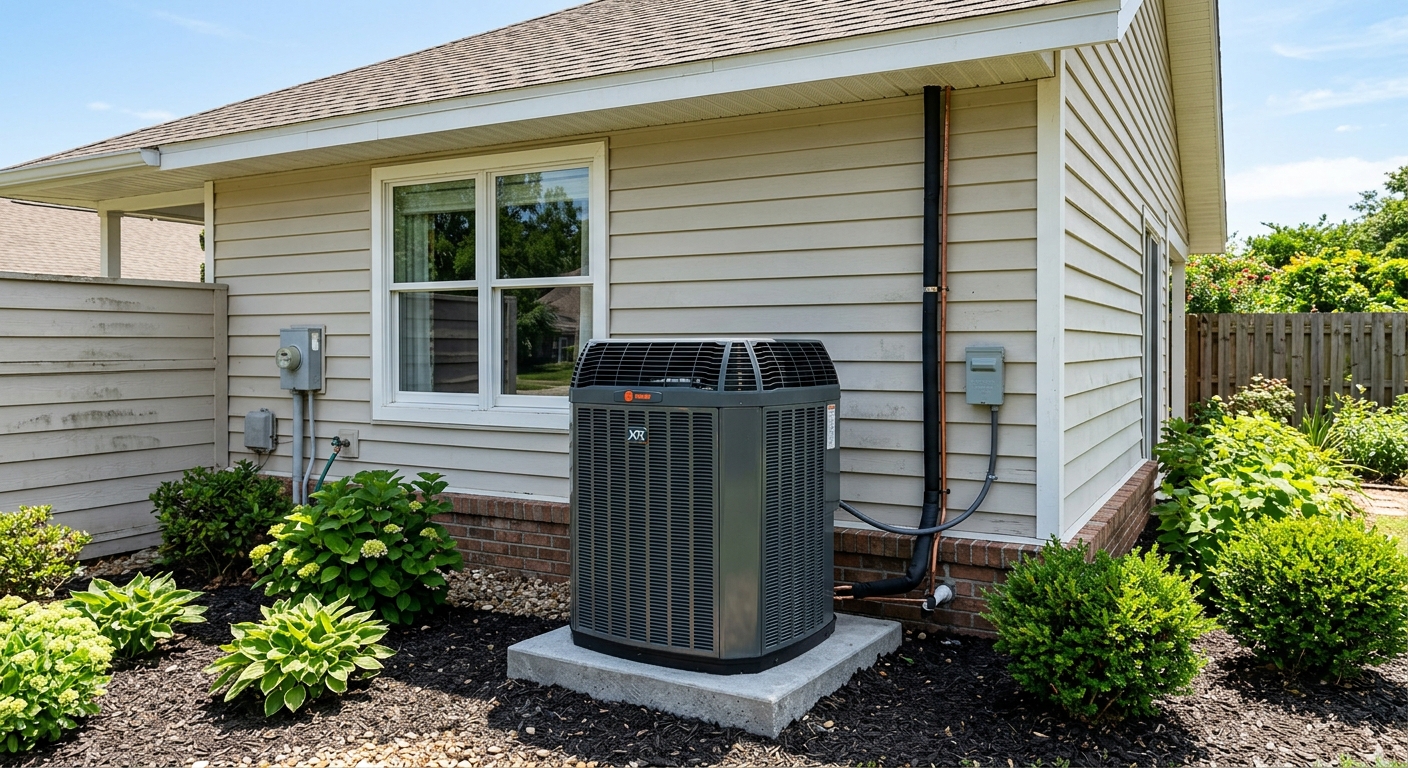
HVAC costs in Allen — 2026
Allen’s mix of well-established households and older homes shapes the HVAC decisions most local homeowners face. With 80.4% homeownership and about one-third of homes built before 1980 (U.S. Census Bureau, ACS 2024), much of what gets installed or replaced here is tailored retrofit work, not quick swaps. The high share of homes predating central air means it’s common to encounter legacy heating setups, often without ductwork sized for today’s high-efficiency equipment. In neighborhoods similar to Bethlehem and Easton, early-1900s rowhomes complicate outdoor condenser placement and running new ducts—something many Allen properties share.
Our region is heating-dominated, not cooling: With 6,100 heating degree days versus only 850 cooling degree days per year, systems here must prioritize reliable, efficient heating above anything else. This puts heat pumps and gas furnaces at center stage, with air conditioning a strong seasonal demand but rarely the primary driver. Below, you'll find real cost ranges for the equipment types you're most likely to consider in Allen. All estimates reflect complete installed prices based on current market conditions:
| System |
Best for |
Efficiency |
Price range (installed) |
| Central AC replacement (existing ducts) |
homes with sound ductwork |
16–20 SEER2 |
$5,300–$12,500 |
| Air source heat pump (ducted) |
year-round heating and cooling |
8–10 HSPF2 |
$8,400–$18,000 |
| Cold-climate heat pump (ducted) |
heat pump as primary heat |
9–11 HSPF2 |
$13,500–$18,000 |
| Ductless mini-split (single zone) |
additions, rooms without ducts |
20–30 SEER2 |
$3,400–$7,400 |
| Full duct system installation |
homes with no existing ducts |
— |
$9,500–$19,000 |
Installed estimates for a typical Allen home. Equipment tonnage, duct condition and electrical capacity move these more than brand.
Refrigerant rules and your existing system
The last few years have brought a major shift in refrigerant regulations, with new residential HVAC equipment now using R-454B or R-32 to meet the phase-down of high-GWP (global warming potential) refrigerants. If your Allen home already has a system with R-410A—which became standard in the past two decades—don’t worry: there’s nothing in Pennsylvania code or federal law that makes your existing system illegal or unserviceable just because the refrigerant is being phased out for new units.
That said, as the supply of R-410A tightens and the industry pivots to the new, lower-GWP blends, the actual cost of recharging a leaky system will keep trending upward. In practical terms, if your current air conditioner or heat pump develops a leak, you’ll be weighing a more expensive repair (due to higher refrigerant cost and supply pressure) against replacing the equipment with something that uses the newest approved refrigerant. But if your system is cooling or heating just fine, there’s absolutely no mandate or looming deadline that compels you to upgrade purely for refrigerant reasons. Maintenance and minor repairs on R-410A equipment remain routine—that threshold only changes if a major refrigerant leak or compressor failure crops up.
When ductless is the right answer
Ductless mini-splits make the most sense in places where extending ductwork would be expensive, disruptive, or visually unappealing. In Allen, much like the older housing of Bethlehem and Easton, many homes present real challenges for central systems: finished attics, additions above garages, and those early-1900s layouts where wall and floor space is at a premium. A ductless system, especially a single-zone unit, can handle these rooms without cutting into original plaster or initiating a pricey whole-home retrofit.
Economically, single-zone ductless units ($3,400–$7,400) give you direct control and maximum efficiency for spaces that need it most. Multi-zone systems—one outdoor unit serving multiple heads—can serve several rooms at once, but often compromise on efficiency and comfort compared to separate single-zone units, especially if all rooms aren't occupied or used simultaneously. Placement of the indoor “head” matters for aesthetics and air flow: best results come from careful mounting and proper condensate drain routing, so old-home conversions need experienced hands. Some owners object to the look of the indoor unit, but for many Allen homes with tough layouts, the alternative is patchwork comfort and higher ongoing expenses.
Choosing an installer in Northampton County
In Northampton County—including Allen—how your HVAC system is installed will impact your comfort and energy bills more than what brand you pick. The same model, installed well or badly, might as well be two different machines. Quality means a system sized for your house, ducts sealed tight, refrigerant charge set to spec, and airflow measured—not guessed.
You can check a contractor’s Home Improvement Contractor (HIC) registration directly, and it’s smart to verify their workers’ compensation insurance using the state’s WCAIS system. Anyone handling refrigerant should have an EPA Section 608 certification; ask to see this for the tech who’ll be on-site. Demand a written load calculation—never let anyone swap a furnace or condenser by just matching the old one’s size. Get a quote listing specific model numbers, not just “3-ton AC.” On commissioning day, ask for proof the installer measured airflow and refrigerant charge, and that it matches manufacturer specs.
- Verify HIC registration (hic.attorneygeneral.gov)
- Check workers’ compensation on WCAIS (wcais.pa.gov)
- Ask for EPA Section 608 card for refrigerant work
- Request full load calculation, room-by-room
- Insist on written contract for projects over $500
- Get model numbers and efficiency ratings in writing
- See commissioning report with airflow and charge
- Ensure responsible disposal of old refrigerants
- Ask about liability insurance (see policy, not just a statement)
- No “waiving” homeowners’ insurance deductibles (illegal)
- Manufacturer training or certifications aren’t required, but a plus
- Clarify warranty registration: installer or homeowner
Red flag for Allen: With a dense Lehigh Valley HVAC market, a local installer should have real jobs to show nearby—not just stock photos or a P.O. box. If you can’t verify recent work in this county, move on.
The central decision for a Allen homeowner
The core heating choice in Allen comes down to our region’s climate and fuel availability. At a winter design temperature of 4 °F and 6,100 heating degree days, reliable heating isn’t optional—it’s the main game. Modern cold-climate heat pumps now hold a good chunk of capacity even in single digits, making “heat pumps don’t work here” almost obsolete. Still, below about 10–15 °F, heat pumps lose efficiency and may need backup—especially in homes that aren’t tightly insulated, or with older windows.
If your home is in Bethlehem or Easton, where natural gas service from UGI Utilities is common, the old gas furnace still makes sense for straightforward, lowest-stress heat during a deep cold snap. But in outlying or rural areas of Allen and Lower Saucon where propane or oil is all that’s available, the story flips: a heat pump could become the economical choice, especially if you’re looking to cut back on fossil fuel deliveries and stabilize operating costs. Dual-fuel systems (heat pump plus gas furnace) offer a hedge against electricity and gas spikes while covering the full temperature range reliably.
A furnace still makes sense when you already have gas on site, existing ducts, and you don’t plan to electrify everything. For everyone else, especially if you’re upgrading an older oil or propane system, cold-climate heat pumps deserve a close look.
| Option |
Installed cost |
Operating cost here |
Best when |
Incentive eligible |
| Gas furnace + central AC |
$5,300–$12,500 |
existing gas service, coldest zones |
Gas on-site, winter reliability |
Some programs |
| Ducted heat pump (cold climate) |
$8,400–$18,000 |
good envelope, all-electric goal |
No gas, desire for full electric |
Often yes |
| Dual fuel (heat pump + gas backup) |
$13,500–$18,000 |
gas on site, deep cold spells |
Want best of both |
Usually yes |
| Ductless multi-zone |
$9,500–$19,000 |
no ductwork, zone control |
No ducts, older construction |
Sometimes |
Keeping a Allen system running
Staying comfortable during Allen’s deep winter means sticking to the basics, not buying every add-on a company offers. Change your filter at the interval the manufacturer recommends and never overdo the MERV rating; too-high resistance strains older blowers, especially in Allen’s legacy duct systems. Annual or biannual coil cleaning keeps efficiency up, and making sure the condensate line is clear helps avoid surprise flooding in summer or at the furnace. Ask for a real refrigerant charge check—topping it off “just because” is wrong; if it’s low, you need a leak found and fixed, not a refill.
Service plans are worth considering mainly for priority scheduling during peak demand and for discounts on major repairs, but don’t pay for so-called “tune-ups” that amount to just a filter replacement and a visual check. The best time to schedule annual maintenance is right after the first warm spell in spring, or as fall transitions to heating season—otherwise you’re competing with every emergency call in the Lehigh Valley market.
What a Pennsylvania HVAC contractor must hold
Pennsylvania does not issue a statewide trade license for HVAC contractors working on homes, which surprises many. Instead, residential HVAC work in Allen falls under the Pennsylvania Uniform Construction Code (UCC) as enforced by your municipality, with requirements for mechanical permits and municipal inspection—especially in cities and townships like Bethlehem, Nazareth, Palmer, and Forks. All residential contractors taking on jobs over $500 must have a Home Improvement Contractor (HIC) registration from the state Attorney General’s office, and you should always verify this before signing a contract.
None of this replaces the federal requirement for EPA Section 608 certification for anyone handling refrigerants; your installer’s company needs it, and the specific technician should show you their card on request. For jobs with employees, workers’ compensation insurance is mandatory. You can check this statewide in the WCAIS system. A written contract is required on projects above $500, with a three business-day right of cancellation—this is strong consumer protection and not just a formality. For homes built before 1978, federal EPA lead safety rules also apply. Plumbing and electrical work follow separate, municipal licensing.
Frequently asked questions — HVAC installation in Allen
Is a high-efficiency system worth the extra cost here?
In Allen’s cold-dominated climate, a high-efficiency HVAC system can pay for itself over time—if your home’s existing insulation and ductwork are up to the task. With our 6,100 heating degree days and real winters, going from an old low-efficiency furnace to a modern cold-climate heat pump or high-efficiency unit means month-after-month savings. That said, your actual return depends on the system’s installed price versus utility rates. For example, boosting from a standard central AC to a higher-efficiency model moves you from about $5,300–$12,500 upfront. Before spending top dollar, tackle draft sealing and attic insulation first. If your ducts leak or your attic is uninsulated, upgrading equipment alone won’t deliver its promised savings in Allen homes, especially those built before 1980.
Is an annual maintenance plan worth it?
Annual maintenance plans can make sense if you want peace of mind for your Allen home, especially during busy winter and summer peaks. They typically cover filter changes, coil cleaning, and a pre-season tune-up. What you really need is proof that essential tasks (like check-and-cleaning the heat exchanger and a refrigerant charge check) are included. With typical tune-up costs running about 1/10th of a system replacement ($5,300–$12,500 for central AC), a plan priced near that with genuine priority response is a fair deal; skip those that just cover quick visual inspections but tie you to that company for every repair. In Allen’s tight contractor market, a maintenance plan can help get faster service, but read the exclusions—some plans are heavy on fine print, light on actual protection.
What does HSPF2 measure?
HSPF2 stands for Heating Seasonal Performance Factor, version 2—a rating that tells you how efficiently a heat pump converts electricity into delivered heat throughout our Pennsylvania winter. In Allen, with our long, cold season, this number matters more than SEER2 (which covers cooling). The higher the HSPF2, the less it costs to keep your house warm. For instance, many new cold-climate units reach 9–11 HSPF2; older or entry-level models may only hit 8. When looking at two otherwise similar options, a jump in HSPF2 can justify paying more up front—say, choosing a $13,500–$18,000 cold-climate ducted heat pump over a cheaper but less efficient model.
How do I verify an HVAC contractor's insurance?
In Pennsylvania and here in Allen, you should always ask to see a copy of your HVAC contractor’s liability and workers’ compensation insurance before signing a contract over $500. Verify workers’ comp coverage state-wide using the WCAIS website (wcais.pa.gov), and for jobs involving refrigerant, ensure the company can show an up-to-date EPA Section 608 certificate. While every Pennsylvania residential HVAC company must be HIC-registered (check at hic.attorneygeneral.gov), their insurance is your real financial protection if something goes wrong. Don’t settle for a verbal assurance—see actual policy paperwork, and make sure it covers the full period of your project, whether it’s a $3,400–$7,400 mini-split install or a major replacement.
How much does a furnace replacement cost in Allen?
For a straightforward furnace replacement in Allen—assuming you already have ducts in good condition and gas on site—the installed cost usually falls into the $5,300–$12,500 range. More complex jobs, like retrofitting an older Easton or Bethlehem rowhome, may run higher, especially if duct modifications are needed. If you also need to replace the air conditioning at the same time (common when switching to a new high-efficiency system), expect to be toward the upper end of that range. For homes on propane or oil, or with no existing ductwork, prices increase as you step up to heat pump systems or ductless solutions.
Do I need dual fuel in northeastern Pennsylvania?
Dual fuel systems—combining a heat pump with a gas furnace—make sense for many Allen homeowners. With our winter design temp dipping to 4 °F and plenty of days in the teens, a heat pump handles most of the season efficiently, but the furnace takes over when it’s truly frigid. If you’ve got natural gas from UGI Utilities, dual fuel adds resilience and can lower your annual bills, compared to running a furnace or a heat pump alone. The cost for a dual fuel install is typically $13,500–$18,000. For rural homes on propane or oil, sometimes it’s better to go all-in on a cold-climate heat pump with electric backup, but dual fuel can still be a smart, dependable choice for comfort and flexibility.
When is the best time of year to replace HVAC in Allen?
The best time to replace your HVAC system in Allen is during the shoulder seasons—early spring and early fall. That’s when contractor schedules slow down between the busy heating and cooling rushes, meaning you’re less likely to compete with emergency breakdowns or wait weeks for an install slot. This not only gets you better attention but often improves the quality of the installation itself. Planning ahead for a summer replacement, rather than waiting for a July breakdown, lets you research options, compare quotes, and schedule at less busy times—saving you potential frustration and even money, with typical replacements ranging from $5,300–$12,500.
Are duct sealing and insulation eligible for incentives?
In Allen and Northampton County generally, duct sealing and insulation are often incentive-eligible through utility programs or federal rebates—especially as part of energy efficiency upgrades. Since about half of homes here were built before 1980, leaky or uninsulated ducts are a top source of wasted heating and cooling, especially if combined with a new high-efficiency heat pump or central AC (install typically $8,400–$18,000). Check with PPL Electric Utilities for rebates. Always get documentation from your installer and keep receipts for any duct improvements if you want to claim available incentives, whether at the state or federal level.
How cold does it get in Allen and does that affect heat pumps?
Allen’s winter design temperature is just 4 °F, with an average 6,100 heating degree days—it gets truly cold. Modern cold-climate heat pumps are built to deliver heat even well below freezing, a major improvement over older models, but they do gradually lose capacity as the mercury drops. The key is proper sizing and installation; a reputable contractor will recommend a unit rated for our coldest days or suggest a dual fuel setup if you want the best of both. Expect to pay $13,500–$18,000 for a ducted cold-climate system. Insulation and weatherization can stretch the practical comfort range of a heat pump in Allen, but backup is still a good idea when Mother Nature is at her iciest.