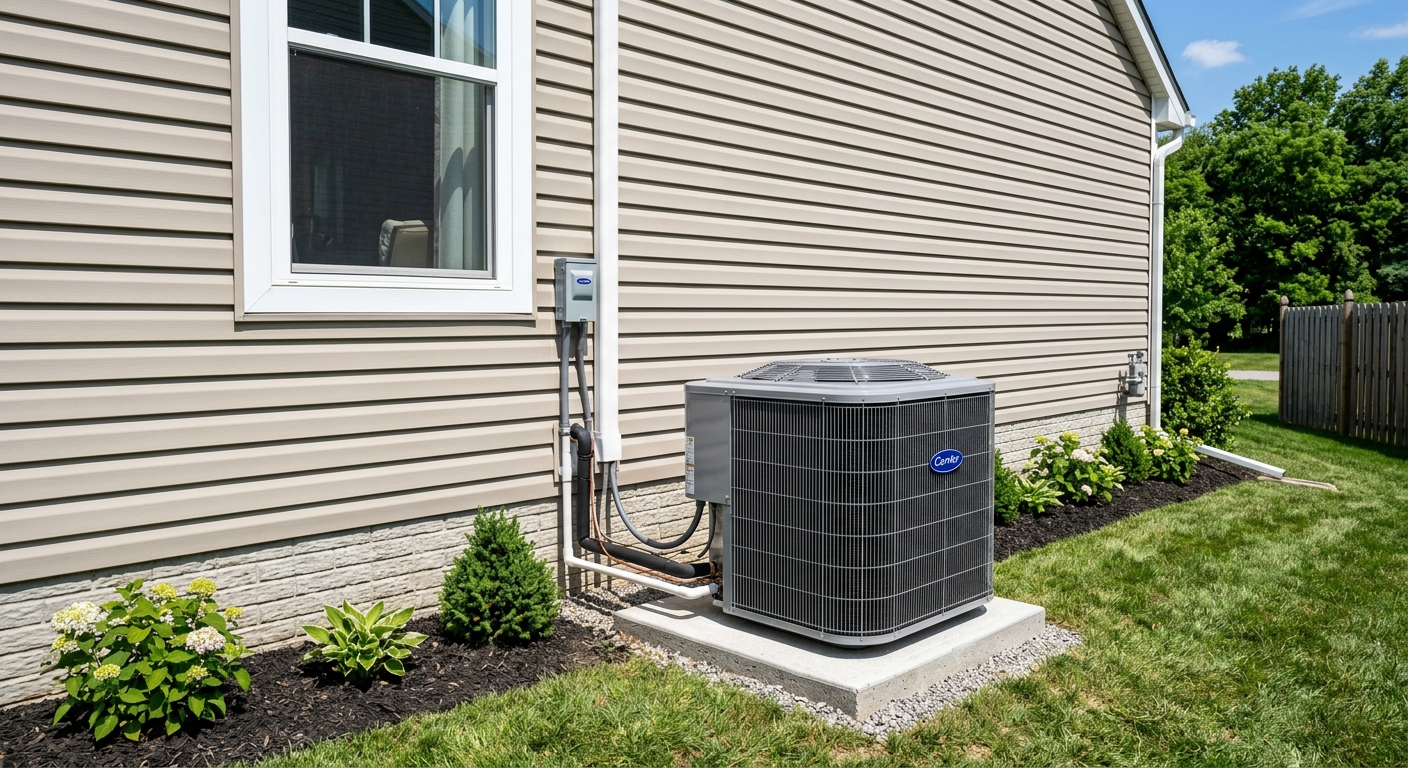
New Holland heating and cooling prices by system type — 2026
New Holland’s HVAC prices reflect both the moderate suburban market of Lancaster County and the character of local housing stock. With a homeownership rate of 70.7% and nearly 7 in 10 homes built before 1980 (U.S. Census Bureau, ACS 2024), this is a replacement market blended with heavy retrofits. Many homes were built before central air was standard, and older city rowhomes have driven strong demand for ductless and high-velocity options where running full-size ductwork isn’t practical. If your home already has functional ducts, you’re likely looking at a straight equipment swap. If not—or if you live in a home from the 1880–1930 period found in nearby Lancaster city—mini-splits or a full-duct installation are typical.
South-central Pennsylvania leans heating-dominated, with around 5,200 heating degree days and only 1,250 cooling degree days. Heating system cost and performance should be the bigger influence on most decisions. Heat pumps are increasingly attractive, but in this climate it pays to size for efficient, reliable heating first, then cooling.
| System |
Best for |
Efficiency |
Price range (installed) |
| Central AC replacement (existing ducts) |
homes with sound ductwork |
16–20 SEER2 |
$4,800–$11,500 |
| Air source heat pump (ducted) |
year-round heating and cooling |
8–10 HSPF2 |
$7,700–$16,500 |
| Cold-climate heat pump (ducted) |
heat pump as primary heat |
9–11 HSPF2 |
$12,500–$16,500 |
| Ductless mini-split (single zone) |
additions, rooms without ducts |
20–30 SEER2 |
$3,100–$6,700 |
| Full duct system installation |
homes with no existing ducts |
— |
$8,700–$17,500 |
Installed estimates for a typical New Holland home. Equipment tonnage, duct condition and electrical capacity move these more than brand.
Repair or replace your New Holland system?
For most New Holland homeowners, repair is often the right call—especially if your furnace, AC, or heat pump is under 10 years old and hasn’t had chronic problems. Systems here typically last 15–20 years if maintained. It’s usually better to repair when the cost is substantially less than one-third the price of replacement, or when the issue is a single replaceable part and the rest of the unit is sound.
Replacement should only be automatic in two circumstances: if your furnace has a cracked heat exchanger, or your compressor fails on an old heat pump or AC. Both are major safety or core failures and, at New Holland prices, repair doesn’t make economic sense. Refrigerant type also matters—older R-22 systems cost more to recharge, but the majority now use R-410A. If your system is relatively efficient and electricity isn’t unusually expensive for your home, new equipment typically won’t “pay back” the replacement cost in this moderate-climate market.
Remember, no honest contractor in Lancaster County should push a full replacement unless the costs are truly close or safety is at stake.
| Situation |
Recommendation |
Typical cost |
Reasoning |
| Under 10 years, single component failure |
Repair |
$300–$1,200 |
Most parts are still available, and system has expected life left. |
| 10–15 years, repair over a third of replacement |
Consider replacing |
$4,800–$11,500 |
Major repair approaches new system cost; age tips the scales. |
| 15+ years, any major failure |
Replace |
$4,800–$11,500 |
Service life exceeded; newer units offer reliability and warranty. |
| Cracked heat exchanger, any age |
Replace immediately |
$4,800–$11,500 |
Safety issue—replacement is non-negotiable. |
| Compressor failure past warranty |
Replace |
$7,700–$16,500 |
Repair approaches replacement cost; reliability unlikely. |
| Working system, high bills |
Test ducts and envelope first |
$300–$800 |
Most wasted energy in this region is duct or insulation related—not equipment. |
Rebates and tax credits for New Holland homeowners
In New Holland, HVAC installations commonly qualify for three incentive types: federal tax credits, utility rebates, and state-level programs. The federal tax credit is a reduction against your income tax bill the following year, not a direct payment—so you must pay upfront and recover the benefit on your return. Rebates, on the other hand, are typically provided by your energy utility and apply as a discount on your invoice or a check after installation.
For Lancaster County, your utilities are PPL Electric Utilities and, in many homes, UGI Utilities for natural gas. Each runs an energy-efficiency program—rebates for qualifying HVAC equipment are available but change year to year. Programme details, qualifying models, and amounts regularly shift. The best way to get up-to-date numbers is to start at your utility’s website and the official ENERGY STAR rebate finder. Relying on articles for specific rebate amounts is risky; these can be outdated within months.
Finally, Pennsylvania participates in some state-level incentive programs, but these are often administered through the utility, not the state directly. When planning your project, ask your contractor to provide current documentation of incentives from both your electric and gas utility, and always confirm eligibility before signing any contract.
How to vet an HVAC contractor in New Holland
In New Holland, the difference between a good and bad HVAC job rarely comes down to equipment brand—it comes down to who installs it and how. The same heat pump or furnace can perform night and day depending on duct sealing, airflow adjustment, and whether a proper load calculation was performed.
Before hiring, check that any contractor is registered with Pennsylvania’s Home Improvement Contractor scheme for jobs over $500. Verify they have EPA 608 certification for anyone handling refrigerants (this applies to all AC or heat pump work). Always insist on a written contract—legally required here—and demand model numbers on the quote, not just generic “3-ton heat pump.” Commissioning matters: proper installation means tested airflow, refrigerant charge confirmed at startup, and paperwork to back it up.
- Verify Home Improvement Contractor (HIC) registration at hic.attorneygeneral.gov
- Require written contract for all work over $500
- Ask for EPA Section 608 certification for anyone working with refrigerants
- Check for mechanical permit if equipment is being replaced or installed newly
- Request a load calculation—not just “rule of thumb” sizing
- Get model numbers, not just size or brand, on all quotes
- Insist on commissioning report: airflow and refrigerant charge measured at startup
- Ask for proof of workers’ compensation via WCAIS (wcais.pa.gov)
- Review liability insurance certificate
- Confirm ductwork will be inspected for air leaks before connecting new equipment
- Beware pushy up-sell tactics or pressure to sign quickly
- Check references from past jobs, especially for older or challenging homes
In Lancaster County, HVAC is a moderate-competition market. No one is booked solid year-round, so if you’re told “this deal today only”—walk away.
Refrigerant rules and your existing system
New Holland homeowners should know that refrigerant rules have evolved, but there’s no law forcing you to replace an otherwise working central air or heat pump. Most units installed in the past decade use R-410A—which remains legal and readily available for servicing. Newly manufactured systems now use refrigerants like R-454B and R-32, part of a gradual shift to lower global warming potential under federal and international agreements.
If you have a system that uses R-410A, rest easy: repairs, recharging, and service remain fully legal. The only real change is economic. As supply of R-410A begins to tighten over the coming years, prices may rise, especially if your system develops a refrigerant leak. On an older system needing costly recharge—especially if compressor health is questionable or the warranty has expired—the added cost can tip the repair-or-replace math toward replacement. But for now, don’t let anyone pressure you into swapping a functioning system just because of refrigerant changes.
If your system still runs on something older—like R-22—supplies are limited and the economics are rarely good. But nothing in Pennsylvania or federal law makes your working system illegal. The rules only affect what new systems can be installed and how the economics look if a major repair is needed.
What construction era means for your system
New Holland’s housing stock skews older, with about 69.5% of homes built before 1980 (U.S. Census Bureau, ACS 2024). This directly impacts what HVAC system makes sense for your home. Many pre-1980 houses either predate ducted central air entirely or have ductwork sized only for heating—not for modern AC airflow or variable-speed equipment. That means retrofits often involve high-velocity systems, ductless mini-splits, or, if you want a conventional heat pump or AC, new ductwork entirely.
Older houses in Lancaster County often have issues like under-insulated attics, single-pane windows, and lower electrical panel capacity—sometimes making all-electric conversions challenging without upgrade work. If your home uses gas or oil, age also determines whether an existing flue is safe for modern gas appliances or needs to be relined or replaced. Chimneys may not be up to current codes or may be sized for much less efficient equipment originally installed.
If your home is a newer, suburban build, original “builder grade” systems are commonly approaching end of life right now. Those units were often sized on the generous side, so a properly-calculated replacement may run smaller and more efficiently—reducing unnecessary strain and improving comfort.
What a Pennsylvania HVAC contractor must hold
HVAC licensing in Pennsylvania is local, not statewide. There’s no state-issued HVAC license for residential contractors—each municipality in Lancaster County handles permits and inspections independently, or the Pennsylvania Department of Labor & Industry steps in if the local government has opted out. What’s required is Home Improvement Contractor registration from the Pennsylvania Office of Attorney General for all jobs over $500, and that is always worth confirming before signing any paperwork.
Regardless of who installs your system, anyone handling refrigerant gases (for example, servicing or installing a heat pump or AC) must hold EPA Section 608 certification—this is federal, not state or local. Mechanical permits are needed for new installations or full replacements; simple filter changes or thermostat checks do not require a permit in Lancaster County. Always insist your contractor provides proof of worker’s compensation insurance, which you can verify yourself online via the WCAIS system. Local regulation might also require liability insurance and further electrician or plumber licenses if the project expands beyond HVAC work alone.
Bottom line: in Pennsylvania, look for a registered HIC, EPA 608 cardholder, and ask your local township office about permit and inspection requirements. Don’t take a contractor’s word alone; verify every credential directly.
Frequently asked questions — HVAC installation in New Holland
What MERV filter rating should I use?
In New Holland, MERV 8 is a good balance for most homes—it captures common dust and pollen without reducing airflow too much in older duct systems often found here. If your home has allergies or respiratory concerns, you can move to MERV 11 or 13, but many pre-1980 houses (making up nearly 70% of the local housing stock) may have blower motors that struggle with high-resistance filters. If you live in a newer build with strong airflow, a higher MERV can make sense. Remember, oversized filters or improper installation can lead to comfort problems or added wear. Sticking with a standard pleated filter and changing it regularly protects your investment—especially if you’ve just installed a new central AC (which runs $4,800–$11,500).
Who inspects HVAC work in New Holland?
In New Holland, mechanical inspections are handled at the municipal level. Each township or borough manages its own permitting and inspection process, following the Pennsylvania Uniform Construction Code. If you live within city limits of Lancaster or major townships like Manheim or East Hempfield, your local code office will schedule and approve inspections for new installations or major replacements. For minor work—like filter changes or thermostat programming—no inspection is required. Before starting a major job, always ask your contractor up front if they have pulled the necessary permit. Inspections, especially for projects in the $4,800–$17,500 range, are not optional if you want to avoid surprises when selling your home.
Do I need to be home during installation?
For most New Holland HVAC installations, it’s best to have someone home for at least the start and finish of the project. Your presence helps answer questions about thermostat placement, equipment location, or changes discovered during the work. Many homeowners arrange to be available at key points rather than the whole time, especially for longer jobs like a full ductwork install (which runs around $8,700–$17,500). Trustworthy contractors will coordinate in advance, give clear arrival windows, and won't object if a trusted neighbor or friend is present instead. They’ll require a final walk-through to explain the system and confirm details—don’t skip this, as it’s your chance to catch issues before sign-off, which is especially critical for New Holland’s older homes where access or installation surprises are common.
What does a ductless mini-split cost in New Holland?
A single-zone ductless mini-split installation in New Holland averages $3,100–$6,700 for equipment and labor. The range depends on capacity, unit efficiency, and the difficulty of running new electrical or refrigerant lines—older homes with thick brick or stone walls can be pricier. Ductless systems are especially common here due to the age of local housing; many homes built before 1980 lack central ductwork or have spaces (like additions or sunrooms) that don’t connect easily to existing heating and cooling. These systems offer both heating and cooling, cost less than a new full-duct install, and avoid major demolition. For multi-zone setups or larger homes, costs scale up accordingly.
How often should I change my filter?
In New Holland, changing your HVAC filter every 2–3 months is good practice, but homes with pets, high pollen, or ongoing renovations may need more frequent changes. Older homes, which make up the majority in New Holland, are more likely to allow dust and outdoor contaminants inside, so checking monthly (especially during heating and cooling seasons) is smart. If you’ve invested in a new system—for example, a central AC running $4,800–$11,500—failing to change filters can void warranties and shorten the life of your equipment. Use the filter change as a reminder to glance at thermostat settings and replace batteries if needed, too.
Do I need ENERGY STAR equipment to qualify for incentives?
Most rebate or incentive programs in New Holland—including those run by PPL Electric Utilities and UGI Utilities—require ENERGY STAR certification or similar efficiency benchmarks for eligibility. The federal tax credit also typically specifies ENERGY STAR-qualified products or equipment meeting CEE standards. For a central AC replacement at $4,800–$11,500, choosing a non-ENERGY STAR model might mean missing out on both rebate and tax credit opportunities. Always check program requirements at the time of purchase—these change annually. Ask your contractor for documentation on the exact models you’re being quoted, and verify using the ENERGY STAR rebate finder or with your utility. Don’t assume “high efficiency” means you qualify—it’s the specific model listing that counts.
How much does ductwork add to an HVAC installation?
Adding new ductwork to your HVAC installation in New Holland significantly increases both cost and project scope. For homes without existing ducts—a common situation in the area’s older stock—expect a full duct system to add $8,700–$17,500 to your bill. This covers new supply and return runs, register installation, and all connections, but can rise further for tricky layouts, plaster walls, or finished basements. Retrofitting older homes often takes longer, especially if your property has limited crawlspace or attic access. On the other hand, if your ducts are in good shape, replacement costs drop drastically. Get ducts tested before a new install; many systems in Lancaster County leak 20–30% of airflow—sealing them can save money and avoid the need for complete replacement.
How cold does it get in New Holland and does that affect heat pumps?
New Holland winters see design temperatures down to 12 °F and, on rare occasions, colder. This climate means you should be careful with standard heat pump models, as performance drops at low temperatures. Modern cold-climate heat pumps do reliably provide heat on all but the harshest days, but sizing and installation quality are critical. Backup heat sources are common in Lancaster County, especially in older homes. For a cold-climate heat pump system, expect to pay $12,500–$16,500—these are engineered to deliver heating here, but make sure your installer follows local best practices for sizing and controls so you don't rely too heavily on expensive electric backup.
Do I need dual fuel in south-central Pennsylvania?
Dual fuel (a heat pump paired with a furnace, usually gas or propane) is popular among New Holland homeowners who want efficient heating and reliable comfort during winter’s coldest snaps. Our region’s 5,200 heating degree days means the heat pump can do most of the work, but on the rare subzero nights, the furnace takes over efficiently. If you pay high propane or electric rates, dual fuel lets you choose the cheaper source. However, installation costs rise: a properly-installed dual fuel system can reach $7,700–$16,500. Not every home needs dual fuel—if you have access to affordable natural gas, a high-efficiency furnace alone is often your best bet. For homes with older electrical service or limited gas access, mini-splits with backup heaters are a practical alternative. The right answer in New Holland depends on your utility rates and how much of the old system can be reused.