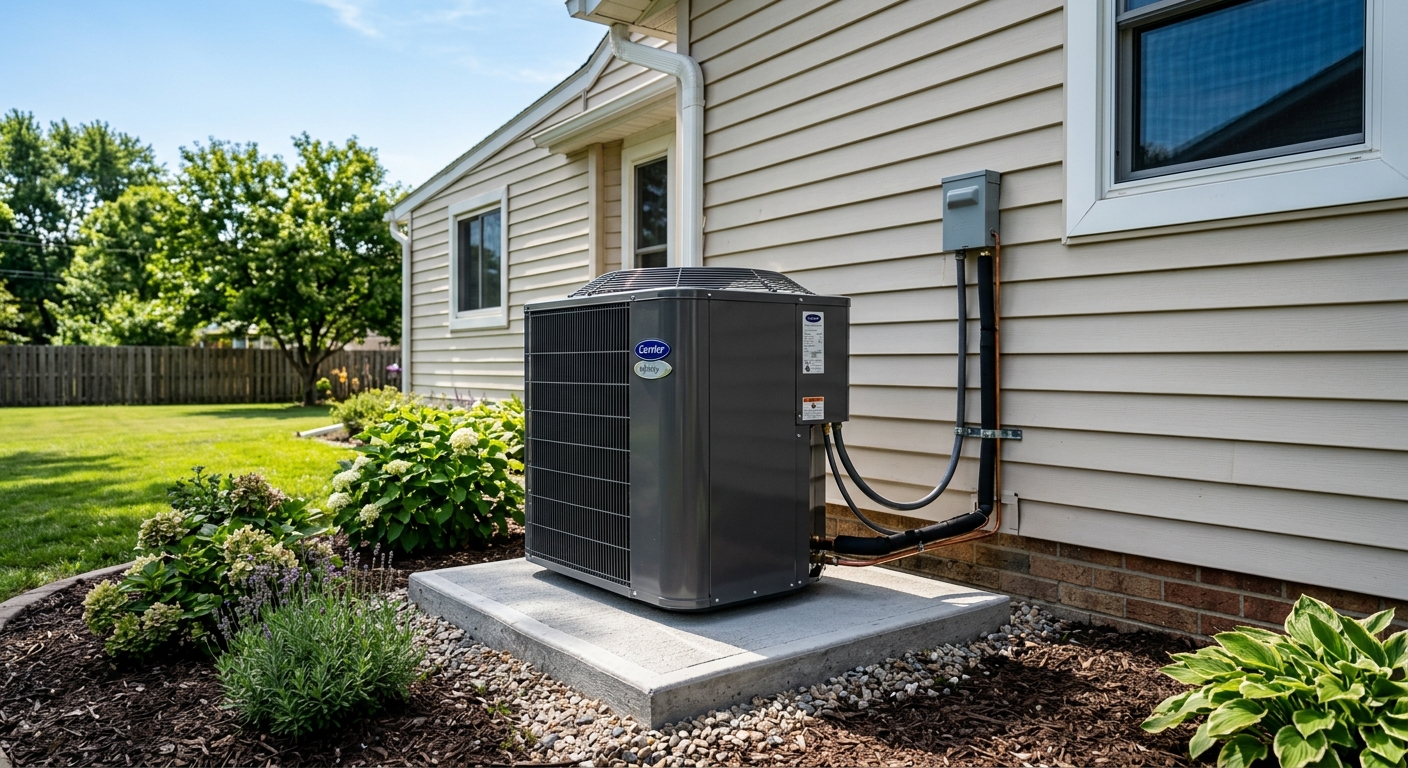
HVAC costs in Antis — 2026
Antis stands out in Blair County for its high homeownership rate and older housing stock. With 79.5% of homes owner-occupied and nearly 59% built before 1980 (U.S. Census Bureau, ACS 2024), most HVAC projects here are not new system installs but rather replacements or significant retrofits. The heavy presence of 1900–1940 wood-frame homes means many houses either lack original ductwork or have systems not designed for modern central AC. This makes ductwork modifications or replacements common, especially when transitioning from older heating setups to today’s standards.
Our climate gives HVAC design a decided tilt toward heating. With 6,300 heating degree days and just 750 cooling degree days each year, the majority of the load through your system happens during the long, cold winter. While central air is welcome come July, design decisions here should always start with heat: your choice of furnace, heat pump, or dual fuel system will drive comfort and efficiency all year round. If you’re on the edge about upgrading, costs are real, and in a market like ours—where lots are tight and retrofit work is routine—labor and material can shift the final bill.
| System |
Best for |
Efficiency |
Price range (installed) |
| Central AC replacement (existing ducts) |
homes with sound ductwork |
16–20 SEER2 |
$4,800–$11,500 |
| Air source heat pump (ducted) |
year-round heating and cooling |
8–10 HSPF2 |
$7,700–$16,500 |
| Cold-climate heat pump (ducted) |
heat pump as primary heat |
9–11 HSPF2 |
$12,500–$16,500 |
| Ductless mini-split (single zone) |
additions, rooms without ducts |
20–30 SEER2 |
$3,100–$6,700 |
| Full duct system installation |
homes with no existing ducts |
— |
$8,700–$17,500 |
Installed estimates for a typical Antis home. Equipment tonnage, duct condition and electrical capacity move these more than brand.
Mini-splits and zoning in Antis homes
In Antis and across Blair County, the 1900–1940 wood-frame home is the norm, not the exception. That’s a house that usually wasn’t built with central air in mind—often with tight lots and little space for new duct runs. For these, ductless mini-splits aren’t just a modern upgrade; they’re often the only practical way to add efficient cooling or heating to rooms missed by the existing system, like attic conversions, additions, or finished basements.
Mini-splits come in two main types: single-zone systems that pair one indoor head to one outdoor unit, and multi-zone systems that let a single outdoor compressor serve several rooms. While multi-zones sound cost-effective on paper, in reality, a group of single-zone systems often outperforms them in both efficiency and comfort—each zone gets exactly the output it needs, and you’re less likely to see uneven temperatures.
Installation flexibility is key: heads can be wall-mounted, ceiling-recessed, or even floor-mounted to match the space. Still, aesthetics and placement matter, especially in a historic home where a wall unit in the parlor isn’t always welcome. Condensate drainage also takes planning, since a poorly-handled setup leads to future leaks. If you’re considering ductwork where none exists, think carefully: a single-zone ductless system starts at $3,100–$6,700, which is usually far less intrusive—and costly—than tearing up finished plaster or routing new supply trunks in a 1930s house.
The decision point on an aging system
The question of repairing or replacing an old HVAC system in Antis depends on more than just age. Look at both the system’s years in service and the nature of the problem. If your system is under 10 years old, a single-component repair—like a blower motor or capacitor—is typically worth it, especially if it’s under a third of the price of a full replacement. But after year 15, or when facing a major failure like a worn-out heat exchanger or failed compressor, replacement almost always makes more sense.
Another consideration is refrigerant: Older systems using phased-out refrigerants are harder and more expensive to repair. And while newer equipment is more efficient, in a climate like Antis—where winters dominate energy use—the payback on efficiency upgrades is slower than in hotter parts of the country. That means high bills might have more to do with leaky ducts or a poorly insulated attic than with your furnace or AC itself.
There are only two situations where replacement isn’t a choice: a cracked heat exchanger or a compressor failure in an old system. These are safety and reliability issues that can’t wait.
| Situation |
Recommendation |
Typical cost |
Reasoning |
| Under 10 years, single component failure |
Repair |
$300–$1,200 |
Long service life left; most repairs here are minor parts. |
| 10–15 years, repair over a third of replacement |
Consider replacing |
$4,800–$11,500 |
Costly repairs in this age range don’t pay off long-term. |
| 15+ years, any major failure |
Replace |
$4,800–$11,500 |
Older systems are inefficient and unreliable; replacement is prudent. |
| Cracked heat exchanger, any age |
Replace immediately |
$4,800–$11,500 |
Safety issue—risk of carbon monoxide; replacement is mandatory. |
| Compressor failure past warranty |
Replace |
$7,700–$16,500 |
Major repair cost rivals replacement; downtime is significant. |
| Working system, high bills |
Test ducts and envelope first |
$300–$800 |
Efficiency losses often stem from air leaks, not the unit itself. |
Retrofit versus replacement in Antis
Antis homes are more than half pre-1980, and much of that is 1900–1940 construction. For a homeowner here, the first question is: does your house have ductwork at all, and if so, what was it designed for? Original ductwork in older homes often handled just heating—frequently undersized and poorly insulated for modern AC. Retrofitting these systems can mean re-sizing, improving insulation, or sometimes a complete replacement, especially where ducts run through attics or crawlspaces that lose a lot of heat.
Insulation and windows also matter. Many older homes still have single-pane glass and minimal attic insulation, which taxes even a brand-new high-efficiency unit. If you’re weighing a switch to an all-electric heat pump, panel capacity and available circuits must be checked—a 100-amp panel from the 1950s probably won’t cut it for a modern heat pump and electric water heater.
If your home is a newer build, say a late-1990s or early-2000s subdivision, this likely isn’t a question of new versus old ductwork but rather whether the original furnace and AC are now at the end of their expected lifespan. Builder-grade systems in these homes were often sized generously—sometimes too much so—so sizing should be checked before swapping “like for like.”
Sizing: why bigger is worse
One of the most expensive mistakes in HVAC installation for Antis homes is oversizing. It’s a persistent myth that bigger means better or “safer.” In reality, too large a system leads directly to short cycling—where the unit blasts on and off rapidly—resulting in uneven temperatures, poor humidity control, higher utility bills, and a shorter equipment lifespan. Oversizing is not a margin of safety, it’s a design defect.
Every home in Antis should get a Manual J heat loss and gain calculation before replacing or installing an HVAC system. Manual J takes into account your home’s actual insulation, windows, orientation, air leakage, and more. Square-footage or “rule of thumb” estimates simply don’t cut it, especially in a county dominated by older homes with unpredictable envelopes.
A trustworthy contractor will not base new sizing on the nameplate of your 30-year-old furnace. Instead, ask directly: “Did you run a load calculation, and can I see it?” If the answer is no, that’s your cue to get a second opinion. Bluntly, in north-central Pennsylvania, systems must be sized for a winter design temperature of 2 °F—if your equipment can’t maintain comfort at that point, you’re living with cold spots all season long and burning money the rest of the year.
Permits, licensing and inspections in Antis
In Pennsylvania—including Antis and the rest of Blair County—residential HVAC contractors aren’t licensed by the state. Instead, they must register as Home Improvement Contractors for jobs over $500, and permitting for mechanical work is handled by local municipalities, not Harrisburg. This means you should always check with your township or borough office for specific permit requirements before starting a project.
Anyone working with refrigerants—central AC, heat pumps, or mini-splits—must hold EPA Section 608 certification, which is federally required. Mechanical permits are also required for most system replacements or new installs, and inspections are standard before the final sign-off. Under the Home Improvement Consumer Protection Act, a written contract is required for any job over $500, and you have a three-day right to cancel after signing.
To verify insurance and active workers’ compensation (which is mandatory for all HVAC employers), homeowners can check the contractor’s information using the official Workers’ Compensation Automation and Integration System (WCAIS) at wcais.pa.gov. Registration status as a Home Improvement Contractor can be checked at hic.attorneygeneral.gov. Skipping these steps risks both safety and your wallet.
The central decision for a Antis homeowner
For Antis homeowners, the real question isn’t simply “what’s new”—it’s “what works best with our long, cold winters?” With a winter design temperature of 2 °F and 6,300 heating degree days each year, heating is the headline, cooling the afterthought. Modern cold-climate heat pumps now deliver impressive efficiency and reliable output well below freezing, so the old advice to skip heat pumps north of Harrisburg is outdated. Still, capacity drops as temperatures plummet—especially below zero—so system sizing and backup heating matter more here than in the mid-Atlantic.
Natural gas is widespread in Altoona, Hollidaysburg, and adjacent boroughs, but further out in Blair County—including parts of Antis—many homes are still on propane or fuel oil. If you have gas on site, a gas furnace paired with a separate AC or a dual fuel heat pump (which switches to gas on the coldest nights) can be the best overall value for comfort and operating cost. But if your lot has no gas line, the comparison shifts: heat pumps are far more cost-effective and cleaner than running propane or oil, especially as equipment incentives keep growing.
A furnace is the right call if your home is drafty, poorly insulated, or you regularly see prolonged subzero spells—gas brings ultimate reliability in deep winter. Otherwise, a properly sized cold-climate heat pump or dual-fuel system will handle almost every day, save you fuel, and keep summer bills low.
| Option |
Installed cost |
Operating cost here |
Best when |
Incentive eligible |
| Gas furnace + central AC |
$4,800–$11,500 |
Lowest with existing gas, highest efficiency in deep cold |
existing gas service, coldest zones |
Some models |
| Ducted heat pump (cold climate) |
$7,700–$16,500 |
Low to moderate in well-sealed homes |
good envelope, all-electric goal |
Most models |
| Dual fuel (heat pump + gas backup) |
$12,500–$16,500 |
Switches to lowest-cost fuel as temps fall |
gas on site, deep cold spells |
Most models |
| Ductless multi-zone |
$8,700–$17,500 |
Lowest for selective use, no duct loss |
no ductwork, zone control |
Most models |
Frequently asked questions — HVAC installation in Antis
Is it worth switching from oil or propane to a heat pump?
In Antis and the outlying areas of Blair County where natural gas isn’t an option, switching from fuel oil or propane to a modern cold-climate heat pump can make strong financial sense. Oil and propane both bring high and volatile fuel costs and require on-site storage, plus you’re exposed to price spikes in harsh winters. A ducted heat pump installation runs $7,700–$16,500 here, but your annual operating costs could be far lower, especially if your home is reasonably insulated. With oil or propane, efficiency gains are immediate and maintenance costs drop, while heat pumps offer cooling for the summer—something older furnaces can’t. Just look to upgrade your electrical panel if it’s outdated, and don’t overlook air sealing and insulation to get the most benefit.
What is a Manual J load calculation?
A Manual J load calculation is a detailed engineering assessment that figures out the exact heating and cooling needs of your specific Antis home. Rather than relying on rules of thumb or just looking at square footage, Manual J accounts for your insulation levels, number of windows, air leakage, sun exposure, and more. It ensures your new HVAC system is neither too big nor too small. In older homes typical to Blair County, skipping this step risks oversizing—a real problem that leads to short cycling and comfort issues, not to mention unnecessary costs as high as $16,500 for an oversized heat pump. Always ask your contractor if they've performed a Manual J calculation and to show the results.
How does north-central Pennsylvania's climate affect system sizing?
The Antis area sits in one of the coldest zones in Pennsylvania, with a winter design temperature of 2 °F and about 6,300 heating degree days per year. That long, cold season means your HVAC system must reliably deliver heat during deep winter, but shouldn’t be oversized to avoid short cycling the rest of the year. Manual J calculations for this climate ensure your system will hold comfort during January’s worst, without wasting money or running inefficiently in milder weather. In practical terms, the difference for your wallet can be substantial, especially when a system replacement here can run $4,800–$11,500 for a standard furnace and AC.
How much does a furnace replacement cost in Antis?
For a homeowner in Antis, a standard gas furnace replacement—including installation and a basic code-required inspection—typically falls in the $4,800–$11,500 range. The wide spread comes from differences in size, efficiency, and especially whether your home needs any ductwork changes—a common need in Blair County’s older housing stock. Homes using propane or oil may see the upper half of this range if the system requires additional venting or fuel storage updates. If your home is particularly drafty or has old ducts sized for coal or gravity systems, those factors may nudge the cost higher.
What HVAC tax credits are available to Antis homeowners?
Most Antis homeowners can qualify for federal tax credits for eligible heat pump systems, high-efficiency furnaces, and certain upgrades like insulation or air sealing. Credits for heat pumps are especially generous—sometimes more than $2,000 for a properly rated system, which helps offset the typical $7,700–$16,500 price tag of a ducted install. Pennsylvania also runs occasional utility-sponsored rebates (often through Penelec), but these can change year to year. Always check the latest listings and get any qualification in writing before you buy, as some credits require proof of installation and equipment ratings.
How do I verify an HVAC contractor's insurance?
In Pennsylvania, the simplest way to verify an HVAC contractor has the required workers' compensation insurance is through the official Workers’ Compensation Automation and Integration System (WCAIS) at wcais.pa.gov. For confirmation of Home Improvement Contractor registration (which is mandatory for any job over $500 in Antis), you can check hic.attorneygeneral.gov. Never rely on a paper certificate alone; systems like WCAIS ensure the coverage is active and covers every worker on your job. Remember that a missed insurance check on a project costing $4,800–$11,500 could cost you far more if an injury happens on your property.
What does a heat pump cost installed in Antis?
In Antis, a ducted heat pump system—including both equipment and labor—ranges from $7,700–$16,500. The price reflects not just the size of your home but also the condition of existing ductwork (if any), electrical panel capacity, and site-specific challenges common in older Blair County houses. Lower-end installations on smaller homes with good ducts hit the lower end, while extensive retrofits, electrical upgrades, or cold-climate models designed for harsh winters move the price up. Always get a written quote that spells out every step—especially if you're converting from oil or propane.
Do I need to be home during installation?
For major HVAC work in Antis—including full system replacements or ductwork installs—it’s best to have someone home if possible. Installers need access to every part of the house connected to your heating, cooling, or ventilating systems, and sometimes questions come up mid-project. That said, many contractors can work with your schedule and will secure the property during off-hours. The process for a typical central AC replacement or heat pump install ($4,800–$16,500) usually takes one to two days. If you can’t be home throughout, arrange for a walkthrough each morning and evening with your contractor for updates and to address any issues immediately.
Why are my Antis energy bills high with a new system?
New HVAC equipment in Antis doesn’t always bring the lower bills you might expect, especially in older homes. The number-one culprit is almost never the brand-new system, but rather hidden duct leaks, poor insulation, or unaddressed drafts in walls and attics. With nearly 59% of homes built before 1980, air leakage is a chronic issue. You might spend $300–$800 to properly test and seal ductwork, and the savings can easily outweigh what you’d get from an ultra-high-efficiency system alone. If you see little change in bills post-install, have your contractor pressure test your ducts and advise on insulation upgrades—they’re almost always cheaper than ripping out and redoing your new equipment.