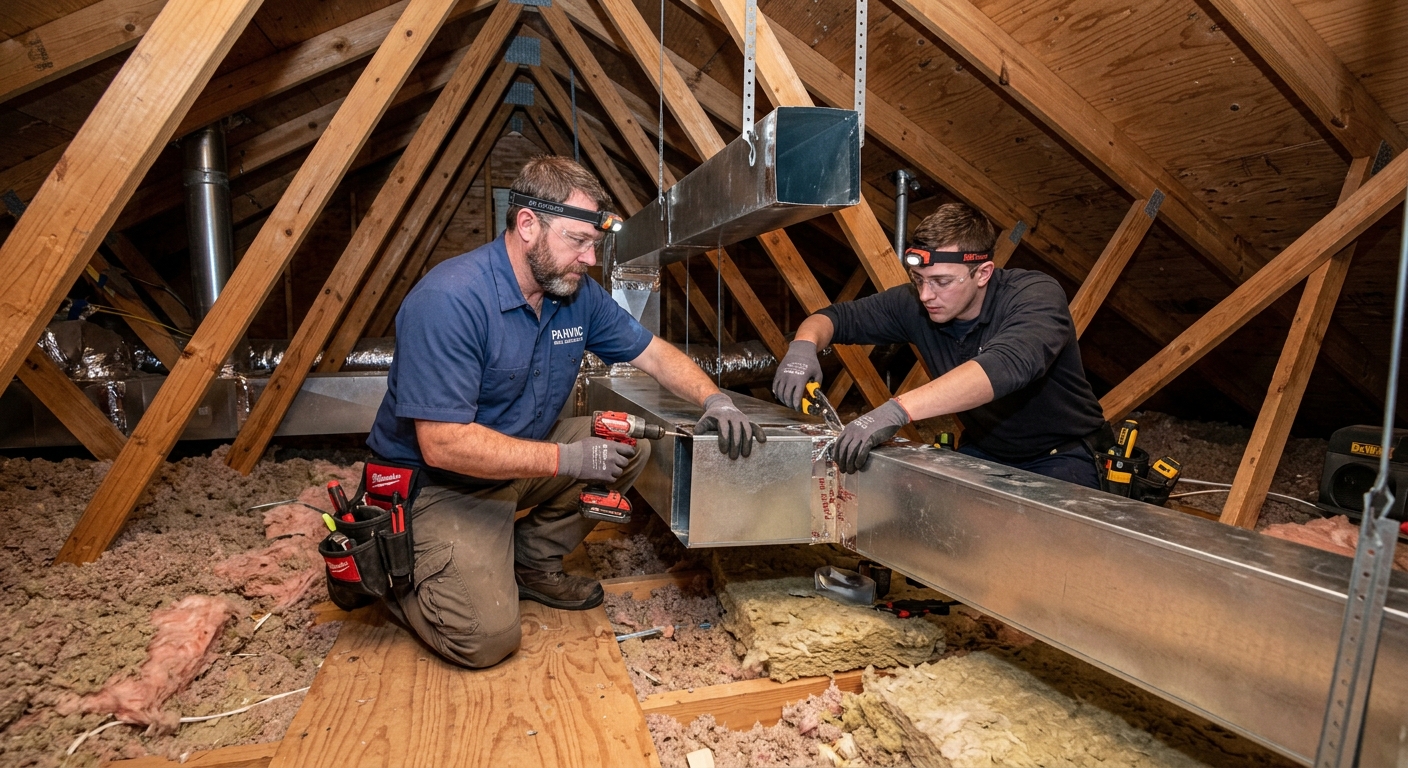
What a new HVAC system costs in Derry
Derry homeowners face a different set of decisions than those in newer Pennsylvania subdivisions. With a homeownership rate of 79.1% and 71.7% of homes built before 1980 (U.S. Census Bureau, ACS 2024), most of the local market involves replacing or upgrading systems in older houses—usually where original ductwork may be undersized, leaky, or missing entirely. Mid-20th-century construction here means retrofit ductwork and electrical upgrades are often part of a job, not optional extras.
Southwestern Pennsylvania is a heating-dominated market: 5,600 heating degree days stack up against just 1,050 cooling degree days each year. Cold snaps (winter design temp: 8 °F) mean the system’s ability to deliver efficient, reliable heat is the first thing to test. Cooling performance counts, but poor heating is the dealbreaker here.
| System |
Best for |
Efficiency |
Price range (installed) |
| Central AC replacement (existing ducts) |
homes with sound ductwork |
16–20 SEER2 |
$4,700–$11,000 |
| Air source heat pump (ducted) |
year-round heating and cooling |
8–10 HSPF2 |
$7,500–$16,000 |
| Cold-climate heat pump (ducted) |
heat pump as primary heat |
9–11 HSPF2 |
$12,000–$16,000 |
| Ductless mini-split (single zone) |
additions, rooms without ducts |
20–30 SEER2 |
$3,000–$6,600 |
| Full duct system installation |
homes with no existing ducts |
— |
$8,400–$17,000 |
Installed estimates for a typical Derry home. Equipment tonnage, duct condition and electrical capacity move these more than brand.
Manual J and the tonnage question
The most expensive mistake a contractor can make in Derry is oversizing your HVAC system. Many homes here were built before central air and heat were standard, so retrofit jobs often run into this: someone guesses the size by square footage, or just copies whatever was on the old unit’s label. The problem? Bigger is not better. Oversized equipment short cycles—kicking on and off too often—leading to uneven comfort, poor dehumidification, temperature swings, higher bills, and breakdowns. A “safety margin” here only guarantees you’ll be less comfortable and buy another unit sooner than you should.
The only reliable sizing method is a Manual J load calculation, which factors in your home’s insulation, windows, orientation, air leaks, and—crucially for Derry—our winter design temperature of 8 °F. This calculation makes sure your system can handle our coldest spells without overshooting most of the year. Rules of thumb or “X tons per 500 square feet” ignore how much older Derry homes vary: two houses the same size built in different years or conditions can have wildly different heating and cooling needs.
The take-home question for any contractor: “Did you run a Manual J calculation, and can I see it?” If not, they’re making it up or repeating someone else’s error. Sizing from your old unit is a shortcut that may repeat decades-old mistakes. Choose the contractor who puts it in writing and explains their math.
Keeping a Derry system running
Not all HVAC maintenance sold to Derry homeowners is worth the money. Focus on the basics: change your filter at the right interval (every 1–3 months is typical), and use the correct MERV for your system’s blower. Restrictive filters can strain older blowers common in local mid-century homes. Clean coils (especially on the outdoor unit), clear the condensate drain line each spring, and have a pro verify refrigerant charge. If you need refrigerant added, your system has a leak—topping it off is not maintenance and won’t solve the problem.
Annual service plans can be useful when they offer true value: a real inspection, priority scheduling, and fair pricing. Skip plans that only get you a superficial “tune-up.” In Derry, the best time for routine service is late spring for cooling or early fall for heating—before the first cold snap but after the rush of emergency calls starts. Booking outside of peaks saves you time, money, and stress. Hold off on bundled upcharges, especially those that don’t address your system’s real condition or age.
Operating cost, not sticker price
The price tag is only part of the story for Derry homeowners—operating cost over 15–20 years will often matter more than the initial install. Our area sees 5,600 heating degree days and a winter design temp of 8 °F, so heating is the lion’s share of your annual spend. If you’re served by West Penn Power, your actual $/kWh rate appears on your bill under “Total Energy Charges.”
To compare systems, multiply seasonal efficiency by your estimated use. For electric heat pumps, HSPF2 tells you how many BTUs per kWh you get; for furnaces, AFUE is percent of gas turned into heat. Then, heating degree days tell you how much the system will need to deliver. For example, suppose your bill shows $0.16/kWh, and your system is rated at HSPF2 10. Heating load = square footage x 30 BTU/ft² x degree days = total BTU per year. Divide by your system’s efficiency to get annual kWh, then multiply by your actual rate.
Bills vary—for leaky older homes, a high-efficiency unit can still run up tabs if ducts leak or attic insulation is thin. A system on poorly sealed ducts in Derry will run more, not less, than a basic unit on tight, clean runs. Use your actual energy rate to compare, but know that envelope and duct upgrades are often a better investment than just higher rated equipment.
Heat pump or furnace: what makes sense in Derry
Derry’s climate—with a winter design temp of 8 °F and 5,600 heating degree days—used to make heat pumps a poor choice for primary heat. That’s changed. Modern cold-climate heat pumps will heat well below freezing, only dropping in capacity near their lower limits. The real cutoff is how well your own house holds heat and whether you want a backup for the coldest nights.
Most homes in Westmoreland County have access to natural gas, but in some rural corners, it’s propane or oil versus a heat pump—and that changes the math. Where gas lines run, a high-efficiency furnace will deliver reliable heat at lower cost in the depth of winter, but if you’re burning oil or paying for propane deliveries, an all-electric or dual-fuel heat pump almost always comes out ahead on both cost and convenience.
The furnace still makes sense in homes with large, older ductwork, especially if you already have gas and only need cooling for a few muggy weeks. For most others, the new crop of properly sized heat pumps—especially when paired with duct upgrades—can easily handle Derry winters and lower year-round bills.
| Option |
Installed cost |
Operating cost here |
Best when |
Incentive eligible |
| Gas furnace + central AC |
$4,700–$11,000 |
lowest with gas on site |
existing gas service, coldest zones |
yes |
| Ducted heat pump (cold climate) |
$7,500–$16,000 |
competitive on electric rates |
good envelope, all-electric goal |
yes |
| Dual fuel (heat pump + gas backup) |
$12,000–$16,000 |
optimized for both fuels |
gas on site, deep cold spells |
yes |
| Ductless multi-zone |
$8,400–$17,000 |
higher, but zone savings offset |
no ductwork, zone control |
yes |
What a Pennsylvania HVAC contractor must hold
Pennsylvania does not issue a statewide HVAC trade license for residential work. Instead, HVAC installation and replacement in Derry fall under local municipal authority; Greensburg handles code enforcement for much of Westmoreland County, with other townships managing their own permits. Every contractor working on contracts over $500 must hold Home Improvement Contractor (HIC) registration, issued by the Pennsylvania Office of Attorney General. This is not a trade test but a registration for consumer protection. For Derry, check a contractor’s HIC status at hic.attorneygeneral.gov first.
Anyone handling refrigerants—installing or servicing ACs and heat pumps—must carry a federal EPA Section 608 certification. This is not optional and applies regardless of state or municipal licensing.
Mechanical permits and inspection are required for installed systems. Verify that your contractor carries active workers’ compensation insurance—as every employer in Pennsylvania must—by checking through the WCAIS online system (wcais.pa.gov). If a contractor cannot document both HIC registration and valid insurance, or shies away from permits, move on. Professional contractors expect to show proof up front in Derry.
Zone control without ductwork
Ductless mini-splits offer a real fix for Derry’s additions, attic conversions, finished basements, sunrooms, or anywhere retrofitting ductwork means tearing open ceilings and walls. In Derry’s older housing stock—where nearly three-quarters of homes date to pre-1980—ductless is often the only viable way to bring comfort to rooms the original system never touched.
Single-zone systems (one indoor unit per outdoor) are ideal for a single space or isolated room. Multi-zone systems can serve several rooms off one outdoor compressor, with separate indoor “heads.” While multi-zone appears less intrusive and may be more convenient, there’s a limit: when you connect too many heads to one outdoor unit, efficiency drops, and comfort in individual rooms can lag (especially with doors closed). Two or three well-placed single-zone systems often outperform one overworked multi-zone branch, if you can place multiple outdoor units sensibly.
Heads mount on walls or, in some models, at floor level for better aesthetics. Condensate removal needs to be designed in—usually a line out of the back wall or routed to a nearby drain. Don’t let anyone tell you ductless is only a “luxury”—in an area where original ductwork is often missing or unfixable, it’s usually the most sensible solution. Derry homeowners should see mini-splits as flexible, efficient options, not just a last resort.
Frequently asked questions — HVAC installation in Derry
Can a heat pump heat my house without backup?
Yes—modern cold-climate heat pumps can keep a typical Derry house warm through most of our winter, even down into single digits. At 8 °F (our local design temperature), the right model can still deliver meaningful heat, especially in homes with updated windows and insulation. However, as outdoor temperatures drop, a heat pump’s output falls. Some all-electric homes rely on built-in electric backup strips, which have higher running costs. In homes with especially poor envelopes or those seeing deep cold snaps, you may want a gas or propane furnace as a secondary heat source. Many systems here are “dual fuel” for just this reason. The installed price for a cold-climate ducted heat pump is typically $12,000–$16,000 for Derry. If your home is reasonably well-sealed, a quality heat pump will handle the vast majority of heating days on its own.
What is a Manual J load calculation?
Manual J is the industry-standard formula for sizing heating and cooling systems to match your actual house—not just its square footage. In Derry, with our mix of mid-century homes and a winter design temp of 8 °F, no two homes are alike. A proper Manual J includes insulation levels, window type, orientation, infiltration rates, and more. It tells you the exact heating or cooling “load” your house presents during peak conditions. Any contractor worth their salt in Pennsylvania—including Westmoreland County—should perform and show you this calculation, not guess or copy from an old tag. Sizing wrong can shorten your system’s life, lower efficiency, and cost you comfort. If the contractor will not hand you a copy of their calculation, find one who will.
What does a heat pump cost installed in Derry?
The typical installed price for a ducted air-source heat pump in a Derry home is $7,500–$16,000, depending on whether you’re replacing both heating and cooling, upgrading ductwork, or requiring electrical work. Cold-climate models tend to the higher end. For most mid-20th-century houses in Derry, expect costs in the $12,000 range for a ready-to-go, high-performance system with new refrigerant lines and thermostat. Homes with older or leaky ductwork may need repairs or replacement to get the full benefit. Always insist on a written estimate that includes all necessary changes, not just the equipment itself.
What does a ductless mini-split cost in Derry?
For a single-zone system—ideal for an addition, sunroom, or a finished attics—the installed cost in Derry runs $3,000–$6,600, including equipment, labor and basic electrical work. Multi-zone systems, which can handle several rooms from one outdoor unit, run higher, with full-home retrofits reaching toward $8,400–$17,000 depending on scope. Local housing here is often a good fit, especially in parts of Derry where installing new ductwork means crossing finished ceilings or walls. A written estimate should spell out head placement, electrical upgrades, and condensate handling, not just a price tag for the base equipment.
How do I verify an HVAC contractor's insurance?
In Pennsylvania, every HVAC contractor must carry workers’ compensation insurance if they have employees. The best way to check is to ask for their current certificate and verify it through the state’s WCAIS system at wcais.pa.gov. If they balk or delay, that’s a red flag. For Derry and the rest of Westmoreland County, also verify their Home Improvement Contractor registration online at hic.attorneygeneral.gov—required for any job over $500. A reputable local firm will provide proof of both up front; don’t hesitate to ask. Insurance matters: if a worker gets hurt or something goes wrong at your property, you don’t want to be on the hook.
Do I need ENERGY STAR equipment to qualify for incentives?
Incentive eligibility in Pennsylvania often tracks ENERGY STAR ratings, but not all rebates or tax credits require exact ENERGY STAR labelling. Some require efficiency levels, like certain SEER2 or HSPF2 minimums, that match or exceed ENERGY STAR. For example, to qualify for federal or utility programs on a new heat pump (installed price $7,500–$16,000 in Derry), confirm whether your chosen model is listed with ENERGY STAR or meets the required performance criteria. Always check the program details or ask for written confirmation from your contractor. There’s no harm in exceeding the baseline if it fits your home and budget, but don’t pay extra chasing a label unless it unlocks a specific incentive for your address.
When is the best time of year to replace HVAC in Derry?
The best window in Derry—avoiding the wait and paying less—is early fall (September–October) for heating systems and late spring (April–May) for cooling systems. These are shoulder seasons, when demand is lowest and contractors aren’t jammed with emergency calls. If you schedule a major replacement in a January cold snap, expect delays, premium pricing, or rushed work. Summer brings its own backlog during heat waves. Planning ahead lets you compare quotes and be without comfort for as little time as possible. For example, a central AC replacement ($4,700–$11,000) can sometimes be done within days in late April, versus weeks in late July.
Which utility serves Derry?
Derry and the rest of Westmoreland County are served by West Penn Power for electricity. Peoples Natural Gas covers most gas connections, though service can be limited in the rural edges of the township. With most homes built before 1980, it’s common to see older homes originally heated with oil or propane. When considering a new heat pump or gas furnace, confirm your local utility for accurate rate information—your actual price per kWh or therm appears clearly on your bill and makes a real difference in annual operating cost. Installation costs—such as $7,500–$16,000 for a heat pump—are only part of the math.
How often should I change my filter?
In Derry’s mid-century and postwar homes, it’s wise to check your HVAC filter every month, especially during peak use—winter for heating, summer for cooling. Most homes do well with a filter change every 1–3 months, but older systems and ducts full of dust may require more frequent swaps. The MERV rating matters: for most Derry systems, don’t go higher than MERV 8–11 unless your blower is rated for higher resistance. Higher MERV filters block more dust but can choke airflow in units not built for them, common in pre-1980 housing. Replacing filters on time extends your equipment’s life—which, for a system worth $7,500–$16,000, is money well spent. If you’re dust-sensitive or have pets, change more often and consider professional duct cleaning during renovations.