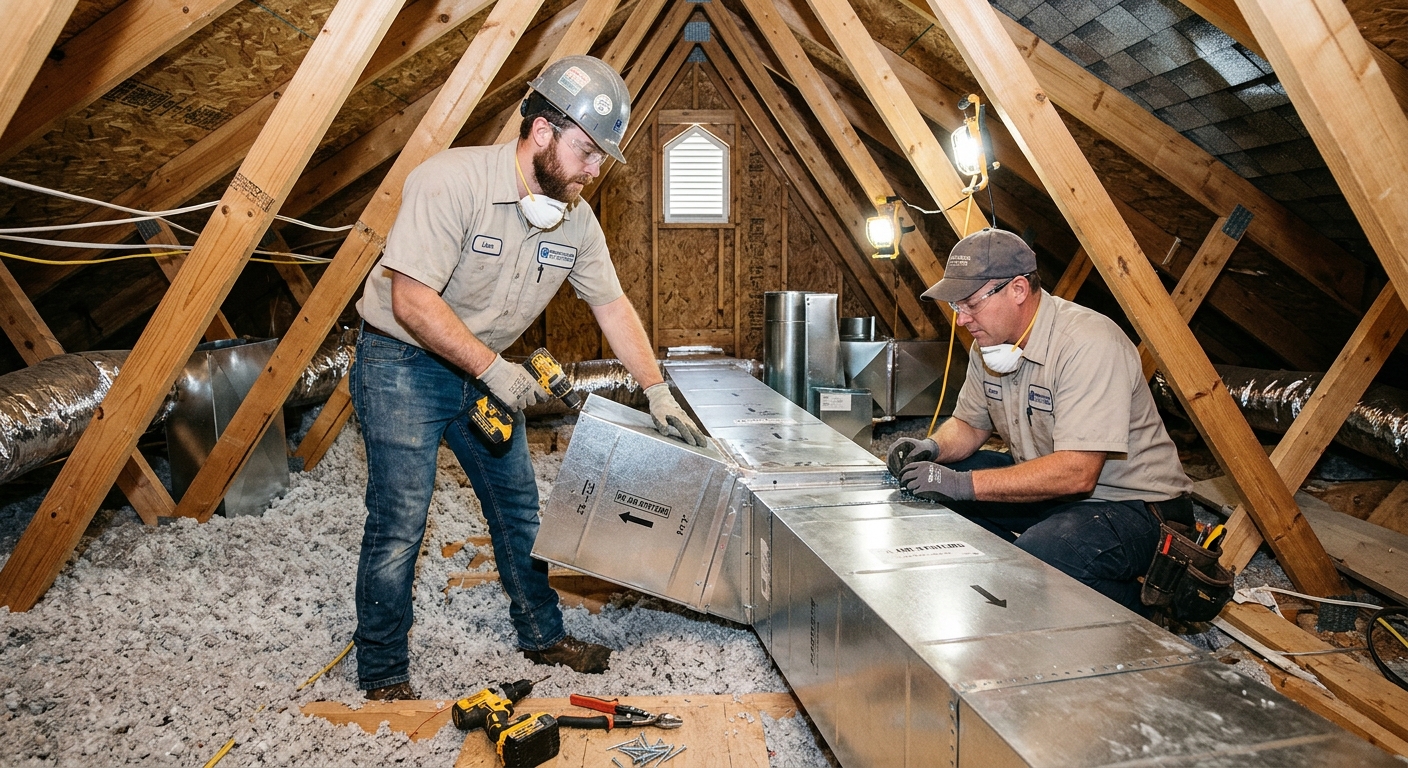
Media heating and cooling prices by system type — 2026
Media, as Delaware County's county seat, sees a different HVAC profile from many suburban areas — most homes here were built before 1980, with a high percentage of owner-occupied multifamily and older single-family homes (U.S. Census Bureau, ACS 2024). With only 17.8% single-family homes and homeownership under 40%, this is very much a retrofit and replacement market, not new construction. In real terms, that means central air replacements, ductless installations, and, in many older units, added ductwork are far more common than full new builds.
Many Upper Darby and Haverford Township homes — especially 1920–1950 rowhouses and twins — rarely came with complete ductwork, which shapes what’s realistic for air conditioning today. Hydronic radiators and oil heat are still present, requiring ductless or high-velocity systems for summer cooling. The climate here delivers about 4,800 heating degree days versus 1,450 cooling degree days, making this a heating-dominated area. That pushes most decisions toward equipment that does well in cold weather — and means any quote for “just upgrading AC” is missing the annual picture.
| System |
Best for |
Efficiency |
Price range (installed) |
| Central AC replacement (existing ducts) |
homes with sound ductwork |
16–20 SEER2 |
$5,100–$12,000 |
| Air source heat pump (ducted) |
year-round heating and cooling |
8–10 HSPF2 |
$8,200–$17,500 |
| Cold-climate heat pump (ducted) |
heat pump as primary heat |
9–11 HSPF2 |
$13,500–$17,500 |
| Ductless mini-split (single zone) |
additions, rooms without ducts |
20–30 SEER2 |
$3,300–$7,100 |
| Full duct system installation |
homes with no existing ducts |
— |
$9,200–$18,500 |
Installed estimates for a typical Media home. Equipment tonnage, duct condition and electrical capacity move these more than brand.
Permits, licensing and inspections in Media
Pennsylvania does not license residential HVAC contractors at the state level. Instead, a Home Improvement Contractor (HIC) registration is required on jobs over $500, managed by the Pennsylvania Office of Attorney General. Any reputable contractor should provide their HIC registration number; homeowners can quickly verify this at hic.attorneygeneral.gov. This rule applies whether you’re in Media Borough, Upper Darby, or another Delaware County municipality, since each township enforces its own permitting on top of the state’s requirements.
For any installation or replacement of HVAC equipment in Media and neighboring Upper Darby, expect a mechanical permit to be required (especially for central air or heat pumps). Each town’s code office will inspect the work under the Pennsylvania Uniform Construction Code, which is based on the IRC. Permit acquisition and inspections are always the contractor’s responsibility, and you should see the permit and inspection sign-off before final payment.
Anyone handling refrigerant must have EPA Section 608 certification, which is federal law — you have the right to ask for it directly. There’s no specific Pennsylvania HVAC license beyond HIC registration, but electrical work, plumbing tie-ins or gas connections may require separate permits handled municipally. Always confirm that your contractor carries current workers’ compensation insurance (check this via the state’s WCAIS system at wcais.pa.gov). If there’s any doubt, cross-check both the HIC status and insurance before signing a contract.
Running the numbers on Media's climate
To estimate what a new HVAC system will cost to operate in Media, you need three things: equipment efficiency (SEER2 or HSPF2), degree days for the area, and your utility rate. The region gets about 4,800 heating degree days (when the average temperature falls below 65°F) and 1,450 cooling degree days per year — so heating drives your budget.
Say you’re considering a heat pump with a 9 HSPF2 rating: this means it produces 9 BTUs of heat for every watt-hour of electricity used. For a typical home, the annual heating load could be about 50 million BTUs (actual needs vary — insulation and window quality matter). At 9 HSPF2, that’s roughly 14,700 kWh per year for heating alone (50,000,000 BTUs ÷ 3,412 ÷ 9). If PECO is your electric utility — which it is for most of Media — your rate per kWh is listed right on the bill.
For cooling, if your central AC is rated 16 SEER2 and your home needs 20 million BTUs for cooling over the summer, annual use would be about 3,660 kWh (20,000,000 BTUs ÷ 3,412 ÷ 16).
But — and this can’t be stressed enough — if your ductwork leaks, those calculations fall apart. Leaky or uninsulated ductwork can waste 20–30% of your system’s output. That means a 20 SEER2 unit running on bad ducts may cost more to operate than a 16 SEER2 unit with tight, insulated ductwork. Always check your actual electric rate and ask your contractor how they calculated expected operating costs for your own building and usage.
Reading an installation proposal
A detailed installation proposal protects both you and the contractor — and makes apples-to-apples comparison possible. The most critical elements are specific model numbers for the indoor and outdoor units; otherwise, you can’t check if the pairing delivers the rated efficiency or fits your space. Sizing should reference a load calculation for your actual house, not just the old unit’s size or rules of thumb.
You’ll also want the proposal to specify if the line set (the copper tubing carrying refrigerant) will be replaced or reused, if electrical upgrades are included, and how condensate (drainage) will be handled. Thermostat replacement needs to be called out, as does the cost and responsibility for the permit and the town inspection. A commissioning report — verifying charge, airflow, and operation — is a must for getting the performance you’re paying for. Finally, labor warranty should be clear and distinct from the equipment warranty.
| Line item |
What to look for |
Red flag if… |
| Equipment |
model numbers, indoor and outdoor matched |
brand name only |
| Sizing |
load calculation attached |
matched to the old nameplate |
| Ductwork |
condition assessed, sealing scoped |
not mentioned |
| Electrical |
circuit and panel capacity confirmed |
assumed adequate |
| Line set |
replaced or documented as reused |
silent |
| Commissioning |
measured airflow and charge, documented |
no startup report |
| Warranty |
labour years stated separately |
manufacturer only |
| Permit |
included and priced |
'not needed' |
Repair or replace your Media system?
Don’t rush a replacement just because your system stops working — in many cases, a repair is smarter, especially for younger equipment or minor components. Here’s a general framework: If your system is under 10 years old and the failure is a compressor relay, fan, or similar part, repair nearly always makes sense if the rest of the unit is sound. Once a unit hits 15 years or repair costs cross a third of a full replacement, it’s time to consider new equipment, especially as reliability drops and efficiency has improved.
A cracked heat exchanger on a furnace, regardless of age, is a major safety concern and absolutely requires replacement, as does a compressor failure in a system out of warranty and over 10–12 years old. Refrigerant is another signpost — old R-22 systems aren’t worth expensive repairs since that refrigerant is being phased out. And finally: in Media’s climate, the payback for jumping to the very highest efficiency isn’t always there, especially if your ducts or building envelope are leaky.
| Situation |
Recommendation |
Typical cost |
Reasoning |
| Under 10 years, single component failure |
Repair |
$300–$1,200 |
System likely has years of service left |
| 10–15 years, repair over a third of replacement |
Consider replacing |
$5,100–$12,000 |
Major components near end of life, efficiency gain possible |
| 15+ years, any major failure |
Replace |
$5,100–$12,000 |
Better reliability and performance with new |
| Cracked heat exchanger, any age |
Replace immediately |
$5,100–$12,000 |
Safety hazard can’t be repaired |
| Compressor failure past warranty |
Replace |
$8,200–$17,500 |
Repair approach often more expensive over time |
| Working system, high bills |
Test ducts and envelope first |
$300–$800 |
Efficiency issues may lie in distribution, not equipment |
What size system does a Media home need?
Sizing is the most crucial decision in any Media HVAC installation. A system that’s too large for the home leads to short cycling, less effective dehumidification, temperature swings, and shortens the life of your equipment — bigger is not better. In this market, many contractors default to "what's on the old nameplate?" or a square-footage rule, but these guesses compound errors, especially in older homes with additions or insulation changes.
Manual J load calculation is the standard for legitimate sizing: it considers room volume, orientation, windows, insulation, and, importantly, the local winter design temperature (14 °F in southeastern PA). This ensures your system can keep every room at temperature on the coldest expected night, not just on average days. Ask: "Did you perform a Manual J calculation, and can I see it?" If the answer is no, keep looking. With 4,800 heating degree days, fudge factors add up fast in comfort and bill costs by the end of the year.
Avoid anyone who insists that going larger offers a safety margin. In Media’s century-old twins and rowhouses, oversized equipment is a defect — not an upgrade.
Reducing the net cost of a Media installation
There are three channels for picking up incentives on a new HVAC system in Media: federal tax credits, utility rebates, and occasional state-level energy programs. A federal tax credit lets you claim part of your installation cost on your next tax return — this only reduces what you owe in taxes, not your upfront bill from the contractor. Utility rebates, on the other hand, are applied as direct discounts after the job is complete. If you’re a Media homeowner, your electric and gas are likely both from PECO Energy Company (check your bill to confirm).
Incentive program names and rebate amounts change almost every year, so rather than chasing the last published blog number, go to your utility’s energy efficiency program page and to the ENERGY STAR rebate finder. For PECO, most rebates target high-efficiency heat pumps and central air. Details depend on equipment and contractor status.
State-level programs rotate and often overlap with utility incentives, so check both for the best outcome. Remember: reliable figures come from the source — always look up current offers at rebate time, not just during planning.
Frequently asked questions — HVAC installation in Media
What does HSPF2 measure?
HSPF2 (Heating Seasonal Performance Factor 2) is the updated standard for measuring the efficiency of heat pumps in real-world heating seasons. It looks at the total heat output over the season divided by the total electricity it uses, including defrost cycles and other realistic loads. In Media, home to older housing stock needing reliable winter comfort, a higher HSPF2 means you’ll spend less to stay warm. For example, a ducted air source heat pump with 8–10 HSPF2 generally lands in the $8,200–$17,500 installed range; paying attention to this rating is more meaningful here than hitting a top SEER for cooling, since this is a heating-dominated market.
Is it worth switching from oil or propane to a heat pump?
For many Media homes with oil or propane heat, switching to a modern air source or cold-climate heat pump can definitely make financial and comfort sense, especially if your house is already on PECO’s electric grid and you’re interested in moving away from price-volatile fuels. Total replacement with a cold-climate ducted heat pump runs $13,500–$17,500 installed. Factor in savings on fuel, lower maintenance, and local utility rebates if available. You’ll want a contractor to check insulation and ductwork first, but between the local utility's electric rates and the high annual number of heating degree days, the payback period is attractive — more so than in southern climates.
How far ahead should I schedule in Media?
Delaware County is served by a dense contractor market due to its proximity to Philadelphia, so you won’t see the long lead times found in rural Pennsylvania. That said, peak summer (for AC) and early fall (for heating replacements) book up quickly. For a ductless mini-split install (single zone, $3,300–$7,100), expect 1–3 weeks from signed contract to install in spring or winter, and 3–6 weeks out at peak season. Full central replacements can be similar or a bit longer if permits and municipal inspection windows become a bottleneck. If your system is failing, start the process in late winter or early fall to avoid peak rush.
How much does ductwork add to an HVAC installation?
If your Media home has no existing ducts — typical in many of the area’s 1920s–1950s rowhouses and twins — adding a full duct system alongside a new central AC or heat pump changes the project and its price range considerably. A full duct system installation in Delaware County runs $9,200–$18,500 on top of the equipment cost. This covers the main trunk, branches to each room, grilles, and full balancing, plus the municipal permit. It’s a large project but necessary if you want evenly distributed central heating and cooling in an older structure otherwise relying on radiators or baseboards.
Do I need ENERGY STAR equipment to qualify for incentives?
For nearly all rebate and incentive programs in Pennsylvania and Media, ENERGY STAR certification is the baseline for eligibility — but always double-check the specific requirements of your utility or the federal tax credit that applies to your equipment. The ENERGY STAR rebate finder and PECO’s energy efficiency page give up-to-date requirements. Keep in mind that high-efficiency, ENERGY STAR–listed ductless mini-splits (single zone) start at about $3,300–$7,100 installed in this region and are almost always eligible, provided you use a qualified installer. Always confirm eligibility before signing a contract to avoid missing out.
Is a high-efficiency system worth the extra cost here?
In Media and across Delaware County, the decision hinges on both climate and your utility rates. With 4,800 heating degree days annually, energy savings from an efficient heat pump (9–11 HSPF2) or a 20+ SEER2 AC are more meaningful than in milder climates — but only if your ductwork is also tight and insulated. Expect to pay at the top of the range for highest efficiency heat pumps, about $17,500 installed. Unless your home is well-insulated and envelope-leakage is low, jumping to top-tier efficiency may not pay back fast, so address air sealing and ductwork as part of the project.
How cold does it get in Media and does that affect heat pumps?
The local winter design temperature in Media is 14 °F, and it’s not uncommon to see a week or more below 20 °F each season. Modern cold-climate heat pumps are absolutely up for the task here — they’re designed to produce reliable heat down to 5 °F or lower. Older heat pumps struggled at the temperatures we see in Delaware County, but newer models (9–11 HSPF2) function as the primary heater in most homes. A system like this will run $13,500–$17,500 installed and eliminates or greatly reduces your need to rely on fossil fuel back-up, lowering your annual heating bill and carbon footprint.
What is EPA Section 608 certification?
EPA Section 608 certification is the federal credential every technician must hold to work legally with refrigerants in the United States. For any Media HVAC installation involving air conditioning or heat pumps — even ductless mini-splits ($3,300–$7,100) — a Section 608–certified tech handles the setup, charging, or disposal of refrigerant. This law exists to ensure environmental compliance and proper training. Don’t hesitate to ask for a contractor’s certification document; it’s your assurance that the person installing or servicing your system knows the environmental and safety requirements specific to this type of work.
How often should I change my filter?
In a Media home, change your HVAC filter every 1–3 months, and sooner if you have pets, allergies, or ongoing construction. Older homes in Delaware County often have more dust and pollen infiltration than newer sealed houses. If you’ve just had a new central AC installed ($5,100–$12,000), ask your installer to show you the filter slot and explain the replacement process. Staying on top of filter changes keeps efficiency up, extends equipment life, and preserves indoor air quality — all especially important in our older, tighter rowhouses and twins.