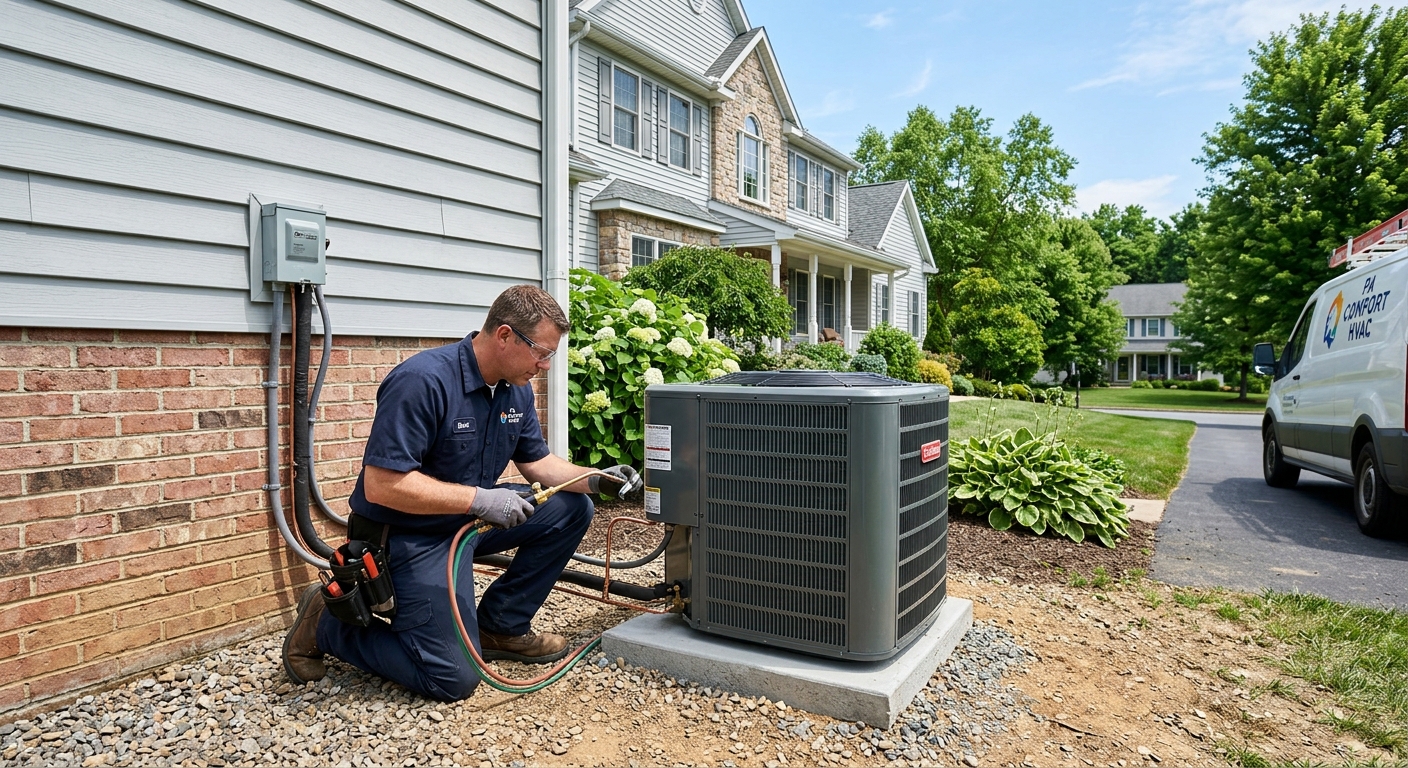
What a new HVAC system costs in Aston
Aston’s high homeownership rate and the age of its housing stock shape what new HVAC installations actually look like. With 88.4% of households owner-occupied and nearly 69% of homes built before 1980 (U.S. Census Bureau, ACS 2024), you’re more likely to be upgrading or replacing an aging system than installing brand new in a blank-slate addition. In nearby Upper Darby and Haverford, homes are often 1920–1950 rowhouses and twins, which commonly lack modern ductwork or have challenging layouts. That’s why ductless mini-split systems or high-velocity retrofits are so common for cooling upgrades in much of Delaware County.
Southeastern Pennsylvania’s climate puts serious heating demand front and center. With a winter design temperature of 14 °F and 4,800 heating degree days—more than triple the 1,450 cooling degree days—your system needs to prioritize reliable, efficient heat. Cooling can’t be ignored, though, as summers get humid and muggy. Most homeowners here run their AC hard from late May through September.
What you’ll actually pay depends heavily on whether your home has good ductwork now. If your existing ducts are solid, replacing just the central AC is much less than a full retrofit. Going ducted is more costly if it means opening walls and ceilings. Here’s what you can expect for installed prices in Aston:
| System |
Best for |
Efficiency |
Price range (installed) |
| Central AC replacement (existing ducts) |
homes with sound ductwork |
16–20 SEER2 |
$5,500–$13,000 |
| Air source heat pump (ducted) |
year-round heating and cooling |
8–10 HSPF2 |
$8,700–$18,500 |
| Cold-climate heat pump (ducted) |
heat pump as primary heat |
9–11 HSPF2 |
$14,000–$18,500 |
| Ductless mini-split (single zone) |
additions, rooms without ducts |
20–30 SEER2 |
$3,500–$7,600 |
| Full duct system installation |
homes with no existing ducts |
— |
$9,800–$19,500 |
Installed estimates for a typical Aston home. Equipment tonnage, duct condition and electrical capacity move these more than brand.
Gas, electric or both in southeastern Pennsylvania
In Delaware County and Aston, your largest HVAC decision is how to heat. With a winter design temperature at 14 °F and over 4,800 heating degree days, heating is non-negotiable, and any system here needs to be sized and selected for steady, reliable performance below freezing. The days when “heat pumps don’t work in our winters” were valid are over—new cold-climate heat pumps can heat efficiently well into the teens, but their output does drop as temperatures fall. That’s where your winter design figure really matters: below 20 °F, heat pumps do lose ground, which is why many homes opt for a backup (dual fuel) or keep a gas furnace if service is available.
Most of Aston and the surrounding townships are served by natural gas from PECO. Gas is widely available in this part of the county, but in outlying areas like Chadds Ford some homes still rely on oil or propane. If you have active gas service already, running a high-efficiency furnace makes economic sense—especially if your existing ductwork is already in good shape. If you’re looking at a conversion from oil or propane, heat pumps offer a much more compelling case.
The sweet spot for heat pumps in Aston is usually a well-insulated home aiming to go all-electric or where adding gas isn’t practical. Still, furnace-plus-central-AC is the most straightforward call for homes with gas on site, especially where winters feel longer and colder than the numbers suggest.
| Option |
Installed cost |
Operating cost here |
Best when |
Incentive eligible |
| Gas furnace + central AC |
$5,500–$13,000 |
lower if gas available |
existing gas service, coldest zones |
yes if replacing old unit |
| Ducted heat pump (cold climate) |
$8,700–$18,500 |
lower with good envelope |
good envelope, all-electric goal |
yes, often stackable |
| Dual fuel (heat pump + gas backup) |
$14,000–$18,500 |
optimized by balancing |
gas on site, deep cold spells |
yes, sometimes partial |
| Ductless multi-zone |
$9,800–$19,500 |
zoned savings with no ducts |
no ductwork, zone control |
yes (multi-zone only) |
Running the numbers on Aston's climate
In Aston, heating is the heavyweight—your energy use for heat will outstrip cooling by over 3 to 1, based on 4,800 vs. 1,450 degree days. The local electric utility (PECO Energy Company) bills you per kWh, and your annual use depends on how much heat you need (the degree days), how efficient your equipment is, and how leaky your house and ducts are.
The honest way to compare heating costs between, say, a gas furnace and a cold-climate heat pump is:
- Look up your fuel rates on your PECO bill (electricity in $/kWh, gas in $/CCF).
- Check your unit’s efficiency: a 95% gas furnace or a heat pump with 9 HSPF2 (that’s 9 BTUs out per watt-hour in, averaged over the season).
- Estimate annual heating load: For an average home, a quick engineering estimate is (degree days × home area × 24) ÷ R-value, but most homeowners can reference last year’s therm or kWh use.
- To compare: For 30,000,000 BTUs (~1 typical winter), the gas furnace needs ~31,579,000 BTUs ÷ 0.95 = 33,241,000 BTUs gas, the heat pump needs 30,000,000 ÷ 9 = 3,333,333 watt-hours (3,333 kWh). Plug your PECO price per kWh or per therm here.
But remember—leaky ductwork ruins even the best design. A system running at high efficiency on paper will underperform if the ducts are unsealed, undersized, or simply routed through cold attics or crawlspaces. Fixing or replacing ducts is every bit as important as picking the right equipment, especially in Aston’s older homes.
Service plans: worth it or not?
Most Aston homeowners will see “annual service plans” offered for new HVAC installs or just as a mailer from a big shop. Here’s what matters and what doesn’t: changing your air filter on schedule and at the right MERV rating is far more important to reliability than any checklist tune-up. A plugged filter puts more strain on your blower than almost anything else. Coil cleaning and condensate line clearing are useful if you have pets, pollen, or trees nearby, but don’t need to be annual for most people. Refrigerant should be checked, but topping off is not maintenance—a unit that’s low has a leak, and adding more only buys a little time. Demand a leak check, not a top-up.
Are annual contracts worth it? Sometimes. Read the fine print—some “maintenance” plans are really just cash-for-priority-response, and don’t even include parts or deep cleaning. The only time a plan is a good deal is if it includes a full cleaning, operational check, priority service, and a discount on parts/labor if something breaks. Otherwise, change filters yourself and schedule cleaning every 2–3 years, not every season.
Best time to book service? Early spring or fall. You’ll skip the summer AC rush and the dead-of-winter emergencies—less waiting, more attention (and probably a lower bill).
Comparing HVAC estimates in Aston
When you’re collecting bids for a new HVAC install in Aston, ignore any quote that just gives a brand and a price. To actually compare, demand model numbers for both the indoor and outdoor units—efficiency ratings only apply when these match. The right tonnage must be supported by a heat load calculation based on your home, not just repeating the old system size. Ask if the refrigerant line set is being replaced or reused, and make sure the bid actually addresses ductwork: are your ducts properly sealed? Are repairs or cleaning needed?
Details matter: does the price include electrical panel upgrades, new thermostat, all permit fees, and a commissioning report showing airflow and refrigerant charge? Labour warranty is not the same as an equipment warranty; both should be spelled out. A tight, detailed bid protects you from surprise add-ons and ensures the system will actually perform at its rated efficiency.
| Line item |
What to look for |
Red flag if… |
| Equipment |
model numbers, indoor and outdoor matched |
brand name only |
| Sizing |
load calculation attached |
matched to the old nameplate |
| Ductwork |
condition assessed, sealing scoped |
not mentioned |
| Electrical |
circuit and panel capacity confirmed |
assumed adequate |
| Line set |
replaced or documented as reused |
silent |
| Commissioning |
measured airflow and charge, documented |
no startup report |
| Warranty |
labour years stated separately |
manufacturer only |
| Permit |
included and priced |
'not needed' |
The comfort problem that isn't temperature
In Aston, it isn’t just about hot or cold—controlling humidity and air quality is just as critical. With muggy summers (1,450 cooling degree days) and dry, heated winters, the problems flip: summer discomfort is too much moisture, while winter’s main complaint is dry skin and static. Many older homes with oversized AC struggle to control humidity, barely running long enough to pull moisture out. The answer is not simply bigger equipment—oversizing makes it worse. Instead, consider variable-speed systems, which run longer and dehumidify more effectively.
If you add a whole-house humidifier for winter dryness, understand that they need regular cleaning—mineral buildup and mold are real risks if left unchecked. When upgrading filters, bigger isn’t always better: MERV 8–11 is usually safe for most blowers in older Aston homes. Higher MERV ratings can choke airflow and actually harm both comfort and efficiency if your ductwork is restrictive or original to a 1950s build.
Mechanical ventilation (fresh air systems) really only matters in tightly sealed homes; most older Aston houses already ‘ventilate’ through leaks. Beware expensive add-ons like UV lights or ‘air scrubbers’—these are frequently sold as miracle cures, but unless your doctor recommends them for a medical reason, your comfort dollars are usually better spent on right-sizing your main system and getting the ducts sealed properly.
Permits, licensing and inspections in Aston
Pennsylvania does not require a state HVAC license for residential contractors. Instead, anyone doing HVAC work over $500 in Aston must have a Home Improvement Contractor (HIC) registration from the Pennsylvania Office of Attorney General. There is no special HVAC license at the state level, but mechanical (HVAC) permits are enforced by individual municipalities in Delaware County, and inspection is almost always required for new or replacement installations — not just for new construction. Contractors must also hold EPA Section 608 certification to lawfully handle refrigerant, which applies everywhere, not just in Pennsylvania.
If you're having a central system replaced or installed in Upper Darby, expect a mechanical permit and inspection; other Delaware County towns run their own code offices, while the state steps in for towns that opt out. Verify your contractor’s workers’ compensation insurance using the WCAIS system, and check HIC registration at hic.attorneygeneral.gov. For pre-1978 homes, the contractor must also follow EPA’s Lead Renovation, Repair and Painting Rule, which you can check against the EPA's certified firm search. Always ask to see hard proof of insurance — not just registration numbers — before signing or putting down a deposit.
Frequently asked questions — HVAC installation in Aston
Should I replace the furnace and AC at the same time?
If your Aston home still has its original furnace and AC, you’ll often get the best long-term value by replacing both together—especially if both are 15+ years old or starting to fail. Most homes in the area have matched systems, and upgrading both ensures they’re properly sized and compatible. However, if your furnace is still in great shape or recently replaced, there’s no technical reason to swap it early. Sometimes, only the AC or only the furnace will need an upgrade. Keep in mind that a completely new matched system typically lands between $5,500–$13,000, depending on efficiency, brand, and your existing setup. The real deciding factor is how much useful life each unit has left and whether you want the warranty clocks aligned.
How do I verify an HVAC contractor's insurance?
In Pennsylvania, and specifically in Aston, contractors must carry liability and workers’ compensation insurance. Ask to see a certificate of insurance—don’t just take their word for it. For workers' comp, you can look up coverage status on the WCAIS website, which is the official tool for all Pennsylvania employers. For general contractor legitimacy, also check their Home Improvement Contractor (HIC) registration at hic.attorneygeneral.gov. If you have a written proposal with prices over $500, HIC registration is required by state law. Never sign a contract or issue a deposit without copies of these documents.
How much does a furnace replacement cost in Aston?
Furnace replacement pricing in Aston is heavily tied to whether you’re also swapping the AC and if any ductwork repairs are needed. A straightforward gas furnace (matched to an existing AC) will typically be in the lower end of the central AC replacement band, so expect a total of $5,500–$13,000 for a furnace and AC package. If it’s just the furnace, costs may dip slightly but rarely fall below $5,000 by the time permits and labor are included. Always check if electrical or flue upgrades are needed, as these can add to the bill.
What MERV filter rating should I use?
For most older Aston homes, a MERV filter rating between 8 and 11 strikes the best balance between filtering performance and system longevity. Higher MERV (13+) filters can reduce airflow in standard-ducted systems, overworking your blower and reducing comfort—especially if your ductwork is original or undersized, as is common with local 1920–1950 homes. Never upgrade to a higher MERV based only on marketing. Check your blower capacity in the documentation, or ask your HVAC contractor to confirm before swapping filters. For standard replacement intervals, a case of three to four filters costs well under $100 per year at hardware stores.
Do I need to be home during installation?
Yes, for much of the installation process, Aston homeowners should plan to be home. Your presence is usually required at the start (to confirm scope, access, and thermostat placement) and at final walkthrough for commissioning and training on new controls. However, you don’t need to hover during actual equipment replacement or ductwork in the attic or basement. If your HVAC quote is for a typical system in the $5,500–$13,000 band, the work will usually be completed in one full day, possibly two for complex jobs or ductless systems. Arrange for someone to be there to answer questions and lock up at the end of the day.
What HVAC tax credits are available to Aston homeowners?
Aston homeowners may qualify for federal energy efficiency tax credits on new installs, especially for heat pumps and high-efficiency equipment. Cold-climate ducted heat pumps (installed in Aston at $14,000–$18,500) often qualify for the largest incentives, but even a standard furnace/AC replacement can be eligible for smaller credits. Always check IRS guidance in the year of installation and save all model numbers and invoices. Pennsylvania’s state-level incentives are more limited; there’s no statewide rebate, but some PECO incentives may apply to upgrades—check their website for seasonal deals. Credits aren’t paid at installation—you’ll claim them on your tax return after the work.
Why are my Aston energy bills high with a new system?
A new HVAC system should lower bills, but in Aston’s older homes, the weak links are often leaky ducts or poor insulation. Even the most efficient unit in the $8,700–$18,500 heat pump range can underperform if duct leaks or uninsulated attics let conditioned air escape. Make sure your installer checks duct pressure and insulation. Also, if your system was oversized “just to be safe”, short run times mean high humidity in summer and static in winter, with no actual savings. Finally, check your PECO rate on the bill—sometimes, delivery or generation charges change year to year.
How does southeastern Pennsylvania's climate affect system sizing?
Aston’s climate, with a winter design temperature of 14 °F and much higher heating than cooling demand, forces a skilled installer to size equipment for both extremes. Sizing only to the coldest day leads to overshooting in spring and fall; sizing for a hot July day will leave you cold-shouldered in February. Most retrofit jobs in Aston (68.9% of homes built before 1980) need detailed load calculations sensitive to the actual envelope, not just square footage or a table lookup. Proper sizing also keeps your costs within the quoted $5,500–$13,000 to $8,700–$18,500 ranges, without paying for unused capacity.
Why do HVAC quotes in Aston vary so much?
Quotes for new HVAC in Aston can swing wildly—even for the same sized house—because the real issues are condition of old ducts, need for new electrical circuits, and what’s included in “standard install.” Equipment price is just one chunk of the total; labor, permits, factory warranty upgrades, and cleanup of hidden surprises (like asbestos wrap or knob-and-tube wiring in older twins) makes up the rest. Some quotes include everything needed for safe, code-compliant operation at $14,000–$18,500 for a top-shelf heat pump, while cut-rate bids can leave you on the hook for extras. Always compare quotes line by line—not just the bottom line—before signing.