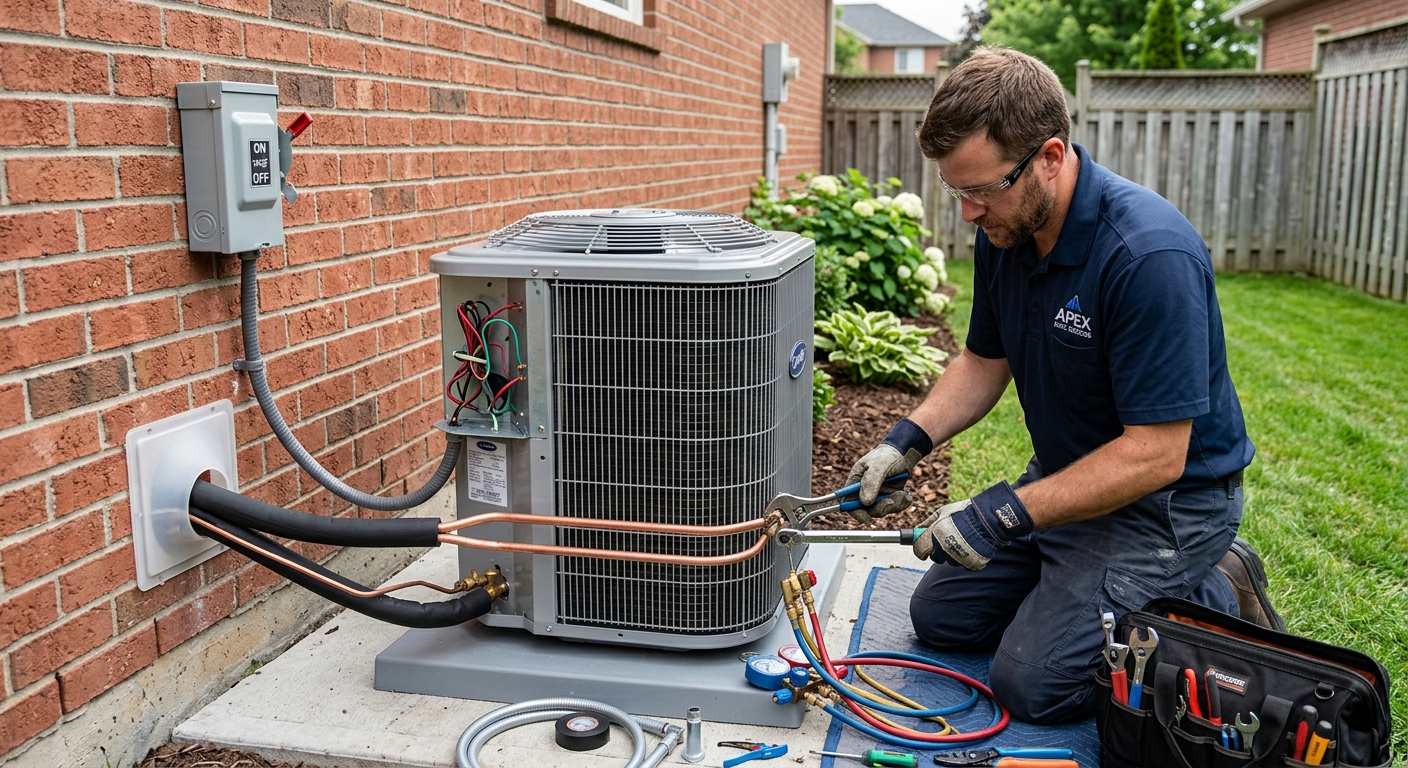
What a new HVAC system costs in Carroll
For Carroll homeowners, the cost of a new HVAC system comes down to whether you’re upgrading a modern system or adapting an older home that was never built for central air. With an 87.9% homeownership rate and many houses built before 1980, a lot of the work here is replacing aging equipment that’s already on its second or third lap, but there’s still a steady stream of ductwork retrofits in homes that never had central air.
Unique to our part of York County, York City’s pre‑1940 rowhomes lead the region in high-velocity or ductless installations—installers often get creative to bring modern cooling to homes that never had ducts or have ones too small for today’s air conditioning. For most of Carroll, though, established ducted systems are the norm unless you live closer to the city’s historic core.
With 5,200 heating degree days and only 1,250 for cooling, this is a heating-dominated market. Winters reach as low as 12 °F, which means your heating system does the heavy lifting. This tilts the cost equation: you’ll get more value from investing in a solid heating source, though efficient cooling is still worth it, especially with last summer's humidity. Here’s what to expect price-wise:
| System |
Best for |
Efficiency |
Price range (installed) |
| Central AC replacement (existing ducts) |
homes with sound ductwork |
16–20 SEER2 |
$5,500–$13,000 |
| Air source heat pump (ducted) |
year-round heating and cooling |
8–10 HSPF2 |
$8,800–$18,500 |
| Cold-climate heat pump (ducted) |
heat pump as primary heat |
9–11 HSPF2 |
$14,000–$18,500 |
| Ductless mini-split (single zone) |
additions, rooms without ducts |
20–30 SEER2 |
$3,500–$7,700 |
| Full duct system installation |
homes with no existing ducts |
— |
$9,900–$19,500 |
Installed estimates for a typical Carroll home. Equipment tonnage, duct condition and electrical capacity move these more than brand.
Why your ducts may be the real problem in Carroll
In Carroll’s mix of postwar houses and older homes, it’s easy to forget the ductwork when thinking about comfort or utility bills—but ignoring ducts costs real money. In homes from the pre‑1980 era, untested duct systems (if they exist at all) can leak 20–30% of heated or cooled air, especially when seams or connections haven’t been sealed since installation. That means your new high-efficiency equipment could be losing a third of its output to the attic or crawlspace before it ever reaches the rooms you care about.
A duct blaster test pressurizes the duct system to measure total leakage, pinpointing where air escapes—you can’t eyeball this. Once leaks are found, many can be sealed for far less than the cost of replacement, unless rust, crushed runs, or asbestos mean starting over. Chronically undersized returns are another silent culprit: if your old system was sized for a furnace only, the returns may starve an AC or heat pump, reducing capacity and efficiency.
In homes near York City’s historic core, retrofits often skip ducts entirely, going with mini-splits or high-velocity systems, simply because there never were proper ducts or they’re impossible to fit in tight framing. For attic or crawlspace runs, insulation and air sealing are a must, since unconditioned spaces pull energy right out of the ductwork in both summer and winter.
My straight advice: get your ducts professionally tested before you spend thousands on new equipment. Fixing distribution issues first prevents buyers’ remorse, especially in older Carroll homes where leaky, undersized, or missing ducts are the real comfort killer.
When an HVAC repair stops being worth it
The best call on repair versus replacement in Carroll comes down to age, cost, and the nature of the failure—not scare tactics. If your system is under 10 years old and the issue is a single component, like a fan or a capacitor, repairs typically pay off. But as systems age past 12–15 years, or if the cost of repair climbs above a third of what new equipment costs, replacement often makes more sense. A compressor or heat exchanger failure is rarely worth fixing outside of warranty—especially here, where heating demand is high and efficiency losses are felt all winter long.
Refrigerant type matters, too: older units using phased-out R-22 face high repair bills as supplies dwindle, which can tip the scales toward replacement early. That said, don’t assume high bills always mean the system is at fault. Here in Carroll, a leaky house or duct system eats up energy just as fast as outdated equipment, so testing the envelope is often smarter than swapping the unit. And with our moderate cooling load, efficiency gains from new cooling equipment alone won’t always pay for themselves quickly.
There are only two cases where replacing the system isn’t optional: a cracked heat exchanger (safety hazard) or a compressor failure outside of warranty on an old system. A straight repair can make sense the rest of the time, especially in younger systems.
| Situation |
Recommendation |
Typical cost |
Reasoning |
| Under 10 years, single component failure |
Repair |
$300–$1,200 |
Lots of expected life, part still available |
| 10–15 years, repair over a third of replacement |
Consider replacing |
$5,500–$13,000 |
Money better put toward new, longer-life system |
| 15+ years, any major failure |
Replace |
$5,500–$13,000 |
At or past expected life; stop sinking money in |
| Cracked heat exchanger, any age |
Replace immediately |
$5,500–$13,000 |
Carbon monoxide risk—do not delay |
| Compressor failure past warranty |
Replace |
$8,800–$18,500 |
Repair is rarely economical |
| Working system, high bills |
Test ducts and envelope first |
$300–$800 |
Efficiency loss may not be the unit's fault |
What construction era means for your system
The construction era of your Carroll home determines almost everything about your HVAC options. With 34.1% of homes built before 1980 and a strong base of single-family houses, many duct systems here were either retrofitted after original construction or sized strictly for heating. If your home falls in this bracket, chances are good the ducts weren’t sized for central AC, and insulation quality may be spotty. Windows are often original-single pane, and you may face limited attic insulation—both big factors in sizing and comfort.
Older homes may also have limited electrical service (usually 100 amps), which matters if you're considering switching to an all-electric heat pump system. Panel upgrades may be needed before new equipment is installed. If you heat with natural gas, older chimneys might require a liner to meet venting codes for new high-efficiency furnaces.
In the newer subdivisions—with most homes built in the 1990s and 2000s—original builder-grade HVAC units are now well past their expected service lives. These were often sized for easy installation and cooling, not tuned for maximum efficiency. You’re likely looking at a first replacement, which is a good time to check duct conditions and sizing, since the original installs were sometimes rushed or undersized—especially at the returns.
Summing up: know your house’s build date, check system capacity, and have duct integrity verified before you choose equipment. The right fix in a Carroll home starts with the construction era.
Mechanical permits for HVAC work in Carroll
Pennsylvania does not require a statewide HVAC contractor license, but any residential HVAC work in Carroll falls under the Pennsylvania Uniform Construction Code (UCC), based on the IRC. Mechanical permits and inspection are required in most municipalities—in the City of York, for example, any installation or replacement of central HVAC equipment will usually trigger the need for a permit. In other York County townships, the responsibility falls to their own code offices.
For residential work, it’s regulated at the municipal level rather than by a state licensing board. If you’re hiring a contractor, make sure they carry Home Improvement Contractor (HIC) registration from the Pennsylvania Office of Attorney General; it’s required by law for jobs over $500, and you can check their status at hic.attorneygeneral.gov.
EPA Section 608 certification is federally mandated for anyone handling refrigerants—if your system uses refrigerant, make sure the technician is certified, no matter the company’s paperwork.
Homeowners should also verify that any contractor carries workers’ compensation insurance, which is mandatory for employers in Pennsylvania. You can confirm coverage via WCAIS (wcais.pa.gov). Written contracts are legally required for jobs over $500, and you have a three‑business‑day right of cancellation under the Home Improvement Consumer Protection Act. When in doubt, ask to see both the HIC registration and an insurance certificate before you sign off on any work in Carroll.
What each system actually costs to run in Carroll
To size up your actual HVAC running costs in Carroll, start with three simple numbers: system efficiency (SEER2 for cooling, AFUE or HSPF2 for heating), your home’s annual heating and cooling degree days, and your real-world utility rate from Met-Ed (you’ll find it on your bill).
Take heating first: With 5,200 degree days and a winter design temp of 12 °F, most homes spend a lot more on heating than cooling. Suppose you have a furnace rated at 95% AFUE burning gas, or a heat pump rated at 9 HSPF2. Your yearly heating load translates into BTUs needed, which you get by multiplying those 5,200 degree days by the square footage and heating factor. Your delivered cost per BTU then comes down to your equipment’s efficiency and your actual fuel or electric price. For example: if electricity costs $0.15 per kWh and your heat pump delivers 9 BTUs per watt-hour (HSPF2), your annual heating cost will be lower than with an older electric resistance heater—but can still be quite close to gas, especially if your ducts are sealed tight.
Cooling runs lighter: With only 1,250 cooling degree days, a central AC rated at 18 SEER2 won’t see the marathon usage it would in the Deep South. If your old AC ran at 10 SEER and your new one is 18 SEER2, you’ll use about 45% less electricity on those hot weeks. To estimate, work out last summer’s kWh from your bill, compare old SEER to new, and adjust for the size of your home.
Just remember, a leaky duct system throws these numbers out the window. Even the most efficient unit in Carroll will underperform if half the air escapes before it gets to your living space. Start with your bill, calculate using equipment ratings, and only trust the projections if your ducts and house are tight.
The central decision for a Carroll homeowner
For homeowners in Carroll, the core HVAC decision is whether to stick with a furnace (typically gas) plus AC, move to a heat pump, or go dual fuel. With a winter design temperature of 12 °F and 5,200 heating degree days, we are solidly a heating-driven market. Modern cold-climate heat pumps work well well below freezing—but their output does drop as outside temperatures near our design lows. That’s why the “heat pumps can’t handle Pennsylvania winters” myth is outdated, but capacity planning is more important here than in warmer states.
Where natural gas is readily available—mostly within York, Springettsbury, and West Manchester—a high-efficiency gas furnace is still a straightforward choice, especially in the chilliest corners of the county. Once you get into the rural outer townships, gas lines often aren’t an option, and homeowners are looking at propane or fuel oil. In those cases, the cost and performance balance shifts heavily toward heat pumps, since electric backup is usually less expensive than buying and maintaining oil or propane tanks. For homes aiming to go all-electric, a high-efficiency cold-climate heat pump makes sense, provided your home is decently insulated and ducts are up to snuff.
A furnace is still the right call if you have gas on site, drafty construction, and limited appetite for envelope upgrades. Dual fuel—heat pump plus a gas backup—can split the difference if you want savings most of the year but reliable heat in the worst cold snaps.
| Option |
Installed cost |
Operating cost here |
Best when |
Incentive eligible |
| Gas furnace + central AC |
$5,500–$13,000 |
Lower if you have gas; stable for deep cold |
existing gas service, coldest zones |
partial, asks on specific models |
| Ducted heat pump (cold climate) |
$8,800–$18,500 |
Lowest with well-sealed home, low gas areas |
good envelope, all-electric goal |
yes, via federal credits |
| Dual fuel (heat pump + gas backup) |
$14,000–$18,500 |
Efficient most of year, gas for cold snaps |
gas on site, deep cold spells |
yes, on new high-efficiency gear |
| Ductless multi-zone |
$9,900–$19,500 |
Lowest with room-by-room control |
no ductwork, zone control |
yes, with certain models |
Frequently asked questions — HVAC installation in Carroll
How often should I change my filter?
In Carroll, the right filter change interval depends on your lifestyle and system, but most homes need a swap every 2–3 months. If you have pets, many houseguests, or allergies, monthly changes might make more sense. Carroll’s mix of pre-1980 homes and new construction means some systems draw more dust and debris than others, especially if ductwork runs through older basements or attics. A clogged filter strains even the best HVAC system, raising bills and risk of repairs—something you don’t want when a replacement could cost $5,500–$13,000. Mark your calendar at the start of each season and check the filter then; err on the side of changing sooner, especially after pollen spikes or remodeling work.
How much does a new HVAC system cost in Carroll?
The cost for a new HVAC system in Carroll typically falls between $5,500–$13,000 for central AC replacement with existing ductwork, while a full ducted heat pump system can range from $8,800–$18,500, depending on size, complexity, and electrical or duct upgrades. Ductless mini-split systems for a single zone run $3,500–$7,700. Full duct installation is at the high end—think $9,900–$19,500. Prices shift based on the condition of your old system and your home’s era; older homes in York’s historic areas often drive up costs due to added retrofit work. Always ask for line-item quotes so you see exactly what you’re paying for and why.
What is commissioning and why does it matter?
Commissioning is the process of testing and fine-tuning your HVAC system after installation to verify it’s running as it should. In Carroll and across Pennsylvania, too many systems are installed and left with factory defaults or poorly calibrated airflow. Proper commissioning checks refrigerant charge, verifies airflow (especially crucial in older homes with unpredictable ductwork), and ensures controls are working. Without it, you might have leaks, shorts, or high bills, even on a brand-new installation that cost $8,800–$18,500. Good contractors include commissioning as part of the job—it’s not just a checklist, it’s your insurance policy against early breakdowns and wasted energy. Always ask your installer to specify what’s included in the commissioning process before you sign off on the work.
How cold does it get in Carroll and does that affect heat pumps?
Carroll homes see winter temperatures down to 12 °F design days, and actual cold snaps can go even lower. With 5,200 heating degree days, heating system performance really matters. Older heat pump models struggled to keep up below freezing, but today’s cold-climate units—priced between $14,000–$18,500 installed—maintain useful heating output well into single digits. That said, their efficiency (and output) declines the colder it gets, so system design must allow for our worst weather. In some cases, backup heat is added (electric or gas) to guarantee comfort on the chilliest days, especially in the rural townships outside gas service territory.
Is a heat pump a good choice for Carroll winters?
Yes, provided you pick a cold-climate rated model and your home’s envelope isn’t extremely leaky. Today’s ducted and ductless heat pumps are engineered to handle South-Central Pennsylvania’s winters, with many systems capable of delivering comfortable heat at 12 °F or below. In the gas-served parts of Carroll, heat pumps compete head-to-head with high-efficiency furnaces, but they’re a strong choice in rural areas reliant on oil or propane. A new ducted heat pump typically runs $8,800–$18,500 installed. If your house is older and drafty, you may want a dual-fuel system for backup, but most modern systems can carry the load if sized and installed correctly.
How much does a furnace replacement cost in Carroll?
In Carroll, replacing a gas furnace along with central AC generally costs between $5,500–$13,000, depending on the brand, system size, ductwork upgrades, and electrical or flue modifications. If you’re just swapping the furnace itself and the AC is newer or separate, the lower end of that range is likely, provided the home’s gas service and venting are up to current code. For older pre-1980 homes, budget extra for chimney liners or return air upgrades if needed. Always insist on a written quote covering removal, disposal, and any parts not included with the unit itself.
Do I need a permit to replace HVAC in Carroll?
Yes, in nearly every case where you’re replacing or installing central HVAC equipment in Carroll, a mechanical permit is required through your local code office. The Pennsylvania Uniform Construction Code (UCC) sets the baseline, with enforcement handled at the municipal level in York County—so requirements can differ from township to township. Simple work like swapping thermostats or a window AC doesn’t usually require a permit. For a standard system installation—costing $5,500–$13,000 or more—a permit and inspection protect you if there’s ever an insurance issue or resale. Always confirm with your township or municipal office before work begins.
What HVAC tax credits are available to Carroll homeowners?
Many Carroll homeowners are eligible for federal tax credits on new high-efficiency heat pumps, central AC, or furnaces. The incentives especially favor cold-climate heat pumps, which can lower your upfront cost from $14,000–$18,500 down by a few thousand, depending on the model and overall household limits on credits. Pennsylvania itself doesn’t currently offer a statewide residential rebate, but Met-Ed and Columbia Gas sometimes run equipment promotions or rebates—always check your utility’s site before installation. To qualify for federal credits, make sure your installer provides a certificate of efficiency for your records at tax time.
What size HVAC system does my Carroll home need?
There’s no one-size-fits-all answer—system sizing depends on your home’s square footage, insulation, window quality, and ductwork condition. Most Carroll homes land in the 2–4 ton range for central AC or heat pump systems, but older homes with poor insulation or lots of windows may require more capacity for the same comfort. Don’t trust a contractor who sizes just by square footage; demand a Manual J load calculation, which factors in local climate (5,200 heating degree days in Carroll), home orientation, and duct conditions. Oversizing wastes money up front ($8,800–$18,500) and creates comfort problems, while undersizing can leave you cold or sweltering. It’s worth taking an extra appointment to get the sizing—and the system—right the first time.