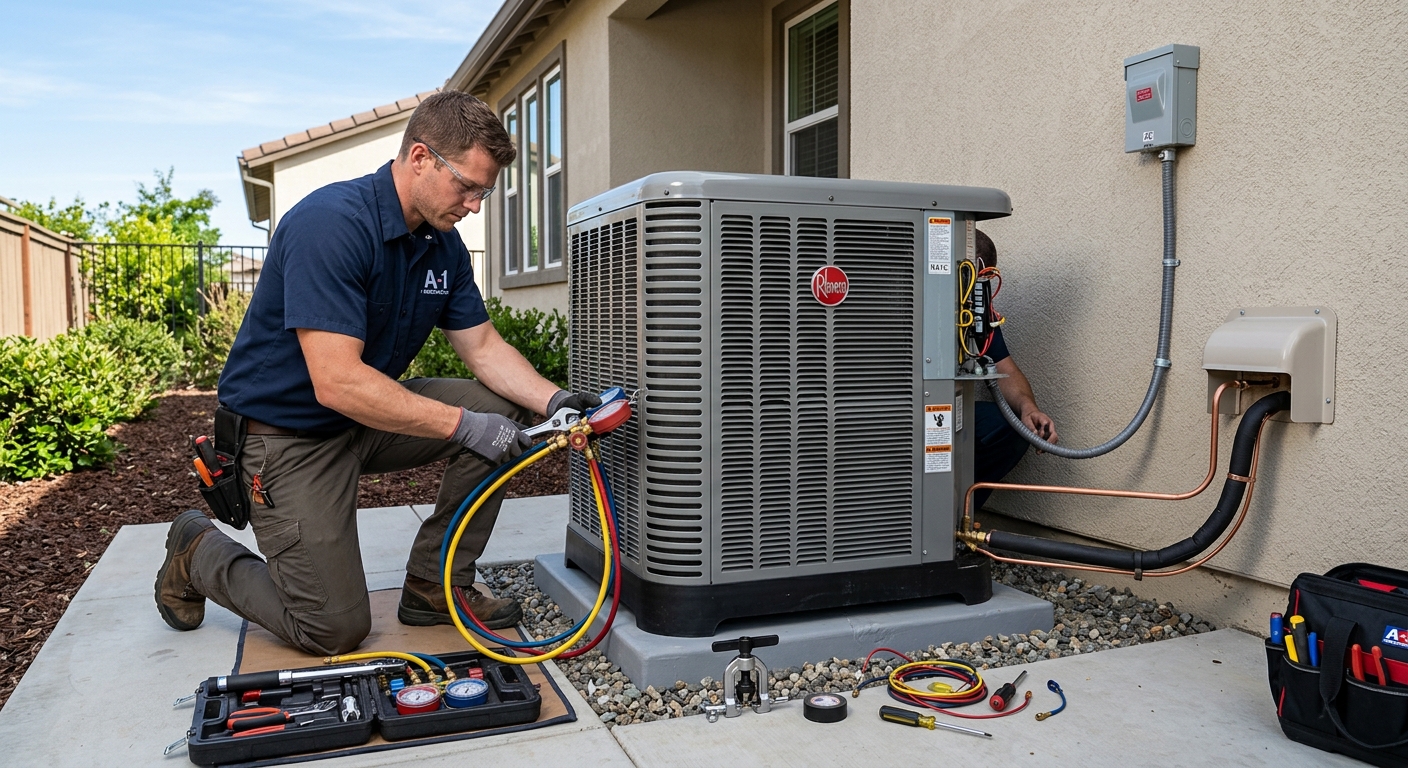
Doylestown heating and cooling prices by system type — 2026
Doylestown’s HVAC replacement market is shaped by high homeownership—82.8% of households own their homes—and an older, established housing stock, with 53.3% built before 1980 (U.S. Census Bureau, ACS 2024). Most systems here are replacements, not first-time installs. In the post‑1960 suburban developments, especially in Bensalem and Middletown, central air and forced-air heat are common, which means that ductwork usually exists and can often be reused or upgraded.
Our region’s climate is heating-dominated, with about 4,800 heating degree days and 1,450 cooling degree days per year. That means your HVAC dollar goes further investing in a system with strong heating efficiency, though reliable cooling is still a must for muggy Doylestown summers. If you already have ductwork in fair shape, central AC replacement or a ducted heat pump usually makes sense. For older homes lacking ducts, adding a full distribution system costs more, but can even out comfort in every room.
| System |
Best for |
Efficiency |
Price range (installed) |
| Central AC replacement (existing ducts) |
homes with sound ductwork |
16–20 SEER2 |
$6,000–$14,500 |
| Air source heat pump (ducted) |
year-round heating and cooling |
8–10 HSPF2 |
$9,600–$20,500 |
| Cold-climate heat pump (ducted) |
heat pump as primary heat |
9–11 HSPF2 |
$15,500–$20,500 |
| Ductless mini-split (single zone) |
additions, rooms without ducts |
20–30 SEER2 |
$3,800–$8,400 |
| Full duct system installation |
homes with no existing ducts |
— |
$11,000–$21,500 |
Installed estimates for a typical Doylestown home. Equipment tonnage, duct condition and electrical capacity move these more than brand.
Mini-splits and zoning in Doylestown homes
Ductless mini-split systems genuinely shine in parts of Doylestown where rooms or additions don’t have existing ductwork. This includes finished basements, attic conversions, sunrooms, and older homes where tearing into walls for ducts would mean costly and messy plaster repair. For a single room, a dedicated single-zone mini-split is both efficient and unobtrusive: you get adjustable comfort, strong dehumidification, and quiet operation—often for less than the cost of extending old ducts.
Economically, single-zone systems tend to deliver better comfort and efficiency compared to multi-zone mini-splits hung on one outdoor unit. With multi-zones, temperature control can lag in rooms not actively calling for heating or cooling, and overall efficiency is pulled down if only one head is running most of the time. From an aesthetic standpoint, indoor heads (wall or ceiling-mounted) are visible, and some homeowners dislike the look. Condensate drains require a decent plan, especially if the room is below grade.
In the post‑1960 tracts of Bensalem and Middletown, central ducted systems predominate. But if your Doylestown home is pre-1980, or if parts were added before AC was standard, you may be sitting on a great candidate for a ductless solution—whether you realize it or not. Ductless is rarely needed as a whole-house system here, but solving hot/cold spots or finishing a space without ducts is where it’s worth every dollar.
Permits, licensing and inspections in Doylestown
For homeowners in Doylestown, it’s important to know that Pennsylvania does not issue a statewide HVAC license for residential contractors. Instead, regulation of residential installation is local: mechanical permits and inspection requirements are enforced by individual municipalities or, sometimes, by the state Department of Labor & Industry in towns that have opted out. Always check with your local code office before starting HVAC replacement.
Contractors who take on residential work over $500 must hold a Home Improvement Contractor (HIC) registration with the Pennsylvania Office of Attorney General. You can verify their registration at hic.attorneygeneral.gov. Regardless of registration, anyone handling refrigerants—installing or recharging air conditioners and heat pumps—must hold a federal EPA Section 608 certification. This is non-negotiable and applies throughout the country.
A reputable contractor should also provide proof of workers’ compensation insurance—mandatory for every employer in Pennsylvania. You can verify this through the WCAIS system (wcais.pa.gov). Directly ask for their insurance certificates. And for homes built before 1978, the installer must follow the federal EPA Lead RRP Rule.
Permits are nearly always required for central HVAC installs in Bucks County’s municipalities. Get a copy of the actual permit and inspection sign-off—don’t just take someone’s word for it.
Running the numbers on Doylestown's climate
Doylestown gets about 4,800 heating degree days and 1,450 cooling degree days a year, so we’re in a heating-weighted climate where how efficiently your system heats matters at least as much as how it cools. With a winter design temperature of 14°F, any heat pump or electric system must be chosen for reliable performance when things get coldest.
To compare the operating costs of different systems, you’ll want to look at efficiency ratings (SEER2 for cooling, HSPF2 for heating) and connect that to how much energy your house actually requires. First, take the annual degree days (found above or from the National Weather Service). Next, factor in your home’s square footage and insulation quality—these determine how much heating and cooling you use. Multiply that by the rating from the yellow label on your unit.
Then, check your utility bill for your current kWh rate—PECO Energy Company serves most Doylestown homes. For a quick example: let’s say your home needs 36 million BTU (British Thermal Units) of heat over the winter, and your chosen heat pump rates at 9 HSPF2 (that’s BTUs delivered per watt-hour input). Divide 36,000,000 by (9 × 3,412) to get roughly how many kilowatt-hours you’ll use. Multiply that total by the rate you pay per kWh to estimate annual heating cost.
Keep in mind: everyone’s home is different and local rates can change. A duct system with leaks will sabotage any efficiency gains you’re hoping for, so get ducts squared away first—the best heat pump in Bucks County will disappoint if half your air is lost to an attic.
Ductwork: the part nobody quotes properly
In Doylestown’s older homes, and especially those built before 1980, the biggest HVAC problem isn’t always the furnace or AC—it’s the ducts. Duct leakage in these houses can easily waste 20–30% of your heating and cooling. That’s why ductwork deserves more attention than it usually gets in quotes. A duct blaster test pressurizes the system and measures how much air escapes before it reaches your rooms; this shows you exactly how much energy you’re losing just to leaks.
In the post‑1960 suburban areas of Bensalem and Middletown, existing ductwork often exists but may have been designed for furnaces only—not AC—and was rarely sealed at the seams. Undersized return ducts are another chronic problem in Bucks County: they’re invisible, but they choke system airflow and reduce both comfort and efficiency.
Ducts running through unconditioned attics or crawlspaces lose (or gain) heat with every foot. Sealing leaks with mastic or tape and insulating exposed runs generally pays back faster than a more efficient HVAC unit installed onto the same leaky system. If your ductwork is undersized or badly deteriorated, full replacement—$11,000–$21,500—is sometimes unavoidable, especially in homes where air quality matters.
The honest advice: test your ductwork before replacing the heating or cooling unit. It’s much cheaper to fix distribution first, and any new equipment sized for leaky ducts will end up over- or under-shooting what your house actually needs.
Reading an installation proposal
When you get an HVAC installation quote in Doylestown, you need enough information to compare apples to apples. Look for model numbers for both indoor and outdoor units—matched pairings are key to getting the performance you’re quoted. Tonnage should match a load calculation for your home (don’t settle for “same size as before”). The proposal should spell out if the refrigerant line set is being replaced or reused, detail needed electrical upgrades (especially panel changes), describe how condensate will be drained, and name the thermostat to be included. All Bucks County municipalities want a mechanical permit and expect to see it itemized—no permit is a red flag. Finally, clear separation of labor and equipment warranties, along with a commissioning report showing measured system performance at startup, is a sign you’re working with a pro.
| Line item |
What to look for |
Red flag if… |
| Equipment |
model numbers, indoor and outdoor matched |
brand name only |
| Sizing |
load calculation attached |
matched to the old nameplate |
| Ductwork |
condition assessed, sealing scoped |
not mentioned |
| Electrical |
circuit and panel capacity confirmed |
assumed adequate |
| Line set |
replaced or documented as reused |
silent |
| Commissioning |
measured airflow and charge, documented |
no startup report |
| Warranty |
labour years stated separately |
manufacturer only |
| Permit |
included and priced |
'not needed' |
Reading the yellow label
Every new HVAC unit comes with a yellow EnergyGuide label. For cooling, you’ll find a SEER2 rating (Seasonal Energy Efficiency Ratio, version 2), and for heating, an HSPF2 rating (Heating Seasonal Performance Factor, version 2). Higher numbers mean greater efficiency—more heating or cooling delivered per dollar spent. These figures were updated and made tougher; that’s why SEER2/HSPF2 numbers are lower than the old SEER/HSPF system in older articles.
In Bucks County, with 4,800 heating degree days and just 1,450 cooling degree days, we’re firmly on the heating-dominated side. That means you’ll get more real-world savings by prioritizing HSPF2 on a heat pump than chasing a top-tier SEER2 on an air conditioner. For most Doylestown homes, a ducted AC or heat pump offering 16–18 SEER2 or 9–10 HSPF2 pays back in a reasonable window. Paying for the absolute highest SEER2 usually doesn’t pencil out unless your home is unusually large and very well-insulated.
Bottom line: Focus on comfort, reliability, and getting your distribution system right. The efficiency rating is important, but should never be the only number you base your investment on—especially if your ducts leak or are uninsulated.
Frequently asked questions — HVAC installation in Doylestown
Is natural gas available throughout Bucks County?
Natural gas service in Bucks County is robust in the developed southern and central municipalities—including Bensalem, Bristol, and Middletown—where PECO provides residential gas lines. However, as you move north into more rural or undeveloped pockets of the county, gas lines thin out, and homeowners rely more on propane or fuel oil. Before planning a new HVAC installation in Doylestown, you should confirm your home’s existing fuel access if you’re considering switching heat sources. For those without gas service, options like ducted heat pumps—ranging from $9,600–$20,500 installed—become more attractive. The infrastructure isn’t uniform, so call your utility or check your property’s meter location before making assumptions.
How far ahead should I schedule in Doylestown?
For HVAC installation or replacement in Doylestown, plan ahead—especially if your project isn’t an emergency. Most reputable contractors in Bucks County book two to four weeks out during peak summer and winter. Scheduling in shoulder seasons (spring or early fall) often means quicker installs and sometimes better pricing. Keep in mind, with 53.3% of local homes built before 1980, unexpected duct or electrical issues may push timelines. If you’re considering a full duct system for a home without existing supply runs, that work alone can add a week or two and may bring your total to $11,000–$21,500. If you need fast replacement (like after a breakdown), you’ll likely have to choose from standard equipment already on hand, rather than custom-ordering high-efficiency or specialty systems.
Why do HVAC quotes in Doylestown vary so much?
HVAC quotes in Doylestown show big swings because home age, ductwork, electrical capacity, and even code enforcement all move the bottom line. A system swap in a post‑1960 Bensalem ranch with newer ducts may be straightforward, yielding a quote near $6,000–$14,500. But if your house is older (over half in Doylestown), old duct runs, tight crawlspaces, or a subpanel stuck in a closet can cause labor and materials to spike. Permitting requirements and whether new lines or code upgrades are needed also change the scope. Brand only matters a little; the details that come out after a contractor inspects—and the labor they’re quoting—are what drive price differences. If a quote skips duct assessment or electrical work, you’re not comparing a complete job.
What is a Manual J load calculation?
A Manual J load calculation is an engineering method used to determine exactly how much heating and cooling a specific Doylestown home needs. It takes into account square footage, insulation, windows, orientation, local climate data (like the 4,800 heating degree days for Bucks County), and more to produce a BTU (British Thermal Unit) requirement. Why does this matter for you? Most older homes in Doylestown aren’t as tight or insulated as new builds, so oversizing or undersizing a new system is common if a contractor just “matches what’s there.” A proper Manual J means you get a right-sized unit, avoiding problems like short cycling or high bills. If your quote includes this calculation and explains the result, you’re off to a good start—especially with systems in the $9,600–$20,500 installed range.
How is a tax credit different from a rebate?
In Doylestown and across Pennsylvania, a tax credit is an amount you subtract from your federal or state taxes owed—often available for qualifying high-efficiency HVAC installations. You claim it when you file your taxes, and it comes off your final bill from the IRS. A rebate, in contrast, is paid by a utility or manufacturer after the purchase, typically as a check or bill credit. For example, a ductless mini-split installation in Doylestown falling between $3,800–$8,400 might be eligible for both: a manufacturer rebate mailed to you and a federal tax credit claimed at tax time. The procedures, paperwork, and who pays you, differ—don’t confuse the two, or you could miss out entirely.
Why does my system short cycle?
Short cycling—where your HVAC turns on and off in rapid bursts without completing a full heat or cool cycle—is a common headache in Doylestown, especially in older or recently remodeled homes. Causes range from oversized equipment (often due to lack of a fresh load calculation), poor ductwork, incorrectly set thermostats, to issues with refrigerant charge or airflow. A system replaced without assessing load or ducts—say, just copying the previous 30-year-old setup—risks this problem even after spending $6,000–$14,500. Short cycling reduces comfort and spikes wear and tear on components. The fix usually starts with a load calculation, duct evaluation, and commissioning documentation. Don’t accept a new unit that behaves like this as “normal”—insist on proper diagnostics.
Do I need dual fuel in southeastern Pennsylvania?
Dual fuel systems, which pair a heat pump with a backup gas furnace, are sometimes useful in southeastern Pennsylvania but rarely mandatory. With our climate—4,800 heating degree days and winters rarely dipping far below the 14°F design temperature—a modern cold-climate heat pump can carry most homes through the cold snaps. If your Doylestown house is in a developed area with natural gas, a dual fuel system means you can let the heat pump do the light lifting in fall and spring and let the furnace cover the rare deep freeze. If your home relies on propane or has old, leaky ductwork, the economics tilt further toward all-electric or a carefully sized gas furnace. A dual fuel install can add to your cost—usually to the upper end of the $15,500–$20,500 range. For most, single-fuel systems do just fine if sized and installed correctly.
How much does a furnace replacement cost in Doylestown?
Strictly speaking, this page focuses on air conditioning and heat pumps, but most furnace replacements in Doylestown—including removal, new equipment, and basic connections—fall into the same range as a straight AC swap. If your existing ductwork is in good shape, expect to pay in the $6,000–$14,500 range for a new furnace install. If your home is older or you need duct or electrical work, that cost will push higher. Always ensure your contractor offers a written quote broken down by labor, materials, permit, and warranty. And don’t skip the load calculation—oversizing a furnace is easy and leads to uneven comfort and inflated bills.
What is EPA Section 608 certification?
EPA Section 608 certification is a federal requirement for anyone installing, servicing, or disposing of equipment that contains refrigerants—this includes every central air conditioner or heat pump installed in Doylestown and throughout Pennsylvania. Its main purpose is to ensure technicians handle and recover refrigerants properly, protecting the environment from leaks and improper venting. When you hire an HVAC installer—whether you’re spending $3,800–$8,400 for a ductless mini-split or much more for a whole new system—ask for proof of this certification. It does not replace state or local registration but is mandatory for the work itself. No reputable company in Bucks County should hesitate to provide a copy or their technician’s card.