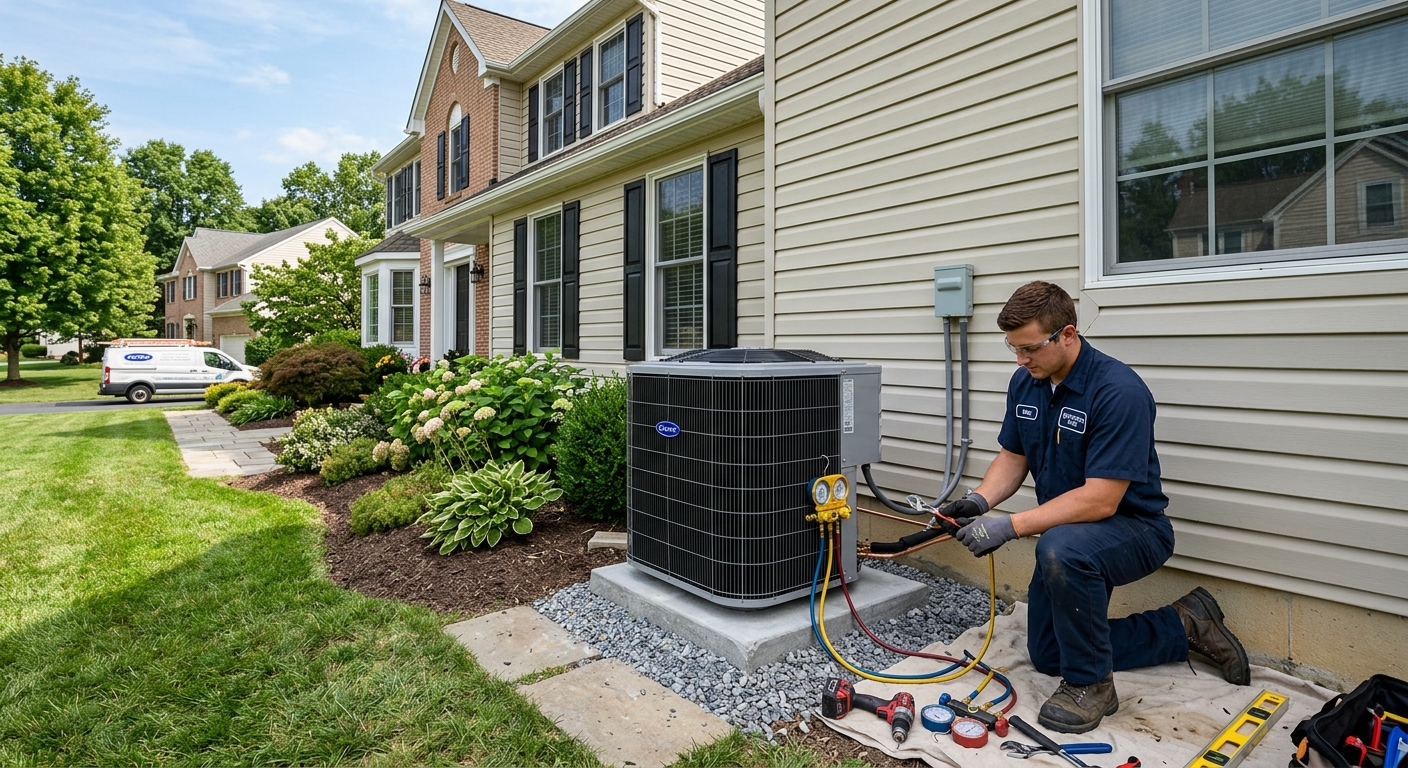
HVAC costs in East Donegal — 2026
East Donegal’s HVAC market in 2026 skews toward replacement and retrofit, not just because of its high homeownership rate (81.0%) but also due to the region’s housing era—nearly 29.0% of homes were built before 1980 (U.S. Census Bureau, ACS 2024). Most properties needing central AC or heat pump upgrades already have ductwork, but where original systems never included ducts—especially common in older houses—ductless mini-splits and high-velocity units are the norm. Many Lancaster city rowhomes dating from 1880–1930 simply can’t accommodate a conventional duct run, so the local contractor market is well-versed in retrofits.
East Donegal is squarely a heating-dominated climate. With approximately 5,200 heating degree days versus just 1,250 cooling degree days, most homes rely more on the furnace or heat pump all winter than on AC during summer. This swings recommendations: if your primary system is aging, heating efficiency and reliability matter most. Moving to a heat pump can make sense for year-round efficiency, but up-front cost is higher. For homes with existing solid ductwork, central AC replacement is economical. If no ducting exists or you’re adding comfort to just one area, a ductless mini-split is hard to beat for cost and efficiency.
| System |
Best for |
Efficiency |
Price range (installed) |
| Central AC replacement (existing ducts) |
homes with sound ductwork |
16–20 SEER2 |
$5,300–$13,000 |
| Air source heat pump (ducted) |
year-round heating and cooling |
8–10 HSPF2 |
$8,500–$18,000 |
| Cold-climate heat pump (ducted) |
heat pump as primary heat |
9–11 HSPF2 |
$14,000–$18,000 |
| Ductless mini-split (single zone) |
additions, rooms without ducts |
20–30 SEER2 |
$3,400–$7,400 |
| Full duct system installation |
homes with no existing ducts |
— |
$9,600–$19,000 |
Installed estimates for a typical East Donegal home. Equipment tonnage, duct condition and electrical capacity move these more than brand.
Reducing the net cost of a East Donegal installation
If you’re planning a new HVAC installation in East Donegal, you’ve got three main layers of possible savings: federal tax credits, utility rebates, and occasionally state-level incentive programs. Understanding the difference between a tax credit and a rebate isn't just semantics—it affects your cash flow. A federal tax credit reduces what you owe on your next tax return (think of it as money recovered the following spring). In contrast, a utility rebate—offered by PPL Electric Utilities or UGI Utilities if your property is served by them—reduces the invoice from your HVAC contractor, so you save right at install time.
The federal tax credit for high-efficiency HVAC (usually found under the ENERGY STAR guidelines) typically requires you to file IRS Form 5695 with your return. The exact dollar amount depends on equipment type and specs, so always consult current IRS guidance. For rebates, start by checking the relevant efficiency program page for your electric or gas utility: PPL Electric Utilities for most of East Donegal, and UGI Utilities where natural gas is available. The ENERGY STAR rebate finder is another useful source and tends to be updated regularly.
Names and amounts for utility rebates in Pennsylvania change year to year and sometimes mid-year—don’t trust any article giving a “forever” number. What matters is verifying eligibility for the equipment you’re planning to install and ensuring your contractor supplies all rebate paperwork up front. Combine tax credits and rebates to shrink your out-of-pocket cost, but read the fine print: some rebates won’t apply if you don’t register the project before work starts.
Mechanical permits for HVAC work in East Donegal
Pennsylvania does not issue a statewide HVAC license for residential work. Instead, what matters to a East Donegal homeowner is municipal regulation: the Pennsylvania Uniform Construction Code (UCC), enforced by municipalities. In practice, this means any permit or inspection for a new HVAC install, such as a central AC replacement or ductwork build-out, is handled by your township office—not by any state board or agency. The critical split in Pennsylvania is between commercial and residential—commercial projects may have entirely different requirements.
While you won’t find a state-issued “HVAC license,” all contractors must carry Home Improvement Contractor (HIC) registration for contracts over $500, issued by the state Attorney General. Always verify this registration at hic.attorneygeneral.gov before you sign anything. For refrigerant work (central AC, heat pumps, or mini-splits), the installing technician must also carry EPA Section 608 certification—a federal requirement not specific to Pennsylvania.
Permitting for HVAC in East Donegal generally means a mechanical permit if you’re installing or swapping any major equipment. Homeowners should confirm their contractor pulls the mechanical permit. You can check a contractor’s workers’ compensation insurance via WCAIS (wcais.pa.gov), and be wary of anyone who won’t show proof. Filter changes and basic thermostat programming do not require a permit.
What a real HVAC quote contains
When you’re comparing HVAC quotes in East Donegal, it’s not just the bottom line that matters; it’s what’s behind that price. Every real quote should detail the model numbers for both the indoor and outdoor units, because mixing and matching from different product lines or years can kill system efficiency. You should see tonnage—with the load calculation that justifies it—not just a copy of your old system’s size. If the job involves keeping or reusing your existing line set, it should be called out and justified; replacement is sometimes necessary, sometimes not. Electrical work should be explicit: will your main panel handle the new system, or is a new circuit or panel upgrade included? Condensate handling (how the system drains) and thermostat specifications should be stated. The quote should price out the mechanical permit and outline what’s covered by the labor warranty versus what’s just covered by the manufacturer. Finally, there should be mention of a commissioning report: a signed-off document on system startup, with readings proving airflow and refrigerant charge are correct.
If your quote just names a brand and a price, you don’t have a quote—you have a gamble. Insist on the detail.
| Line item |
What to look for |
Red flag if… |
| Equipment |
model numbers, indoor and outdoor matched |
brand name only |
| Sizing |
load calculation attached |
matched to the old nameplate |
| Ductwork |
condition assessed, sealing scoped |
not mentioned |
| Electrical |
circuit and panel capacity confirmed |
assumed adequate |
| Line set |
replaced or documented as reused |
silent |
| Commissioning |
measured airflow and charge, documented |
no startup report |
| Warranty |
labour years stated separately |
manufacturer only |
| Permit |
included and priced |
'not needed' |
What size system does a East Donegal home need?
The most consequential mistake an HVAC contractor can make in East Donegal is oversizing your system. Many homeowners (and sadly, some contractors) think bigger is always better—a little extra “just to be safe.” In reality, an oversized system short cycles: it runs for only a few minutes at a time, never reaches steady-state efficiency, and fails to dehumidify properly. Your home ends up with temperature swings, clammy air, and much shorter equipment life. In a heating-dominated climate like this—with a winter design temperature of 12 °F—correct sizing for cold snaps is vital, but that does not mean overshooting.
Sizing should always start with a Manual J load calculation. This calculation considers every relevant detail: insulation, window quality, orientation, infiltration, and more. Square-footage rules of thumb (“one ton per 500 square feet”) simply don’t hold up, especially in a housing market where nearly a third of homes are pre-1980 with widely varying construction quality. Don’t accept a quote sized to your old unit’s label; that’s just copying someone else’s guess. Always ask every bidder: “Did you run a load calculation, and can I see it?”
In East Donegal, proper sizing balances both the tough winters and the warm, humid shoulder seasons. The right system should run long, steady cycles, keeping you comfortable without blowing tons of extra kilowatts through the year.
How to vet an HVAC contractor in East Donegal
Whichever brand or model you select, the difference between a good install and a bad one is the quality of the contractor—not the sticker’s logo. A careful job outlasts and outperforms a careless one every time. To vet an HVAC contractor in East Donegal, start with verification: check Home Improvement Contractor (HIC) registration at hic.attorneygeneral.gov. For anyone handling refrigerant on your job, verify that the installing technician holds EPA Section 608 certification. A good contractor provides you with their load calculation, not just a “same size as before” bid. Every quote should state actual model numbers to make apples-to-apples comparisons, and spell out commissioning (startup testing, airflow, charge).
- Check HIC registration for every contractor
- Ask if the installing technician is EPA Section 608 certified
- See a Manual J load calculation for your home
- Require matched equipment model numbers on your quote
- Insist on commissioning reports (startup readings, airflow, charge)
- Confirm mechanical permits are pulled and included
- Require proof of workers’ compensation (check wcais.pa.gov)
- Get references from recent customers in your township
- Compare warranty coverage—labor versus parts
- Ask who handles rebate paperwork (if eligible)
- See proof of insurance certificates before work begins
- Don’t pay more than 1/3 up front under PA law
Red flag: a contractor who promises the lowest price but won’t answer detailed questions. East Donegal isn’t oversaturated with HVAC outfits; reputable work stands out. If you can’t get clear documentation, keep looking.
Zone control without ductwork
Ductless mini-splits aren’t just a modern luxury—they solve real-world problems in East Donegal, especially in homes and rowhouses built before central air was ever considered. If you’re updating an addition, basement, attic, or any room beyond the reach of existing ducts, ductless units offer effective, flexible climate control without tearing into walls and ceilings or wrestling with decades-old plaster. Many Lancaster city rowhomes dating from 1880–1930 rely on these systems because large-scale ductwork would be a retrofit nightmare.
Single-zone mini-splits serve one room or area, giving focused control and the highest efficiency. Multi-zone systems use one outdoor condenser to run several indoor heads. That can be more economical upfront, but each zone’s capacity is somewhat compromised; in a house where you want robust, year-round comfort in multiple rooms, two singles often perform better than one multi.
Aesthetics and condensate drainage are real decisions: indoor units are visible (wall, floor, or ceiling-mounted) and need a drainage path. Good installers can minimize intrusion, but you should weigh location and look.
East Donegal’s mix of housing stock—lots of homes erected long before anyone thought about forced-air—means ductless isn’t just a trend, it’s often the best and most cost-effective answer for zoning and add-ons.
Frequently asked questions — HVAC installation in East Donegal
What is EPA Section 608 certification?
All technicians who handle refrigerants—meaning anyone charging, recovering, or repairing line sets in a central AC, heat pump, or ductless mini-split—must have EPA Section 608 certification. This is a federal requirement that applies in every Pennsylvania township, including East Donegal. It’s not a company license, but individual, and every installer working with refrigerant on your system must hold it. Don’t take a contractor’s word for it—ask to see their technician’s card. This especially matters when you’re spending between $5,300–$18,000 on a new ducted system. An uncertified technician puts both your warranty and the environment at risk.
What does a heat pump cost installed in East Donegal?
A ducted air source heat pump installation for a typical East Donegal home falls between $8,500–$18,000. Cold-climate models designed for year-round primary heating run from $14,000–$18,000. These estimates cover equipment, installation, basic electrical, and permit fees, but updating ductwork or electrical panels will push costs higher. Multi-zone ductless setups, common in older Lancaster County homes, are often less for single-zone (from $3,400–$7,400) but can match or exceed ducted systems if you’re outfitting the whole house. Always base your budget on a written quote accounting for your home’s current ducts and electrical.
Do I need dual fuel in south-central Pennsylvania?
Many East Donegal homes are all-electric or rely partly on fuel oil or propane, with natural gas widely available only in certain townships. Because South-central Pennsylvania gets long, cold winters (design temp 12 °F, ~5,200 heating degree days), a standard heat pump may need backup heat for the coldest stretches. Dual fuel (a heat pump paired with a gas furnace) gives you high efficiency during mild weather and reliable heat when it’s freezing. For some, it’s worth it—particularly if your old furnace still works or if fuel costs fluctuate a lot. Cold-climate heat pumps ($14,000–$18,000) can go without dual fuel, but make sure your installer does a true load calculation, not just rules of thumb.
How is a tax credit different from a rebate?
A tax credit, like the federal one for high-efficiency heat pumps or central ACs, reduces your tax bill the next time you file your return—so the savings arrive the following tax season, not at the point of sale. A rebate, such as one from PPL Electric Utilities or UGI Utilities, shows up faster: the contractor applies or you claim it soon after install, shrinking your invoice or sending you a check. Both can cut the net cost of a system in East Donegal by hundreds or thousands, especially on projects costing $8,500–$18,000. To get both, confirm eligibility and registration with your contractor before work starts. Tax credits require tracking receipts for your tax records; rebates often mean online claims plus paperwork.
Why does my system short cycle?
Short cycling—frequent starting and stopping—usually traces back to improper sizing. In an East Donegal home, this often means the system is too large for its heating or cooling load. Oversized equipment can’t run long enough to dehumidify in summer or evenly heat in winter. Over time, you’ll see more wear, higher bills, and rooms that never feel quite right. Solutions aren’t always expensive: sometimes it’s a control or thermostat issue, but usually it’s an install problem. If you’re considering new equipment (say, $5,300–$13,000 for a central AC) make sure you’re getting a full load calculation so the new system matches your house, not just “bigger is better.”
When is the best time of year to replace HVAC in East Donegal?
For East Donegal homeowners, mid-spring and early fall are best. During these “shoulder seasons,” contractors can schedule more quickly, suppliers have fewer backorders, and you avoid the peak rush—meaning AC outages in July or furnace failures in January. Installers may have more flexibility and sometimes offer incentives. Don’t wait until the system fails completely; even on a $5,300–$13,000 AC job, proactive replacement can mean same-week scheduling instead of emergency pricing. In rural parts of Lancaster County, shipping times for specialty equipment can also stretch longer during the summer and winter peaks.
What is SEER2 and how is it different from SEER?
SEER2 is the newer efficiency rating for air conditioners and heat pumps, replacing SEER starting in 2023. It uses tougher lab test conditions to better mimic real-world duct losses—meaning numbers dropped compared to SEER, but the equipment itself didn’t change. If your old system was rated 16 SEER, most new units list as 15 SEER2 for an apples-to-apples performance. In East Donegal, modern replacements typically run 16–20 SEER2 ($5,300–$13,000), which is a big upgrade over units from 15+ years ago. Always compare SEER2 when looking at any new quote or energy savings projection.
Which utility serves East Donegal?
Most East Donegal properties receive electric service from PPL Electric Utilities. For natural gas, UGI Utilities supplies the larger townships and denser areas, including parts of Lancaster and Manheim Township. Rural homes in eastern and western areas may be outside natural gas lines and rely instead on propane or oil. Utility service affects not only your rates, but also the rebates available for efficient HVAC upgrades—so check which rebate programs you qualify for if you’re considering a $5,300–$13,000 AC or a $14,000–$18,000 cold-climate heat pump install.
Why do HVAC quotes in East Donegal vary so much?
HVAC quotes can vary widely in East Donegal for several reasons: not all contractors quote the same scope (some skip load calculations or ductwork repairs), equipment brand and model can swing prices by thousands, and labor quality is critical—a thorough install, with commissioning and permit, will cost more up front but save you later. The ductwork in older houses, common in Lancaster County’s pre-1980 stock, often needs extra work, which one quote might omit or gloss over. Two quotes for a heat pump may range from $8,500–$18,000 because of these differences. Always look at the details, not just the sticker price—demand breakdowns, and don’t rush to the lowest bid without understanding what you’re (not) getting.