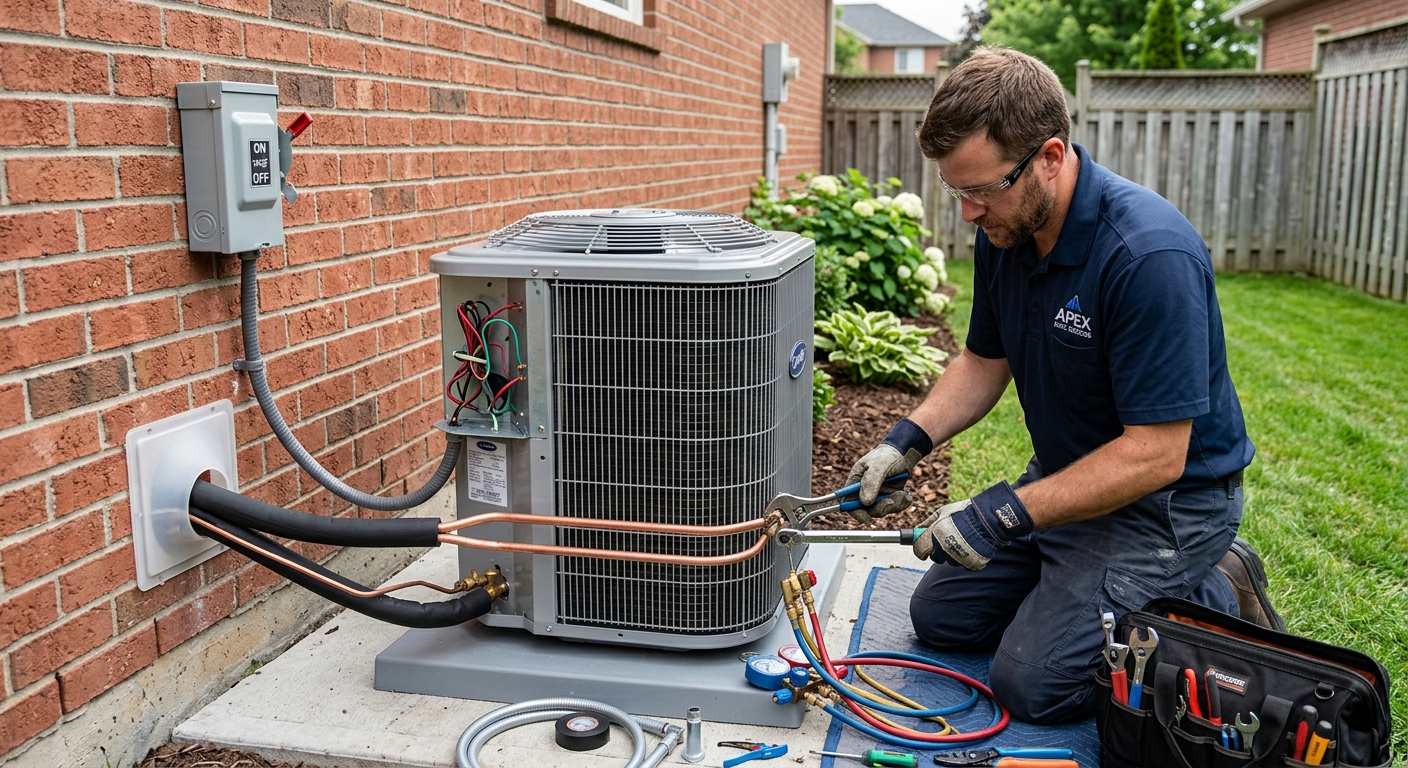
Forest Hills heating and cooling prices by system type — 2026
Forest Hills is a homeowner-dominated neighborhood, with a 70.0% homeownership rate and the vast majority of houses built before 1980 (U.S. Census Bureau, ACS 2024). That means most folks here are replacing existing equipment, not starting from scratch. Pre-1960 homes comprise much of the stock, so central air and heating retrofits often grapple with tight, sometimes leaky ducts, and electrical panels that aren’t always ready for big new loads.
With 5,600 heating degree days and only 1,050 cooling degree days per year, Forest Hills is a true heating-dominated market. Staying warm in our long, cold winters is a bigger energy challenge (and expense) than summer cooling. That weighs heavily toward choosing the right heat pump or gas furnace, and means AC add-ons alone don’t cut it in most single-family homes.
| System |
Best for |
Efficiency |
Price range (installed) |
| Central AC replacement (existing ducts) |
homes with sound ductwork |
16–20 SEER2 |
$5,000–$12,000 |
| Air source heat pump (ducted) |
year-round heating and cooling |
8–10 HSPF2 |
$8,100–$17,000 |
| Cold-climate heat pump (ducted) |
heat pump as primary heat |
9–11 HSPF2 |
$13,000–$17,000 |
| Ductless mini-split (single zone) |
additions, rooms without ducts |
20–30 SEER2 |
$3,200–$7,100 |
| Full duct system installation |
homes with no existing ducts |
— |
$9,100–$18,000 |
Installed estimates for a typical Forest Hills home. Equipment tonnage, duct condition and electrical capacity move these more than brand.
Running the numbers on Forest Hills's climate
To figure out heating and cooling costs in Forest Hills, you have to start with the local weather you’re up against and what kind of system you’re running. Forest Hills sees 5,600 heating degree days each year—meaning the need for heat is nearly year-round—and the winter design temperature drops to 8 °F. Cooling demand is lower at 1,050 cooling degree days per year. That’s why heating efficiency and cost matter more here than cooling.
Here’s the logic for comparing technologies: An efficiency rating (like SEER2 for cooling or HSPF2 for heat pumps) tells you, in basic terms, how much energy goes in versus how much heating or cooling you actually get out. Degree days turn outdoor weather into a measure of “how much” heating or cooling you need over a year. To estimate annual energy cost, multiply your home’s heating or cooling load (in BTUs) by your system’s efficiency, then by your utility’s rate. In Forest Hills, electricity comes from Duquesne Light Company—check your actual rate on your most recent bill, since this can swing the math quite a bit.
Suppose you have a 24,000 BTU heat pump rated at 10 HSPF2 and you pay $0.14 per kWh. The rough formula: (Total annual heating BTUs ÷ efficiency) ÷ 3,412 = kWh needed; then multiply by your rate for the annual cost. Always adjust these numbers to your own insulation, windows and habits, because envelope leaks or single-pane glass can raise costs dramatically.
Don’t ignore ductwork. A leaky or poorly insulated duct system can waste 20–30% of what you’re paying for. In reality, a high-efficiency heat pump paired with bad ducts will heat your wallet more than your house, while an older mid-tier furnace on tight, sealed ducts will outperform its specs. Plug your own numbers in for best accuracy, and get your ducts visually inspected during any HVAC quote.
The comfort problem that isn't temperature
In Forest Hills’s cold winters and humid summers, comfort is about much more than temperature. The 5,600 annual heating degree days mean winters here are dry, leaving many people uncomfortably parched. Come July, humidity soars and the same house can feel clammy even with the AC running non-stop. An oversized central AC—a common “solution”—can actually make summer muggier because it cools air quickly before it can remove much moisture. Right-sizing, not supersizing, is the answer.
Winter dryness is often managed with whole-house humidifiers. They work but need routine cleaning to avoid mold and mineral buildup, and many are ignored until there’s a smell or a leak. Look for models that are easy to open for cleaning, and understand they are one more thing to maintain. On the filtration side, high-MERV filters catch finer particles but can strain weaker blowers common in pre-1980 homes; always balance filtration with your system’s specs.
If you’ve tightened up your old house with new windows and insulation, you may need mechanical ventilation to keep indoor air healthy—especially when burning appliances are present. As for air cleaners, UV lights, and ionizers: these are frequently oversold. For most Forest Hills homes, investing in good filters and regular filter changes will deliver measurable air quality improvements, while many expensive add-ons do little except boost the invoice.
Mini-splits and zoning in Forest Hills homes
Ductless mini-splits are a go-to solution in Forest Hills, thanks to homes mostly built before central air existed. If you live in a classic Forest Hills house—plaster walls, narrow chases, and maybe an old electric panel—retrofitting new ducts can be a mess and a budget-buster. Mini-splits shine in converted attics, basements, glassed-in porches, or additions where running new ductwork means tearing up finished rooms.
Single-zone systems (one indoor head, one outdoor unit) are simplest and most efficient when targeting one problem room, like a home office or a nursery. Multi-zone setups run several indoor units off one outdoor unit, useful for whole-house retrofits, but they can spread heating and cooling thin if you try to connect too many rooms—separate single-zone systems often perform better and are easier to diagnose if something goes wrong.
Head placement matters for comfort and looks; they’re visible on the wall or ceiling, so planning matters. Condensate drains need to head downhill or have a pump, which is one more point for leak risk—avoid burying those lines inside finished walls where possible. For many Forest Hills homes where duct retrofits are impractical due to age, layout, or cost, mini-splits are the most flexible and least intrusive option available.
Gas, electric or both in southwestern Pennsylvania
Heating is the main energy bill in Forest Hills. With a winter design temperature of 8 °F and 5,600 heating degree days a year, any heating system here needs to pull its weight when it’s cold. The belief that heat pumps “don’t work in cold climates” used to be justified, but not anymore: Modern cold-climate heat pumps retain real heating capacity even below freezing, though output does decline as it gets colder. That’s why, right at our design temp, you need a system sized for those single-digit nights—or a backup plan.
Natural gas is widely available in Allegheny County, making high-efficiency furnaces and dual fuel (heat pump plus gas backup) popular options. If you live farther from the gas main and rely on propane or oil, a heat pump becomes much more attractive, since electricity often beats delivered fuels on price and carbon. The best fit depends on what’s at your curb: In a gas neighborhood, a furnace is reliable and tough to beat on total install price. If you’re all-electric, or aiming for it, invest in the best heat pump you can afford—especially in a well-insulated house.
A furnace is still the clear answer for homes with gas on site, unpredictable power, or owners who value proven reliability and fast recovery when it’s near zero. Dual fuel is a hedge for deep cold spells on a modern panel. Full ductless systems make sense if you need room-by-room control or there are no existing ducts, though installation price rises fast with more indoor heads.
| Option |
Installed cost |
Operating cost here |
Best when |
Incentive eligible |
| Gas furnace + central AC |
$5,000–$12,000 |
low to moderate |
existing gas service, coldest zones |
Some utility rebates |
| Ducted heat pump (cold climate) |
$8,100–$17,000 |
moderate to high |
good envelope, all-electric goal |
State/federal incentives possible |
| Dual fuel (heat pump + gas backup) |
$13,000–$17,000 |
lowest in hybrid use |
gas on site, deep cold spells |
Often eligible |
| Ductless multi-zone |
$9,100–$18,000 |
moderate |
no ductwork, zone control |
Some programs |
Keeping a Forest Hills system running
For most Forest Hills homes, smart HVAC maintenance means a handful of basics done right: Change your filter on schedule, and pick a MERV rating your blower can handle. If your system’s older or ductwork is borderline, don’t “upgrade” to a super-dense filter—a clogged filter strains motors and raises bills. Regular coil cleaning helps efficiency, especially in homes with indoor pets or lots of dust. Check or clear your AC’s condensate line every spring to avoid water damage. If a technician ever says they need to “add refrigerant” every year, find another one—a system losing charge has a leak, which needs to be found and fixed, not just topped up.
Annual maintenance plans are sometimes worth it, especially for newer systems under warranty, or if you want reminders and priority service. But read the terms: Some Forest Hills plans are little more than a high-priced filter change. Look for plans that actually include coil cleaning, charge check, and a written inspection. Schedule tune-ups before the first cold snap (late August–September) or before AC season (April), when you’re not waiting behind no-heat emergencies. Companies in Allegheny County are busiest during first freezes and heat waves, so beat the rush if you want to keep costs and stress down.
What a Pennsylvania HVAC contractor must hold
Pennsylvania does not issue a statewide HVAC license for residential work. Instead, contractors must be registered with the state as Home Improvement Contractors (HIC registration) if the contract exceeds $500, and municipalities enforce their own mechanical permits. In Forest Hills, the rules follow the Pennsylvania Uniform Construction Code, based on the IRC, and enforcement can depend on local officials or L&I for those municipalities that’ve opted out. Residential permits, inspections, and code enforcement are handled at the municipal level or, for some areas, by the state’s Department of Labor & Industry.
No matter where your house sits in Allegheny County, anyone handling refrigerant—meaning virtually any central AC or heat pump installer—must have EPA Section 608 certification. Mechanical permits, inspections, and written contracts (mandated by the Home Improvement Consumer Protection Act above $500) are all required. Don’t take a contractor’s word on insurance or workers’ compensation: verify active workers’ comp coverage in the state system before work begins, and confirm HIC registration using the Attorney General’s online lookup. Statewide, there is no separate license for HVAC, electrical, or plumbing except as dictated by each individual municipality, so always ask what permits will be pulled for your address.
Frequently asked questions — HVAC installation in Forest Hills
How does southwestern Pennsylvania's climate affect system sizing?
Sizing an HVAC system in Forest Hills means planning for more heating than cooling. Our area averages 5,600 heating degree days but only 1,050 cooling degree days, which is why most homes here put far more hours on the furnace or heat pump than the air conditioner. Oversizing for summer cooling, especially with central AC, leads to short cycles that don’t remove humidity—making the house stickier and less comfortable. Undersize a system, though, and it’ll struggle when January hits single digits. For a typical replacement, expect a system cost in the $8,100–$17,000 range depending on the technology and existing ductwork. Accurate sizing should always be done with a real load calculation—guesswork based only on square footage in Forest Hills’s older housing is a shortcut that leads to more repairs and higher bills.
Who inspects HVAC work in Forest Hills?
In Forest Hills and across much of Allegheny County, inspection and permitting for residential HVAC projects follow the Pennsylvania Uniform Construction Code. Mechanical permits for installs or major replacements are required and enforced by the local municipality or by the state’s Department of Labor & Industry if the municipality has opted out. The City of Pittsburgh, for example, runs its own inspections. For homes in Forest Hills, always check with your borough about permit requirements before work begins. If you’re planning a ductless mini-split installation, which can run $3,200–$7,100 for a single zone, inspection typically verifies refrigerant handling and electrical work are up to code. Don’t skip the permit: it’s you, not the contractor, who’s left exposed if codes aren’t met.
How much does ductwork add to an HVAC installation?
If your Forest Hills house has no existing ductwork—or the current ducts are too small for modern airflow—installing all-new ducts is a significant upgrade in both comfort and cost. For a standard single-family home with no ducts at all, a full new duct system typically runs $9,100–$18,000. This price is in addition to the core equipment (furnace, AC, or heat pump). Adding ductwork to finished houses is labor-intensive, especially with plaster or tight chases common in local pre-1960 construction, often meaning some patching or painting after install. If you don’t want to tear up walls or live with soffits, consider ductless options—even a multi-room ductless system is sometimes less invasive and can cost less when all finishing work is counted.
Should I replace the furnace and AC at the same time?
In Forest Hills, replacing both units together often makes sense, because matched systems are more efficient, and you avoid redoing labor (and paying double on ductwork or electrical) down the road. If your existing furnace and AC are both near or past half their typical lifespan—10–15 years for AC, 15–20 for gas furnaces—it’s cost-effective to do it once, especially in older homes where access is tight. Combined installs can also be less expensive overall, falling in the $5,000–$12,000 band for a basic furnace and AC swap using existing ducts. If one unit is still young and efficient, or budget is tight, there’s no harm in staggering the jobs—just make sure your contractor checks the compatibility if mixing new and old equipment.
How often should I change my filter?
Filter change intervals vary by type, but in Forest Hills’s older homes with pets, heavy dust, or heavy winter usage, plan for every 1–3 months. Cheap 1-inch filters may need monthly changes, especially if you opt for a higher MERV (better filtration but more airflow resistance), while 4–5 inch media filters may last up to 6 months. The best test is a visible check: if the filter looks dirty, change it. Newer, tighter homes without much dust or dander might stretch longer. Don’t let a clogged filter hammer your blower motor—over time, that can force premature replacement, which can run anywhere from $8,100–$17,000 for a whole new heat pump system, just because the basics were missed.
Why do HVAC quotes in Forest Hills vary so much?
Price swings in Forest Hills HVAC quotes are nearly always tied to older homes, tight quarters, and what’s hiding behind the walls. Homes built pre-1960 may have ductwork that’s too small or badly sealed, or may require electrical upgrades to support new high-efficiency heat pumps. Local contractors must also factor in permit costs and any asbestos or lead paint considerations, especially for equipment swaps in finished basements. That’s why you’ll see central AC quoted anywhere from $5,000–$12,000. Always demand a detailed, written proposal that breaks out equipment, labor, and what’s included—lowball quotes often skip the hard (expensive) fixes, leaving you to deal with the mess later.
Are duct sealing and insulation eligible for incentives?
Duct sealing and insulation projects in Forest Hills may qualify for incentives, depending on current local and state programs. Sometimes, utility-sponsored rebates are offered for verified improvements that can be documented through before-and-after testing. These rebates come and go, so ask the contractor and check your utility’s website. For a full duct retrofit, costs in Forest Hills run $9,100–$18,000, with a portion sometimes rebated if you’re upgrading an old, leaky system to meet current energy standards. Be wary of any contractor who promises guaranteed incentives—eligibility depends on program funding, your property, and proper testing, all of which must be documented.
What is the R-410A refrigerant phase-down?
R-410A is a common refrigerant in central ACs and heat pumps, but it’s being phased down under federal rules due to its climate impact. For Forest Hills homeowners installing or replacing HVAC equipment, this means newer systems may use different, lower-global-warming refrigerants instead. Supply of R-410A will tighten over the decade, potentially increasing repair costs for older systems down the road. If you’re buying a new AC or heat pump—installation price from $8,100–$17,000 for a ducted heat pump—ask the contractor what refrigerant the unit takes. Systems built for current and future rules will be easier (and likely cheaper) to maintain for the life of the equipment.
How long does HVAC installation take in Forest Hills?
Standard HVAC replacements in Forest Hills usually take 1–2 days if existing ducts and electrical service are in good shape. New ductwork or significant upgrades, especially in older, finished homes, can stretch that to 3–5 days or more if patching and cleanup are needed. Ductless mini-splits (single zone, about $3,200–$7,100 installed) can often be done in a day, but multi-zone or whole-house projects need more time for each indoor head and outdoor wiring. Weather, permit inspection schedules, and the need for electrical or structural upgrades all add variables. Ask your contractor to spell out a realistic timetable for your actual address—not just “how fast it can go” under perfect conditions.