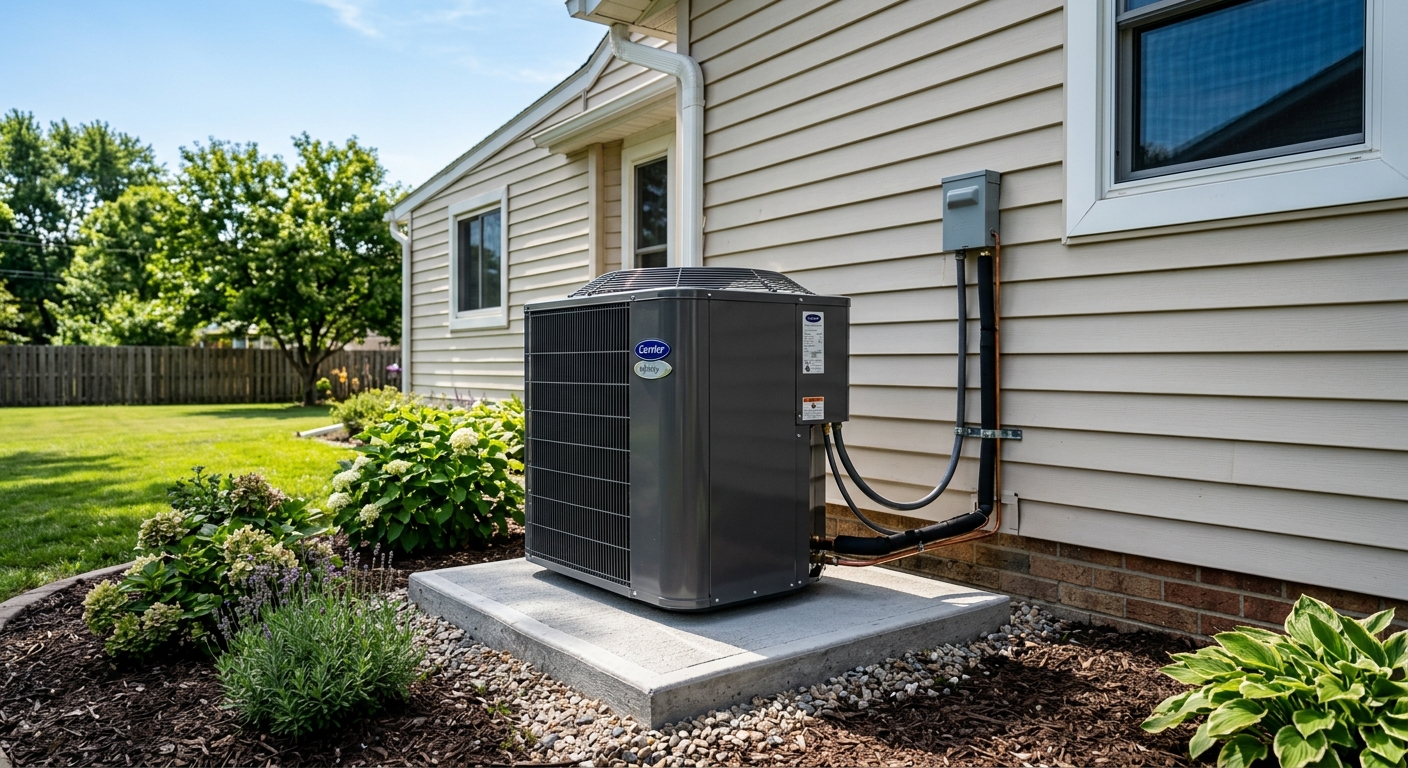
New Garden heating and cooling prices by system type — 2026
In New Garden, the high homeownership rate—at 80.1%—and the fact that over a quarter of homes were built before 1980 means most residents are not shopping for a first-time install, but are facing either full replacement or substantial retrofit of aging forced-air systems. The majority of homes in the area were constructed between 1970 and 2000 and relied on ducted heating and cooling, so much of the market centers around replacing existing central air and heat units using that original ductwork. However, duct condition varies widely and sometimes requires upgrade or sealing to support new high-efficiency systems.
This region racks up about 4,800 heating degree days compared to 1,450 cooling degree days per season. That temperature swing makes it a heating-dominated climate. Systems in New Garden will get worked harder during cold months than through summer; that will shape both your equipment choices and whether to prioritize heating or cooling efficiency.
| System |
Best for |
Efficiency |
Price range (installed) |
| Central AC replacement (existing ducts) |
homes with sound ductwork |
16–20 SEER2 |
$5,900–$14,000 |
| Air source heat pump (ducted) |
year-round heating and cooling |
8–10 HSPF2 |
$9,400–$20,000 |
| Cold-climate heat pump (ducted) |
heat pump as primary heat |
9–11 HSPF2 |
$15,500–$20,000 |
| Ductless mini-split (single zone) |
additions, rooms without ducts |
20–30 SEER2 |
$3,800–$8,200 |
| Full duct system installation |
homes with no existing ducts |
— |
$10,500–$21,000 |
Installed estimates for a typical New Garden home. Equipment tonnage, duct condition and electrical capacity move these more than brand.
Reading an installation proposal
When you get an HVAC proposal in New Garden, the detail matters far more than the logo on top. Each quote should list the specific model numbers for both your indoor and outdoor equipment; mixing brands or mismatching models doesn’t get you the rated efficiency—and in some cases, voids warranties. Tonnage numbers need a proper load calculation, not just a copy of your old unit’s size. Proposals should indicate whether the line set (that’s the copper refrigerant piping) will be replaced or reused—old ones don’t always fit with new refrigerants or capacities. Electrical work is another sticking point: if your panel can’t handle the new equipment, you should see any needed upgrades spelled out upfront. Permits and inspection fees must be included by law for most installations in the area.
Good proposals itemize ductwork inspection or upgrades, a commissioning checklist (documenting that airflow and refrigerant charge were measured, not guessed), and labor warranty terms separated from the equipment warranty. If any of these fields are left blank or just list a brand and an all-in price, you have nothing to compare.
| Line item |
What to look for |
Red flag if… |
| Equipment |
model numbers, indoor and outdoor matched |
brand name only |
| Sizing |
load calculation attached |
matched to the old nameplate |
| Ductwork |
condition assessed, sealing scoped |
not mentioned |
| Electrical |
circuit and panel capacity confirmed |
assumed adequate |
| Line set |
replaced or documented as reused |
silent |
| Commissioning |
measured airflow and charge, documented |
no startup report |
| Warranty |
labour years stated separately |
manufacturer only |
| Permit |
included and priced |
'not needed' |
SEER2, HSPF2 and AFUE decoded
SEER2 (Seasonal Energy Efficiency Ratio 2) is the cooling efficiency rating for air conditioners and heat pumps, measuring how much cooling output you get per unit of electricity over a typical summer. HSPF2 (Heating Seasonal Performance Factor 2) is the heating equivalent for heat pumps. AFUE (Annual Fuel Utilization Efficiency) applies only to gas or oil furnaces, measuring the ratio of heat created per unit of fuel consumed—all as a percentage.
For Chester County, heating is the heavier lift. With 4,800 heating degree days and only 1,450 cooling degree days, installing equipment with top-of-the-line SEER2 ratings does not pay back here the way it might in the Carolinas or Florida. You’ll see a greater return from investing in higher HSPF2 (for heat pumps) or AFUE (for furnaces) than stretching for the maximum SEER2. Aim for 17–18 SEER2 and 9–10 HSPF2—once you go above that, the extra cost has a much slower payback in this region’s mild but humid summers and long, cold heating seasons. Remember, as standards changed from SEER/HSPF to SEER2/HSPF2 starting in 2023, so check which ratings you’re comparing—older values and today’s don’t match one-to-one.
Repair or replace your New Garden system?
Most New Garden homeowners should first weigh the age of their system and the size of the repair bill against current replacement costs. If your system is under 10 years old and the failure is a single part—a blower motor, a capacitor, or a contactor—repair almost always makes sense. The older your unit (especially over 15 years), the more any major repair edges closer to the “replace” line. If the quoted repair cost is a third or more of the price of a full replacement, pause and compare what you’d gain from a new system’s efficiency or reliability. A cracked heat exchanger or a heat pump compressor that fails after the warranty is up—those are not repairable events in the field and mean it’s time to replace.
Another factor is refrigerant type: older R-22 systems are costly to charge, and every year fewer contractors will work with them. If your bills are just higher than they used to be, test ductwork and insulation before writing off the whole system—sometimes that’s the real culprit. Efficiency gains will not always pay back in our heating-heavy climate, so don’t let a sales pitch pressure you into a new system unless your situation fits.
| Situation |
Recommendation |
Typical cost |
Reasoning |
| Under 10 years, single component failure |
Repair |
$300–$1,200 |
Most parts are still available; less than 20% of replacement cost. |
| 10–15 years, repair over a third of replacement |
Consider replacing |
$5,900–$14,000 |
Major repairs get close to full system cost; warranties often expired. |
| 15+ years, any major failure |
Replace |
$5,900–$14,000 |
End of typical service life; newer systems are far more efficient. |
| Cracked heat exchanger, any age |
Replace immediately |
$5,900–$14,000 |
Safety hazard; cannot be field repaired legally or safely. |
| Compressor failure past warranty |
Replace |
$9,400–$20,000 |
Most expensive component; not worth re-investing in old systems. |
| Working system, high bills |
Test ducts and envelope first |
$300–$800 |
Leaks and bad insulation are often cheaper to fix than replacing units. |
Heat pump or furnace: what makes sense in New Garden
Chester County’s winter design temperature is 14 °F, and we rack up 4,800 heating degree days annually. That’s cold enough that heating load outweighs cooling every year. For years, the assumption was that heat pumps just didn’t work here because older models couldn’t provide adequate heat below the mid-20s. That was true a decade ago—not now. Modern cold-climate ducted heat pumps retain real heating capacity well below freezing, only dropping off in the single digits. For the average New Garden home with moderate insulation, a cold-climate heat pump will cover most of the winter, with electric strip heat or a gas furnace as a fallback for truly frigid snaps.
Many homes in West Chester, Tredyffrin, and West Goshen tap into natural gas, making gas furnaces a sound, cost-effective option there. But if you’re in a part of Chester County without gas access, it’s usually a comparison between a heat pump and propane or oil—and in that scenario, heat pumps have the clear advantage on both cost and emissions, especially if you are aiming for an all-electric home or already have solar.
The one case where a furnace is still hands-down the way to go: when gas is on site and your home isn’t suited for a high-efficiency heat pump (poor insulation, leaky ducts, or need for highest heat output at the coldest temperatures). About 80% of single-family homes in the area are suited to either solution; what tips it is your utility service and the shape your ducts are in.
| Option |
Installed cost |
Operating cost here |
Best when |
Incentive eligible |
| Gas furnace + central AC |
$5,900–$14,000 |
lower, if gas is available |
existing gas service, coldest zones |
yes (furnace efficiency, if eligible) |
| Ducted heat pump (cold climate) |
$9,400–$20,000 |
moderate, depending on electric rates |
good envelope, all-electric goal |
yes (federal/state) |
| Dual fuel (heat pump + gas backup) |
$15,500–$20,000 |
lowest, covers all seasons |
gas on site, deep cold spells |
yes |
| Ductless multi-zone |
$10,500–$21,000 |
depends on load and home size |
no ductwork, zone control |
yes (often) |
Service plans: worth it or not?
In New Garden, the most important maintenance you can do is change the filter—on time and with a MERV rating appropriate for your blower, not just the thickest one the store sells. Annual coil cleaning and a check of the condensate line matter more than “topping up” refrigerant (which isn’t real maintenance: if it’s low, you’ve got a leak). True maintenance verifies system charge, confirms airflow, and checks the safety controls.
Service plans shouldn’t cost as much as a car payment. They’re worth it if they give you priority scheduling during our peak breakdown months—cold snaps in January, muggy August weekends—and if they actually include a full system check, not just a filter swap and a sticker on your unit. Plans that tie you in for three or five years, or that void the remaining manufacturer warranty if you skip a visit, aren’t a great deal. Independent annual service every spring (for AC) and fall (for heating) is usually enough for most New Garden owners. Schedule your check before the seasonal stampede starts: March–April for cooling, September–October for heating.
What a Pennsylvania HVAC contractor must hold
Pennsylvania has no statewide HVAC trade license. Instead, mechanical permitting and any licensing happens at the municipal level, so the requirements in West Chester Borough aren’t always the same as in the surrounding townships. For any contract over $500—including nearly every replacement or major install—a Home Improvement Contractor registration is mandatory. Always ask for the HIC number and confirm it at official state sites. Insurance, especially workers’ compensation, is also a legal must for any company with employees. In Pennsylvania, that insurance is provided through the private and self-insured market; you can check active coverage online via WCAIS.
Every contractor working with refrigerant anywhere in the U.S.—including here—must have active EPA Section 608 certification. That goes for owners and every crew member who connects gauges or handles refrigerant, no exceptions. Finally, for most full system replacements or new installations in the West Chester area, a municipal mechanical permit and inspection are required by law. Don’t be sold on a contractor who tells you residential work doesn’t need one: if a permit isn’t included on your proposal, you shouldn’t sign.
Frequently asked questions — HVAC installation in New Garden
How long does HVAC installation take in New Garden?
In New Garden, a straightforward central AC or furnace replacement (using existing ductwork in good shape) typically takes a single day—sometimes two if electrical upgrades or difficult attic/basement access are involved. If you’re adding a full duct system, or converting an older house to heat pumps, it can run two to five days, especially where drywall needs to be patched or new lines installed. Most homeowners in this area are replacing systems 20–30 years old, where some surprises turn up: asbestos wrap, hidden duct leaks, or undersized returns. Permitting processes can also add a day or two, especially in West Chester Borough. All told, expect a range of about one to five days onsite for most jobs. For a typical central AC replacement, the installed price is $5,900–$14,000 in 2026.
What does HSPF2 measure?
HSPF2, or Heating Seasonal Performance Factor 2, is the current standard for rating a heat pump’s heating efficiency under modern testing conditions. It specifically gauges how much heat energy the system delivers across a full heating season for every kilowatt-hour of electricity it consumes—updated from the older HSPF to reflect real-world restrictions like ductwork losses and new installation practices. In a heating-heavy place like New Garden, with 4,800 heating degree days, HSPF2 tells you how much bang you’ll get for your buck in winter, not just in laboratory conditions. Heat pumps installed here typically rate between 8 and 11 HSPF2; investing in the higher end of that scale has much more impact on your winter utility bills than squeezing every last ounce out of your cooling rating.
Is a high-efficiency system worth the extra cost here?
The answer depends not just on the sticker price, but on how much time your system spends heating or cooling in New Garden’s specific climate. Because Chester County experiences much longer and colder winters than sweltering summers, any premium you pay for super-high SEER2 (cooling) units takes far longer to pay back than if you put that money toward a system with better HSPF2 or AFUE (heating) ratings. For most people, aiming for mid- to upper-tier HSPF2 (around 9–10) or AFUE (94–96%) is smart; going beyond that can add thousands to the price for small returns. For example, a cold-climate heat pump ranges from $15,500–$20,000 installed—if your insulation and ductwork aren’t up to par, you’re unlikely to recoup the extra investment through energy savings alone.
How cold does it get in New Garden and does that affect heat pumps?
In New Garden, winter design temperatures drop to about 14 °F on the coldest mornings—well within the range for modern cold-climate heat pumps. Systems specified for our market retain useful output well below freezing, only needing supplemental heat (electric strips or gas) during the coldest snaps. That said, as temperature drops, even advanced heat pumps lose efficiency and capacity. If you’re in a drafty or poorly insulated house, or you experience frequent power outages, a heat pump alone may not keep up in the dead of January. Many residents here opt for dual fuel (heat pump plus backup gas or electric) for exactly that reason. Ducted heat pumps start around $9,400–$20,000 installed, and should always be sized using a proper load calculation for our real cold spells.
What is EPA Section 608 certification?
EPA Section 608 certification is a federal requirement for anyone handling refrigerants in air conditioning and refrigeration systems, including both installation and service. In Pennsylvania and specifically the New Garden area, every technician who connects gauges, installs, or maintains anything that contains refrigerant gas (like central ACs or heat pumps) must carry this certification. Section 608 comes in several levels; residential HVAC usually requires Type II or Universal. It’s not a state license, so it applies everywhere in the U.S. including Chester County, regardless of whether your local township requires a contractor’s license. If a contractor or installer can’t show a current Section 608 card, they should not legally be handling refrigerant systems—period. Always insist on seeing this before letting anyone open your system.
Can a heat pump heat my house without backup?
Nearly all New Garden homes can be heated with a modern cold-climate heat pump alone—no gas or oil backup needed—as long as the house is properly insulated and the ductwork is in good shape. Systems built for our area deliver steady heat even below 20 °F. However, during extreme cold snaps (below 10 °F), some homes may need emergency electric resistance heat or auxiliary backup, particularly if leaks or poor windows let the cold creep in. For new construction or deep retrofits aiming to go all-electric, high-efficiency heat pumps work year-round; for other situations, a dual fuel setup still makes sense. Ducted cold-climate heat pumps run from $15,500–$20,000 installed in New Garden as of 2026.
How long should an HVAC system last in New Garden?
A typical central HVAC system in New Garden lasts about 15 to 20 years, though some older units in Chester County have kept running for 30 years or more with regular care. Much depends on the equipment brand, installation quality, and—most critically—the maintenance done year to year. The high homeownership rate and the era of housing stock here mean a lot of local systems are now ripe for full replacement; most forced-air units built or installed from 1970–2000 are at or near the end of their practical life. When repairs start stacking up or you’re facing a big component failure, it’s time to run the numbers: typical replacement costs here are $5,900–$14,000 for central AC, and more for heat pumps. Always get a load calculation and check duct condition before replacing.
What HVAC tax credits are available to New Garden homeowners?
New Garden homeowners can tap into several federal tax credits for qualifying HVAC upgrades, especially for heat pumps, high-efficiency central ACs, and advanced furnaces. As of 2026, federal incentives under the Inflation Reduction Act—subject to annual renewal—cover up to 30% of installed costs for systems like high-efficiency heat pumps, capped at defined annual dollar amounts. State or local utility programs available through PECO Energy may also offer separate rebates for certain ENERGY STAR-rated devices. Savings on a cold-climate ducted heat pump running from $15,500–$20,000 installed could total several thousand back at tax time, making it more affordable to go high efficiency in a heating-dominated market like ours. Be sure to confirm equipment meets listed criteria before signing any contract.
What does a heat pump cost installed in New Garden?
A professionally installed ducted air-source heat pump in New Garden runs between $9,400–$20,000, depending on system capacity, brand, ductwork condition, and whether you’re choosing a cold-climate rated unit or standard efficiency. For older homes with no existing ductwork, you may need to budget for new ducts as well. Most local installations fall around $15,500, but complex setups—like adding zones or pairing with a backup fuel system—push the price toward the higher end. Ductless mini-splits for a single zone cost less ($3,800–$8,200), making them a practical fit for additions or problem rooms. For the majority of Chester County houses, the condition of the existing ductwork and local electrical panel capacity are the biggest factors affecting your final quote.