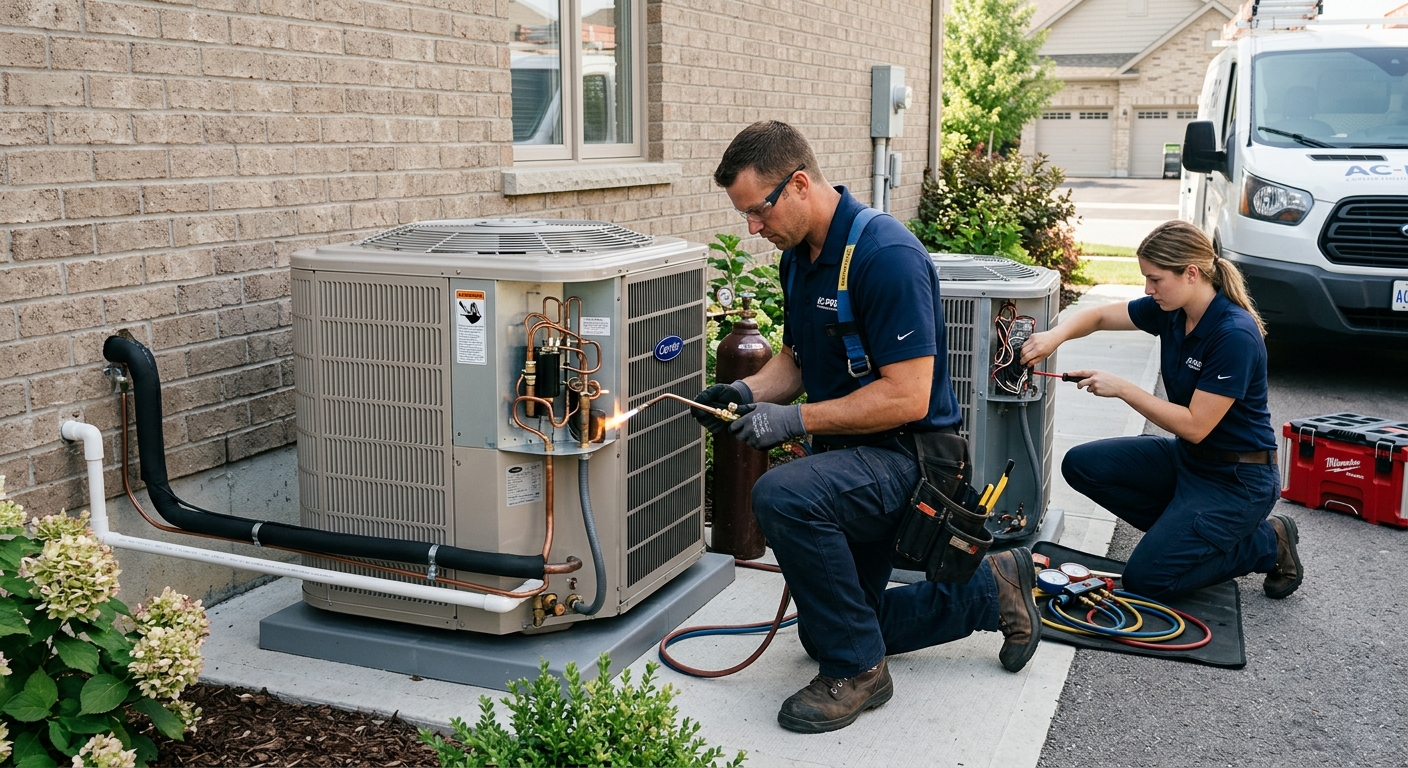
Exeter heating and cooling prices by system type — 2026
Exeter’s housing stock is shaped by its high homeownership rate and a significant percentage of homes built before 1980, which means HVAC upgrades are often full retrofits, not just quick replacements. In real terms, that means many Exeter homeowners are facing older ductwork that may not be sized or sealed for today’s standards—especially in Reading and older boroughs like Hamburg, where full-system changeouts are common due to pre-1940 construction. Most single-family houses here have some kind of ducted system already, but the spread of housing eras means not every home’s ducts were designed with air conditioning in mind.
The local climate leans heavily toward heating: Exeter sees around 5,200 heating degree days against just 1,250 cooling degree days each year. That drives system choices toward robust winter performance, making heating capacity the top concern—especially for those thinking about heat pumps versus furnaces. Cooling matters, but it’s secondary, and typically served by central air or ductless systems in finished attics, additions, or sunrooms.
| System |
Best for |
Efficiency |
Price range (installed) |
| Central AC replacement (existing ducts) |
homes with sound ductwork |
16–20 SEER2 |
$5,200–$12,500 |
| Air source heat pump (ducted) |
year-round heating and cooling |
8–10 HSPF2 |
$8,300–$17,500 |
| Cold-climate heat pump (ducted) |
heat pump as primary heat |
9–11 HSPF2 |
$13,500–$17,500 |
| Ductless mini-split (single zone) |
additions, rooms without ducts |
20–30 SEER2 |
$3,300–$7,300 |
| Full duct system installation |
homes with no existing ducts |
— |
$9,300–$18,500 |
Installed estimates for a typical Exeter home. Equipment tonnage, duct condition and electrical capacity move these more than brand.
Repair or replace your Exeter system?
Deciding between repair or replacement in Exeter comes down to four main factors: system age, repair vs. replacement cost, the nature of the failure, and whether an efficiency upgrade makes sense in our climate.
In Exeter, many older systems were installed when utility costs were lower or codes simpler. With so many homes built before 1980, it’s not rare for systems here to last 15–20 years with regular maintenance. If your unit is under 10 years old and the problem is a simple part—like a capacitor or control board—repair is almost always the better move. But if the repair is priced more than a third of full replacement, especially if your system is 10–15 years old, replacement deserves a hard look.
Absolutely replace if you have a cracked heat exchanger, which can pose a carbon monoxide risk; or if the compressor has failed on an out-of-warranty unit. Otherwise, weigh the repair cost against replacement, and don’t get talked into replacement for modest efficiency bumps. With Exeter’s 5,200 annual heating degree days, efficiency boosts are real—but seldom pay back unless your system is truly past its prime or you're fixing persistent envelope problems.
| Situation |
Recommendation |
Typical cost |
Reasoning |
| Under 10 years, single component failure |
Repair |
$300–$1,200 |
Most systems last 15+ years here; no need to replace. |
| 10–15 years, repair over a third of replacement |
Consider replacing |
$5,200–$12,500 |
Major investment in an older system may not pay off. |
| 15+ years, any major failure |
Replace |
$5,200–$12,500 |
Service life reached for most homes in Berks County. |
| Cracked heat exchanger, any age |
Replace immediately |
$5,200–$12,500 |
Safety hazard; not repairable. |
| Compressor failure past warranty |
Replace |
$8,300–$17,500 |
Core system failure; cost usually rivals full replacement. |
| Working system, high bills |
Test ducts and envelope first |
$300–$800 |
Poor duct sealing or insulation is often the real culprit. |
Comparing HVAC estimates in Exeter
Every year, I see homeowners in Exeter presented with HVAC quotes that can’t be compared apples to apples. The only way to compare bids is to look beyond the brand and price: you need full model numbers for both indoor and outdoor units (which must be matched to deliver rated efficiency), the stated tonnage along with the heat/cool load calculation, details on duct repairs or sealing, and line-set plans. Do not assume a bid covers necessary electrical upgrades or a new disconnect—these add up, especially here where electrical panels are more likely to be marginal in older stock.
Condensate management, a new thermostat, mechanical and electrical permit costs, and a commissioning report (measured airflow and refrigerant charge) all deserve line-item scrutiny. Warranty coverage varies widely—always distinguish between manufacturer parts and labor coverage, and get years in writing. Finally, "permit included" should mean exactly that: every full central system replacement in Reading and surrounding towns triggers mechanical and most likely electrical permits.
| Line item |
What to look for |
Red flag if… |
| Equipment |
model numbers, indoor and outdoor matched |
brand name only |
| Sizing |
load calculation attached |
matched to the old nameplate |
| Ductwork |
condition assessed, sealing scoped |
not mentioned |
| Electrical |
circuit and panel capacity confirmed |
assumed adequate |
| Line set |
replaced or documented as reused |
silent |
| Commissioning |
measured airflow and charge, documented |
no startup report |
| Warranty |
labour years stated separately |
manufacturer only |
| Permit |
included and priced |
'not needed' |
The refrigerant change and what it means for repairs
If you own a central air conditioner or heat pump in Exeter installed in the last 10–15 years, it likely runs on R-410A, which is still legal to use and service. The shift toward lower-GWP refrigerants like R-454B and R-32 only impacts newly manufactured equipment. You do not need to replace a working R-410A system just because of the change.
The main consequence is that, over the next few years, R-410A will become more expensive as production ramps down, but it will remain available for servicing older systems. If your R-410A system develops a refrigerant leak and is otherwise in good shape, repair is reasonable—just recognize that a large leak may become much pricier to address as refrigerant supply tightens. This is where age and repair cost matter most; with rising R-410A prices, a borderline system might tip toward replacement sooner, especially on units over 10–12 years old.
Bottom line: you’re not forced to switch. The refrigerant transition changes long-term service economics but does not make existing R-410A equipment obsolete, illegal, or unfixable. Plan ahead if your system is aging, but don’t let anyone pressure you into replacing for compliance concerns alone.
Gas, electric or both in south-central Pennsylvania
Exeter and the rest of south-central Pennsylvania land squarely in a heating-driven climate, with winter design temps down to 12 °F and about 5,200 heating degree days per year. Not long ago, that made gas furnaces the obvious default. But cold-climate heat pumps now reliably heat even as outdoor temps hover in the teens, making the old "heat pumps don’t heat here" objection less true each year. That said, capacity drops off in the coldest spell, so backup (either electric strip or gas) is still factored in by responsible installers.
Gas service is easily available in Exeter, Reading, Muhlenberg, and Spring—it’s the rule, not the exception, in most developed parts of Berks County. But if you’re outside the main townships, you’re probably on propane or oil. In those areas, all-electric systems (especially heat pumps) can compete strongly: electricity is cleaner, and propane or oil prices swing unpredictably. Still, in homes with leaky envelopes or poor insulation, a gas furnace may remain the best option for reliability during deep winter.
Furnaces are still the right call for homeowners with existing gas service who value redundancy, rapid heat recovery, or for whom upgrading panel power for an electric system would be costly or disruptive—particularly in older homes without upgraded breakers.
| Option |
Installed cost |
Operating cost here |
Best when |
Incentive eligible |
| Gas furnace + central AC |
$5,200–$12,500 |
Lowest if gas line present |
existing gas service, coldest zones |
sometimes |
| Ducted heat pump (cold climate) |
$8,300–$17,500 |
lower with high efficiency |
good envelope, all-electric goal |
yes |
| Dual fuel (heat pump + gas backup) |
$13,500–$17,500 |
flexible, strong for deep cold spells |
gas on site, deep cold spells |
yes |
| Ductless multi-zone |
$9,300–$18,500 |
depends on electric rates |
no ductwork, zone control |
yes |
What construction era means for your system
Nearly 44% of homes in Exeter were built before 1980, making existing ductwork a mixed bag—some systems were sized strictly for heating and lack the airflow for modern AC, while others may be poorly insulated or leaking. Many pre-1980s homes have smaller electrical panels, which can matter if you’re considering a switch to a heat pump or other all-electric solution; a panel upgrade often figures into the job.
In older Reading-area boroughs, you may discover no central ductwork at all, or that chimneys and flues need full evaluation before a new furnace can go in. Upgrades here usually mean adding or replacing ducts entirely or sealing and insulating them to avoid comfort and efficiency losses. Newer subdivisions—popping up in the 1990s and early 2000s—are now approaching the first round of major system replacements. In those cases, you may run into oversized equipment (to please builders, not homeowners) or basic-efficiency units at the end of their useful life.
Window and insulation upgrades pay off any time but especially before sizing a new HVAC system. Get the shell right, then the equipment.
Mechanical permits for HVAC work in Exeter
Pennsylvania does not issue a statewide trade license for HVAC contractors. Instead, residential work like heating and cooling system installation in Exeter is regulated at the municipal level. If you're in Reading, the Codes Department administers mechanical and electrical permits; nearby Berks County townships each have their own code offices and requirements. On a residential project, your contractor should carry a current Home Improvement Contractor (HIC) registration, which you can check via the Pennsylvania Office of Attorney General.
Anyone handling refrigerant—whether installing, replacing, or servicing AC or heat pumps—must have EPA Section 608 certification, which is a federal rule. Mechanical permits and inspections come into play for nearly every central air or heat pump replacement. It’s not enough for a contractor to just claim insurance or workers’ compensation coverage; you can verify actual status using the WCAIS system directly.
Finally, consumer protection law in Pennsylvania requires a written contract for any residential project over $500, with a built-in three-day right of cancellation. A reputable contractor will mention all of these requirements up front.
Frequently asked questions — HVAC installation in Exeter
What does a heat pump cost installed in Exeter?
A ducted heat pump replacement in Exeter typically ranges from $8,300–$17,500, with most jobs landing closer to the middle of that range. This price includes both equipment and all standard labor, but not always electrical panel upgrades, which can be a hidden cost in homes built before 1980. Our climate's high heating demand means you’ll want to spec a model with cold-climate performance if you expect to use it as your primary heat source—expect to pay at the high end of the band for that. Ductless single-zone heat pumps, often used for additions or rooms without ducts, usually run $3,300–$7,300 installed.
How is a tax credit different from a rebate?
In Pennsylvania, a tax credit reduces the amount of state or federal tax you owe after your install and is only realized when you file your return. A rebate, on the other hand, is a direct payment or discount—sometimes from a utility or manufacturer—usually soon after installation. For example, if you install a high-efficiency heat pump in Exeter costing $13,500–$17,500, a federal tax credit comes off your tax bill, whereas a utility rebate would be a check or discount you can see much sooner. Always check eligibility before you buy: some incentives require pre-approval or paperwork at install.
Can I service my R-410A system after the refrigerant change?
Yes, you can continue to service any working R-410A air conditioner or heat pump in Exeter. The recent refrigerant changes only apply to newly manufactured units—your current system remains legal and repairable. However, R-410A refrigerant will likely get more expensive over the next few years as production is reduced, so major leaks could mean a larger repair bill. If your 10-year-old AC needs a major charge and the cost nears $8,300–$17,500 (cost of replacement), that’s the time to consider a new system. But day-to-day maintenance and smaller repairs remain perfectly feasible. No one will force a working R-410A system out of service.
Is natural gas available throughout Berks County?
Natural gas is widely available in Exeter, Reading, Muhlenberg Township, and Spring Township, making it a common fuel choice for central heating systems in those areas. In contrast, outlying portions of Berks County still rely primarily on propane or fuel oil due to limited gas mains. If you’re renovating or replacing a furnace in a rural area, this can shift your best option toward a heat pump—especially since delivered fuel prices are less stable and often higher. Your installed cost for a ductless multi-zone heat pump, for example, usually falls in the $9,300–$18,500 range, depending on the number of indoor heads.
Is it worth switching from oil or propane to a heat pump?
For Exeter and other parts of Berks County not on the gas grid, switching from oil or propane to a high-efficiency heat pump can make financial sense, especially if your home is relatively well insulated. While the upfront cost for a cold-climate, ducted heat pump runs $13,500–$17,500, electric rates have been more predictable than oil or propane costs in this region. New heat pumps also provide efficient cooling—something oil or propane furnaces can’t offer. Consider the switch most seriously if your old system is at the end of its life and you already need a major replacement.
Is an annual maintenance plan worth it?
In Exeter’s freeze-thaw climate, annual HVAC maintenance is valuable—especially for older systems, which make up a big share of our local housing stock. A typical plan, priced well below full repair costs (usually in the $300–$800 band), involves cleaning coils, checking refrigerant charge, tightening electrical connections, and inspecting safety controls. Regular maintenance reduces the chance of a breakdown in a January cold snap, keeps efficiency closer to rated, and can extend equipment life, deferring that next $8,300–$17,500 system replacement. If your system is new and under factory warranty, you’ll also need annual tune-ups to keep warranty coverage active.
How far ahead should I schedule in Exeter?
For most major installs or replacements in Exeter, two to four weeks’ lead time is typical in the spring and fall; peak-demand periods like July or January can stretch waits much longer. Contractors in Berks County serve a wide area, and rural demand can mean a less crowded schedule, but towns like Exeter and Reading fill up fast in heatwaves or cold snaps. If your AC or furnace needs to be replaced during one of those crunch times, you could face delays getting on the schedule—even if your replacement costs $5,200–$12,500. Planning ahead makes for a less stressful experience and better selection.
Who inspects HVAC work in Exeter?
Mechanical and electrical permits for HVAC system replacements in Exeter are handled by the local township or city code office—Reading has its own, while Exeter and other nearby townships run separate code enforcement. The code inspection itself covers that the work matches the Pennsylvania Uniform Construction Code, and that new systems meet safety and efficiency standards. If you’re spending anywhere from $8,300–$17,500 on a full installation, the inspection helps ensure your job is up to local standards. Always confirm your contractor includes permit and inspection fees in their quote.
How much does a furnace replacement cost in Exeter?
For a standard gas furnace replacement with existing ductwork, most Exeter homeowners should expect an installed price between $5,200–$12,500, depending on the size of the house, access to gas, and any duct or electrical repairs needed. In older homes, additional costs can come from bringing vents, flues, or gas lines up to modern codes. If you’re converting from oil or electric resistance heat to gas, or adding central air at the same time, your price may trend to the upper part of the range. Quotes should always be detailed—if the proposal is vague, get another.