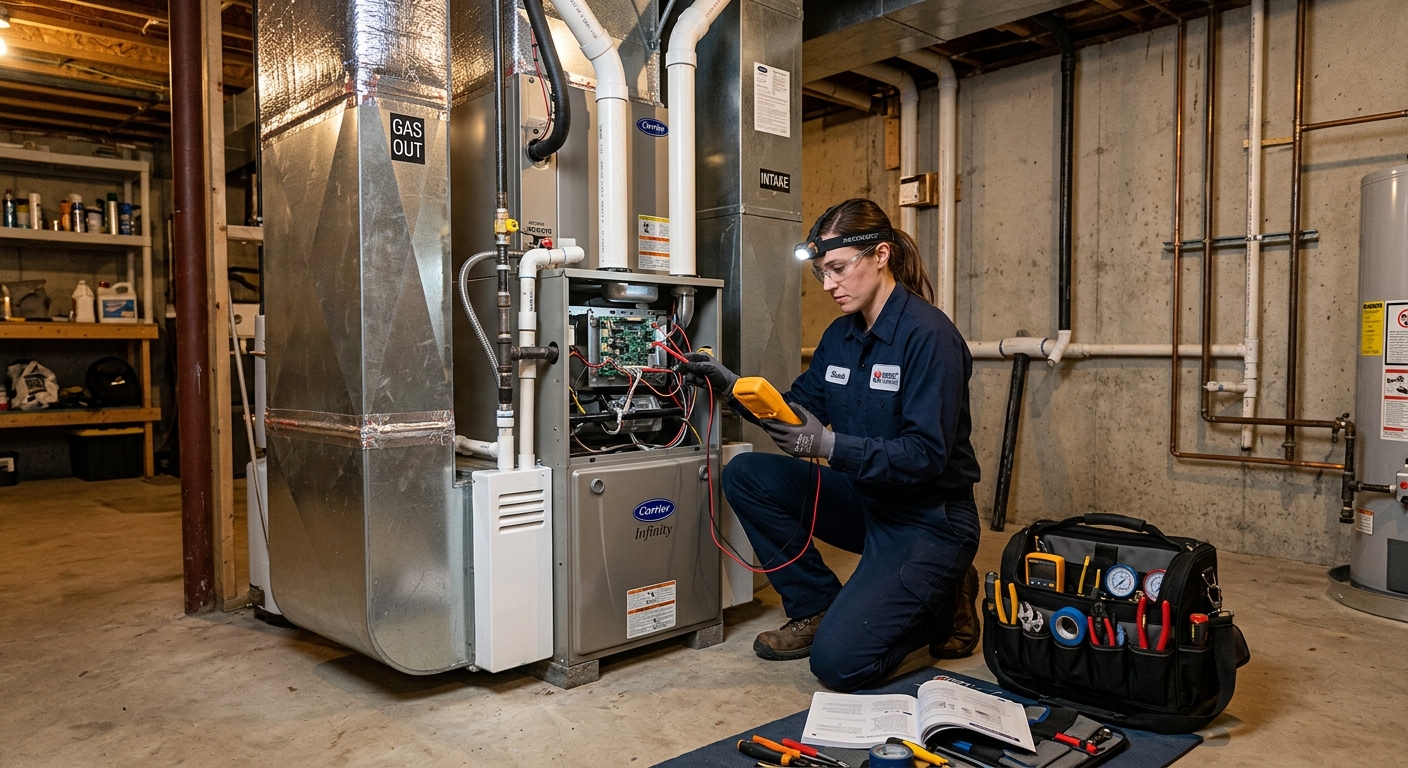
What a new HVAC system costs in Upper Providence
In Upper Providence, the cost of installing or replacing an HVAC system depends as much on your home's age and design as it does on the equipment. With a homeownership rate over 70% and nearly three-quarters of homes built before 1980 (U.S. Census Bureau, ACS 2024), many residents are dealing with older structures. The local housing stock includes a large number of 1920–1950 rowhouses and twins, where it’s common to find little or no existing ductwork. That means retrofits—especially ductless or high-velocity systems for cooling—are routine here.
Our climate leans heating-dominated, with about 4,800 heating degree days and 1,450 cooling degree days each year. That makes a reliable heating system (often integrated with cooling) a priority. Full duct installations are sometimes required in older homes, but it’s more typical for owners to lean on options like air source heat pumps or central AC replacements where usable ductwork already exists. Ductless mini-splits are popular for additions, finished attics, or spaces left out by aging forced-air systems.
| System |
Best for |
Efficiency |
Price range (installed) |
| Central AC replacement (existing ducts) |
homes with sound ductwork |
16–20 SEER2 |
$5,600–$13,500 |
| Air source heat pump (ducted) |
year-round heating and cooling |
8–10 HSPF2 |
$9,000–$19,000 |
| Cold-climate heat pump (ducted) |
heat pump as primary heat |
9–11 HSPF2 |
$14,500–$19,000 |
| Ductless mini-split (single zone) |
additions, rooms without ducts |
20–30 SEER2 |
$3,600–$7,900 |
| Full duct system installation |
homes with no existing ducts |
— |
$10,000–$20,500 |
Installed estimates for a typical Upper Providence home. Equipment tonnage, duct condition and electrical capacity move these more than brand.
The refrigerant change and what it means for repairs
There’s been a shift in refrigerants for newly manufactured HVAC systems. Most new units now use lower-GWP options like R-454B or R-32, especially as older high-GWP refrigerants such as R-410A are being phased down at the federal level. For homeowners in Upper Providence with an existing R-410A system, you don’t have to worry about immediate changes—your unit remains legal and can be serviced or repaired like before.
The biggest impact is long-term: as R-410A production declines, the cost for this refrigerant will trend upward. If your system develops a significant leak, the price to recharge it could get noticeably higher over the next several years. For any repair that involves replacing major components and recharging the refrigerant, you’ll want to weigh that rising cost against the value of putting those dollars into a new, more efficient unit using the latest refrigerants. Still, there’s no regulation forcing a homeowner in Delaware County to replace a working R-410A system. Routine service—like fixing minor leaks, checking the charge, or replacing parts—remains straightforward for now. The change simply tilts the balance, making replacement a little more attractive as your system gets older and parts or refrigerant become pricier. But if your equipment runs well and isn’t leaking, you don’t need to make any move just because of refrigerant changes.
Mechanical permits for HVAC work in Upper Providence
In Pennsylvania, HVAC contractor licensing for residential work isn’t handled at the state level. Instead, regulation is local—each municipality in Delaware County sets and enforces its own requirements. For any residential HVAC project in Upper Providence, you should expect to need a mechanical permit for major equipment changes or new installations. Permit offices review plans for basic code compliance under the Pennsylvania Uniform Construction Code (UCC), based on the International Residential Code (IRC), which covers mechanical systems for single-family homes. Simple jobs, like swapping a thermostat, are often allowed without a permit in nearby townships like Haverford.
Anyone handling refrigerant is required by federal law to hold EPA Section 608 certification, whether or not your local office checks for it. That applies to all central AC, heat pumps, and ductless split systems. For your contractor, check that they hold a valid Home Improvement Contractor (HIC) registration, issued by the state Attorney General, for projects over $500. You can verify HIC registration at hic.attorneygeneral.gov. Proper workers’ compensation coverage is mandatory for all employers—verify this directly through the Workers’ Compensation Automation and Integration System (WCAIS) at wcais.pa.gov before signing a contract. This paperwork is every bit as important as the equipment or the price—don’t take a contractor’s word for it.
Maintenance that actually extends system life
To keep your HVAC system running well in Upper Providence, two essentials matter most: changing the filter on time and keeping the coils clean. Use the right MERV filter—high enough to trap dust, but not so restrictive that it strains the blower. For most Delaware County homes, a MERV 8 or 11 is the sweet spot. Clean evaporator and condenser coils help your system shed and absorb heat as designed, especially after our pollen-heavy springs and sticky summers. A clogged condensate line can end up flooding the pan and causing water damage, so annual clearing is wise, particularly in humid weather.
Always ask that your technician verifies refrigerant charge against the manufacturer’s specs instead of simply “topping it up.” Adding refrigerant without finding the leak is a repair deferred—not real maintenance. As for annual service plans, their real value depends on what’s included. Some deliver just a quick look and a filter swap; others provide a full performance check and priority scheduling. In a climate with distinct winter and summer peaks, schedule maintenance in early spring or fall. That way, you avoid the rush and get more attention—not a rushed tune-up squeezed between emergency no-heat calls or AC outages.
Reducing the net cost of a Upper Providence installation
Three layers of incentives can help lower the net cost of a new HVAC system in Upper Providence: federal tax credits, utility rebates, and state or local programs. Federal tax credits for qualifying high-efficiency equipment will reduce your tax bill, but only after you file your return—meaning you pay the contractor in full, then get the benefit the next tax year. Utility rebates, by contrast, are usually applied to your invoice or paid as a check, so the savings are felt much sooner. In Delaware County, most homes are served by PECO Energy Company for both electric and natural gas, so their programs are the ones to check first.
There’s no fixed rebate amount that’s reliable year to year—utility efficiency programs and federal criteria change regularly. For accurate, up-to-date rebate and incentive information, start with PECO’s efficiency program page for the current offerings and check the ENERGY STAR rebate finder tool online. Don’t count on any single article for final numbers, as program names and dollar amounts are revised annually. Expect questions about eligibility based on the system’s efficiency, the installer’s credentials, and who actually pays the utility bill. Your savings could be anywhere from a few hundred to a couple of thousand dollars, but the homework is worth it for nearly every installation.
SEER2, HSPF2 and AFUE decoded
SEER2 measures a central air conditioner or heat pump’s cooling efficiency over an average season. HSPF2 gauges a heat pump’s efficiency in heating mode over the winter. AFUE applies to furnaces and means “Annual Fuel Utilization Efficiency”—the percentage of heat extracted from every dollar spent on fuel.
In Delaware County’s climate, with 4,800 heating degree days and 1,450 cooling degree days, you’re spending more on heating every year than cooling. That shifts your priority—pay for a better HSPF2 rating on heat pumps or a higher AFUE on furnaces, but think twice before shelling out for the very highest SEER2 numbers. Once you move past roughly 18–19 SEER2 for cooling, the extra upfront cost rarely pays back within the life of the equipment here. It’s a different story out West, but in Upper Providence’s long heating season, efficient heating trumps “elite” cooling ratings.
One note: efficiency ratings were updated in recent years, so SEER and HSPF figures from older articles don’t compare directly to SEER2 and HSPF2—always look for the “2” to be sure you’re comparing apples to apples.
Mini-splits and zoning in Upper Providence homes
Ductless mini-split systems are often the smartest solution for Upper Providence homes, especially those built before 1950. Many local rowhouses and twins never had ductwork run to every room, and it isn’t practical—or sometimes possible—to install new ductwork without tearing up walls or ceilings. Mini-splits shine in additions, finished attics and basements, or any room ignored by older forced-air systems.
Single-zone mini-splits are simple: one indoor “head” paired to one outdoor unit—reliable and efficient, especially for a targeted space. Multi-zone systems let one outdoor unit feed several indoor heads, but they can struggle to keep all zones equally comfortable, and “over-zoning” can reduce efficiency. From an installer’s viewpoint, separate single-zone systems work best if you can manage the placement and outdoor space.
Expect to talk through indoor unit location and aesthetics; heads can stand out on the wall, though newer models are less intrusive. Condensate from the indoor head must drain outdoors or to a proper location—cutting corners here invites mold or water damage. If you want comfort in a tricky Upper Providence rowhouse, ductless mini-splits outshine window units and avoid the mess of retrofitting ducts. For homes built long before central air was standard, ductless is almost the default—even if the owners haven’t realized it yet.
Frequently asked questions — HVAC installation in Upper Providence
Who inspects HVAC work in Upper Providence?
Each municipality in Delaware County, including Upper Providence, operates its own code office for residential HVAC inspection. For a project here, the local building department checks for compliance with the Pennsylvania Uniform Construction Code (UCC), which follows the IRC for homes. If you install a new system or change major equipment, expect a municipal inspector to assess the job before final approval. Routine jobs, like replacing a thermostat, often do not require inspection in nearby townships. Always pull a mechanical permit before starting work—your contractor should coordinate this and schedule the inspection. This local oversight ensures your system meets code and safety standards, not just manufacturer instructions. For new ducted central AC replacement, expect the permit and inspection process whether you’re spending $5,600–$13,500 or upgrading beyond that range.
Is natural gas available throughout Delaware County?
Natural gas, supplied primarily by PECO Energy Company, is widely available throughout Delaware County. In inner-ring townships such as Upper Providence, Upper Darby, and Haverford, virtually every block has access to gas service and it’s the primary fuel for furnaces and newer HVAC systems. Older homes may still have oil or, in some outer areas like Chadds Ford, propane is sometimes used due to the absence of gas lines. Always confirm natural gas availability at your specific address before committing to a gas-fired system—don’t assume just because your neighbor has it that your street is served. If gas isn’t available, you’ll be looking at heat pumps, oil, or propane, which can alter both your system cost and payback. For a ducted heat pump installation, plan on $9,000–$19,000 total.
How much does a new HVAC system cost in Upper Providence?
Installed costs in Upper Providence depend on the system type and whether your home already has ductwork. Replacing central AC in a home with solid ducts typically runs $5,600–$13,500. Adding a ducted air source heat pump comes in higher, around $9,000–$19,000. If you need brand new ducts run through a pre-1950 rowhouse or twin, that alone ranges from $10,000–$20,500. For small additions or single rooms, a ductless mini-split starts at $3,600–$7,900. Prices move most with the scope—new electrical work or tricky access ramps costs up fast—so ask for a detailed estimate. Compare bids, but don’t just chase the lowest number; quality of installation matters as much as the equipment brand.
Does my utility offer a heat pump rebate in Upper Providence?
In Upper Providence, residents are served by PECO Energy for both electric and natural gas. PECO regularly offers rebates for high-efficiency heat pumps, along with other qualified HVAC equipment. However, the details—amounts, qualifying models, and eligibility—do change nearly every year. Don’t rely on a set figure in an article; instead, always check PECO’s official efficiency program page and the ENERGY STAR rebate finder online before making your purchase. Sometimes these rebates apply directly to your contractor’s invoice, other times the homeowner submits paperwork and waits for a check. A typical heat pump can qualify for incentives, shaving some off the installed cost—say, from $9,000–$19,000 to a better number—but exactly how much should be confirmed at the time you’re signing a contract.
How long does HVAC installation take in Upper Providence?
For most Upper Providence homes with good access, replacing a central AC or furnace is a one-day job. Installing a ductless mini-split in a single room can be done in less than a day. If you’re adding a full duct system to a home that never had one—a common scenario with a pre-1950 twin or rowhouse—it often takes three to five days, depending on the scope, existing finish work, and whether electricians or other trades are needed. Your contractor should provide a schedule with your written estimate. Small delays are common, especially when coordinating permits or inspections through the local municipal office, so always pad your plans. For a full duct system and new AC, expect the project total to fall in the $10,000–$20,500 range, and installation could take the better part of a week.
What does HSPF2 measure?
HSPF2, or Heating Seasonal Performance Factor 2, is a rating of a heat pump’s heating efficiency over the course of a full season. The higher the HSPF2 number, the less electricity it uses to provide a given amount of heat. This is especially important in Upper Providence, where our 4,800 heating degree days each year mean long heating seasons and higher total heat demand. In practice, when choosing a heat pump, prioritizing HSPF2 over other flashier cooling numbers (like top-tier SEER2) makes the most sense for our climate. Ducted heat pumps for this area range in price from $9,000–$19,000, and paying extra for a top HSPF2 rating, particularly with “cold-climate” models, can pay back over the years in bill savings.
How much does ductwork add to an HVAC installation?
In Upper Providence—where nearly three-quarters of homes were built before 1980 and many rowhouses never had central air—adding new ductwork is often the biggest driver of cost on a whole-house HVAC upgrade. Installing a complete new duct system will typically add $10,000–$20,500 to the project, depending on house size and layout. Ductwork involves not only the materials and labor, but often patching and finishing after opening floors, walls, or ceilings. For homes where running ducts is impractical or would ruin original finishes, ductless mini-split systems, which cost much less ($3,600–$7,900 per zone), are usually a better match both economically and aesthetically.
Why are my Upper Providence energy bills high with a new system?
If you’ve just invested in a new HVAC system in Upper Providence and your bills are still high, there are a few likely culprits beyond equipment efficiency. Duct leaks and poor sealing—common in older housing stock—can undermine even the best system. Improper sizing (installing a unit too large or small for your specific house), dirty filters, or poor thermostat settings also drive up energy use. The local climate, with hot, humid summers and long winters, means your system works hard. Be sure the total installation included testing for duct leakage and properly balancing the airflows. If not, spending a bit on a professional tune-up or duct sealing can help lower bills. Even a high-efficiency AC, costing between $5,600–$13,500, won’t deliver savings if the rest of the system isn’t matched and maintained.
Is a heat pump a good choice for Upper Providence winters?
Yes, a modern air source heat pump—especially a cold-climate model—is a sound choice in Upper Providence’s winters. With winter design temperatures down to 14°F and roughly 4,800 heating degree days, your heat pump needs to maintain steady output in some real cold. Cold-climate models, with HSPF2 ratings between 9 and 11, now outperform old oil or resistance electric heat in most Delaware County homes, balancing efficiency and comfort. Many local homeowners use a heat pump as their primary heat, switching to furnace backup on the rare deep-freeze days. While these systems cost more up front, at $14,500–$19,000, the long-term savings and comfort can be well worth it. If you’re ready to replace fossil heat, ask your contractor for a model with verified Northeast performance—not just a sticker rating.