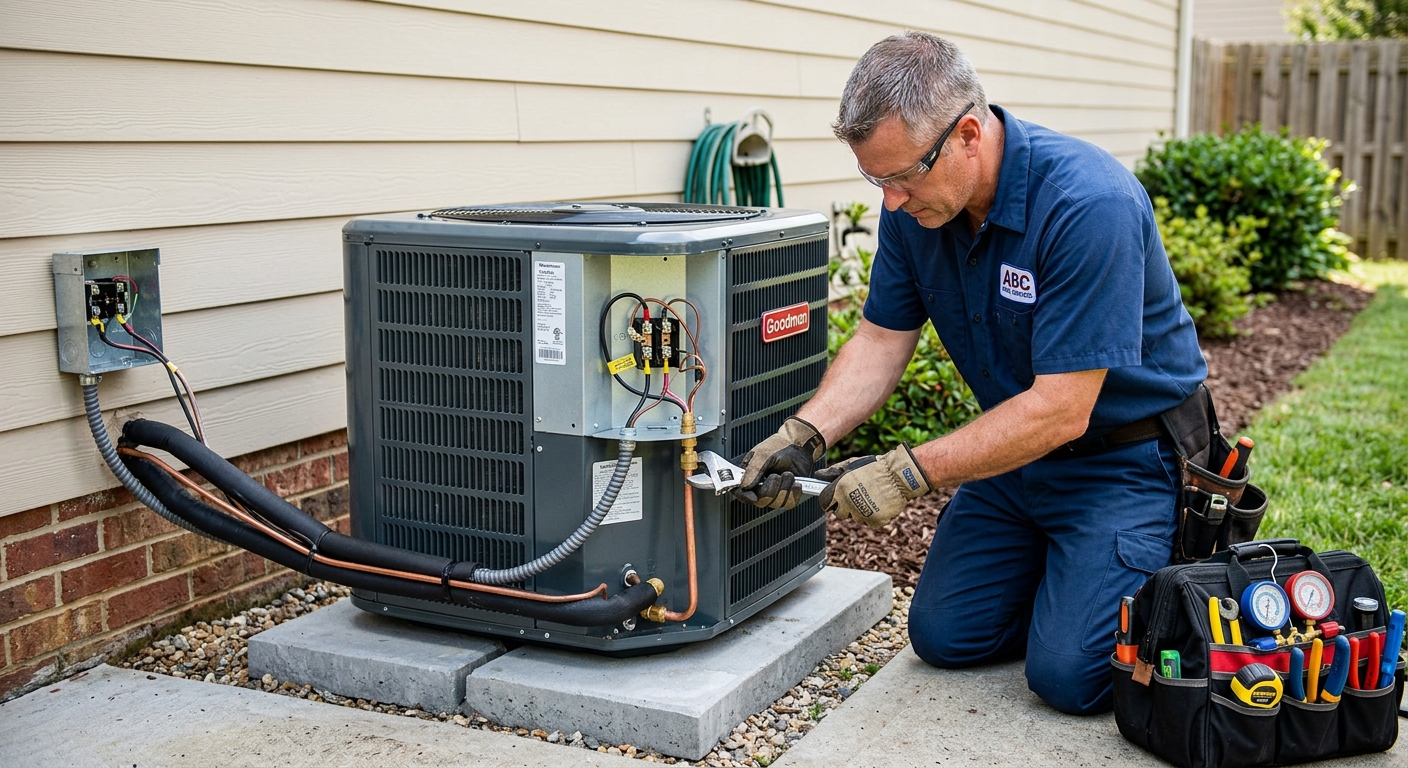
Frankstown heating and cooling prices by system type — 2026
Frankstown’s high homeownership rate and older housing era shape what HVAC systems are in place and what upgrades get done. With 81.7% of homes owner-occupied and over half built before 1980 (U.S. Census Bureau, ACS 2024), much of the housing stock in Frankstown is 1900–1940 wood-frame, typical of Blair County. In practice, this means frequent retrofits—adding or repairing ductwork and squeezing modern outdoor condensers into tight lots—rather than just swapping new equipment for old in open basements.
This part of Pennsylvania is solidly heating-dominated, with 6,300 heating degree days and only 750 cooling degree days each year. Our winters regularly hit 2 °F, with long cold spells that stretch any heating system. Cooling is important, but heating needs control the system choice and price. For most Frankstown homes, existing ductwork can be hit or miss, so the cost of repairs or full duct installs is common. If you’re budgeting for new HVAC, the price tag is driven much more by duct condition, house layout, and installation complexity than the brand on the box.
| System |
Best for |
Efficiency |
Price range (installed) |
| Central AC replacement (existing ducts) |
homes with sound ductwork |
16–20 SEER2 |
$5,200–$12,500 |
| Air source heat pump (ducted) |
year-round heating and cooling |
8–10 HSPF2 |
$8,400–$18,000 |
| Cold-climate heat pump (ducted) |
heat pump as primary heat |
9–11 HSPF2 |
$13,500–$18,000 |
| Ductless mini-split (single zone) |
additions, rooms without ducts |
20–30 SEER2 |
$3,400–$7,300 |
| Full duct system installation |
homes with no existing ducts |
— |
$9,400–$19,000 |
Installed estimates for a typical Frankstown home. Equipment tonnage, duct condition and electrical capacity move these more than brand.
Filtration, humidification and ventilation
Long winters with 6,300 heating degree days leave Frankstown homes dry, while our humid Pennsylvania summers often have the reverse problem. Whole-house humidifiers do help with winter dryness—but come with a maintenance burden. You must clean or replace the humidifier pad or canister every year or risk mold and mineral buildup. It’s a sensible add-on for homeowners who consistently see relative humidity under 30% indoors in January and February, especially with older radiators or heat pumps.
On the cooling side, an oversized air conditioner—one that’s too big for your house—will short cycle. This means it cools the air quickly but runs too little to actually pull out moisture, leaving the house both cold and clammy. Sizing right, not just for total square footage but for room layout, is crucial. High-MERV filters (MERV 13 or above) can help with allergens, but they also restrict airflow and sometimes outpace what the original blower can manage—especially in our older, high-static-duct homes. More is not always better.
Finally, if you’ve heavily air sealed or done a deep energy retrofit, mechanical ventilation—like an ERV or HRV—may be needed. In most Frankstown homes, though, it’s not mandatory under current code, and simple spot ventilation (bath fans, range hoods) often suffices. Watch out for sales pitches on “air purifiers” and high-end UV add-ons: in most homes here, they have little measurable benefit compared to basic filter upgrades and better maintenance.
Operating cost, not sticker price
What you pay up front is only one line of the budget. With Frankstown’s long winters (6,300 heating degree days, winter design temp 2 °F) and relatively mild summers (750 cooling degree days), running costs tilt heavily toward heating, especially for homes on electric or oil. Local rates from Penelec (FirstEnergy) are what determines your dollars per kilowatt-hour—but you only know your true rate by looking at your actual bill: the total electric charge for the month divided by usage in kWh.
Here’s how the math comes together: the efficiency rating (like HSPF2 for heat pumps or AFUE for furnaces) tells how well your system converts fuel into useful heat. The more degree days, the more “work” your system has to do each year. For a heat pump, for example, take your home’s annual heating load (in kWh or BTUs, based on degree days and house size), divide by the system’s HSPF2, and multiply by your actual electric rate. For a furnace, estimate gas (or oil/propane) usage from BTUs and multiply by your per-therm (or gallon) rate.
This is all only as accurate as your house’s ductwork and insulation. If you have leaky or undersized ducts—common in older Frankstown homes—the most efficient heat pump or AC will underperform and burn more energy than a mid-range unit on good ductwork. Envelope improvements (caulking drafts, adding attic insulation) usually have a faster payback than springing for exotic high-end equipment. Always compare sticker price against total cost to operate, but anchor it to your own bills, not just hopeful spec sheets.
The refrigerant change and what it means for repairs
Starting recently, new residential HVAC equipment is transitioning from R-410A to lower-global warming potential (GWP) refrigerants like R-454B and R-32. This is part of a nationwide move to phase down high-GWP HFCs. If your Frankstown home already has a system using R-410A—very likely if your AC or heat pump is less than 10–15 years old—you are not required to replace it. R-410A remains legal to buy and use for servicing, and technicians can still obtain it.
However, as new installs use these next-generation refrigerants, R-410A supplies will gradually get tighter and more expensive. This means the cost to recharge an older system (if it develops a leak) will rise over time. For homeowners, the upshot is that as repair costs for R-410A systems increase, the “fix or replace” question starts to favor replacement sooner, purely for economic reasons—not because your equipment has become illegal or unserviceable.
If your system is working well and isn’t leaking, there’s no cause for action. But if you’re facing a major repair involving refrigerant, especially after 2026, it’s smart to ask your contractor to quote the cost of repair versus upgrading to a new system with a modern refrigerant. The switch is about long-term economics and future serviceability, not sudden obsolescence.
Heat pump or furnace: what makes sense in Frankstown
Frankstown’s climate (6,300 heating degree days, 2 °F winter design temp) was once firmly in “furnace country.” That’s less true today. Modern cold-climate heat pumps can maintain most or all of their rated output well below freezing. The old argument—that heat pumps can’t heat northern homes—no longer holds up, especially with current equipment. However, output does fall off in deep cold, which is why backup or dual fuel setups exist. If your home is well insulated and it’s important to get off fossil fuels, a cold-climate heat pump can work for most winters here, though electric bills in extreme cold may spike.
In Altoona and Hollidaysburg, where natural gas from Peoples Natural Gas is widespread, a gas furnace paired with AC or a dual fuel heat pump is often the best mix of reliability and lowest cost over time, especially in older, less insulated homes. In Frankstown Township and outlying Blair County areas without gas access, the comparison becomes heat pump versus propane or oil—which alters the calculation entirely. With propane and oil bills prone to sharp swings, a heat pump, even allowing for higher electric costs, can now compete or even come out ahead over time.
A furnace is still the right call when: you have gas on site, your home is drafty or large, or you simply want the fastest, hottest air delivery possible on the coldest nights. If you want to zone heat or have a house that's hard to duct, ductless mini-splits are a fit.
| Option |
Installed cost |
Operating cost here |
Best when |
Incentive eligible |
| Gas furnace + central AC |
$5,200–$12,500 |
lower with gas, higher with propane |
existing gas service, coldest zones |
sometimes, for high efficiency |
| Ducted heat pump (cold climate) |
$8,400–$18,000 |
moderate if envelope is good |
good envelope, all-electric goal |
yes, federal/state programs |
| Dual fuel (heat pump + gas backup) |
$13,500–$18,000 |
varies with outdoor temp |
gas on site, deep cold spells |
yes, on heat pump portion |
| Ductless multi-zone |
$9,400–$19,000 |
room-by-room control, higher upfront |
no ductwork, zone control |
yes, if replacing resistance heat |
Separating installers from equipment sellers
The most important factor in a Frankstown HVAC job isn’t the equipment brand—it’s the installer’s attention to detail and understanding of old Blair County homes. Even the best system will run too loud, break early, or deliver half its rated efficiency if installed poorly. Before hiring, verify the contractor’s Pennsylvania Home Improvement Contractor (HIC) registration (searchable at hic.attorneygeneral.gov) and ask to see their EPA Section 608 card for anyone handling refrigerant. Only the installer, not just the company, must be certified.
Ask: does the quote include a load calculation (Manual J) or are they sizing "by eyeball"? Do they state make/model numbers or just tonnage? Is commissioning—meaning airflow and refrigerant charge measured on-site—documented and included? In a market as saturated as Blair County, where contractors also work in rural neighboring counties, paying attention to these checks is what separates quality installers from simple equipment sellers.
- Verify HIC registration (hic.attorneygeneral.gov)
- Ask for EPA Section 608 card from technician
- Confirm written contract (required over $500)
- Request proof of workers' compensation coverage
- Ask for mechanical permit and inspection (required locally)
- Demand a room-by-room load calculation (not just square footage)
- Ensure quote lists equipment model numbers
- Check for clear statement of warranty—labor and parts
- Ensure commissioning (measured airflow, refrigerant charge) is included
- Ask about expected duct sealing and airflow improvements
- Get specific references from recent Frankstown/Blair County jobs
- Understand cancellation rights under contract law
Red flags: vague quotes, no permit detail, pushy upsells without measuring your house, and contractors focusing more on brand discounts than showing their install process. In a dense market like Altoona and nearby townships, you can afford to be choosy.
Mechanical permits for HVAC work in Frankstown
Pennsylvania does not issue a statewide HVAC contractor license. Instead, mechanical permits and residential HVAC code compliance are enforced locally—each Blair County borough or township handles its own. In Frankstown, permits for installs, replacements and major repairs are issued through the local permitting office, following the Pennsylvania Uniform Construction Code which is based on the IRC for residential work. Commercial and residential work are treated very differently, and home HVAC upgrades are squarely in the residential/mechanical arena.
While there is no state-level HVAC license, every contractor working on a job over $500 must have HIC registration from the Office of Attorney General—always check this at hic.attorneygeneral.gov. For any refrigerant work, the technician must hold a federal EPA Section 608 card. Mechanical permits require inspection of work before use, and you should always request proof of current general liability and workers’ compensation insurance. Workers' compensation status in Pennsylvania is checked through WCAIS (wcais.pa.gov) and should match the business on your contract.
Never let a contractor skip the permit or talk you out of an inspection: it is your legal and budget protection.
Frequently asked questions — HVAC installation in Frankstown
How is a tax credit different from a rebate?
A tax credit is a reduction on your end-of-year income tax bill—so you'll see the benefit when you file your Pennsylvania state or federal taxes for the year you bought and installed your HVAC system. For example, if you qualify for a $2,000 tax credit on a cold-climate heat pump, that comes off your tax bill, not your upfront price. A rebate, by contrast, is typically a direct check or discount from a utility or manufacturer—sometimes paid by Penelec or equipment makers—applied at the time of install or a few weeks after. For a system priced at $8,400–$18,000, a rebate reduces what you need to pay now, while a tax credit helps you at tax time, provided you owe taxes that year. In Frankstown and the rest of Blair County, you may qualify for both, but always ask your contractor to separate those in your written contract.
How long should an HVAC system last in Frankstown?
In Frankstown, the life span of an HVAC system depends on the system type, usage, and especially maintenance—given our long heating season and older home stock. Central ACs and heat pumps here typically last 12–16 years, gas furnaces closer to 18–22 years, though older equipment sometimes makes it longer in milder use. Blair County’s climate (6,300 heating degree days) puts extra miles on any heating appliance, especially heat pumps running in deep cold. Regular maintenance (like cleaning, filter changes, and annual professional service) helps longevity, as do repairs to old ductwork or resolving installation mistakes at the time of upgrade. When replacement costs run as high as $5,200–$12,500 for a single system, planning ahead makes sense.
What is commissioning and why does it matter?
Commissioning is the process of measuring and adjusting your new HVAC system after installation to make sure it operates as designed. In Frankstown, proper commissioning means checking actual airflow room to room, setting refrigerant charge by measured pressure (not just “factory settings”), and verifying safety features. Why does this matter? Because Blair County’s older homes often have quirks—leaky or undersized ducts, tight attics, or long refrigerant runs on tight lots. Systems left uncommissioned may run too loud, miss target temperatures, or cost more to operate, even if you paid top dollar. On a $8,400–$18,000 heat pump install, commissioning should not be optional—it’s how you get what you paid for, not just a box and some ductwork.
Do older Frankstown homes need ductwork replaced?
Many pre-1980 homes in Frankstown (over 54% of the stock) have aging or makeshift ductwork, sometimes retrofitted years after original construction. If you’re noticing rooms that never heat or cool right, or you have obvious leaks, chances are your ducts need repair—or outright replacement. However, not every system needs a full tear-out. If your ductwork is sheet metal and accessible, sealing and adding insulation can often bring performance up to par without spending on a total swap. A full duct system install costs $9,400–$19,000, so this is not a minor decision. Get a contractor who will scope the entire system and show you the math before recommending new ducts.
Is a heat pump a good choice for Frankstown winters?
Modern cold-climate heat pumps are absolutely viable for Frankstown—unlike older models, today’s units are rated to deliver almost full output down to 0 °F or lower. With 6,300 heating degree days here, your heat pump will work hard—but if your home is well air-sealed and insulated, all-electric heating can be economical and comfortable. Expect a higher upfront cost (often $13,500–$18,000), but ongoing savings versus oil or propane can be substantial, especially if you don’t have natural gas available. In the coldest spells, some homes may need electric resistance or backup, but in Blair County’s modernized homes, cold-climate heat pumps are well proven.
What MERV filter rating should I use?
In most Frankstown homes, a MERV 8 or MERV 11 filter offers the right balance between air cleaning and airflow. Older Blair County ductwork can struggle with the pressure drop from high-MERV (13+) filters, especially with original blower motors or undersized returns. Increasing MERV for allergies or smoke is fine if your system can handle it, but pushing too high can actually reduce heating and cooling output and boost electric bills—sometimes costing you more than a filter upgrade is worth. On a replacement system in the $5,200–$12,500 range, always have your contractor check static pressure before moving up in filter rating.
How much does a furnace replacement cost in Frankstown?
For a standard gas furnace replacement in Frankstown, costs run $5,200–$12,500 installed, depending on the home’s layout, whether duct repairs are needed, and the efficiency rating of the new unit. In homes with clean existing ductwork and natural gas already on site—common in Altoona, Hollidaysburg, and neighboring boroughs—prices land on the lower half of the band. In rural areas with only propane or oil, or where tight crawlspaces add labor, the job can move toward the high end. Always insist on a full written contract under Pennsylvania law for any job over $500, and make sure the total includes permits and all necessary ductwork improvements.
What is EPA Section 608 certification?
EPA Section 608 certification is a federal requirement for anyone who installs, services, or disposes of equipment that contains refrigerants—like most ACs and heat pumps. In Frankstown, this means every technician who handles refrigerant on your system must hold a Section 608 card, regardless of their company’s status. This law governs how refrigerant is recovered and recycled, protecting both the environment and your property from accidental releases. It is separate from Pennsylvania’s Home Improvement Contractor registration and applies everywhere in the U.S. For any job in the $8,400–$18,000 range involving refrigerant, don’t just ask—demand to see your technician’s card before work begins.
How much does ductwork add to an HVAC installation?
Adding full ductwork to a Frankstown home—especially one from the 1900–1940 era—can easily double the price of your HVAC job. For a new full duct system, expect to pay $9,400–$19,000, with the larger, two-story wood-frame homes at the high end due to the labor involved running trunks and branches through old framing. Retrofits in houses that never had forced air cost more than swaps in homes with decent existing ducts. Sometimes sealing, insulating, or adding a few branches is all you need; other times, a mini-split is more practical. Get a room-by-room proposal—never guess, and never sign for a full system unless you know where every run will go.