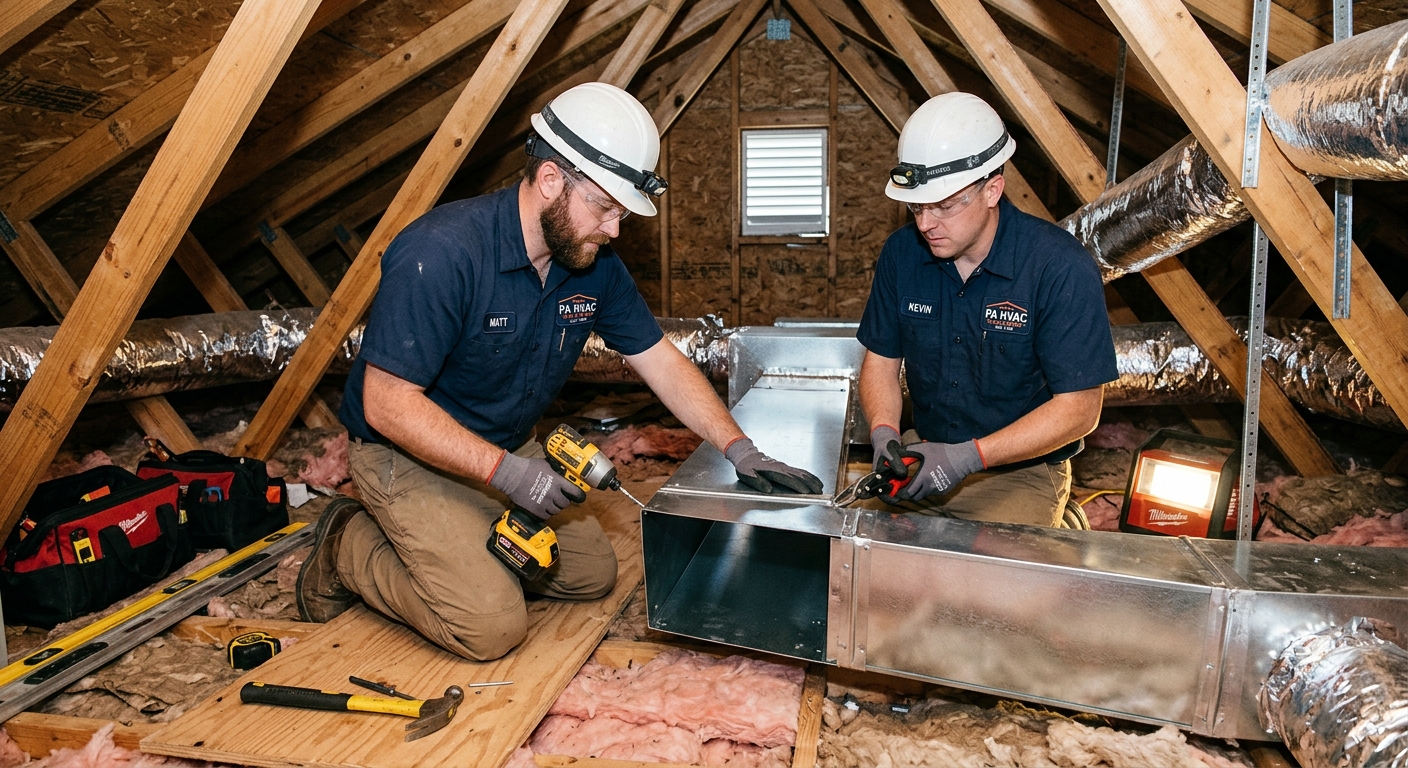
Harris heating and cooling prices by system type — 2026
Harris sits within Centre County’s mostly owner-occupied, single-family housing market, with 81.9% homeownership and nearly half its homes built before 1980 (U.S. Census Bureau, ACS 2024). This makes Harris very much a replacement market, not a pure new-build environment. Many homes—especially in and around State College—have existing ductwork dating back to the 1960s–1980s, and much of the ongoing work here involves upgrading those systems to high-efficiency models that fit current code and energy expectations.
This area’s 6,300 heating degree days and only 750 cooling degree days make Harris a heating-dominated market. Furnace or heat pump sizing, selection, and running costs will matter more here than in southeastern Pennsylvania, where air conditioning drives the numbers. For cooling, installed central AC prices for Harris run from $5,500–$13,000, while heating-focused replacements, like ducted heat pumps, start higher but can serve year-round. Ductless systems are common for older homes or additions where ducts don’t exist, but for full-home comfort in a typical Harris house with existing ductwork, replacement or upgrade is the core job.
| System |
Best for |
Efficiency |
Price range (installed) |
| Central AC replacement (existing ducts) |
homes with sound ductwork |
16–20 SEER2 |
$5,500–$13,000 |
| Air source heat pump (ducted) |
year-round heating and cooling |
8–10 HSPF2 |
$8,700–$18,500 |
| Cold-climate heat pump (ducted) |
heat pump as primary heat |
9–11 HSPF2 |
$14,000–$18,500 |
| Ductless mini-split (single zone) |
additions, rooms without ducts |
20–30 SEER2 |
$3,500–$7,600 |
| Full duct system installation |
homes with no existing ducts |
— |
$9,800–$19,500 |
Installed estimates for a typical Harris home. Equipment tonnage, duct condition and electrical capacity move these more than brand.
Maintenance that actually extends system life
In Harris and Centre County, the maintenance that truly extends the life of your HVAC system comes down to consistent basics: change your filters regularly, matching the MERV rating to your blower's limits—overdoing it with a high-MERV filter on an older system will simply stress the motor and can reduce performance. For most homes here (with heavy winter use and light summer cooling), swap filters about every three months, but check monthly during peak heating or pollen season.
Coil cleaning is often skipped, but for systems running hard during our long heating season, dirty coils cut efficiency and lead to higher bills. The condensate line needs to stay clear, especially during the humidity spikes of summer—just a small backup can shut down cooling or overflow in the basement. Refrigerant is another point: any system that ‘needs’ refrigerant annually has a leak. Proper maintenance means leak checking and repair, not topping off.
As for annual service plans, they have their place—but read the fine print. A good plan should include a full, documented tune-up and not just a basic check. Avoid plans that only discount future repairs or seem overpriced for the real value; in our low-cooling but high-heating zone, you want the spring or early fall shoulder seasons for scheduling. That way, you’re ahead of the emergency rush and get a proper, unrushed service call.
When an HVAC repair stops being worth it
Harris homeowners usually face the repair-or-replace decision somewhere after that first decade of system life. The numbers here favor repair in many cases, especially if your system is less than 10 years old and the needed fix is a single component—like a capacitor or igniter—rather than a big-ticket item. Once repair costs climb toward a third of full replacement—so, between $5,500–$13,000 for a typical central AC in Harris—you should at least price out a new system. For major failures on a 15+ year-old system or if the compressor fails and warranty is expired, replacement is the honest answer.
Two situations always require replacement: a cracked heat exchanger (your furnace is unsafe) and a failed compressor outside warranty. Most other failures can be repaired, but refrigerant matters—if you have an older system needing hard-to-find refrigerant, future repairs will only get pricier and efficiency won’t keep up with new standards, but systems using common refrigerants like R-410A can often still be serviced at a lower cost. If bills are just high but the system works, test the ductwork and building envelope before leaping to full replacement—many Harris homes leak more heat than their systems ever could fix through sheer equipment upgrade.
| Situation |
Recommendation |
Typical cost |
Reasoning |
| Under 10 years, single component failure |
Repair |
$300–$1,200 |
System likely has years left; repair is cost-effective. |
| 10–15 years, repair over a third of replacement |
Consider replacing |
$5,500–$13,000 |
High repair cost vs. remaining life; replacement may save in long run. |
| 15+ years, any major failure |
Replace |
$5,500–$13,000 |
Older systems are less efficient; part failures become common. |
| Cracked heat exchanger, any age |
Replace immediately |
$5,500–$13,000 |
Unsafe to operate; repair is not an option per code. |
| Compressor failure past warranty |
Replace |
$8,700–$18,500 |
Compressor is the costliest part; total replacement is justified. |
| Working system, high bills |
Test ducts and envelope first |
$300–$800 |
Leaks or poor insulation often explain high costs more than equipment. |
Reducing the net cost of a Harris installation
There are three practical ways to bring down the net cost of a new HVAC system in Harris: federal tax credits, utility rebates, and any state-level programs (which change frequently and aren’t always available). A tax credit, unlike a rebate, reduces the tax you owe the following year—so while it saves you money, it doesn't lower your upfront invoice. Utility rebates, on the other hand, usually come as check or bill credit after installation and paperwork are processed. These can sometimes be bundled with manufacturer promotions, but it's your local utility's program that reliably offers rebates regardless of brand.
In Harris, the primary electric utility is West Penn Power, while Peoples Natural Gas serves the State College–Bellefonte area; propane and oil remain common outside the metros. To see current rebate amounts and program details—which change annually—check your utility’s energy efficiency program webpage directly, as well as the official ENERGY STAR rebate finder. Ignore any third-party blog or estimate unless it links straight to an official page; the numbers age quickly and can mislead. For most homeowners, federal credits are the main ‘guaranteed’ incentive, but local rebate programs can move the bottom line by $300–$1,000 depending on system efficiency and type, so do your research right up to signing the contract.
Permits, licensing and inspections in Harris
Pennsylvania does not issue a statewide HVAC contractor license for residential projects. Instead, residential HVAC work in Harris falls under local regulation—municipalities or, in some cases, the PA Department of Labor & Industry serve as code enforcement. For example, in State College, replacing or installing central HVAC equipment typically requires a mechanical permit and a final inspection; surrounding Centre County towns have their own code offices and may have slightly different rules. For smaller jobs like swapping out a thermostat, most Centre County townships do not require permits.
Any contractor working on a job over $500 must hold a Home Improvement Contractor (HIC) registration from the Pennsylvania Office of Attorney General—homeowners should always verify this before signing a contract. Written contracts are required over $500, and the Home Improvement Consumer Protection Act gives you a 3-business-day right to cancel. If refrigerant is involved, your technician must have EPA Section 608 certification regardless of local licensing status. Insurance and workers’ compensation are both required for employers and can be verified through the WCAIS system. When in doubt, ask for proof: a reputable Harris HVAC company will not hesitate to provide current documentation and registration numbers.
Filtration, humidification and ventilation
Harris winters are long and dry, while summers bring spikes of humidity. That means different indoor air quality needs depending on the season. In winter, dry air can lead to cracked woodwork and comfort problems—whole-house humidifiers can help, but they require regular cleaning and seasonal shut-down to prevent mold and scale. In summer, a properly sized AC or heat pump should dehumidify as it cools, but oversized systems in older homes (a common mistake due to underinsulated attics and aging ductwork) often cool air quickly without pulling out enough moisture. That leaves rooms clammy despite the temperature setting.
MERV 8–11 filters strike a balance between air cleaning and blower capacity for most Centre County homes. Going higher can strain static pressure, especially on older systems not built for dense filtration media. For Harris homes built since the 1980s and tightly sealed during upgrades, mechanical ventilation (like HRVs or ERVs) may be needed to bring in fresh air without major energy penalties. Be wary of UV-lamp and “air scrubber” add-ons—measurable benefits are minimal in well-maintained residential homes and the upfront cost rarely pays back. Focus first on filter quality, humidity control, and realistic ventilation improvements.
Refrigerant rules and your existing system
For Harris homeowners with working R-410A heat pumps or air conditioners, nothing about the recent refrigerant changes suddenly makes your equipment illegal or unserviceable. The refrigerant transition—phasing down high-GWP HFCs in favor of lower-GWP options like R-454B and R-32—only impacts newly manufactured residential systems. Older R-410A systems can and will be serviced as long as supplies last; what changes is the economics. As the supply of R-410A tightens (due to federal phase-down), prices for the refrigerant trend upward. That doesn’t mean you need a new system, but if your system develops a refrigerant leak, repair costs rise, and that can push you toward replacement if the unit is already near or past its expected service life.
It’s important to know: a working system should not ‘consume’ refrigerant. If it’s low, it has a leak—and in Harris, with our heavy heating and light cooling loads, a failing heat pump or AC leaking refrigerant is simply more expensive to keep nursing along every year. Switching to the new refrigerants requires new equipment; there are no legal or practical retrofits. Don’t be swayed by pressure sales tactics: as long as your current system is performing, you do not need to upgrade simply because of these new rules.
Frequently asked questions — HVAC installation in Harris
How far ahead should I schedule in Harris?
The best time to schedule HVAC installation or replacement in Harris is well before the first heat wave or deep freeze. Most local contractors get slammed with emergency calls once the heating or cooling season kicks in—especially in a heating-heavy market like Harris, where a long winter keeps everyone’s systems running overtime. Ideally, book installations during the spring or early fall shoulder seasons. Expect lead times of 2–4 weeks for a typical central AC or heat pump installation ($5,500–$18,500), but this can stretch longer during peak demand. In rural Centre County townships, thinner service coverage and travel times can add days, so act early if you suspect your system won’t make it through the season. Always get on a contractor’s calendar as soon as you’re set on a project.
Does Pennsylvania license HVAC contractors?
Pennsylvania does not issue a statewide HVAC contractor license for residential work. Instead, residential HVAC installation in Harris is regulated at the local (municipal) level, and any contractor taking jobs over $500 must hold a Home Improvement Contractor registration. Always verify this registration before signing a contract for any job—especially larger ones like a ducted heat pump system ($8,700–$18,500). For work involving refrigerant, EPA Section 608 certification is required no matter what. Municipalities like State College also require mechanical permits for HVAC installations and replacements. A true pro in Centre County will always provide paperwork, including insurance and workers’ comp—don’t be afraid to ask.
Should I close vents in unused rooms?
While it might seem like closing vents in unused rooms would save energy, in most Harris homes it actually creates more problems than it solves. Closing vents increases static pressure in the ductwork, which can strain your blower and reduce system performance—especially in older homes with marginal duct design. Instead of lowering your bills, you could shorten the life of your system and reduce overall comfort. If you have uneven temperatures, look into zoning or minor ductwork upgrades before resorting to vent-shutting. To actually save money, consider a properly sized upgrade—like a ductless mini-split ($3,500–$7,600) for additions or hard-to-heat rooms.
What size HVAC system does my Harris home need?
System sizing in Harris is driven by our climate: with 6,300 heating degree days and mostly older insulation, many homes are at risk of oversized or undersized equipment. The only way to know your proper size is a load calculation that factors in square footage, insulation level, window quality, and infiltration—not just square footage alone. Oversizing, especially with AC or heat pumps, leaves you overpaying both upfront (say, installing equipment at the top of the $8,700–$18,500 band unnecessarily) and monthly through reduced efficiency and comfort. Make sure your contractor takes the time to measure—not just guess—before recommending a system.
Is it worth switching from oil or propane to a heat pump?
In rural Centre County, many Harris-area homes still run on oil or propane. For these homes, switching to a ducted air source or cold-climate heat pump ($8,700–$18,500) can lower annual heating costs and reduce fuel deliveries, especially if your house has been reasonably well-insulated and weatherized. With electricity supplied by West Penn Power, energy costs are relatively reasonable. That said, initial installation is a bigger jump than swapping out a furnace, and if your home’s ductwork is not ready for heat pump pressures, factor in duct upgrades. On truly drafty, leaky old homes, savings can be limited unless envelope problems get fixed too.
How does north-central Pennsylvania's climate affect system sizing?
Harris and north-central Pennsylvania have far more cold weather than most of the state—6,300 heating degree days compared to only 750 for cooling. That means sizing a furnace or heat pump for heating load is almost always the priority. But because summer humidity and short cooling seasons do matter, oversizing can lead to poor dehumidification and uneven comfort. A heat pump or AC placed at the higher capacity end of the price bands ($5,500–$18,500) is not always better. Insist on a Manual J load calculation from your contractor rather than a “rule of thumb.”
How much does ductwork add to an HVAC installation?
For Harris homes without existing central ductwork—especially in older sections or farmhouses—installing a full new duct system adds significantly to the bottom line. In 2026, expect a new duct system to add $9,800–$19,500 to the job, on top of the equipment cost. Often this can double your total project price. Duct installation is invasive; it requires opening floors, walls, and ceilings, especially in homes built with minimal or no chases. If your home already has solid ductwork, you save considerably—just paying for equipment swap, not infrastructure. Always have the existing ducts evaluated for leaks or design issues during estimate stage.
Is a high-efficiency system worth the extra cost here?
Harris’s long heating season can make high-efficiency systems financially worthwhile, but only if your home is already reasonably air-sealed and insulated. If you’re running a drafty old house, the efficiency gains of a higher-SEER or HSPF unit are eaten up by heat loss elsewhere. High-efficiency setups land at the top of the bands ($13,000–$18,500). For the average well-maintained Harris house, the payback often comes in comfort and reliability before pure cost savings. Upgrade other weak points in your home envelope before spending on top-tier equipment.
Are duct sealing and insulation eligible for incentives?
Duct sealing and insulation are sometimes eligible for utility or state-level incentives, but the specifics change regularly and vary by provider. In Harris, check directly with West Penn Power’s or Peoples Natural Gas’s energy efficiency programs for current offerings. Federal tax credits may also apply for duct sealing when bundled with other upgrades, but you’ll need to check eligibility through the ENERGY STAR rebate finder. In recent years, rebates have typically covered a fraction of the cost ($300–$800), rather than the entire project, so weigh your long-term savings and comfort improvements against whatever incentive is currently available.