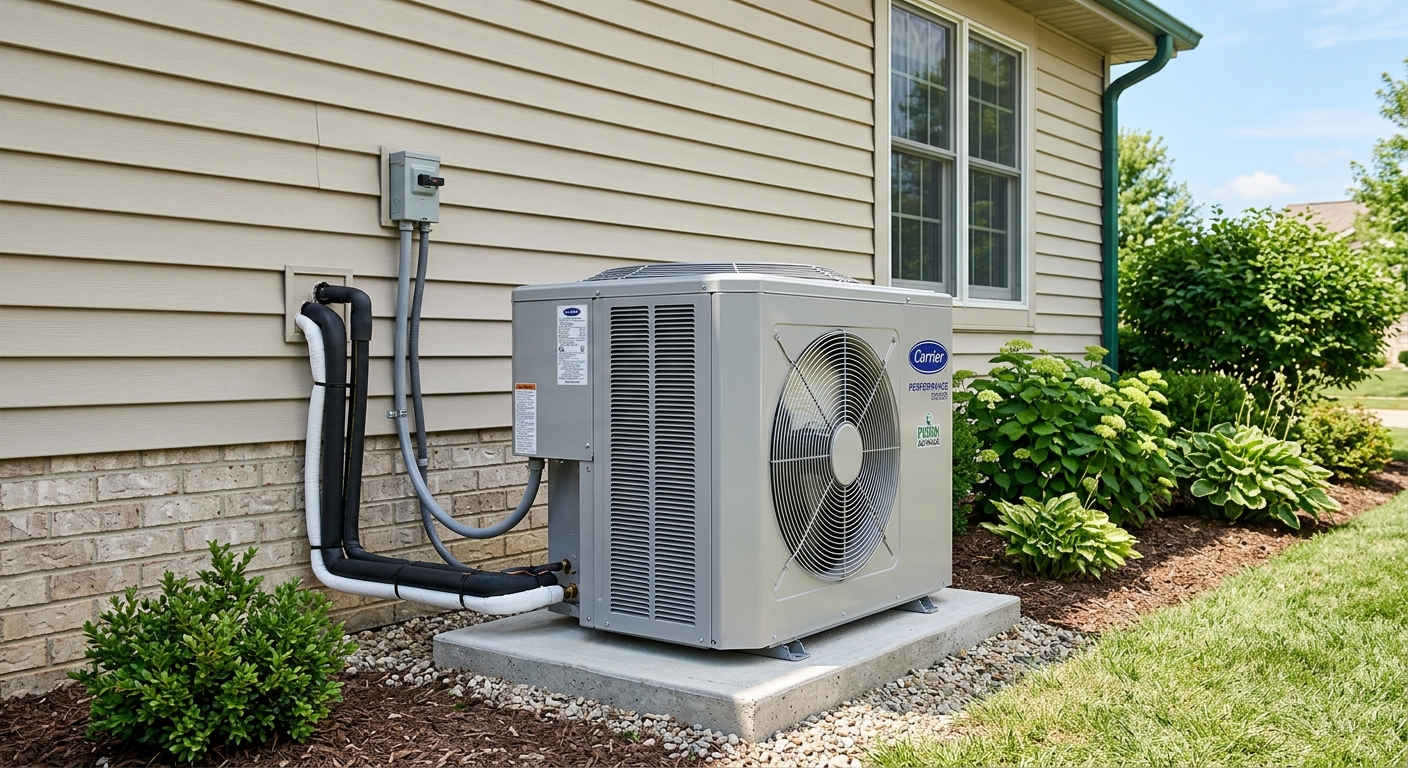
Darby heating and cooling prices by system type — 2026
Darby’s housing market, with just 50.1% owner occupancy and a striking 93.5% of homes built before 1980 (U.S. Census Bureau, ACS 2024), is overwhelmingly a retrofit town. Most properties, especially Upper Darby rowhouses and twins from the 1920–1950 period, were never designed for central air and often lack existing ductwork—making ductless or high-velocity mini-split systems a frequent solution. For homes that do have ductwork in decent shape, a straightforward central AC or heat pump replacement is possible, but owners should expect a thorough inspection to confirm ducts can handle today’s more powerful systems.
This region logs 4,800 heating degree days against just 1,450 cooling degree days, which marks Darby and the rest of southeastern Pennsylvania as a predominantly heating-driven market. That’s why heating performance, system efficiency and the potential for robust cold-weather operation are more important here than the peak cooling output you might prioritize further south. Most existing equipment in Darby struggles more with January lows than summer humidity—so sizing, fuel source, and duct condition all matter when weighing new installations.
| System |
Best for |
Efficiency |
Price range (installed) |
| Central AC replacement (existing ducts) |
homes with sound ductwork |
16–20 SEER2 |
$4,800–$11,500 |
| Air source heat pump (ducted) |
year-round heating and cooling |
8–10 HSPF2 |
$7,700–$16,500 |
| Cold-climate heat pump (ducted) |
heat pump as primary heat |
9–11 HSPF2 |
$12,500–$16,500 |
| Ductless mini-split (single zone) |
additions, rooms without ducts |
20–30 SEER2 |
$3,100–$6,800 |
| Full duct system installation |
homes with no existing ducts |
— |
$8,700–$17,500 |
Installed estimates for a typical Darby home. Equipment tonnage, duct condition and electrical capacity move these more than brand.
Gas, electric or both in southeastern Pennsylvania
With Darby winters dropping to a design temp of 14 °F and the region seeing 4,800 heating degree days, heating systems—not cooling—drive yearly comfort and bills. That’s why local decisions tend to focus on robust, reliable heat. Modern cold-climate heat pumps legitimately solve the old complaint that “heat pumps can’t handle Pennsylvania winters”—today’s equipment can heat efficiently well below freezing, even into the low teens. However, their output does dip as outdoor temperatures drop, and backup or “dual fuel” options still matter in deep cold—especially for homes with average insulation or where the system must run in single digits.
Natural gas is widely available in Delaware County’s townships, so for many Darby homeowners it’s not a debate between propane or electric—it’s very much heat pump versus natural gas, with some lingering oil or propane in outer areas. If a home already has gas service, a furnace can still be the most straightforward, reliable, and cost-effective option, especially if you don’t plan a major electrical upgrade. Dual fuel systems, combining a high-efficiency heat pump with a gas furnace for the coldest spells, fit the bill for owners focused on year-round efficiency but unwilling to risk discomfort during coastal cold snaps.
| Option |
Installed cost |
Operating cost here |
Best when |
Incentive eligible |
| Gas furnace + central AC |
$4,800–$11,500 |
low with existing gas |
existing gas service, coldest zones |
partial: utility/efficiency programs |
| Ducted heat pump (cold climate) |
$7,700–$16,500 |
moderate, lower bills when envelope is tight |
good envelope, all-electric goal |
yes: federal/state rebates |
| Dual fuel (heat pump + gas backup) |
$12,500–$16,500 |
lowest in hybrid use |
gas on site, deep cold spells |
yes (heat pump portion) |
| Ductless multi-zone |
$8,700–$17,500 |
moderate to low per zone |
no ductwork, zone control |
yes |
R-410A phase-down: repair or replace?
Starting in 2025, new residential HVAC systems must use lower-GWP refrigerants like R-454B or R-32—part of the ongoing R-410A phase-down in the United States. If you have an existing R-410A system in Darby, nothing about the law makes your equipment illegal or unserviceable. Repairs, maintenance, and even adding refrigerant are still legal and available for the foreseeable future.
The main impact for homeowners comes at the intersection of age, leaks, and rising refrigerant costs. R-410A supply will gradually tighten, which could mean steeper repair bills if your older AC or heat pump develops a large leak. For a newer, tight system, there’s no urgency—run your equipment as long as it performs and doesn’t have recurring refrigerant issues. If, however, your system develops a major refrigerant leak and is already a decade old or struggling elsewhere, it’s smart to compare the cost of repair (with refill) to that of a new system using current refrigerants. But there’s no need to replace preemptively: replace only when reliability, repair cost, or efficiency truly justify it, not because of the phase-down itself.
The decision point on an aging system
In Darby, most heating and cooling equipment should last 12–20 years if maintained. When facing an HVAC repair, look at system age, the specific failure, and cost relative to replacement—especially with the higher service bills for older refrigerants. If a single component fails on a younger unit, a repair in the $300–$1,200 range may get you several more solid years. But if you’re over the 10–15 year mark and a repair runs above a third of the price of a replacement ($4,800–$11,500), strongly consider putting your money toward new equipment.
Some failures—like a cracked heat exchanger (for safety), or a compressor causing an old R-410A unit to lose its cooling—essentially force your hand. High utility bills on an otherwise working system don’t necessarily require replacement: poor ductwork or air sealing may be the real culprit, and professional testing is more cost-effective than a hasty upgrade.
| Situation |
Recommendation |
Typical cost |
Reasoning |
| Under 10 years, single component failure |
Repair |
$300–$1,200 |
Most recent units have life left; part cost justified. |
| 10–15 years, repair over a third of replacement |
Consider replacing |
$4,800–$11,500 |
Approaching end of life, risky to invest heavily in repairs. |
| 15+ years, any major failure |
Replace |
$4,800–$11,500 |
Replacement more reliable and cost-effective long-term. |
| Cracked heat exchanger, any age |
Replace immediately |
$4,800–$11,500 |
Safety hazard—do not operate, cannot repair safely. |
| Compressor failure past warranty |
Replace |
$7,700–$16,500 |
Compressor is a core part; cost rarely worth it on older equipment. |
| Working system, high bills |
Test ducts and envelope first |
$300–$800 |
Leaks or insulation often the cause—cheaper than replacement. |
The comfort problem that isn't temperature
In Darby and the rest of southeastern Pennsylvania, cold winters (4,800 heating degree days) mean low indoor humidity and dry air from November through March. In summer, humidity rises—especially if the home’s AC system is oversized or short cycles, which robs you of good moisture removal. If you’re uncomfortable even when the thermostat shows your target temp, you may have an air quality or humidity issue instead.
Whole-house humidifiers, while helpful for many, demand steady maintenance to keep them clean and mold-free—which isn’t always worth it for everyone. Oversized equipment, heavily oversold in older Darby homes, often “blasts and rests,” failing to run long enough to properly dehumidify in summer. Air cleaners and MERV-13 or above filters help with allergies, but only if your blower can handle the airflow reduction; otherwise, you risk stressing your system. Add-on UV lights and so-called “ionizers” are common upsells with minimal proven benefit in the typical Darby, PA home, while balanced mechanical ventilation (like an ERV) matters most in new or tightly sealed retrofits—and is rarely needed in a drafty pre-1980 rowhouse.
Mechanical permits for HVAC work in Darby
For residential HVAC work in Darby, state licensing is not as clear-cut as many expect. Pennsylvania does not issue a statewide HVAC license for residential contractors. Instead, you must have a valid Home Improvement Contractor registration for jobs over $500, which is a consumer protection measure enforced at the state level, not a trade competency check. Actual permits, inspections, and trade-specific licensing for mechanical (HVAC) work are regulated locally—so your municipality, not the state, governs what’s required for both new and replacement work.
Anyone handling refrigerants (such as R-410A or its replacements) on your installation must hold federal EPA Section 608 certification, which applies no matter what the state or township requires otherwise. For larger replacements or new installations, most Delaware County municipalities—including Upper Darby—require a mechanical permit, and will not inspect or sign off work without proof of proper workers' compensation coverage. Verify coverage via WCAIS (wcais.pa.gov) for your own protection. Always request a copy of the contractor’s HIC registration and workers’ comp before work starts—reputable locals won’t hesitate to provide them.
Separating installers from equipment sellers
In Darby and Delaware County, a saturated contractor market means dozens of companies promise “top brands” and “premium efficiency.” But what separates a reliable comfort system from a future headache is installation quality—not the brand on the box. Two identical pieces of equipment will live very different lives based on sizing, ductwork, commissioning, and the care shown on install day.
Don’t just take a company’s word: use the official HIC registration lookup and demand to see EPA 608 cards for the techs working on your refrigerant lines. A true professional will insist on a load calculation for your home—never just a square-foot guesstimate. Every proposal for new equipment should list exact model numbers and included accessories, not just “3-ton AC.” Commissioning, meaning measured airflow and refrigerant charge with paperwork, is not an extra: it’s a requirement for performance and warranty, and you’re entitled to that documentation.
- Verify contractor’s HIC registration online
- Request EPA 608 certification for anyone handling refrigerant
- Ask for proof of workers' comp coverage—check via WCAIS
- Get a written, detailed quote showing equipment model numbers
- Insist on a load calculation, not just square footage
- Request a breakdown of installation steps and who does what
- Review included warranty periods (parts/labor)
- Demand commissioning reports (airflow, charge, controls)
- Ask for references in Delaware County—older homes preferred
- Clarify who pulls the mechanical permit and schedules inspection
- Check that attic, basement and room work is included if ducts are needed
- Never allow a quote that’s just a brand and a total price—details matter
Red flag: anyone pushing a quick close without inspection or refusing written detail. In a crowded Darby market, legitimate contractors stand out by being transparent and methodical.
Frequently asked questions — HVAC installation in Darby
How is a tax credit different from a rebate?
In Pennsylvania, especially in Darby, many homeowners are confused about rebates and tax credits for new HVAC systems like ducted heat pumps or high-efficiency central ACs. A tax credit reduces your federal or state income tax liability dollar-for-dollar and is only realized when you file your taxes for that year—meaning it can offset what you owe, but only if you actually pay taxes. A rebate, by contrast, is an up-front or after-the-fact cash incentive paid by your local utility or government after installation. For example, a cold-climate heat pump installation between $12,500–$16,500 may make you eligible for both—utility rebates can provide immediate financial relief, while the tax credit shows up many months later. Plan finances knowing credits won’t lower your out-of-pocket cost at installation.
Which utility serves Darby?
Darby, like much of Delaware County, is served by PECO Energy Company for both electricity and natural gas. This matters because any new central HVAC installation—whether it’s a ducted heat pump (usually $7,700–$16,500) or an efficient gas furnace—will connect to your PECO electric or natural gas service. If your home hasn’t used gas before, double-check with PECO about availability and costs to run a new line. Always confirm with your contractor that all necessary code and utility requirements (such as meter upgrades or permitted connections) are addressed up front, so there are no surprises post-install.
What MERV filter rating should I use?
In Darby’s mix of older, often tight mechanical rooms and variable ductwork, a MERV 8 to 11 filter fits most systems. Higher MERV ratings do catch finer particles and allergens, but they also restrict airflow unless your blower is sized for it—which is rarely the case in a 1920–1950 rowhouse. Using too high a MERV without adjustment can shorten equipment life and even increase energy bills. Unless a contractor specifically verifies your system’s capacity for a MERV 13+ filter (common in new ductwork installations, which cost $8,700–$17,500), stick to what your existing fan can handle. Airflow always comes first to maintain comfort and efficiency.
Does Pennsylvania license HVAC contractors?
Pennsylvania does not issue a statewide trade license for HVAC contractors working on residential systems. Instead, what you want to see is a Home Improvement Contractor (HIC) registration for any job over $500, and local mechanical permits pulled by the installer for work in Darby. For commercial jobs and in some larger cities, local licensing is different, but most Darby homeowners only need to verify HIC registration and make sure the tech handling the refrigerant has EPA 608 certification. For installs above $4,800, documentation is part of your consumer protection under current law.
Why do HVAC quotes in Darby vary so much?
Darby is part of the dense and highly competitive Philadelphia metro HVAC market. This saturation means prices range widely—from the low end for a basic central AC swap ($4,800–$11,500) to the high end for ductless multi-zones or new ductwork. Local installers also see a lot of diverse home types—from 1920s rowhouses needing specialty ductwork to modest twins ready for drop-in replacements. Some contractors pad bids with extras, skip critical steps like permits, or quote a “special” that seems low up front but adds hidden fees. Reputable Darby contractors spell out every step and line item in writing—if the price seems too good (or vague) to be true, it often is.
Is a high-efficiency system worth the extra cost here?
With 4,800 heating degree days per year, heating costs in Darby are significant enough that a high-efficiency system can pay back—if your house is reasonably tight. However, homes with poor insulation or duct leaks (common before 1980) may see limited savings even from a top-tier system costing $7,700–$16,500 for a ducted heat pump. Sometimes, spending a fraction of that (on insulation or duct sealing) gives greater returns than squeezing out a few extra SEER points. Factor in your true heat load and compare before defaulting to the maximum efficiency sticker.
Why does my system short cycle?
Short cycling—when your furnace, heat pump, or AC turns on and off frequently—often comes down to oversizing, poor thermostat placement, or airflow restrictions. In Darby, it’s common in older homes with recently replaced oversized equipment or where a system was swapped without recalculating loads. Short cycling wastes energy, wears out components, and means less effective dehumidification in summer and uneven heat in winter. Address the underlying cause: a service call at $300–$800 to check controls, refrigerant charge, and duct issues beats long-term damage or discomfort.
Can a heat pump heat my house without backup?
If you live in Darby and your home is well-insulated and weatherized, a modern cold-climate heat pump can reliably heat your home, even at the 14 °F design temps common in southeastern Pennsylvania. Many new ducted systems—installed for $12,500–$16,500—are sized specifically to carry nearly all your heat load. That said, capacity does fall as it gets even colder, so backup (either electric resistance or your older furnace left in place) offers added security and lower bills for those freak deep-freeze events. For older, draftier Darby rowhouses, a backup plan remains smart.
How far ahead should I schedule in Darby?
In the busy seasons—May through August and again October through December—it pays to schedule installations and replacements several weeks in advance. Even with a dense local market, demand for legitimate, detail-oriented contractors spikes, and lead times for equipment like heat pumps or ductless systems ($3,100–$17,500 depending on scope) can stretch to three or four weeks. If you suspect your system is aging out, start the process early so you’re not left choosing between whatever’s available and what’s actually right for your home. Quick fixes are rarely long-term solutions around Darby—plan to compare at least two well-documented bids.