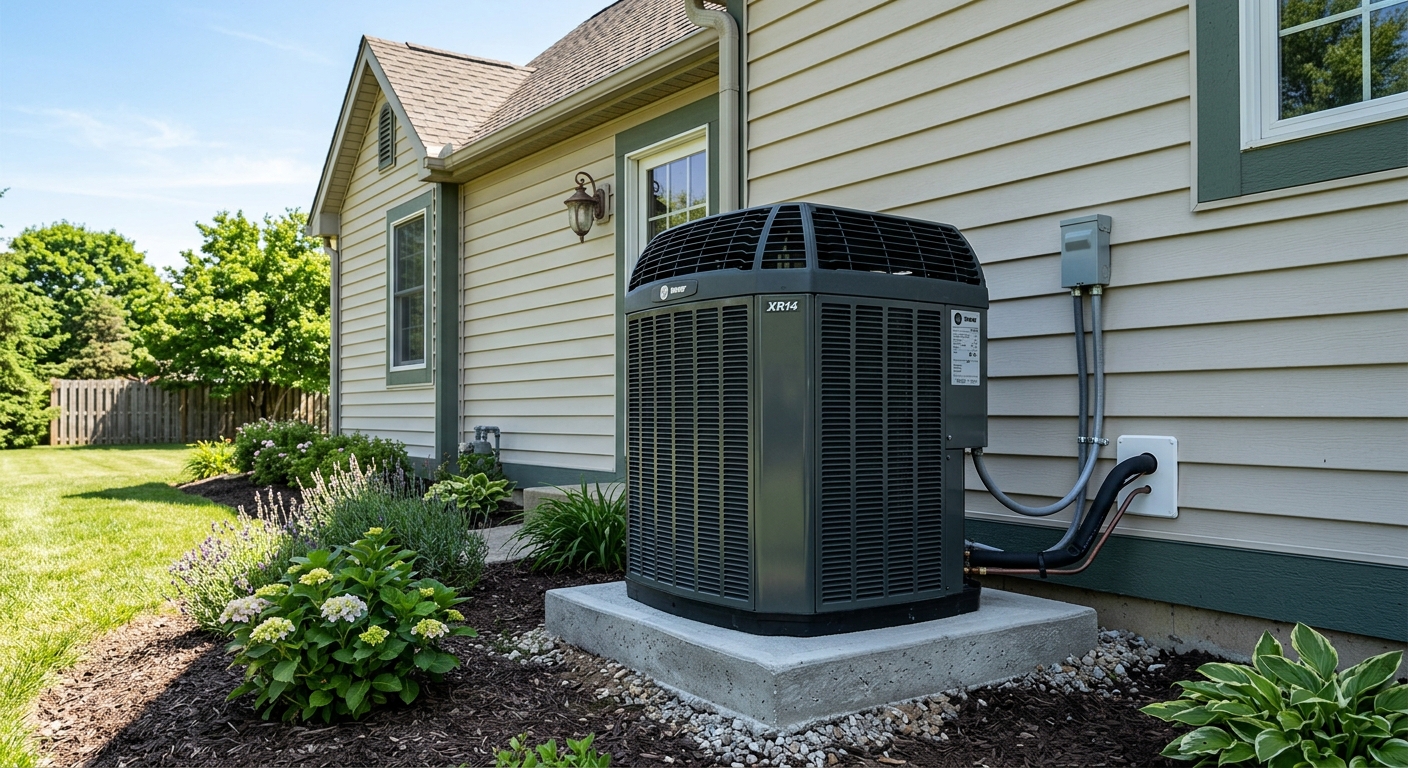
What a new HVAC system costs in Hempfield
In Hempfield, where 83.0% of households own their homes and 67.0% of homes were built before 1980 (U.S. Census Bureau, ACS 2024), most HVAC work falls into the retrofit or replacement category, not new installs in open-wall construction. The area is dominated by mid-20th-century and postwar housing where ductwork and upgraded electrical panels are frequently added or modified after the home was originally built. That means many systems require some adaptation—either to existing, sometimes undersized ductwork, or to older electrical configurations.
Southwestern Pennsylvania is a heating-dominated climate: 5,600 heating degree days dwarf just 1,050 cooling degree days. Winters are long, and eco-friendly upgrades, such as heat pumps, must be sized to cover cold spells, not just mild shoulder seasons. While air conditioning is common, it's not as heavily used as the furnace. The choice of equipment here must account for reliable winter heating, challenging local topography, and older home construction.
| System |
Best for |
Efficiency |
Price range (installed) |
| Central AC replacement (existing ducts) |
homes with sound ductwork |
16–20 SEER2 |
$5,000–$12,000 |
| Air source heat pump (ducted) |
year-round heating and cooling |
8–10 HSPF2 |
$7,900–$17,000 |
| Cold-climate heat pump (ducted) |
heat pump as primary heat |
9–11 HSPF2 |
$13,000–$17,000 |
| Ductless mini-split (single zone) |
additions, rooms without ducts |
20–30 SEER2 |
$3,200–$6,900 |
| Full duct system installation |
homes with no existing ducts |
— |
$8,900–$18,000 |
Installed estimates for a typical Hempfield home. Equipment tonnage, duct condition and electrical capacity move these more than brand.
The comfort problem that isn't temperature
Around Hempfield, it isn’t just about hot and cold—it's about humidity control, especially with 5,600 heating degree days and cold winters followed by humid summers. In winter, forced-air heating often makes indoor air noticeably dry, particularly in older homes. Many homeowners ask about whole-house humidifiers, and while they do raise comfort, they require regular cleaning and maintenance to avoid mold and mineral buildup—more neglected systems cause trouble than dry air ever does.
Summer comfort can be equally challenging: on muggy August days, the main job of central air is dehumidification. But if your AC is oversized “for safety” (a common old-school practice), it cycles off before pulling enough moisture from the air, leaving your home clammy. Right-sizing avoids this. High-efficiency filters (higher MERV) can help with dust and pollen, but restrict airflow if your blower isn’t sized to handle it—always balance filtration with system capacity.
Mechanical ventilation is rarely critical in Hempfield's typical mid-century houses, since they're not tightly sealed like today's new construction. If you’re in an upgraded or retrofitted home, a heat recovery ventilator may be recommended, but many add-ons—UV lights, air purifiers, specialized humidity controls—are oversold. If you don’t have a specific allergy or moisture problem, stick to quality filtration, proper sizing, and routine filter changes for the best value.
Comparing HVAC estimates in Hempfield
Sorting through HVAC quotes in Hempfield demands more than comparing price tags. Every quote should name exact model numbers for both the indoor and outdoor units—matching ensures rated efficiency, while mismatching means you'll sacrifice performance and warranty support. Your quote should also state the calculated HVAC load (not just “same size as old”), with paperwork attached to show how the size was determined based on your home's actual needs.
Ductwork situation is critical here: most homes have older, sometimes retrofit ducts, so your quote must assess duct condition and spell out any included sealing or repair work. Electrical upgrades matter more than in new construction—if your panel is old or maxed out, a new system may require a panel upgrade, and that should appear up front.
Smaller details—such as line-set replacement (the copper tubing carrying refrigerant), new vs. reused thermostat, condensate drainage, and a startup/commissioning report—should be listed, along with the labor warranty (years, not just manufacturer coverage). Don’t accept “permit not needed”—municipalities here expect a mechanical permit for most HVAC replacements. Matching apples to apples only works if all these points are spelled out.
| Line item |
What to look for |
Red flag if… |
| Equipment |
model numbers, indoor and outdoor matched |
brand name only |
| Sizing |
load calculation attached |
matched to the old nameplate |
| Ductwork |
condition assessed, sealing scoped |
not mentioned |
| Electrical |
circuit and panel capacity confirmed |
assumed adequate |
| Line set |
replaced or documented as reused |
silent |
| Commissioning |
measured airflow and charge, documented |
no startup report |
| Warranty |
labour years stated separately |
manufacturer only |
| Permit |
included and priced |
'not needed' |
The refrigerant change and what it means for repairs
If your Hempfield HVAC system was installed within the last decade, it probably uses R-410A refrigerant. As of 2026, new residential systems are switching to lower-GWP refrigerants like R-454B and R-32, following the national phase-down of high-GWP refrigerants. This shift is about new system manufacturing—nothing in current regulations makes your existing R-410A system illegal or unserviceable.
You can still repair and recharge R-410A units, but pay attention to future economics: as supplies of R-410A tighten, refrigerant costs are rising. That means small leaks or repairs are getting pricier, enough to tip the balance from “fix it” to “replace it” sooner than before, especially if your unit is aging or inefficient. The repair decision comes down to part cost, refrigerant price, and the age of your current equipment.
If your system isn’t leaking and is cooling or heating fine, you don’t need to change anything. But if you’re facing a major R-410A repair, remember that all new replacements must use newer refrigerants, and repairs on existing R-410A systems may cost more with each passing year. Do not let anyone push you into replacing a healthy system just because of the refrigerant change—but do weigh replacement more seriously if you’re facing a major R-410A leak.
Mechanical permits for HVAC work in Hempfield
Pennsylvania does not have a statewide license for HVAC contractors working in private homes, but it does require Home Improvement Contractor registration from the Attorney General’s Office for projects over $500. Any contractor you consider for a Hempfield project should have this registration, and you can verify their status online. Local mechanical permits and inspections are handled by township offices in Westmoreland County, not by the state. Each township—including Hempfield—requires a mechanical permit for HVAC replacement or installation, with local officials checking the work.
If your project involves refrigerant (as in all central AC, heat pump, and mini-split installs), the installer must have EPA Section 608 certification. This federal credential is required all across the country, not just in Pennsylvania, and there’s no workaround. For ductwork or mechanical-only jobs, local township rules apply, so you want your contractor to be familiar with code enforcement in Westmoreland.
Insurance matters: contractors in Pennsylvania must carry workers' compensation, and you can check their coverage status using the WCAIS system. Make sure coverage is in place before any workers set foot on your property. Any contract over $500 must be in writing, with clear terms and a 3-business-day right to cancel under state law. Never hire on a handshake for a major HVAC job.
Gas, electric or both in southwestern Pennsylvania
With a winter design temperature of 8°F and 5,600 heating degree days, Westmoreland County is classic “furnace country.” For decades, the default answer was a gas furnace and central AC, especially since natural gas is widely available across most of Hempfield and surrounding townships. But technology and climate priorities are changing—modern cold-climate heat pumps keep running even into single digits, though output and efficiency do drop as temperatures fall.
Here's where local details matter: if your home has good insulation and weather sealing, a ducted cold-climate heat pump can handle nearly all the winter, switching to electric resistance (or a gas furnace in a dual-fuel setup) only on the very coldest nights. Dual-fuel systems combine the steady warmth of a gas furnace below 20°F with the efficiency of a heat pump in milder weather, automatically alternating as needed. In rural corners of the county, if gas isn’t available, the real trade-off is between heat pump systems and expensive propane or oil—where all-electric can be appealing.
Gas furnaces are still the simplest and most cost-effective solution if you already have working gas lines, especially in homes with older ductwork that may struggle to deliver large heat pump air volumes. They require less electrical upgrade work and deliver reliable warmth at the lowest operating cost where gas is cheap.
| Option |
Installed cost |
Operating cost here |
Best when |
Incentive eligible |
| Gas furnace + central AC |
$5,000–$12,000 |
low on existing gas |
existing gas service, coldest zones |
rarely |
| Ducted heat pump (cold climate) |
$7,900–$17,000 |
low to moderate |
good envelope, all-electric goal |
often |
| Dual fuel (heat pump + gas backup) |
$13,000–$17,000 |
lowest for deep cold spells |
gas on site, deep cold spells |
sometimes |
| Ductless multi-zone |
$8,900–$18,000 |
zone-dependent |
no ductwork, zone control |
often |
Running the numbers on Hempfield's climate
Figuring out true operating costs in Hempfield starts with the climate: we get 5,600 heating degree days and 1,050 cooling degree days each year, which means most energy dollars go to heating. West Penn Power serves this area, so you'll find your electricity rate—typically in cents per kWh—right on your bill. Gas rates for Peoples Natural Gas appear in cost per therm or CCF.
To estimate heating costs, take your system's efficiency rating—AFUE for gas furnaces, HSPF2 for heat pumps—and calculate how many BTUs or kWh it takes to meet your annual heating load (which is what heating degree days represent). For example, a home needing 50 million BTUs per year, with a 95% AFUE furnace, would use about 526 therms. Multiply by your gas rate for the season. For a heat pump with 9.5 HSPF2, you'd divide total required BTUs by the seasonal efficiency (in BTUs per kWh) to get kWh used, then apply your electric rate.
But be honest: rates can change, and the "real" cost depends on how well your home holds heat and whether your ducts are sealed. Leaky or poorly insulated homes, common in Hempfield's older housing stock, may see actual bills much higher than calculated. Even a super-efficient system can underperform if saddled with bad ductwork—don’t skip duct repairs if you're spending for a high-end system.
For the cooling season, the process is similar—use SEER2 to convert days of need (the lower 1,050 number) into electricity used. Keep your own bills handy and substitute your rate and last year's usage to get nearest to real numbers.
Frequently asked questions — HVAC installation in Hempfield
Which utility serves Hempfield?
In Hempfield and throughout much of Westmoreland County, West Penn Power is the primary electric utility, while Peoples Natural Gas delivers gas service to most township households. Both are well-established in this market and work with local HVAC contractors for service and, occasionally, rebate documentation. Your contractor should be familiar with the application processes specific to these utilities. If you're planning an electric-to-gas conversion in an area that lacks piped gas, propane or oil alternatives can add to your project cost. For homes that need total electric heat—often heat pumps—the installed price generally falls between $7,900–$17,000 depending on scope. For the most accurate answer, check a recent bill or visit the utility’s website for Hempfield-specific updates.
Why are my Hempfield energy bills high with a new system?
Even with a new HVAC system, many Hempfield homes—especially the 67.0% built before 1980—lose a surprising amount of heat through older ductwork, insufficient insulation, or unsealed areas. An efficient central AC or heat pump won’t save much if the conditioned air leaks out before it gets to your rooms. Another culprit is system oversizing, a common issue during retrofits in older houses: not only does that drive up initial costs (sometimes $13,000–$17,000 for a premium heat pump), it can short-cycle and waste energy. Before replacing or blaming the equipment, have your ductwork and attic insulation checked. A modest fix there often cuts utility bills far more than “upgrading” from one efficient system to another. Your installer should verify insulation and airflow as part of any major replacement in Hempfield.
How much does a new HVAC system cost in Hempfield?
For most homes in Hempfield, a straightforward central air replacement with good existing ductwork runs $5,000–$12,000 installed. If you’re putting in a full ducted heat pump system as a furnace replacement, expect $7,900–$17,000, with top-of-the-line cold climate models at the higher end. Homes that never had ductwork (common in smaller postwar houses or older upgrades) push costs higher—complete new ducts add another $8,900–$18,000 to the project. Always ask for a written quote that factors in your home’s duct condition, electrical service, and the equipment model numbers. Most Hempfield homeowners are looking at the midpoint of each price range in practice.
How long does HVAC installation take in Hempfield?
For a routine replacement—such as swapping out a furnace or AC that matches duct locations and doesn't need new electrical runs—most Hempfield jobs are wrapped up in one to two days. Additions like retrofitting a full duct system for a home that never had one, or including panel upgrades, can stretch to three to five days, especially in older houses where surprises lurk behind finished walls. A basic ductless mini-split install (single zone) sometimes takes less than a full workday but still lands in the $3,200–$6,900 range. Delays most often come from county permit timing, electrical coordination, or unexpected ductwork repairs. Ask your contractor for a day-by-day plan up front; the best ones will schedule around both weather and utility interruption windows.
What size HVAC system does my Hempfield home need?
The right size depends on much more than square footage–especially in Hempfield, where so many homes were built before 1980 with a mix of attic insulation and varying window quality. Instead of simply copying the old system’s tonnage, your installer should perform a new load calculation, factoring in insulation, window type, airtightness, and number of occupants. Oversizing is as problematic as undersizing: an oversized AC in a 1,600-square-foot Hempfield ranch might cost $12,000 and still fail to control humidity. Undersizing, on the other hand, leaves you cold in January. Insist on a calculation based on your actual home—not a rule-of-thumb or the old nameplate. Each reputable estimate should include this step as standard, not as an add-on.
Do I need a permit to replace HVAC in Hempfield?
Yes. In Hempfield and the rest of Westmoreland County, HVAC replacement or major installation always requires a township mechanical permit. Local code enforcement, not the state, oversees this process—so exact permit and inspection steps can vary a bit by township office. Your contractor should include mechanical permit fees and documentation in the quote. Be skeptical of any company telling you a furnace swap or full system replacement (which could cost anywhere from $5,000–$17,000 depending on scope) can be done without a permit—it’s false and leaves you exposed at resale or if there's a later insurance claim. Always request a copy of the final inspection signoff for your records.
Does my utility offer a heat pump rebate in Hempfield?
West Penn Power has occasionally offered heat pump rebates, especially for high-efficiency or cold climate models, but program details change year to year. Even if there’s no direct rebate this month, heat pump systems in the $7,900–$17,000 installed range may also qualify for federal tax credits or other incentive programs that your contractor should monitor. Peoples Natural Gas does not commonly rebate electric heat pump installations, but may have efficiency bonuses for gas-to-gas furnace upgrades. Rebate amounts and eligibility depend on the installed equipment's efficiency and whether it replaces oil, propane, or old resistance heat. Always ask the installer to check the most current utility and federal offers at the time of your quote.
Is a high-efficiency system worth the extra cost here?
In much of Hempfield, upgrading to a higher-efficiency heat pump or furnace (rather than just the cheapest allowed by code) does offer savings over time—especially with 5,600 heating degree days each winter and energy prices always in flux. A premium cold-climate heat pump might cost $13,000–$17,000 installed, but can save several hundred dollars a year over a lower efficiency model in both heating and cooling. Still, don’t pay for high efficiency if your ductwork is undersized or leaks: the benefit vanishes if heat never reaches your living spaces. Factor in duct repairs first, and pick the highest efficiency model that fits your home’s real needs—not just the sticker rating. Your return on investment will always depend on how long you own the house and your comfort preferences.
Should I replace the furnace and AC at the same time?
If both your furnace and AC are approaching the end of their reliable lifespan, replacing as a matched system makes sense in Hempfield—especially since most homes use forced-air systems where major components interact. Modern matched pairs deliver efficiencies not possible when mixing old and new units, can often be installed together for less labor cost, and reduce the risk of unwanted surprises later. For a typical replacement, a combined job falls in the $7,900–$17,000 range, depending on the type and efficiency chosen. If one unit is only a few years old, it may be cost-effective to wait, but ensure the old equipment won’t “bottleneck” the new (especially with refrigerant transitions underway). A reputable contractor will compare costs and give a clear breakdown for both the pair and each unit separately.