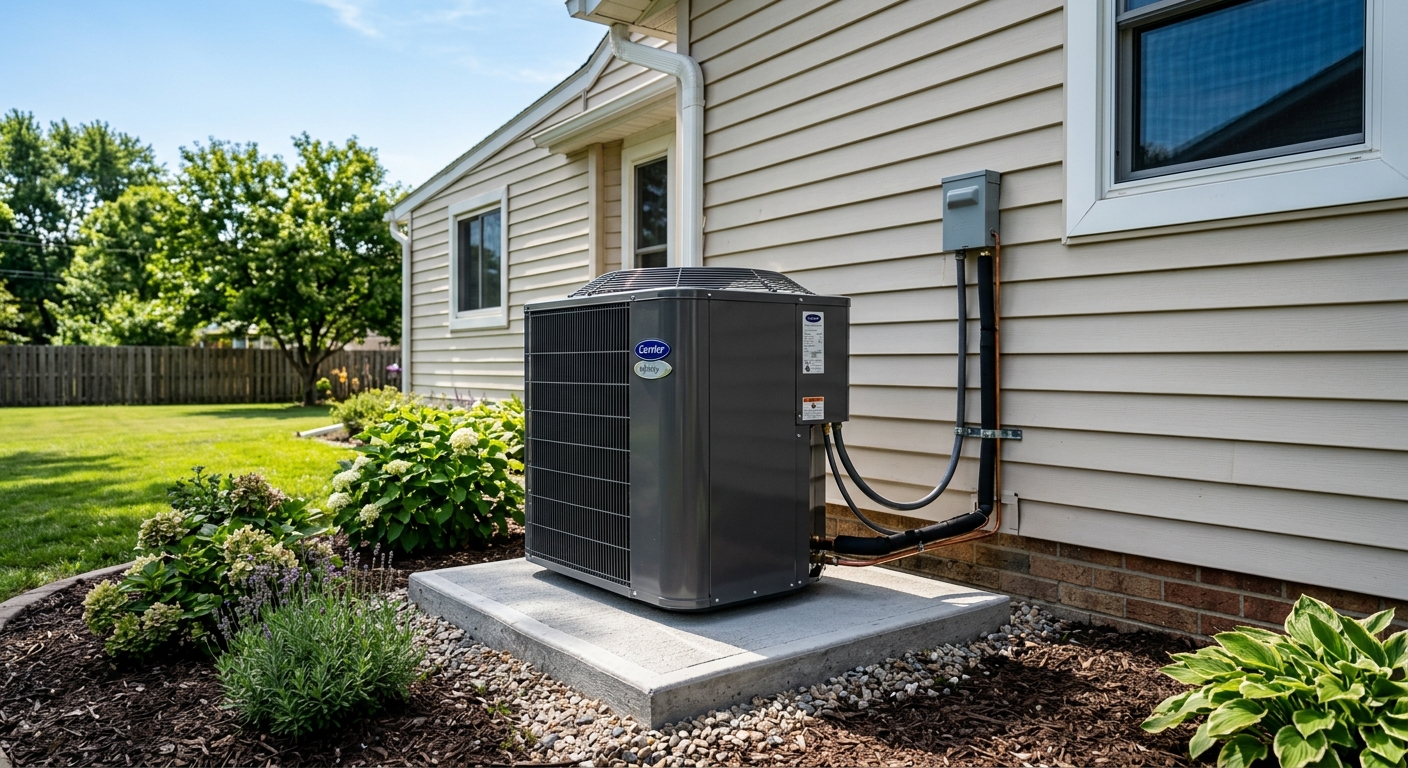
Upper Chichester heating and cooling prices by system type — 2026
Upper Chichester’s HVAC costs are shaped by two defining facts: 70.3% of households own their homes, and more than 60% of housing was built before 1980 (U.S. Census Bureau, ACS 2024). This means homeowner investment is the norm here, but much of the housing stock was built before central air was common and often before ducts were sized for cooling loads. In many cases, adding or replacing central air is actually a retrofit—especially in rowhouses and twins, as seen in nearby Upper Darby and Haverford, where ductless options or high-velocity systems may be the only practical approach for cooling.
Southeastern Pennsylvania’s climate is heating-dominated, with about 4,800 annual heating degree days and just 1,450 for cooling. New installs should prioritize efficient, reliable heating—cooling is important in summer’s humidity, but you’ll feel your HVAC decision most from November through March.
Most Upper Chichester homes that already have forced air heating can use existing ductwork for central AC or a ducted heat pump, which keeps costs lower. Where there are no ducts or old gravity systems, expect retrofit costs to be higher, especially for mini-split or full-duct installs. Below are 2026 installed price estimates you can expect when considering system replacement or conversion:
| System |
Best for |
Efficiency |
Price range (installed) |
| Central AC replacement (existing ducts) |
homes with sound ductwork |
16–20 SEER2 |
$5,100–$12,000 |
| Air source heat pump (ducted) |
year-round heating and cooling |
8–10 HSPF2 |
$8,100–$17,500 |
| Cold-climate heat pump (ducted) |
heat pump as primary heat |
9–11 HSPF2 |
$13,000–$17,500 |
| Ductless mini-split (single zone) |
additions, rooms without ducts |
20–30 SEER2 |
$3,300–$7,100 |
| Full duct system installation |
homes with no existing ducts |
— |
$9,100–$18,500 |
Installed estimates for a typical Upper Chichester home. Equipment tonnage, duct condition and electrical capacity move these more than brand.
Mechanical permits for HVAC work in Upper Chichester
Pennsylvania does not have a statewide mechanical license for residential HVAC contractors. Instead, regulation happens at the local municipal level. In Upper Chichester and the rest of Delaware County, HVAC jobs fall under the Pennsylvania Uniform Construction Code (UCC), modeled on the International Residential Code (IRC). Municipalities enforce code and handle mechanical permitting for most residential installations—meaning you or your contractor must apply to the local office for permits anytime you’re replacing or newly installing central HVAC equipment.
Anyone who works with refrigerant (installers, techs, and anyone handling line sets or charging a system) must hold an EPA Section 608 certification. This is a federal requirement and applies in every part of Pennsylvania, regardless of which municipality issues permits. The contractor firm (not just the tech) must also have a Home Improvement Contractor (HIC) registration from the Pennsylvania Office of Attorney General for any job over $500. You can verify registration status any time at hic.attorneygeneral.gov.
Workers’ compensation insurance is mandatory for all employers in Pennsylvania’s private and self-insured market. You have the right to request proof and verify coverage for any contractor through the state’s WCAIS system (wcais.pa.gov). For projects over $500, a written contract is also required by the state’s Home Improvement Consumer Protection Act. You get three business days to cancel, no questions asked. If your home was built before 1978 and any demolition or surface disturbance is expected, be sure your contractor is trained and certified under the federal EPA Lead RRP Rule.
What construction era means for your system
With over 60% of Upper Chichester homes built before 1980, what you find behind the walls drives everything about your HVAC options and cost. In much of Delaware County—including Upper Chichester, Upper Darby, and Haverford—rowhouses and twins built before World War II or soon after were either never fitted with ductwork, or the ducts are undersized for modern air conditioning and poorly insulated by today’s standards.
If your home is pre-1980, stock ductwork may only serve a gravity or low-pressure heating system—sized for heat, not cooling airflow. In these homes, installing central AC or a heat pump using the original ducts can result in noisy, inefficient operation and uneven cooling. Where there is no ductwork at all, installation costs jump: full-duct installs or ductless mini-splits become the only practical approaches. Many older homes also have older windows, minimal insulation, and potentially limited electrical panel capacity—electrical upgrades may be required for an all-electric system like a heat pump.
For homes built after 1980, you’re more likely to find properly sized, insulated ductwork and enough electrical service for a heat pump installation without panel work. These homes were usually built with forced air in mind, so replacements are more straightforward and cost-effective. Across both eras, inspect your chimney or flue if switching from gas to electric, and don’t assume “existing ducts” means “good ducts”—condition, insulation, and pressure matter.
SEER2, HSPF2 and AFUE decoded
SEER2 is the updated cooling efficiency rating for air conditioners and heat pumps, measuring how much cooling the system delivers per unit of electricity over a typical season. HSPF2 is the new heating efficiency standard for heat pumps, doing the same for heating output. AFUE, used for furnaces, is the annual fuel utilization efficiency—a percentage showing how much fuel becomes usable heat.
Ratings recently shifted to SEER2 and HSPF2 from older SEER and HSPF scales, so pay attention when comparing figures in older articles or ads—SEER2 and HSPF2 numbers are always a bit lower (stricter test conditions).
In Delaware County—with 4,800 heating degree days versus 1,450 for cooling—efficiency matters most for heating, not cooling. That means: spend to get at least mid-tier HSPF2 (around 9–10) on a heat pump since your system will run hard all winter. For air conditioning, a jump from 16 to 18 SEER2 can save some electricity, but paying top-dollar for ultra-high SEER2 (above 20) rarely pays back over system life in this county. For furnaces, 95%+ AFUE is sensible; pushing to ultra-premium rarely pencils out unless you have fuel cost spikes.
Don’t get caught up in the efficiency chase past the point of diminishing returns. Spend where it saves—heating efficiency is where the payback happens in our local climate.
Gas, electric or both in southeastern Pennsylvania
The main choice for Upper Chichester homeowners is between traditional gas furnaces and heat pumps, or some combination—what’s called “dual fuel.” Southeastern Pennsylvania is a true heating climate: 4,800 heating degree days and a winter design temperature of 14°F mean most homes need serious heat from November through March.
Modern cold-climate heat pumps hold up well in most of a Pennsylvania winter, delivering comfortable heat to well below freezing. In fact, old beliefs that “heat pumps don’t work in cold climates” are mostly outdated. Still, as outdoor temperatures approach the design low of 14°F, heat pump output drops—precisely why dual fuel (heat pump with gas backup) remains popular: you get efficient electric heating for most of the season, then gas or oil kicks in only on the coldest nights.
Natural gas is widely available in Delaware County’s core townships, including Upper Chichester, Upper Darby, and Chester. If your home already has gas, a replacement furnace plus central AC is usually the simplest and least expensive path, especially if your ducts are in solid shape. For outer areas relying on oil or propane, a ducted or ductless heat pump is often more economical than new oil or propane equipment. The only time a furnace is still the obvious call? If your ducts are set up for forced air, gas service is already present, and you simply need a reliable heat upgrade.
| Option |
Installed cost |
Operating cost here |
Best when |
Incentive eligible |
| Gas furnace + central AC |
$5,100–$12,000 |
Lower if you have existing gas |
existing gas service, coldest zones |
select rebates |
| Ducted heat pump (cold climate) |
$8,100–$17,500 |
Similar or lower if envelope is efficient |
good envelope, all-electric goal |
federal tax credit |
| Dual fuel (heat pump + gas backup) |
$13,000–$17,500 |
Only uses gas in extreme cold |
gas on site, deep cold spells |
federal tax credit |
| Ductless multi-zone |
$9,100–$18,500 |
Higher than ducted if whole-house |
no ductwork, zone control |
federal tax credit |
Refrigerant rules and your existing system
As of 2026, all new residential HVAC systems in the U.S. are shipping with lower-global-warming-potential refrigerants, like R-454B and R-32, as part of a broader phase-down of higher-impact HFCs. Nearly all systems from the last decade use R-410A. If you already have an R-410A system in Upper Chichester, it is absolutely legal to keep running and servicing it for years to come.
What does change is economics. While you can keep charging and repairing R-410A systems, the price of the refrigerant will keep rising as supply drops. This doesn’t mean you must replace a working unit, but if you have a major leak or mechanical issue late in the unit’s life, the repair-versus-replace math tips sooner in favor of new equipment. For most, this only becomes a concern once parts or refrigerant costs approach 30–40% of new system cost.
Bottom line: If your system is cooling or heating fine, there’s no need to change it just because of a refrigerant transition. If it develops a refrigerant leak or compressive failure, be aware that the financial case for replacement becomes stronger as R-410A prices rise and the system ages.
What each system actually costs to run in Upper Chichester
Estimating operating costs in Upper Chichester starts with your actual use—not abstract “averages.” Here’s how you’d figure heating or cooling costs for your home:
- Start with local climate: Upper Chichester sees about 4,800 heating degree days and 1,450 cooling degree days per year. That’s your rough annual heating and cooling load relative to a 65°F baseline.
- System efficiency: For cooling, SEER2 tells you how many BTUs you get per watt-hour; for heating, HSPF2 does the same. Gas furnaces use AFUE (percentage of fuel that becomes heat).
- Energy rates: For electricity, check your PECO Energy Company bill (your electric utility here) for your $/kWh. For gas, look for $/CCF or $/therm.
To get yearly cost, multiply your estimated annual BTU use (from degree days and home size) by your system’s efficiency, then by your local rate. For example, if you use 40 million BTUs of heat (a bit below average for a 1,900 sq. ft. home), and have a 9 HSPF2 heat pump, you can estimate power used and multiply by your $/kWh from PECO. With a gas furnace, do the same using the AFUE and your gas rate.
There are wildcards: insulation, air leaks, window age, and—especially—duct condition. Leaky or poorly insulated ducts can waste 10–30% of your heated or cooled air. A mid-tier system with tight, insulated ductwork will often run cheaper than top-tier equipment crippled by bad ducts.
Bottom line: There’s no one answer—run the math using your own utility bill and, if you’re replacing a system, make sure home upgrades (like duct sealing) are considered along with efficiency ratings.
Frequently asked questions — HVAC installation in Upper Chichester
What is EPA Section 608 certification?
EPA Section 608 certification is a federal credential required for any technician who installs, services, or works with refrigerants in air conditioners or heat pumps. In Pennsylvania—including Upper Chichester—state and local authorities may regulate permits and general trade registration, but only someone holding this EPA credential can legally handle or purchase refrigerant. It’s not optional; if anyone will be opening lines, charging new equipment, or recovering refrigerant from an old system, ask to see their Section 608 card. This matters for homeowner liability as well. If a contractor can’t show proof, it’s a red flag, and you shouldn’t hire them. Most reputable companies bidding central air or heat pump replacements (which fall between $5,100–$17,500 installed) will note their EPA compliance up front.
How is a tax credit different from a rebate?
In Upper Chichester, you’ll see both tax credits and rebates offered for high-efficiency HVAC upgrades. A tax credit reduces what you owe when you file your federal taxes—think of it as a discount off your tax bill, not cash at the point of sale. You must buy and install an eligible system first, keep the paperwork, then claim the credit on your tax return the following year. A rebate, by contrast, is typically handled by utilities or manufacturers and comes as a check or bill credit after installation—sometimes almost immediately, or within a couple of months. For example, a ducted cold-climate heat pump priced at $13,000–$17,500 may qualify for both a federal tax credit and a local utility rebate, which can be stacked, but you need to apply for both separately. Don’t count on getting full incentives unless you follow each program’s process—keep records.
How much does ductwork add to an HVAC installation?
In most Upper Chichester homes built before 1980, retrofitting or replacing ductwork is often as expensive as the new HVAC equipment itself—sometimes more. If your home has old or leaky ducts not suitable for modern cooling or heating, a full duct system install can cost between $9,100–$18,500. This does not include the new heat pump or AC, which is usually a separate line item. For homeowners with good existing ducts, replacing the HVAC unit alone (not the ducts) can save thousands—the typical central AC replacement lands at $8,100. Ductless mini-splits, which eliminate the need for ductwork, can keep up-front costs lower in many older houses with no central duct system.
Can I service my R-410A system after the refrigerant change?
Yes, you can absolutely continue to have your R-410A air conditioner or heat pump serviced in Upper Chichester after the refrigerant transition. There is no requirement to upgrade a working system just because new models use R-454B or R-32. Parts and service remain legal and available, but expect R-410A refrigerant prices to rise as supply contracts over time. If your system develops a major leak late in its life, the repair-versus-replacement cost equation will shift, especially since a new ductless mini-split starts at $3,300 installed. But otherwise, routine servicing on your R-410A system will remain business as usual for years ahead.
Which utility serves Upper Chichester?
PECO Energy Company is the primary electric and natural gas utility serving homes in Upper Chichester. When planning installation of a new heat pump, air conditioner, or furnace—whether ducted or ductless—PECO handles your electric and (for most homes) gas supply. This matters when you’re checking your rates for operating cost calculations or applying for any available utility rebates. The typical central AC replacement in our area lands between $5,100–$12,000. Always have your most recent PECO bill on hand when comparing efficiency upgrades.
Why does my system short cycle?
Short cycling is when your HVAC system starts and stops in rapid bursts rather than running for longer, steady periods. In Upper Chichester’s older housing stock, it’s often caused by oversized equipment—common in homes built before tight load calculations became standard. Poor ductwork design and airflow restrictions can also cause the system to shut off early. This leads to uneven temperature, higher operating costs, more wear and tear, and a shorter system lifespan. Addressing it might mean adjusting the controls, repairing ducts, or, in some cases, right-sizing with a new system. Newer, correctly sized equipment—like a well-matched heat pump in the $8,100–$17,500 range—will usually eliminate the issue if installed with proper airflow in mind.
When is the best time of year to replace HVAC in Upper Chichester?
The shoulder seasons—spring and fall—are generally the best times for HVAC replacement in Upper Chichester. Demand for new installations drops after the big winter and summer rush, so contractors may offer faster scheduling and sometimes seasonal discounts. This is your window to replace an aging central AC (typically $8,100) or upgrade to a heat pump before peak load or a mid-season breakdown. In emergency replacement season (July or January), you’ll routinely face longer waits and less negotiating room. Plan ahead if you can, especially for full duct system overhauls or when switching fuels.
Do I need dual fuel in southeastern Pennsylvania?
Dual fuel (a heat pump paired with gas backup) makes sense for many homes in southeastern Pennsylvania—including Upper Chichester—because winter lows regularly reach 14°F or below. At these temperatures, even newer cold-climate heat pumps lose some capacity, and gas or oil backup can kick in just for the coldest snaps. If you already have natural gas and want efficient heating most of the year but peace of mind during deep cold spells, dual fuel is the low-risk, high-flexibility answer. It does cost more upfront—dual fuel setups land in the $13,000–$17,500 installed range—but lets you take full advantage of electricity most of the season while keeping gas costs contained.
Is a high-efficiency system worth the extra cost here?
In Upper Chichester’s climate, investing in a higher-efficiency heating system makes the most payback sense. With 4,800 heating degree days each year, a jump from a basic system to a mid-tier cold-climate heat pump (in the $13,000–$17,500 band) can save hundreds annually compared to older electric or oil heat. For cooling, going above 16–18 SEER2 isn’t usually worth the price premium—our cooling season is real but short, and the savings from a top-tier SEER2 system don’t add up fast enough to outweigh the higher purchase cost. Spend on good heating HSPF2 or high AFUE for a furnace, and only target high SEER2 if you have heavy AC use or unique indoor comfort needs.