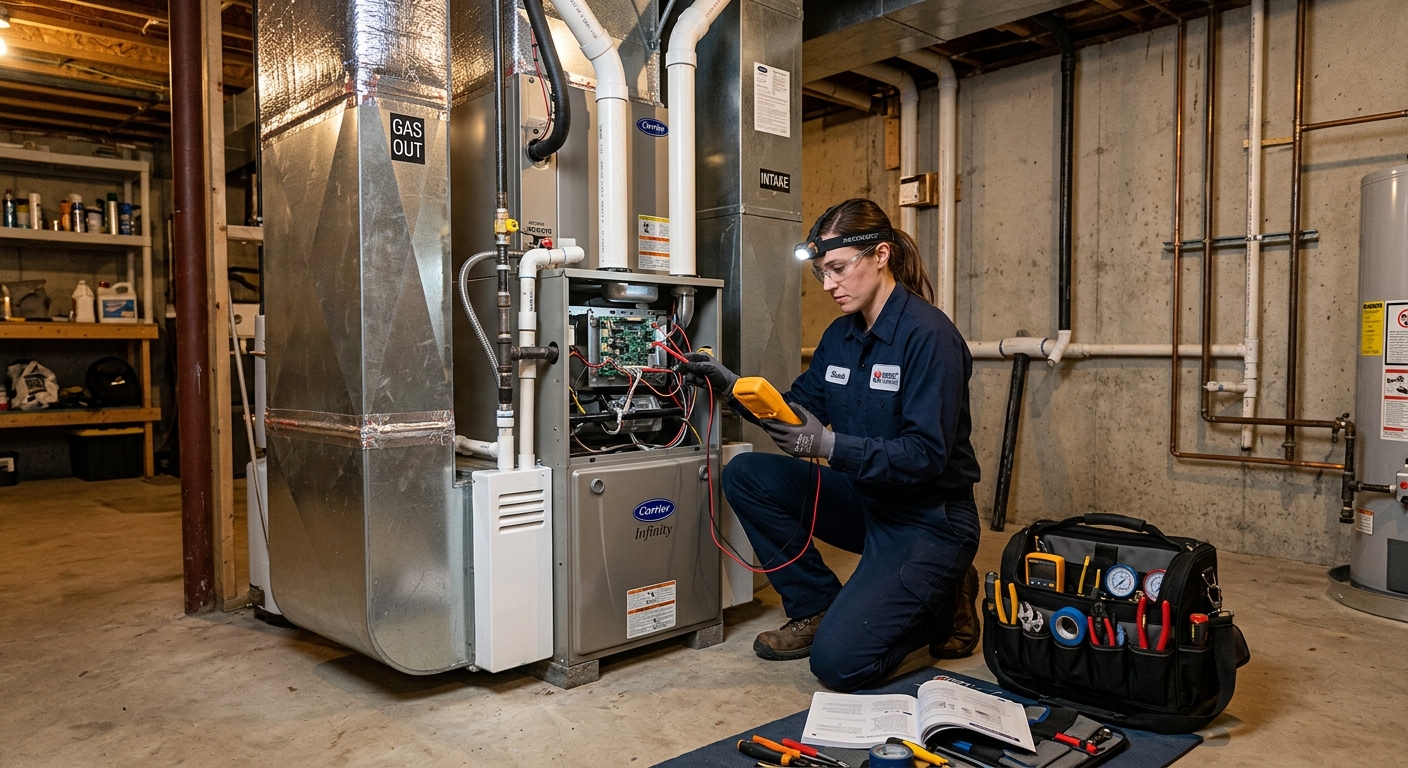
What a new HVAC system costs in Hollidaysburg
In Hollidaysburg, most HVAC installations involve either updating aging systems or retrofitting homes that predate central air. With a homeownership rate of 68.2% and over three-quarters of local houses built before 1980 (U.S. Census Bureau, ACS 2024), you will likely face either the need to replace worn-out equipment or to install complete systems where none existed. Blair County’s 1900–1940 wood-frame stock often means you’re dealing with older duct runs, tight lots, or even no ducts at all—retrofit is the rule, not the exception.
This is a heating-dominated market. We sit at 6,300 heating degree days and just 750 cooling degree days—meaning that heating performance and efficiency outrank cooling concerns. If you are choosing between systems, know that your investment for cold weather reliability pays off here more than squeezing a couple extra SEER points from your AC. Homes with gas service often choose furnace/AC pairs, but heat pumps have gained ground thanks to strong performance in year-round comfort and energy savings.
| System |
Best for |
Efficiency |
Price range (installed) |
| Central AC replacement (existing ducts) |
homes with sound ductwork |
16–20 SEER2 |
$4,700–$11,500 |
| Air source heat pump (ducted) |
year-round heating and cooling |
8–10 HSPF2 |
$7,600–$16,000 |
| Cold-climate heat pump (ducted) |
heat pump as primary heat |
9–11 HSPF2 |
$12,500–$16,000 |
| Ductless mini-split (single zone) |
additions, rooms without ducts |
20–30 SEER2 |
$3,000–$6,600 |
| Full duct system installation |
homes with no existing ducts |
— |
$8,500–$17,000 |
Installed estimates for a typical Hollidaysburg home. Equipment tonnage, duct condition and electrical capacity move these more than brand.
Zone control without ductwork
Many Hollidaysburg homes—especially from the 1900–1940 era—predate central air and lack modern ductwork, making ductless mini-splits a practical solution. Ductless systems win outright where running new ducts would mean tearing into plaster, patching ceilings, or giving up headroom in basements and converted attics. That covers more of our local housing than most people realize. Even newer homes with add-ons or finished rooms the main system doesn’t reach can benefit.
Single-zone mini-splits serve individual rooms efficiently, with SEER2 ratings that far exceed even the best central units. Their up-front price—$3,000–$6,600 per zone—is less than installing full ductwork ($8,500–$17,000). Multi-zone systems, running multiple indoor heads off one outdoor unit, promise tidier exteriors. In practice, however, one outdoor compressor must satisfy every zone’s demand, which can mean rooms running warmer or cooler than intended during deep winter or summer. For comfort, separate single-zone units still win.
Head placement is part art, part science—you want airflow reaching where you live, not just the nearest doorway, but also have to accept a wall or high-mounted indoor unit as part of the room. Some people dislike the “hotel unit” look. Every mini-split needs a way to drain condensate, which isn’t always simple in a finished basement.
With Hollidaysburg’s housing stock, if you’re facing a choice between multi-zone ductless and full duct installation, factor in not just price but future flexibility and the possibility of adding more zones later.
When an HVAC repair stops being worth it
Not every HVAC problem in Hollidaysburg means it’s time for a new system. First, judge age versus expected service life—modern systems in our climate generally last 12–18 years with decent care. If your equipment is under 10 years old and the failure is an isolated component—like a capacitor, contactor, or control board—repair makes sense, especially if the cost is modest compared to replacement.
Cost is the next test. If a repair approaches a third or more of full replacement—especially on units over 10 years old—replacement deserves a hard look. Replacing the compressor or a cracked furnace heat exchanger tips the scale, as both are core failures and often exceed half the install price. Also, many older systems use R-22 refrigerant, which is no longer manufactured. A major repair on an R-22 unit almost never pencils out.
Efficiency gains from replacement can help in our heating-dominated market, but mile-high efficiency doesn’t always pay back unless you’re replacing equipment near or below minimum code. If bills suddenly spike, before buying new, pay to have the ductwork and house envelope tested—hidden leaks and duct issues are common in Blair County’s older homes.
| Situation |
Recommendation |
Typical cost |
Reasoning |
| Under 10 years, single component failure |
Repair |
$300–$1,200 |
Good equipment life left, cost fraction of new |
| 10–15 years, repair over a third of replacement |
Consider replacing |
$4,700–$11,500 |
Sunk cost approaches new system value |
| 15+ years, any major failure |
Replace |
$4,700–$11,500 |
Past typical service life |
| Cracked heat exchanger, any age |
Replace immediately |
$4,700–$11,500 |
Safety hazard—no safe repair |
| Compressor failure past warranty |
Replace |
$7,600–$16,000 |
Core part failed, expensive repair on old system |
| Working system, high bills |
Test ducts and envelope first |
$300–$800 |
Leaks and insulation often blame in older homes |
Ductwork: the part nobody quotes properly
If you live in one of Hollidaysburg’s many older homes, chances are your ducts weren’t designed with modern HVAC in mind—or weren’t sealed at all. Duct leakage in these houses often ranges high enough to waste 20% or more of your heated or cooled air, a loss much greater than any difference between middle and high-end equipment. Before swapping your system, test what you have.
A duct blaster test pressurizes your ductwork to measure unseen air leaks, revealing exactly how much you’re leaking into attics, crawlspaces, or wall cavities. High leakage can sometimes be addressed with mastic or aerosol sealing, but in wood-frame homes and especially tighter lots in Blair County, ducts might not be sized for AC or heat pumps at all—just the old, roaring furnace.
Undersized return ducts are a chronic problem here, choking airflow, stressing new blower motors, and leaving rooms too hot or cold. This rarely gets caught unless specifically tested, and simply plugging in new equipment sometimes makes things worse.
Many ducts in Hollidaysburg run through unconditioned zones—think uninsulated attics or crawlspaces—where extreme temperatures magnify any leak or missing insulation. If your ductwork is uninsulated, poorly sealed, or you have uneven temperatures room to room, test before you replace. Getting the distribution right can save you more than jumping to the latest compressor technology.
How to vet an HVAC contractor in Hollidaysburg
Whichever brand you consider, correct installation trumps equipment on comfort, bills, and system life. In Blair County’s dense contractor market, you need someone with real credentials, not just a logo on their truck. Pennsylvania requires Home Improvement Contractor registration for any job over $500—verify at hic.attorneygeneral.gov. Who actually installs the equipment matters too: the technician handling refrigerant must hold federal EPA Section 608 certification.
Ask whether your quote includes a proper load calculation—this is key in older Hollidaysburg homes with additions, attic conversions, or changed insulation levels. The best quotes specify exact model numbers, not just “3-ton heat pump.” For a real-quality install, expect commissioning: measured airflow at the registers, refrigerant charge checked and documented at startup, and a demonstration that the system actually hits design temperatures.
- Check HIC registration at hic.attorneygeneral.gov
- Confirm EPA Section 608 certification for refrigerant work
- Request proof of active liability insurance and workers’ compensation (wcais.pa.gov)
- Ask for a written contract as required for jobs over $500
- Insist on a room-by-room load calculation
- Get detailed specs—brand, model, and efficiency ratings
- See installed references within Blair County if possible
- Ask about permitting and inspection—local municipality or code office
- See who will be on site—employees or subcontractors
- Demand startup commissioning with documented readings
- Make sure you receive the warranty paperwork
- Get any rebates or incentives in writing
Red flags: A “deal” contingent on cash only, no written contract, or pressure to waive your right of cancellation under state rules—all are bad signs. With plenty of contractors locally, you can afford to insist on all the above.
Service plans: worth it or not?
Annual service plans for your HVAC system sound attractive, but most of their value boils down to disciplined basics. For Hollidaysburg’s heating-biased climate, priority one is regular filter changes with the right MERV rating—anything too dense chokes older blowers common locally. Next is periodic coil cleaning to keep airflow up, and clearing the condensate drain so clogs don’t flood your basement or utility room.
What matters: a plan that inspects and proves system operation, not just “checking refrigerant levels.” Needing to add refrigerant isn’t maintenance—it means you have a leak, and topping up repeatedly ignores the real issue. A legitimate service plan offers real seasonal tune-ups and discounts on unscheduled repair visits.
Skip any plan that is just a list of “visual checks,” automatic filter shipments, or that restricts service to odd hours. The best plans cover what’s expensive to fix and catch small issues before they cascade into big failures.
Schedule maintenance for spring and late summer—long before or after the cooling and heating rushes—when contractors aren’t triaging emergency calls around town. A solid plan can help, but you won’t dodge basic maintenance by paying for one.
Mechanical permits for HVAC work in Hollidaysburg
Pennsylvania does not issue a statewide HVAC trade license for residential work. Instead, you’re looking for a contractor with Home Improvement Contractor (HIC) registration, required for contracts over $500. This isn’t a trade license, but a way to check the business’s standing and consumer record—verify registration at hic.attorneygeneral.gov.
Mechanical permits and inspections for installs and major replacements are handled by the municipality, not the state. In Hollidaysburg, expect to apply through the borough or city’s own code enforcement office—not a Harrisburg or statewide office. Permitting ensures adherence to the Pennsylvania Uniform Construction Code, which mandates safe installation and compliance with the building’s needs.
Anyone working with refrigerant (including all AC and heat pump jobs) must have current EPA Section 608 certification. Insurance is just as critical—Pennsylvania requires employers to carry workers’ compensation, and you can check active policies at wcais.pa.gov. For jobs over $500, state law demands a written contract and spells out your three-business-day right to cancel. Always ask for proof of paperwork before the first truck arrives.
Frequently asked questions — HVAC installation in Hollidaysburg
How much does a furnace replacement cost in Hollidaysburg?
In Hollidaysburg, the typical price to replace a gas furnace falls within the same range as a central air system, given the overlap in installation and permitting. Expect to pay between $4,700–$11,500 for a standard forced-air furnace paired with an existing set of ducts. Most local homes with natural gas can use this tier, but older or rural homes on propane or oil may see extra costs for venting or fuel conversion. The largest variable is the condition and layout of your ductwork. In Blair County's 1900–1940 housing stock, patching or upgrading old returns or supply trunks often adds both labor and material costs. Ask your contractor if your existing ducts are properly sealed and sized—they can swing cost and comfort more than brand of furnace.
When is the best time of year to replace HVAC in Hollidaysburg?
The best window for replacing your HVAC system in Hollidaysburg is typically late spring or early fall, after the heating season ends but before air conditioning becomes essential. In central Pennsylvania, both you and the contractor avoid peak demand. Most urgent calls crowd into our coldest stretches, with 6,300 heating degree days, or into sudden heatwaves later. Scheduling during shoulder months often means quicker appointments, more thorough attention, and less risk of rushed work. Replacing a system ahead of high season can also leave room to address ductwork issues or electrical upgrades before you’re desperate for heat or AC. Since total prices can range from $4,700–$16,000 in Hollidaysburg depending on system and scope, you’ll also get a more accurate, unrushed quote and less chance of paying a premium for immediate installs.
Can a heat pump heat my house without backup?
In Hollidaysburg, a modern cold-climate heat pump can serve as the sole heat source for most homes—if it’s correctly sized and installed for our winter design temperature of 2 °F. The latest ducted heat pumps deliver real output even below freezing, and smaller, well-sealed homes from the local stock can get by on the high end of heat pump performance. However, in many Blair County homes (especially larger or poorly insulated older ones), a backup source—like electric strips or a gas furnace—remains recommended for the coldest nights. The up-front cost of a cold-climate, variable-speed heat pump typically falls between $12,500–$16,000 installed. If your backup rarely runs, you’ll save on fuel and maintenance, but don’t eliminate it unless you’re certain the new system is tailored to your specific house and envelope.
What is the R-410A refrigerant phase-down?
R-410A is the standard refrigerant in most heat pumps and ACs installed in Hollidaysburg during the past two decades. Federal policy is phasing it down to limit greenhouse gas emissions. While R-410A isn’t banned overnight, “phase-down” means manufacturers and distributors are gradually reducing its production and importing new, lower-global-warming refrigerants. For homeowners replacing a system, this matters because in a few years, older R-410A units will become more expensive to service and recharge. If you’re investing $7,600–$16,000 in a heat pump today, ask whether your chosen unit uses a next-generation refrigerant, and whether replacement parts or recharging support will remain available through its lifespan.
Who inspects HVAC work in Hollidaysburg?
All permitted residential HVAC work in Hollidaysburg is inspected by the municipality’s code enforcement office, not by a state agency. The mechanical permit falls under the Pennsylvania Uniform Construction Code, and the inspector ensures both code compliance and that the system matches the home’s needs. If you live in the borough, the office handling your inspection is local, not statewide. For work involving refrigerants, the federal EPA Section 608 certification is also mandatory for anyone doing the installation or charging. Your final inspection is often what “closes the job” before you pay the final bill—costs for inspection and permitting are typically included in the install price, which runs $4,700–$16,000 depending on system type.
Is a high-efficiency system worth the extra cost here?
In Hollidaysburg’s heating-centric climate, high-efficiency furnaces and heat pumps can provide payback, especially if your home is well sealed and insulated. With 6,300 heating degree days, efficiency gains are more pronounced during long winters than in areas with mild seasons. However, for many older homes in Blair County, more savings come from fixing duct leaks and insulation before paying for a top-tier system. Upgrading from a basic to a high-efficiency unit adds anywhere from $1,500–$3,000 to the total, but won’t offset losses if your distribution system is subpar. Ask your contractor to test and quote on duct upgrades, not just shiny new equipment.
How often should I change my filter?
For Hollidaysburg homeowners, most standard HVAC filters should be changed every 60–90 days, though older systems common in our area (built before 1980) may need more frequent changes due to leakier ducts and higher dust loads. If you have pets or are renovating one of our typical wood-frame houses, check monthly and replace as soon as you see visible buildup. Using a filter with too high a MERV rating can choke airflow, so always follow your system’s manual or ask your contractor. Since most repairs from dust and airflow cost $300–$1,200, regular filter checks are cheap insurance—don’t wait for the next annual service to check it.
Does my utility offer a heat pump rebate in Hollidaysburg?
Penelec, the primary electric utility for Hollidaysburg and Blair County, has periodically offered rebates for high-efficiency heat pumps, though openings and amounts change from year to year. When available, these rebates can reduce the installed cost of a system, which otherwise falls between $7,600–$16,000 for most homes. To claim a rebate, you’ll need proof of qualifying equipment, typically a cold-climate model, and installation by a properly registered contractor. Always confirm rebate terms before signing—but don’t count on rebates to shave off the full cost or to continue indefinitely. Contractors familiar with Blair County’s utilities usually handle rebate paperwork as part of the closing packet.
How cold does it get in Hollidaysburg and does that affect heat pumps?
Hollidaysburg’s winter design temperature is 2 °F, with long heating seasons and 6,300 heating degree days, making it among the colder parts of Pennsylvania. Standard heat pumps work less efficiently as outside temperatures drop, and older models sometimes struggled with local extremes. But cold-climate models now deliver reliable output even near zero degrees, provided the ductwork and insulation aren’t working against them. Most single-zone or ducted heat pump installations here, running $7,600–$16,000, will include electric backup strips or retain a secondary heating source for deep freezes. Be sure your load calculation uses real local conditions, not just “rule of thumb,” so performance holds up through a Hollidaysburg January.