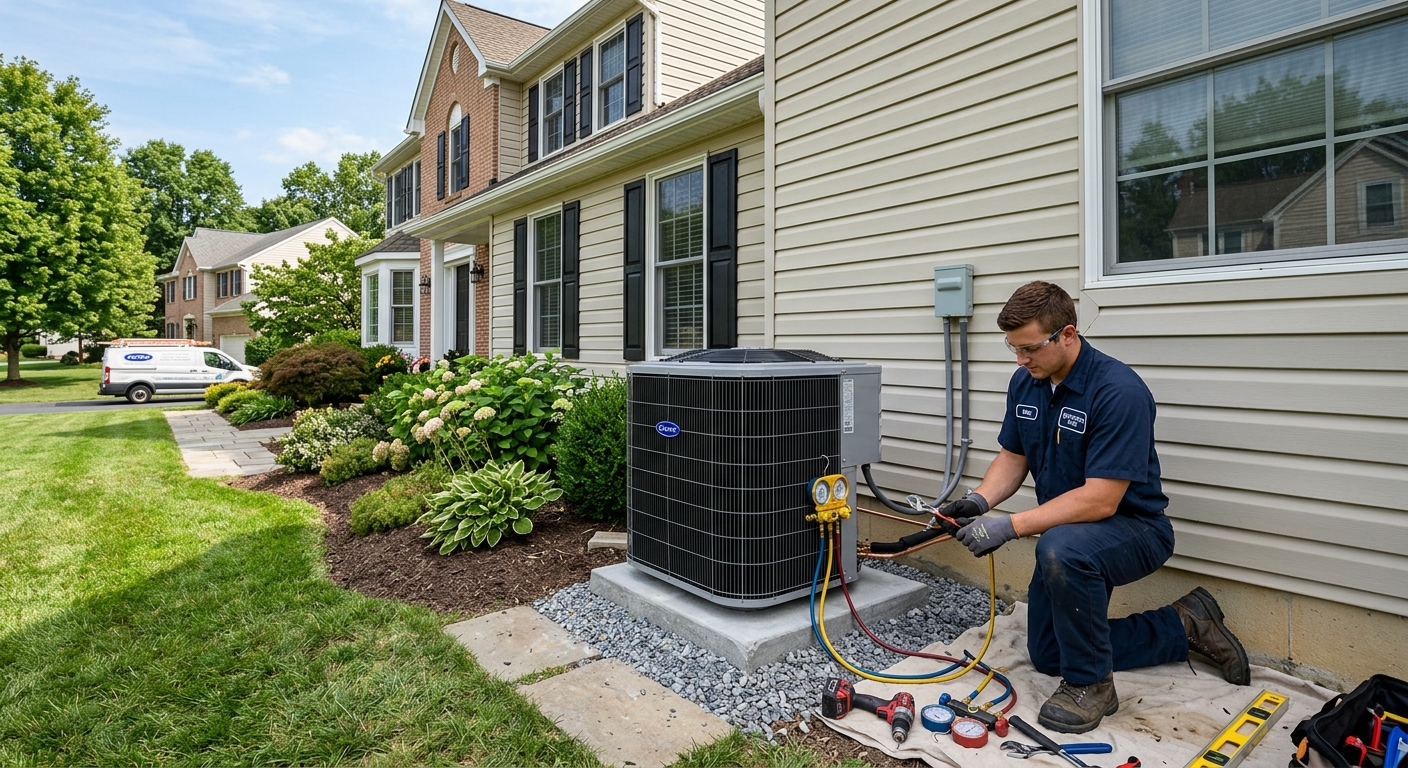
Center heating and cooling prices by system type — 2026
Center sits at the heart of Butler County, where the homeownership rate surpasses 80%, and well over half of all homes were built before 1980 (U.S. Census Bureau, ACS 2024). This marks Center as a market dominated by replacement and retrofit projects, not first installations. Ductwork is widespread, but its age varies — especially in subdivisions built during Cranberry Township’s 1990–2010 housing boom, where forced-air HVAC was standard. Many of those systems are now due for replacement, and most houses have at least some ductwork in place.
Our region is solidly heating-dominated. With 5,600 heating degree days but just 1,050 cooling degree days, Center homeowners run their furnaces months longer than the AC. The winter design temperature here is only 8 °F, so heating performance, not peak cooling, should anchor your decision. This makes the system choice — especially if you’re considering a heat pump — very different than in southern or coastal climates. Here, you’re paying primarily for comfort in deep winter.
| System |
Best for |
Efficiency |
Price range (installed) |
| Central AC replacement (existing ducts) |
homes with sound ductwork |
16–20 SEER2 |
$5,100–$12,500 |
| Air source heat pump (ducted) |
year-round heating and cooling |
8–10 HSPF2 |
$8,200–$17,500 |
| Cold-climate heat pump (ducted) |
heat pump as primary heat |
9–11 HSPF2 |
$13,500–$17,500 |
| Ductless mini-split (single zone) |
additions, rooms without ducts |
20–30 SEER2 |
$3,300–$7,200 |
| Full duct system installation |
homes with no existing ducts |
— |
$9,200–$18,500 |
Installed estimates for a typical Center home. Equipment tonnage, duct condition and electrical capacity move these more than brand.
SEER2, HSPF2 and AFUE decoded
HVAC equipment efficiency is defined by SEER2 for cooling, HSPF2 for heat pumps in heating mode, and AFUE for furnaces. SEER2 (Seasonal Energy Efficiency Ratio 2) measures cooling efficiency over a range of test conditions, while HSPF2 (Heating Seasonal Performance Factor 2) rates a heat pump’s efficiency in heating mode. AFUE (Annual Fuel Utilization Efficiency) applies to gas or oil furnaces, representing the percentage of fuel converted to usable heat over a season.
For Center and the wider Butler County area, payback on each efficiency upgrade isn’t equal. With 5,600 heating degree days but only 1,050 cooling degree days, most energy bills go to staying warm, not cool. That means AFUE and HSPF2 ratings matter more here — it rarely pays to chase the highest SEER2 models for air conditioners. Stick to the 16–18 SEER2 range; above that, the upfront cost climbs faster than the long-term savings for our number of cooling days. For heat pumps, higher HSPF2 (9 or above) cuts winter bills and does pay back, especially in all-electric homes.
Note: Efficiency standards have changed — SEER and HSPF on older models and articles aren’t directly comparable to SEER2 and HSPF2. SEER2 and HSPF2 use more stringent testing, so don’t compare new equipment ratings directly with systems installed 5–10 years ago.
Gas, electric or both in southwestern Pennsylvania
Most Center homes rely on heating systems sized for true Pennsylvania winters, with a design temperature of 8 °F and 5,600 heating degree days annually. For decades, that’s meant a gas furnace for those with a gas line, or oil/propane for rural parts of the county. But the landscape is changing: today’s cold-climate heat pumps hold usable capacity well into the teens, and the cliché that “heat pumps don’t work here” is out of date. Still, the cold eats into their output, which is why the winter temperature target is so important — no heat pump maintains full capacity at single digits, and a backup or dual-fuel system is smart in this region.
Gas is widely available in Cranberry, Butler, and Adams, but some townships (like Slippery Rock) rely on propane or oil, which generally costs more to operate than either a gas furnace or a heat pump. So the core decision in Center: if you have gas on site, a furnace is still hard to beat for outright cold- weather performance, though pairing it with a heat pump cuts bills during the milder spring and fall. If you’re in an all-electric or propane/oil area, a quality heat pump suddenly looks a lot more attractive. The only time a gas furnace is clearly the right answer is in older, drafty houses with gas on site or if you routinely see power outages — a gas furnace can still operate with a simple generator, while a heat pump often needs more amps than a portable can supply.
| Option |
Installed cost |
Operating cost here |
Best when |
Incentive eligible |
| Gas furnace + central AC |
$5,100–$12,500 |
low with gas service |
existing gas service, coldest zones |
select rebates |
| Ducted heat pump (cold climate) |
$8,200–$17,500 |
lower in mild winter; higher in deep cold |
good envelope, all-electric goal |
yes |
| Dual fuel (heat pump + gas backup) |
$13,500–$17,500 |
lowest combined |
gas on site, deep cold spells |
yes |
| Ductless multi-zone |
$9,200–$18,500 |
varies by use |
no ductwork, zone control |
select rebates |
What size system does a Center home need?
Proper sizing is the most important — and most often botched — step of any HVAC project in Center. Oversized systems short-cycle, meaning they turn on and off too frequently. This leads to poor humidity control, uneven temperatures, noisy operation, and cuts years off equipment life. Worse, oversizing is not a hedge or safety margin; it’s an outright flaw that you pay for in every season.
Every responsible installer should perform a Manual J load calculation, which is a scientific estimate of your home’s actual heating and cooling loads based on insulation, window area, orientation, and local weather. Square footage rules of thumb are not valid — one 2,000-square-foot Center home might need a 2-ton system, while another needs a 4-ton, depending on its leaks and exposure. At minimum, your contractor should present the load calculation results: “Did you run a load calculation, and can I see it?” If they’re only matching the prior system’s nameplate, they’re just repeating the last guy’s error, and sometimes those units were never right in the first place.
The winter design temperature in Center is 8 °F, so load calculations aim to keep your home comfortable even in a severe cold snap. This protects against under-sizing, but don’t let anyone pitch bigger-is-better logic — a properly sized, modern system will deliver comfort through our winters and humid summers alike.
Humidity and air quality in Center homes
Center’s cold winters and muggy summers create two distinct indoor air quality challenges. In the heating season, the issue is dryness: running a furnace through a long winter in a tightly sealed house can drop your indoor relative humidity far below healthy levels. This can be addressed with a whole-house humidifier, but know that these units require regular cleaning to avoid mold and mineral buildup — an ignored humidifier does more harm than good.
Conversely, during humid Pennsylvania summers, AC systems that are oversized don’t run long enough to pull enough moisture from the air, leading to clammy, uncomfortable indoor conditions. Proper AC sizing is critical for dehumidification.
When it comes to filtration, a MERV 8 to 11 filter is usually a good balance for most Center duct systems. Higher-rated filters (MERV 13+) trap more fine particles, but if your system’s blower isn’t designed for that extra resistance, you can cut airflow and harm efficiency. Newer, tightly sealed homes often need mechanical ventilation (like an ERV or HRV) to manage both fresh air and moisture, but don’t let anyone upsell you on UV lights, plasma air cleaners, or expensive “whole-house air purifiers” unless you have a specific health concern — real-world benefits for the average Center homeowner are modest compared to simply running the system and filter as designed.
R-410A phase-down: repair or replace?
You may have heard that R-410A is being phased down as the refrigerant in new residential systems. That’s true: under current environmental rules, newly manufactured units in Center and the rest of Butler County are moving to refrigerants like R-454B and R-32, which have lower global warming potential. But this doesn’t mean your existing R-410A system is illegal or unserviceable — you can still get it repaired, recharged, or maintained by any competent HVAC technician.
The key thing for Center homeowners is economics, not legality. R-410A will remain available for years, but as new production drops, its cost is starting to rise. If your 410A system develops a major refrigerant leak, especially in an older unit, the increased cost to recharge may tip the financial equation toward replacement with newer technology. For routine service and minor repairs, there’s no immediate pressure. Just know that, as older systems approach the end of their lifespan and refrigerant becomes more costly, replacement may make more long-run sense if you’re quoted a high price for adding or recovering R-410A.
Mechanical permits for HVAC work in Center
Pennsylvania does not issue a statewide HVAC trade license for residential work — instead, all residential mechanical permitting and code enforcement is handled at the municipal level. In Center and the surrounding Butler County area, towns are responsible for enforcing the Pennsylvania Uniform Construction Code (UCC), which is based on the IRC. Some, like Cranberry Township, require mechanical permits and inspections for the replacement or installation of any new HVAC system, while others operate differently. It’s local, so always check with your township first.
For any contractor doing HVAC work involving refrigerant (ACs, heat pumps), EPA Section 608 certification is mandatory — that’s a federal rule that applies everywhere. While there’s no state HVAC license, every contractor should hold a Home Improvement Contractor (HIC) registration from the Pennsylvania Office of Attorney General for jobs over $500 — you can verify at the state’s official HIC portal. For your protection, confirm the contractor’s workers’ compensation insurance through the WCAIS verification site if they employ others. Written contracts (required over $500 by state statute) and the three-day right of cancellation are enforceable statewide. When in doubt, documentation protects you best in Center and across Butler County.
Frequently asked questions — HVAC installation in Center
How long does HVAC installation take in Center?
The length of an HVAC installation in Center depends on the type and complexity of the job. A straightforward furnace or central AC replacement (with existing ductwork in good condition) is typically completed in a single working day, sometimes two if unexpected issues come up. Installing a heat pump or a dual fuel system may take longer if electrical upgrades or line set replacements are needed. Full duct system installations usually require several days, especially in older homes where access and routing present challenges. For example, a new duct system in a Center home could run $9,200–$18,500 and require thoughtful planning. In every case, ask your contractor for a written schedule—Center's older homes sometimes reveal surprises once walls open up. Weather delays are rare with indoor work, but inspection schedules vary depending on your township's permitting process.
What is EPA Section 608 certification?
EPA Section 608 certification is a federal requirement for anyone in Center (or anywhere in the United States) who handles refrigerants commonly used in air conditioners and heat pumps. This certification ensures that technicians are trained in the proper methods of refrigerant recovery, recycling, and safe disposal, to protect both the environment and homeowner safety. It doesn’t matter whether your contractor advertises as licensed—if they're installing or repairing ACs or heat pumps using refrigerants like R-410A, they must have Section 608 certification. If you're getting a new heat pump installed (expect $8,200–$17,500 in Center), ask to see credentials; most reputable local outfits will have technicians who can show you a Section 608 card. This is a federal credential—local or state licensing is a separate issue and doesn't substitute for Section 608 where refrigerants are involved.
Should I close vents in unused rooms?
For Center homes with forced-air systems, closing vents in unused rooms is usually not a good idea—it doesn’t save much and can create new problems. Your system was sized and balanced to operate with all vents open; blocking supply registers can increase air pressure inside ducts, potentially leading to duct leaks, reduced airflow, and even equipment damage over time. This is especially risky in older homes, common in Center, with aging or poorly sealed ductwork. If you need to zone areas separately, consider retrofitting with a multi-zone ductless system (starting at $3,300–$7,200 per zone) or talk to a contractor about proper zoning controls. For most families, leaving vents open and using the programmable thermostat achieves better, more efficient results.
Are duct sealing and insulation eligible for incentives?
In Center and wider Butler County, duct sealing and insulation work often qualifies for rebates or energy efficiency incentives, especially if completed as part of a utility-sponsored program or a full system replacement. Sealing and insulating ducts in older homes—where leaks and uninsulated runs are common—can boost efficiency considerably. For example, a full duct system replacement/upgrade in this market is $9,200–$18,500, but basic sealing alone is far less. Check directly with your utility (such as West Penn Power) for current offers. Beware any contractor who promises a rebate up front without confirming your eligibility; always get incentive details in writing, and don’t accept anyone offering to “waive” your insurance deductible, which is prohibited by state consumer protection law.
How much does a furnace replacement cost in Center?
Furnace replacement in Center typically falls in the $5,100–$12,500 range when paired with a new central AC, which is how most replacements are done. Standalone furnace swaps (if you don’t need new cooling equipment) may be on the lower end, depending on duct condition and model efficiency. Older homes—over half the Center housing stock—may need minor duct repairs or additional venting, which can affect time and budget. Always get a written, itemized quote that matches the actual load size of your home, not just a swap of the old furnace’s BTU rating. Don’t be swayed by ultra-high efficiency ratings unless your existing system is below 80% AFUE or you have very high gas bills; the payback on the very highest efficiency models is small in most Center homes.
Should I replace the furnace and AC at the same time?
In many Center homes, replacing both furnace and AC together makes sense, especially if both are over 15 years old or showing signs of wear. Matching systems ensures the blower and controls are properly sized for each other, delivering best efficiency and trouble-free performance. Many local HVAC pros also offer package discounts for doing both. Expect typical combined replacement costs between $5,100–$12,500. However, if your furnace is newer and your AC is failing, or vice versa, there is no code saying you must replace both. Just confirm that the new unit will work properly with the old one—mixing technologies or mismatched blower capacities can cause problems. Don't let a contractor insist on "mandatory" replacement of both unless they've explained why.
Is a high-efficiency system worth the extra cost here?
In Center's heating-heavy climate, a premium on heating efficiency—AFUE for furnaces or HSPF2 for heat pumps—is usually worth it up to a point. With 5,600 heating degree days annually, marginal gains in AFUE or HSPF2 can add up, especially if energy prices go up. But for cooling, where our region sees only 1,050 cooling degree days, top-end SEER2 air conditioners rarely pay back the price difference. For most Center homes, a furnace at 92–96% AFUE or a heat pump at 9–10 HSPF2 is the best value. Don’t let anyone pressure you into a super-premium (and costly) model unless your energy bills are especially high or your home is super insulated. For example, a cold-climate heat pump system installed here is $13,500–$17,500, but the payoff for ultra efficiency above standard “high” models can be slow.
Is natural gas available throughout Butler County?
No—while natural gas is widely available in Center, Cranberry, Butler, and Adams, outlying townships like Slippery Rock often rely instead on propane or fuel oil. This makes a difference if you’re choosing between a heat pump and furnace: in rural parts of Butler County, where there is no gas line, heat pumps can be a much more attractive long-term choice versus expensive oil or propane heating. If you’re connected to Columbia Gas of Pennsylvania, the typical furnace and AC replacement will run $5,100–$12,500, with low ongoing fuel costs. Always confirm utility access before deciding on equipment.
What is SEER2 and how is it different from SEER?
SEER2 is the updated version of the Seasonal Energy Efficiency Ratio, measuring and rating how efficiently air conditioners and heat pumps cool your home. The change from SEER to SEER2 involves tougher laboratory testing that better reflects real-world conditions, using higher static pressure to simulate duct losses typically found in actual Center homes. As a result, SEER2 numbers are slightly lower than equivalent SEER ratings from older equipment—so a 16 SEER unit from 2015 is not as efficient as a 16 SEER2 system today. For our region, where AC use is relatively moderate, most Center homeowners will find good value in 16–18 SEER2 units (costing $5,100–$12,500), but don’t pay for ultra-high SEER2 systems unless you have large cooling loads or unusually high electricity rates.