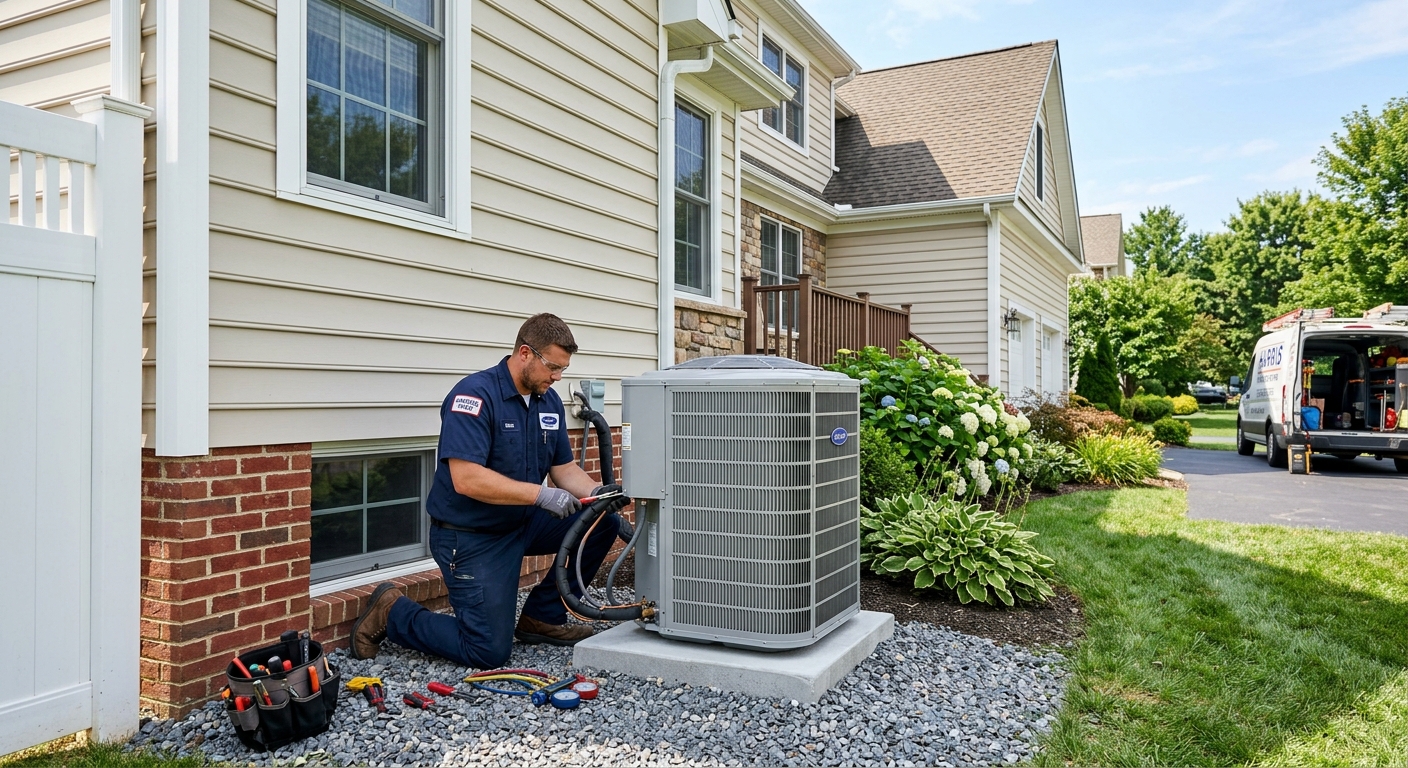
Manchester heating and cooling prices by system type — 2026
Manchester’s HVAC market is defined by its high homeownership rate and a solid block of homes built before 1980. With 88.3% of homes owner-occupied and 37.2% built before 1980 (U.S. Census Bureau, ACS 2024), most homeowners here are making replacement or retrofit decisions instead of first-time installations. Older housing often has aging or absent ductwork, which is why retrofits—especially ductless mini-splits and high-velocity systems—are popular in neighboring York City’s pre-war rowhomes. These trends spill over into Manchester, meaning not every home is ready for a simple swap of central AC or furnace.
The region is heating-dominated. With 5,200 heating degree days versus 1,250 cooling degree days, Manchester households spend a larger share on keeping warm than staying cool. For most, this puts furnace replacements and all-electric air source heat pumps at the center of any serious upgrade. Strong winters also influence system sizing and efficiency priorities.
| System |
Best for |
Efficiency |
Price range (installed) |
| Central AC replacement (existing ducts) |
homes with sound ductwork |
16–20 SEER2 |
$5,400–$13,000 |
| Air source heat pump (ducted) |
year-round heating and cooling |
8–10 HSPF2 |
$8,600–$18,500 |
| Cold-climate heat pump (ducted) |
heat pump as primary heat |
9–11 HSPF2 |
$14,000–$18,500 |
| Ductless mini-split (single zone) |
additions, rooms without ducts |
20–30 SEER2 |
$3,400–$7,500 |
| Full duct system installation |
homes with no existing ducts |
— |
$9,700–$19,500 |
Installed estimates for a typical Manchester home. Equipment tonnage, duct condition and electrical capacity move these more than brand.
Permits, licensing and inspections in Manchester
Pennsylvania does not issue a statewide HVAC trade license for residential work. Instead, every contractor working on jobs over $500 must have Home Improvement Contractor (HIC) registration from the Pennsylvania Office of Attorney General. This is strictly for consumer protection and does not test technical skill. In practical terms, for Manchester homeowners, that means you should always ask your installer for their HIC registration number and verify it at hic.attorneygeneral.gov.
Installation and replacement of central HVAC systems in York County require municipal mechanical permits, but how this is handled depends on where you live. Manchester Township and the other local townships run their own code offices, while neighboring York City’s Bureau of Permits, Planning and Zoning covers the city. Inspection is tied to the mechanical permit, and the Pennsylvania Uniform Construction Code (UCC), based on the IRC, is the minimum standard.
EPA Section 608 certification is federally required for anyone who installs, services, or disposes of systems containing refrigerant. You can (and should) ask to see your contractor’s card. For insurance, Pennsylvania requires employers to carry workers’ compensation coverage, which can be confirmed in the WCAIS database (wcais.pa.gov). The main takeaway: permitting, code enforcement, and mechanical inspection are always local here, and homeowner due diligence matters more than in states with a state license for HVAC.
Refrigerant rules and your existing system
Recent changes at the federal level have phased down the use of high global-warming-potential HFC refrigerants in newly manufactured residential systems. If you’re buying new equipment in Manchester, you’ll find most units now use lower-GWP refrigerants like R-454B or R-32. These are safe in the hands of a trained installer and meet the latest codes.
If your home’s AC or heat pump currently uses R-410A, you do not need to replace it just because of the new rules. It remains legal to service, and repairs will still be possible through the foreseeable future. However, as new production of R-410A winds down, the wholesale price is likely to creep upward over time. That means if your system develops a leak or requires a large recharge, the cost of refrigerant will be noticeably higher, which can tilt the repair-or-replace question toward replacement if the system is already nearing end of life.
Bottom line: your existing R-410A equipment is not obsolete, and there is no legal reason to replace it before failure. But after a high refrigerant bill, it’s worth weighing the economics of further repair against the benefits and efficiency of a compliant replacement. New equipment will come factory-charged with a lower-impact refrigerant in line with current regulations.
Sizing: why bigger is worse
Getting the size of your new HVAC system right is more important than the brand, features, or any add-on option. Too many systems in Manchester are oversized because someone used a loose rule-of-thumb or copied the old unit’s rating. The problem is that bigger is not safer—it’s worse. An oversized system short cycles, which means it turns on and off rapidly. That leads to uncomfortable temperature swings, poor humidity control (especially in summer), higher bills, and a system that wears itself out years before its time.
The professional way to size a system is with a Manual J load calculation. This takes into account not only the square footage of your home, but also insulation, window quality, infiltration, sun exposure, and your specific design temperature. Here in Manchester, the winter design temperature is 12 °F—your system should be able to maintain comfort down to that temperature, but no more.
If your contractor can’t show you their Manual J calculation, or if they say “we replaced like-for-like,” that’s a red flag. Each replacement is a chance to get sizing right, accounting for window upgrades, added insulation, or even a finished basement. The best question you can ask: “Did you run a load calculation, and can I see it?” Anything less puts your comfort and investment at risk.
What construction era means for your system
The age of your Manchester home is the starting point for any HVAC decision. With over a third of homes built before 1980, it’s common to find under-insulated walls, dated windows, and ductwork that was designed for heating only—or, in many cases, no central ductwork at all. Especially in homes that never had central AC, adding a system often means running new ducts or using ductless mini-splits to avoid extensive remodels.
In newer subdivisions north and west of York, houses built from the late 1990s onward often came with builder-grade central AC and gas furnaces. If yours is one of these, that equipment is now at or past its expected lifespan. These original systems are notorious for being oversized to be “safe,” rather than right. If you’re replacing, use it as an opportunity to review the actual needs of your improved or changed home.
Major retrofits—like moving from oil or propane to an all-electric heat pump—raise questions about electrical service and breaker capacity. For gas equipment, chimneys and flues need inspection before reuse; code requires safe venting, and some old setups don’t meet current standards. Ductless systems sidestep these issues, but for most Manchester homes, the starting point is deciding how far your current infrastructure will take you.
Rebates and tax credits for Manchester homeowners
When you upgrade your HVAC system in Manchester, rebates and tax credits can make a significant difference in your out-of-pocket cost. There are three main layers to check: federal tax credits, utility rebates, and occasional state-level incentives. Tax credits, such as those for qualifying high-efficiency heat pumps or furnaces, lower what you owe at tax time next year—they’re not upfront savings, but can be substantial for the right system. Rebates, on the other hand, lower the price you pay your contractor, putting money back in your pocket sooner.
For most Manchester households, Met-Ed (your electric utility) and Columbia Gas of Pennsylvania (your primary gas utility) may offer efficiency rebates. These programs tend to change every year, sometimes in the middle of the year, and the utility websites are your best source for up-to-date rebate details. Always check the efficiency program page before you buy or sign a contract.
State and utility incentive names and amounts change frequently. To avoid disappointment or relying on outdated figures, use the ENERGY STAR rebate finder or your utility’s official program page for the latest offerings. Don’t commit to a system based on a number you saw in an article—start with an estimate, then confirm everything directly with your utility or contractor.
The comfort problem that isn't temperature
In Manchester, persistent winter cold and muggy summers create comfort issues beyond simply keeping the house at 70 degrees. With 5,200 heating degree days, baked-in winter dryness leaves many homes uncomfortably parched for months, while humid York County summers trigger sticky rooms if the AC doesn’t run long enough to dehumidify.
Whole-house humidifiers can fix winter dryness, but they’re not maintenance-free. Mineral buildup and microbial growth require yearly attention. For summer, an oversized or poorly calibrated AC can cool your home without running long enough to actually pull moisture from the air, leading to that clammy feeling. (Another reason why sizing matters.)
Air quality upgrades—like high-MERV filters or UV lights—are often sold as add-ons. Higher-rated filters can cause airflow problems if your blower isn’t sized for the extra resistance, so never jump to MERV 13 “just because.” Newer tightly built homes may need mechanical ventilation, but for Manchester’s stock, most simply need balanced airflow and sound duct sealing before chasing gadgets. Think twice before spending on every possible add-on; get the basics—humidity balance and air circulation—right first.
Frequently asked questions — HVAC installation in Manchester
Why do HVAC quotes in Manchester vary so much?
Quotes can swing widely here for a few reasons. First, Manchester sits within the saturated York–Hanover service market, with plenty of contractors competing for jobs. That competition is good for homeowners but leads to varied markup, labor quality, and approaches—some will skimp on permits and code compliance, while others include a real consultation or use higher-end equipment. Second, our local housing mix includes everything from pre-1980 homes (with tough retrofits) to modern subdivisions needing straightforward replacements. The cost to replace a central AC with existing ducts can range from $5,400–$13,000, while ductless or full retrofit jobs can go higher, especially if ductwork or electrical upgrades are needed. Always compare clear, apples-to-apples bids, and look for a contractor willing to explain where every dollar is going.
How far ahead should I schedule in Manchester?
Even with plenty of contractors around Manchester, demand spikes from March through June for AC installs and October through December for heating. For standard central AC or furnace replacements without major ductwork, plan on at least 2–4 weeks lead time from your signed contract to installation during those busy seasons. For ductless or whole-house ductwork jobs, expect it to run longer—about 4–8 weeks is not uncommon, especially if municipal inspections are involved. During off-peak months, you might get service in under two weeks. Complex projects like a full duct system ($9,700–$19,500) often move slower due to permit timelines and parts supply, so contacting contractors early—while your old system is still limping along—gives you the most choices and less stress.
How cold does it get in Manchester and does that affect heat pumps?
Manchester's winter design temperature is 12 °F, so expect real cold snaps every year. Standard air source heat pumps lose efficiency below freezing, but modern cold-climate models are designed to provide heat reliably down to at least 5 °F, or even lower if sized well. The right system for this region is almost always a cold-climate model if you are planning for the heat pump to serve as your primary heat source. Central air source heat pump installations here run from $8,600–$18,500, depending on the model and whether it’s cold-climate rated. Don’t let an installer talk you out of electric heat based on outdated technology; just make sure your system fits our climate and is sized using a real Manual J calculation.
Does my utility offer a heat pump rebate in Manchester?
If you’re in Manchester, your electric provider is Met-Ed and your gas is likely Columbia Gas of Pennsylvania. Both often run efficiency rebate programs for new heat pumps, but the offers change year to year and sometimes by equipment type or installer. Rebates for qualifying air source heat pumps can easily add up to hundreds of dollars off the invoice, but you need to check your utility’s program page (Met-Ed or Columbia Gas efficiency sections) or the ENERGY STAR rebate finder right before buying. Don’t rely on a contractor’s offhand quote. For a ducted heat pump install at $8,600–$18,500, a confirmed rebate can move the needle on which model fits your budget.
Do I need dual fuel in south-central Pennsylvania?
In Manchester, with winters routinely dropping near 12 °F, dual fuel setups—where a heat pump is paired with a backup gas furnace—are a practical option if you already have natural gas or propane. This approach gives you efficient electric heating most of the year while letting the furnace take over for extreme cold. For all-electric homes with no gas line, a cold-climate heat pump paired with electric backup heat strips is workable, though you must ensure your electrical panel can handle the extra load. A dual-fuel system typically isn’t necessary if you’re sticking with a modern gas furnace, but for a whole-home heat pump install ($14,000–$18,500), it’s a conversation worth having with your installer about your comfort priorities and utility costs.
Who inspects HVAC work in Manchester?
In Manchester Township, inspections for HVAC installations are handled by the township's code office, following the Pennsylvania Uniform Construction Code (UCC). For those within York City limits, the Bureau of Permits, Planning and Zoning conducts the inspection. These inspections confirm that your contractor pulled the proper mechanical permits and followed all applicable safety and performance codes. As for legal requirements, there's no state HVAC license, but your installer must have a Home Improvement Contractor registration if the job is over $500, and workers’ compensation insurance checked through WCAIS. Whether your project is a straightforward AC replacement ($5,400–$13,000) or a full retrofit, passing inspection is what closes out the permit and protects you if you sell your home.
Why are my Manchester energy bills high with a new system?
High bills after a new system install in Manchester can be traced to a few things. First, oversized systems tend to short cycle, leaving rooms uneven and forcing the system to work harder than planned. Even a brand-new heat pump ($8,600–$18,500) or AC won’t deliver its rated efficiency if the ducts leak, are dirty, or weren’t sealed when the new unit was installed—a real risk in pre-1980 homes. Also, a cheaper job might have skipped duct redesign or missed extra attic insulation. If windows and insulation haven’t improved since your last unit was sized, it might not have been resized correctly during replacement. The fastest way to lower bills after an upgrade: ensure a proper Manual J sizing was done, and that ducts were commissioned or, at least, checked for significant leaks.
What is a Manual J load calculation?
A Manual J load calculation is the gold standard for sizing a new HVAC system, and it’s how good contractors work in Manchester. Instead of guessing based on square footage, Manual J software models heat loss and gain for your home using real details: insulation, window types, number of occupants, orientation to the sun, local design temperatures (which for Manchester is 12 °F), and even infiltration from leaky doors and walls. The calculation tells you what size system you actually need—not what the builder or last installer guessed. This is especially vital in our area, where pre-1980 housing dominates and improvements since the last system went in may have changed your needs. It’s the best way to ensure the system you install (whether a $5,400–$13,000 AC or anything else) doesn’t cost you more in bills and headaches for years to come.
How much does a new HVAC system cost in Manchester?
New HVAC system costs in Manchester depend heavily on whether you have good existing ducts or need major retrofitting. For homes with usable ductwork, central AC replacement typically runs $5,400–$13,000, with most landing near the middle. If you’re going for an all-electric ducted heat pump, expect $8,600–$18,500. Where there are no ducts—common in pre-1980 homes—a full duct system can cost $9,700–$19,500. Ductless mini-splits (ideal for additions or fixes where ducts can’t go) start around $3,400 for a single zone and top out at $7,500. These ranges reflect typical Manchester labor and code costs, but site conditions or extra permit needs can move your actual price higher or lower.