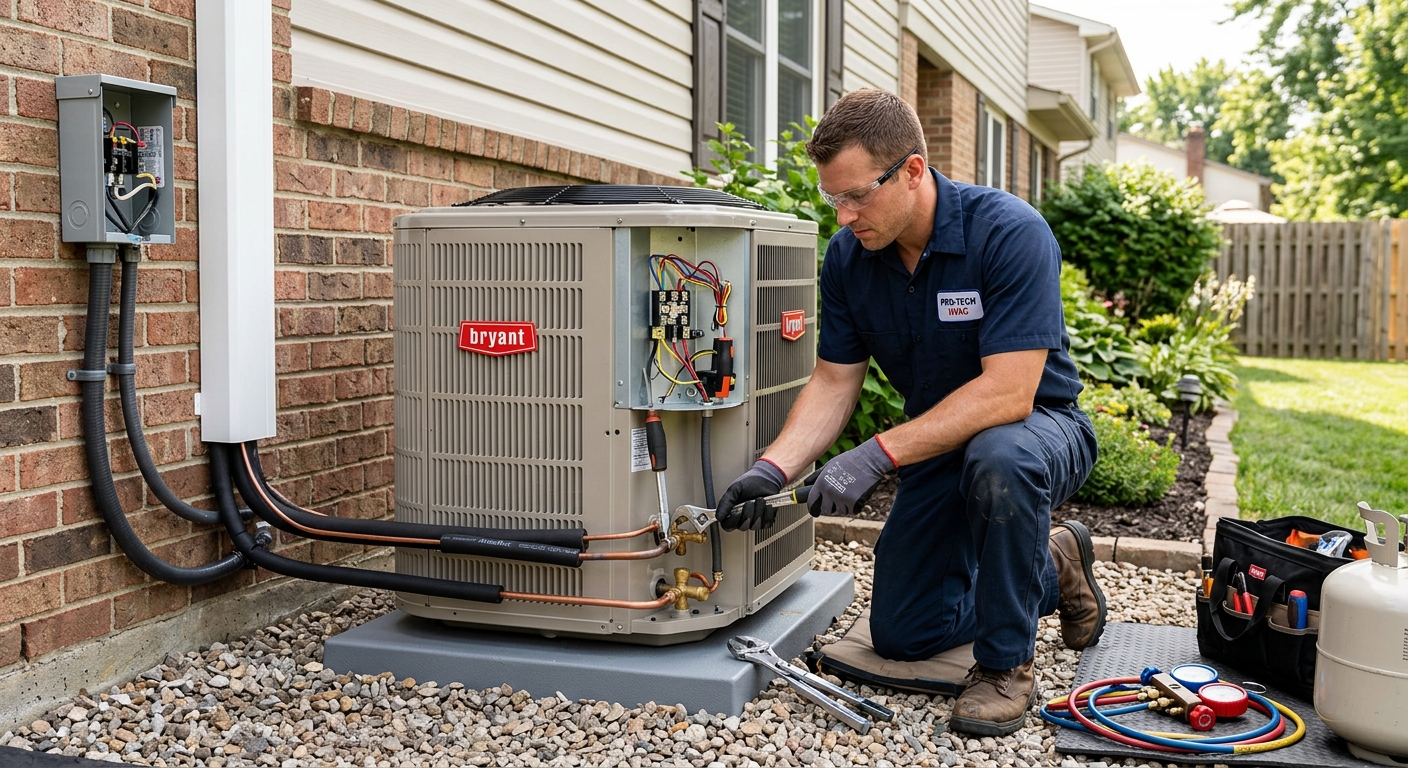
What a new HVAC system costs in Johnstown
Johnstown’s housing market is shaped by its past and its climate. With a homeownership rate of 52.0% and over 92.7% of homes built before 1980 (U.S. Census Bureau, ACS 2024), most HVAC work here is retrofit or replacement—especially in small, older houses that often lack modern ductwork. In these pre-1950 homes, it’s common to see individual room solutions or partial duct additions, rather than full central air in every case.
Our region is heating-dominated, with 6,300 heating degree days and only 750 for cooling, so winter matters more than summer. If you’re picking a system for Johnstown or across Cambria County, the urgency is keeping warm during long, snowy winters (with ground snow loads among the highest in the state), not just staying cool for a few sticky weeks in July. That shifts costs and priorities—reliability and effective heat output count for more here than in a milder or more cooling-driven region.
Your price will depend on existing ducts, service access and your home’s electrical panel. Age and layout push many jobs into the higher price bands because of extra retrofitting. Don’t assume your neighbor’s cost applies to you: a house with original radiators and no ducts will see higher installation costs than a 1980s ranch with central AC already in place. Here’s a breakdown of typical installed system types and ranges for 2026:
| System |
Best for |
Efficiency |
Price range (installed) |
| Central AC replacement (existing ducts) |
homes with sound ductwork |
16–20 SEER2 |
$4,500–$11,000 |
| Air source heat pump (ducted) |
year-round heating and cooling |
8–10 HSPF2 |
$7,200–$15,500 |
| Cold-climate heat pump (ducted) |
heat pump as primary heat |
9–11 HSPF2 |
$11,500–$15,500 |
| Ductless mini-split (single zone) |
additions, rooms without ducts |
20–30 SEER2 |
$2,900–$6,300 |
| Full duct system installation |
homes with no existing ducts |
— |
$8,100–$16,000 |
Installed estimates for a typical Johnstown home. Equipment tonnage, duct condition and electrical capacity move these more than brand.
Gas, electric or both in north-central Pennsylvania
With Johnstown’s harsh winters—winter design temps bottoming at 2°F and over 6,300 heating degree days—a heating system’s real test is performance in extended cold. That used to be an automatic win for gas or oil furnaces, since early generation heat pumps just couldn’t keep up. Today’s cold-climate heat pumps are different: even as it dips well below freezing, they keep useful heating capacity, especially when properly sized. Still, there is a drop-off as temperatures plummet—so much that the local winter design matters. In northern Cambria County’s coldest zones, a pure electric system might still need backup for the brutal snaps.
Natural gas is available in central Johnstown, Richland, and Westmont, but many outlying townships rely on propane or heating oil. For those areas, the choice isn’t just gas-versus-heat-pump but heating oil or propane against electricity. Because delivered fuels are expensive, a heat pump often comes out cheaper to run, despite higher initial costs.
A modern gas furnace still makes sense if you have existing ductwork and reliable gas service, especially in older homes that might be hard to insulate or if you’re wary of electric outages. For homes where gas isn’t available, a cold-climate or dual-fuel system usually wins—dual fuel (heat pump plus gas) systems give you flexibility for those single-digit nights.
| Option |
Installed cost |
Operating cost here |
Best when |
Incentive eligible |
| Gas furnace + central AC |
$4,500–$11,000 |
lower in gas areas, higher for oil/propane |
existing gas service, coldest zones |
yes, with efficiency upgrades |
| Ducted heat pump (cold climate) |
$7,200–$15,500 |
lower than propane/oil, higher than gas |
good envelope, all-electric goal |
often, including federal |
| Dual fuel (heat pump + gas backup) |
$11,500–$15,500 |
optimized for cold snaps |
gas on site, deep cold spells |
some programs cover |
| Ductless multi-zone |
$8,100–$16,000 |
varies by envelope/zones |
no ductwork, zone control |
yes, with efficiency levels |
Humidity and air quality in Johnstown homes
Johnstown’s cold winters and short, muggy summers mean houses here battle both dryness and humidity. In January, indoor air can get painfully dry, especially in homes with forced-air heat and older, draftier construction. Whole-house humidifiers can help, but they require regular maintenance—if you don’t clean or replace pads and check drains, you risk mold or mineral buildup.
Come summer, humidity can spike, but with only 750 cooling degree days, oversized air conditioners are common in older homes, especially after a quick retrofit. An oversized AC cools too quickly to properly remove moisture, so you end up cool but clammy. Correct sizing and variable-speed systems do far more for comfort than any dehumidifier add-on for most Johnstown houses.
Better air filtration (higher MERV filters) can improve pollen and dust control but strains older blowers if taken too far—stick to manufacturer limits unless your system is newer and rated for it. As for electronic air cleaners and ultraviolet lights, they’re sometimes oversold. Few homes here need more than a good filter and balanced humidity for healthy air.
Whole-house ventilators or energy recovery ventilators make sense only in newer, tightly sealed homes, which are rare in Cambria County. For most, simple measures and correct equipment sizing get you the best indoor air quality without buying gear you’ll never actually feel the benefit from.
Running the numbers on Johnstown's climate
Any homeowner in Johnstown or Cambria County who wants to estimate system operating cost needs just three things: heating/cooling degree days, equipment efficiency, and their utility rate (from their own bill—Penelec is the main electric supplier for most). As an example, with 6,300 heating degree days and only 750 cooling degree days, nearly nine times as much energy goes to heating as to cooling each year here.
Suppose you’re comparing a gas furnace (95% AFUE) to a modern air source heat pump (9 HSPF2). The equipment’s nameplate efficiency tells you what fraction of fuel or electricity ends up as heat in the home. Multiply your home’s annual load (based on square footage and degree days—your contractor can run this) by the inverse of efficiency, giving total energy consumed, and then multiply by your utility’s kWh (for electric) or ccf (for gas) rate as listed on your bill.
Uncertainty is real: if your ductwork leaks, 20–30% of heat never gets indoors, no matter what the furnace is rated. Building insulation quality moves the total load as much as equipment choice. That means it’s possible for a well-sealed home with a midrange system to outperform an old, high-efficiency system that’s losing heat to the basement or attic. Always check duct sealing and insulation before expecting savings from a high-spec machine.
Rates change and every house is unique, but the math itself is simple. If your bills seem high, try a seasonal comparison against neighboring homes built about the same time. Real savings come as much from fixing hidden losses as from the shiny new equipment itself.
The refrigerant change and what it means for repairs
As of 2026, newly manufactured residential systems in Johnstown are being shipped with lower-GWP refrigerants like R-454B or R-32. This follows the phasedown of high-GWP HFCs such as R-410A, a change pushed by both federal and manufacturer initiatives. But if you have a working R-410A system in your house, there’s no need to panic. It remains legal to service and maintain, and you’re not required to replace it—no technician should claim otherwise.
What changes is the long-term repair landscape. R-410A as a refrigerant will become more expensive and, as the years go on, less readily available. If your system develops a slow refrigerant leak or needs a major recharge, the cost of the service may make replacement more attractive compared to years past. For as long as the system’s compressor and coils are sound, regular repairs such as capacitor or contactor replacement remain cost-effective.
This transition affects only new equipment and the economics of major repair. If your R-410A system is in good shape and not leaking, there is no advantage to swapping it out early. Most of the region’s contractors and supply houses will support R-410A service well into the 2030s—you just may want to weigh major repairs against replacement more carefully as time passes.
Repair or replace your Johnstown system?
For Johnstown homeowners with HVAC trouble, replacement shouldn’t be the default. If your system is less than 10 years old and hasn’t had a history of failures, repair almost always makes sense, especially when it’s a single part—think blower motors, thermostats, or circuit boards. If a major repair runs a third or more of the cost of a whole new system, it’s time to consider the long view.
Cracked heat exchangers or compressor failures in systems past their warranty, though, are game over: both are high-cost, high-risk repairs with little payback. The type of refrigerant matters too—a major leak on an older R-22 system nearly always tips toward replacement, while R-410A is still serviceable, though, as previously mentioned, more expensive over time.
Efficiency claims are often oversold; in Cambria County’s climate, gains from newer equipment are real but rarely dramatic unless your current system is truly ancient or your ductwork leaks like a sieve. First rule out bad ducts and missing insulation—a small investment here (often $300–$800) can deliver outsized comfort returns.
| Situation |
Recommendation |
Typical cost |
Reasoning |
| Under 10 years, single component failure |
Repair |
$300–$1,200 |
Cheaper than replacement, life left in system |
| 10–15 years, repair over a third of replacement |
Consider replacing |
$4,500–$11,000 |
Approaching end of service life, better payback now |
| 15+ years, any major failure |
Replace |
$4,500–$11,000 |
Old system, repair rarely worth it |
| Cracked heat exchanger, any age |
Replace immediately |
$4,500–$11,000 |
Safety risk—cannot be patched |
| Compressor failure past warranty |
Replace |
$7,200–$15,500 |
High repair cost, system likely near end of life |
| Working system, high bills |
Test ducts and envelope first |
$300–$800 |
Hidden leaks or drafts often to blame |
Permits, licensing and inspections in Johnstown
Pennsylvania does not issue a statewide HVAC trade license for residential work. Instead, every contractor working on home HVAC systems must hold Home Improvement Contractor (HIC) registration from the Pennsylvania Office of Attorney General for contracts over $500. You can verify a contractor’s HIC registration at hic.attorneygeneral.gov. Beyond registration, Johnstown and all Cambria County boroughs or townships enforce their own mechanical permit rules—so installation or replacement of major HVAC equipment and ductwork within Johnstown city limits requires a mechanical permit and will be inspected by the City of Johnstown Codes Department.
No one can legally handle refrigerants unless they hold EPA Section 608 certification. This is a federal rule, not just a local one, so it applies to any technician swapping out an AC or heat pump. Insurance and workers’ compensation are mandatory for all employers; homeowners can check coverage through the WCAIS system at wcais.pa.gov. A written contract is required by law for any job over $500, and you have three business days to cancel the contract under Pennsylvania’s Home Improvement Consumer Protection Act. Remember: never pay a contractor who offers to waive your insurance deductible—it's illegal here. For older Johnstown homes (pre-1978), the federal EPA Lead RRP Rule applies if paint is disturbed; contractors are required to be certified for that work.
Frequently asked questions — HVAC installation in Johnstown
Can I service my R-410A system after the refrigerant change?
R-410A remains legal to service and recharge in Johnstown and throughout Pennsylvania. If you have an R-410A system, no law forces you to replace it because of the refrigerant transition—HVAC contractors still have access to both the parts and refrigerant for repair. However, as supply tightens over the years ahead, the price of R-410A can become a larger part of any refrigerant leak repair. For example, a major repair that once cost around $800–$1,200 could inch higher as R-410A availability declines. But unless your system has a chronic leak or repeated failures, you’re better off maintaining it than replacing it simply because of upcoming changes. Keep your unit serviced yearly; when a big repair comes due, weigh the repair cost against the price of a new, more efficient system.
How long does HVAC installation take in Johnstown?
For most Johnstown-area homes with existing ductwork and good access, a full central air conditioning or furnace replacement can typically be finished in a single working day—two days at most if electrical or venting upgrades are needed. Installations in older houses (and over 92.7% of Johnstown’s housing stock was built before 1980) often run into surprises like hidden duct runs, undersized panels, or access issues, which sometimes extend the job to two or three days. If you’re adding a full new duct system, the total project can stretch to a week and increase costs to around $8,100–$16,000. Always ask your contractor to explain the schedule and what could delay the job in your particular home.
Are duct sealing and insulation eligible for incentives?
Duct sealing and insulation improvements are often eligible for utility and federal efficiency incentives, especially in older Pennsylvania homes like most of those in Johnstown. The process involves using mastic or aerosolized sealant to stop leaks, plus adding insulation to duct runs in unconditioned basements or attics. The work commonly costs $300–$800 for a typical Johnstown house and can deliver big energy savings in our cold-winter climate. Always keep the invoice and serial numbers—the paperwork is essential for any rebate. Many incentives are tied to blower door or duct leakage test results after the work, so be sure your contractor is familiar with these requirements.
How long should an HVAC system last in Johnstown?
With regular maintenance, most forced-air HVAC systems in Johnstown last 15–20 years—sometimes longer if built with quality parts and installed properly. The heavy heating load in Cambria County (6,300 heating degree days a year) works equipment harder than downstate regions, so lifespan often lands on the lower end if filters, blowers, or coils are neglected. You’ll find many homes here still running 20-year-old furnaces, but once repairs climb toward a third of the replacement cost—say, $4,500–$11,000 for a new system—it’s usually wiser to put money into new equipment. Proper ductwork and annual tune-ups always extend service life.
How much does ductwork add to an HVAC installation?
In Cambria County’s older homes, lacking any central ductwork is common, driving up retrofit costs. For a full central duct system (including supply and return runs, registers and installation labor), expect to pay between $8,100–$16,000 just for the ductwork in addition to the equipment. If you’re installing a system in a house with no previous ducts, the jump in cost and disruption (cutting into walls, dropped soffits, patching) can be considerable. In compact Johnstown houses, this process is often the hardest part of the job—sometimes, switching to ductless mini-splits is a money-saver, with single-zone systems starting at $2,900–$6,300.
How cold does it get in Johnstown and does that affect heat pumps?
Johnstown’s winter design temperature is 2°F—meaning systems must keep up even during bitter cold snaps. Older heat pumps struggled in these conditions, but modern cold-climate models can deliver 80–90% of rated capacity down to 5°F. If your house is well-sealed and reasonably insulated, a cold-climate heat pump will often heat it on its own down to the low teens. For homes in outlying Cambria County with less insulation or higher heating needs, it’s smart to add a backup—either electric strip heat or stick with a dual-fuel (heat pump plus gas furnace) setup, where combined systems usually cost $11,500–$15,500. Always have your home’s insulation checked to know what works for you.
How much does a new HVAC system cost in Johnstown?
In Johnstown and nearby boroughs, the cost to install a new central HVAC system depends on your home’s age, ductwork, and electric or gas service. If you’re just replacing an existing furnace and air conditioner with no duct upgrades, expect a total in the $4,500–$11,000 range. New ducted heat pumps come in higher at $7,200–$15,500. But if your house needs all new ducts, the price jumps—total projects with new ductwork start at $8,100–$16,000. Compact, older homes with no ducts sometimes do best with ductless mini-splits, which are usually $2,900–$6,300 per zone. Always get a few written quotes for your exact house and layout.
Who inspects HVAC work in Johnstown?
Within Johnstown city limits, all major residential HVAC jobs—new installations or full replacements—are inspected by the City of Johnstown Codes Department after your contractor pulls a mechanical permit. Each Cambria County township or borough runs its own code office, so requirements differ outside the city. Repairs on existing equipment alone usually don’t trigger inspections. All work must follow the Pennsylvania Uniform Construction Code (based on the IRC), and written contracts are required for jobs over $500. Always ask to see the mechanical permit before work begins; this protects both you and your contractor and is your assurance the work will be checked for code compliance.
Can a heat pump heat my house without backup?
In Johnstown, a modern cold-climate heat pump is designed to supply enough heat for most of the winter—including down to the local design temperature of 2°F—if your home is reasonably tight and well-insulated. Older homes with lots of drafts or little attic insulation may require either electric auxiliary heat or pairing with a furnace (called a dual-fuel system) for those rare nights below zero. The added cost for a dual-fuel setup runs in the $11,500–$15,500 range, but for many 1950s-and-newer homes, a standalone heat pump does the job with just a modest backup coil. The most important factor is a proper load calculation and honest insulation check—don’t overspend if your house doesn’t actually need it.