HVAC costs in Downingtown — 2026
Downingtown sits in a part of Chester County where most homes were built before 1980 (U.S. Census Bureau, ACS 2024). This timing shapes what you’ll find overhead and underfoot: forced-air ducts already in place, with central HVAC systems now reaching the end of their expected life. With a local homeownership rate of just over half, owners here are often replacing rather than installing a system for the first time. If your house was built during the 1970–2000 boom, it almost certainly has an existing duct system, which opens the option to replace just the core equipment rather than starting from scratch.
The regional climate here brings about 4,800 heating degree days and only 1,450 cooling degree days—so it’s a heating-dominated market where the furnace or heat pump is working hardest during the long, cold winters. This shifts the value calculus: heating efficiency and system reliability are worth more than just high-SEER cooling stats.
Below is a look at installed price bands for common system types in Downingtown—not just the sticker price for equipment, but a realistic estimate of complete installation, including labor. These costs flex up or down with the size and complexity of your home, but the bands below hold for most local jobs with standard equipment and no major surprises:
| System |
Best for |
Efficiency |
Price range (installed) |
| Central AC replacement (existing ducts) |
homes with sound ductwork |
16–20 SEER2 |
$5,500–$13,000 |
| Air source heat pump (ducted) |
year-round heating and cooling |
8–10 HSPF2 |
$8,800–$18,500 |
| Cold-climate heat pump (ducted) |
heat pump as primary heat |
9–11 HSPF2 |
$14,500–$18,500 |
| Ductless mini-split (single zone) |
additions, rooms without ducts |
20–30 SEER2 |
$3,500–$7,700 |
| Full duct system installation |
homes with no existing ducts |
— |
$9,900–$20,000 |
Installed estimates for a typical Downingtown home. Equipment tonnage, duct condition and electrical capacity move these more than brand.
Keeping a Downingtown system running
With humid summers and real winters, Downingtown systems need regular attention to stay efficient and avoid breakdowns. The single most important—and often neglected—item is the filter. Use the MERV rating your system’s blower can handle; for most Chester County homes, MERV 8 or 11 fits the bill. Change filters every 1–3 months, depending on dust and pets. If your system starts tripping limit switches or you see ice, check the filter first.
Coil cleaning really makes a difference—evaporator and condenser coils gather dust and pollen that strain the system over years. Clear any landscaping or leaves from outdoor units. For the condensate line that drains water from summer cooling, a simple vacuum or a little bleach flush each spring will stop overflows that can ruin ceilings or floors.
Refrigerant is not a consumable. A system that “needs a top-off” has a leak. Adding more without finding and repairing the leak is a band-aid move, not proper maintenance—local contractors should pressure-test and fix before adding refrigerant.
Annual service plans can be fair value if they specify what’s included and lock in priority during heat waves and cold snaps. However, skip plans that cost nearly as much as a full tune-up for a quick “check” or hard-sell add-ons. Schedule maintenance before the HVAC busy season—spring or early fall—so you won’t compete with no-heat emergencies or summer failures in Downingtown’s peak months.
Reading an installation proposal
An HVAC quote in Downingtown should lay out every measurable—the more details, the easier to compare. Make sure both the indoor and outdoor unit model numbers are listed. The efficiency ratings only hold true when the system is properly matched. Sizing must tie back to a load calculation for your home, not just whatever size came out during the last swap.
Read the fine print: are the refrigerant lines being replaced or reused? If reused, corrosion or size mismatch could become a problem. Any quote should spell out electrical work—will you need more panel capacity, or a new circuit? For comfort, confirm if a new thermostat is included and whether it supports staging or smart features. Local codes in Chester County require a permit for full replacements, and the cost should be included. Look for a commissioning report: startup diagnostics matter more for performance than the brand.
Warranties come in two parts—parts (manufacturer) and labor (your installer). Don’t confuse the two. A quote that lists only a brand and a price is impossible to compare to anything meaningful.
| Line item |
What to look for |
Red flag if… |
| Equipment |
model numbers, indoor and outdoor matched |
brand name only |
| Sizing |
load calculation attached |
matched to the old nameplate |
| Ductwork |
condition assessed, sealing scoped |
not mentioned |
| Electrical |
circuit and panel capacity confirmed |
assumed adequate |
| Line set |
replaced or documented as reused |
silent |
| Commissioning |
measured airflow and charge, documented |
no startup report |
| Warranty |
labour years stated separately |
manufacturer only |
| Permit |
included and priced |
'not needed' |
The refrigerant change and what it means for repairs
All newly manufactured residential HVAC systems now use refrigerants with lower global warming potential, like R-454B and R-32, as part of a national phase-down of higher-GWP HFCs such as R-410A. If your system at home uses R-410A, it remains perfectly legal and can still be serviced by any Chester County contractor with proper EPA Section 608 certification. There's no mandate in Downingtown, or Pennsylvania at large, to force system replacement just because the refrigerant changes—only new equipment must meet the new standards.
Cost is where you’ll feel the squeeze over time: as new imports and production of R-410A continue to be reduced, the price for servicing older equipment with a refrigerant leak will climb. This especially affects repairs on failing compressors or evaporator coil leaks. It can mean that a borderline cost-effective repair tips the balance toward replacement, since topping up refrigerant is no longer cheap or sustainable, and ongoing leaks just compound the expense. That said, there’s no requirement to rush a replacement if the system is not leaking and still operates smoothly.
A reputable contractor in Downingtown will always test for leaks before recharging and should explain the costs and long-term considerations—nobody should pressure you to replace a functioning system solely due to refrigerant type.
What a Pennsylvania HVAC contractor must hold
Pennsylvania does not issue a statewide HVAC contractor license for residential work. Instead, regulation of residential HVAC is left to local municipalities. Installation or full replacement of central HVAC equipment typically calls for a mechanical permit in Downingtown-area municipalities, such as West Chester Borough, but requirements vary by township. Always check with your own code office. On the legal side, any residential HVAC contract over $500 requires Home Improvement Contractor (HIC) registration from the Pennsylvania Office of Attorney General—verify at hic.attorneygeneral.gov for peace of mind.
Handling refrigerant in Pennsylvania, including in Downingtown, is federally regulated. All techs must have EPA Section 608 certification, which you have every right to ask about. Workers’ compensation is mandatory for anyone employing workers, and you can verify coverage through the WCAIS system at wcais.pa.gov.
Before hiring for a Downingtown job, ask to see HIC registration and proof of insurance. In this region, mechanical permits and code inspections are standard, with most local townships enforcing the Pennsylvania Uniform Construction Code (UCC), based on the IRC. A good proposal should name the permit and price it in writing.
Retrofit versus replacement in Downingtown
In Downingtown, most homes were built before 1980, which tells you a lot about what you’ll encounter in the attic and basement. Ductwork very likely exists, and it was often sized primarily for heating, not balanced for air conditioning. Original ducts in these houses may be undersized for high-efficiency cooling or left unsealed altogether. If your house is from the late ’90s or early 2000s, expect the original builder-grade HVAC to be reaching end-of-life—twenty-plus years is a full run for most standard equipment, and replacement makes much more sense than a piecemeal retrofit.
Older Downingtown homes have variable insulation and the windows aren’t always up to modern standards, which affects the load calculation for any replacement system. Electrical panel capacity is another bottleneck, especially if switching to all-electric heat pumps—many older homes were built with panels sized for gas heat, not high-amperage compressor loads. For gas systems, keep an eye on chimney or flue condition: lined or relined chimneys may be needed if you switch to a newer, more efficient furnace that vents differently.
In this market, replacing the core equipment, reviewing ductwork, and occasionally upgrading wiring is the norm. Full duct replacement is unusual unless a major renovation is under way.
Duct condition, leakage and sealing
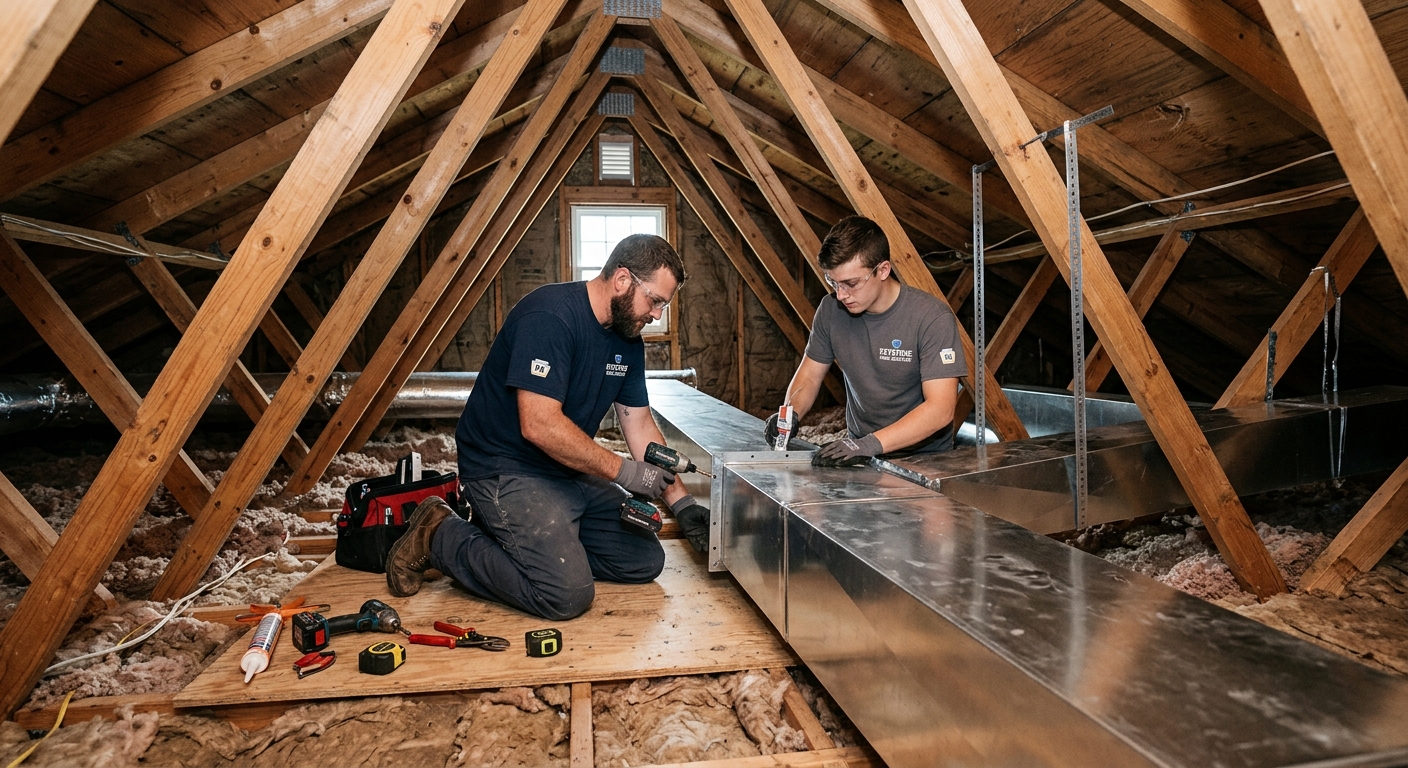
Ductwork is the “silent partner” in any Downingtown HVAC setup, particularly in homes built between 1970 and 2000. These forced-air ducts are likely original to the house, unsealed, and may run through attics, crawlspaces, or unconditioned basements. Hidden leakage is common enough to waste 20–30% of heated or cooled air—sometimes more. That loss can cost you more on utility bills than upgrading your equipment ever will.
If your system struggles to keep rooms evenly conditioned, or if there’s dust streaking at supply grilles, duct leakage or undersized returns are prime suspects. A duct blaster test is the tool for the job: it pressurizes the duct system and measures air loss, pinpointing problem sections. Good contractors offer sealing—using mastics or aerosolized sealant—where accessible, rather than recommending whole replacement unless the ducts are beyond rescue (crushed flex, asbestos trunk lines, or persistent mold growth).
Many Chester County systems were built without any duct sealing, and it shows after decades of use. Undersized or poorly planned return ducts are an unseen but chronic weakness, especially during air conditioning season. If your ducts run through an unconditioned attic or crawl, insulating and sealing those runs should be part of any serious replacement or major retrofit.
My honest advice: always test (duct blaster or smoke) before investing in new HVAC equipment. You’ll get more comfort and savings from tight ducts than you ever will from a raw efficiency boost alone.
Frequently asked questions — HVAC installation in Downingtown
What is commissioning and why does it matter?
Commissioning is the process of systematically testing and adjusting a new HVAC system in your Downingtown home to ensure it operates to factory specifications. This means checking refrigerant charge, measuring airflow, verifying thermostat operation, and documenting key performance numbers. Most local homes have unique ductwork or insulation quirks, so “set and forget” just doesn’t cut it. A detailed commissioning report ensures your $8,800–$18,500 heat pump or $5,500–$13,000 central AC is operating at peak efficiency, not just plugged in and forgotten. Without commissioning, even new high-end equipment can run poorly and waste money. Insist on this in Downingtown, where climate swings put real demands on your HVAC system.
Do older Downingtown homes need ductwork replaced?
Not always. Most pre-1980 homes in Downingtown came with ductwork that’s now 40+ years old. That ductwork is often leaky or may have loose or missing insulation, but outright replacement is rarely necessary unless the ducts are crushed, moldy, or made from hazardous materials. More often than not, duct sealing or adding insulation will solve comfort and efficiency problems for far less cost than a full replacement (which runs $9,900–$20,000). Before any replacement, have a duct blaster test done by a local contractor—it’s the only way to know if your system leaks enough to justify new ducts or if a focused repair will suffice.
Are duct sealing and insulation eligible for incentives?
In Downingtown, utility or state incentives for duct sealing and insulation are sometimes available, especially for homes with significant leakage found by testing. While the specifics change by year and program, PECO Energy historically participates in rebate programs for targeted upgrades that improve efficiency. Professional duct sealing itself usually costs far less than new equipment ($5,500–$13,000 for a central AC), and insulation can make a measurable impact on comfort. Ask your local contractor to confirm which rebates are currently active for Chester County homeowners—they change year to year and are worth pursuing before any major project.
Do I need dual fuel in southeastern Pennsylvania?
Dual fuel—combining a heat pump with a backup gas furnace—can make sense in the Downingtown area, but isn’t mandatory for everyone. Our winters do see temps dipping below 20 °F, and heat pumps lose efficiency as it gets colder. However, many modern cold-climate heat pumps work reliably here if sized and installed correctly. If you already have a natural gas line, a dual fuel setup can give you the best of both worlds, but most homes with a good-quality heat pump (costing $14,500–$18,500 installed for cold-climate models) will be comfortable without needing gas backup. It comes down to your expectations in a hard cold snap and what utilities you have available.
Do I need a permit to replace HVAC in Downingtown?
Yes, in almost all cases. In Chester County, installation or replacement of a central HVAC unit—furnace, heat pump, or AC—typically requires a mechanical permit from your municipality code office. For Downingtown-area homes, it’s best practice to ask your contractor to provide and include the permit (which is usually a few hundred dollars in the quoted price). If your project’s scope is under $500 or only involves swapping a thermostat, you may slide under the requirement—but full system replacements always trigger one. Make sure your quote, whether for a $5,500–$13,000 AC replacement or bigger project, spells this out. Permits protect you both legally and structurally.
What does a heat pump cost installed in Downingtown?
For a typical single-family home in Downingtown with existing ductwork, expect an installed air source heat pump price in the $8,800–$18,500 range. Cold-climate systems, capable of carrying a home through the coldest spells without relying on an electric or gas backup, come in at the higher end: $14,500–$18,500. The final cost depends on system size, your electrical panel’s capacity, and whether other upgrades (like duct sealing) are necessary. Always get multiple quotes with model numbers and a load calculation tied to your unique home.
Should I close vents in unused rooms?
It might seem logical to close off unused rooms to force more heating or cooling elsewhere, but in Downingtown homes, this usually backfires. Closing supply vents in forced-air systems increases static pressure, which can trigger blower safety switches, short cycling, and in older ductwork, even more air leakage—plus you’ll rarely save energy. Instead, make sure your system has the correct balance of supply and return, and look to programmable thermostats or zone controls if you want to target only specific living areas. Put the savings into sealing and insulating your ducts before trying to game the system by closing vents—in most Downingtown houses, that means more comfort and less risk of damaging equipment that costs $5,500–$13,000 or more to replace.
Why do HVAC quotes in Downingtown vary so much?
Price swings are common because every Downingtown home is different—age, ductwork quality, accessibility, and local code requirements all factor in. One contractor may quote based on reusing an old line set or ductwork, while another insists on new components. Some proposals include a detailed commissioning and labor warranty; others don’t. Local labor costs and insurance, as well as whether the quote is for basic or cold-climate equipment, further stretch the range—from $5,500–$13,000 for AC replacement up to $18,500 for top-end heat pumps. Only compare “apples to apples”—demand a detailed breakout for every line item, not just the brand or model, and look for the permit and commissioning details included.
What size HVAC system does my Downingtown home need?
Size should never be guessed or carried over from an old system—proper sizing means a Manual J load calculation performed for your specific Downingtown house. Factors include insulation, window quality, ductwork, home orientation, and local weather (those 4,800 heating degree days matter!). Too large a system cycles on and off, wasting energy, while being too small leaves you uncomfortable. An experienced Chester County contractor will use these details to recommend the right tonnage, typically ranging from 2–5 tons for most local homes. Since equipment costs from $5,500–$18,500 depending on type and features, sizing right gives you efficiency and comfort—guesswork only leads to disappointment and bills down the road.