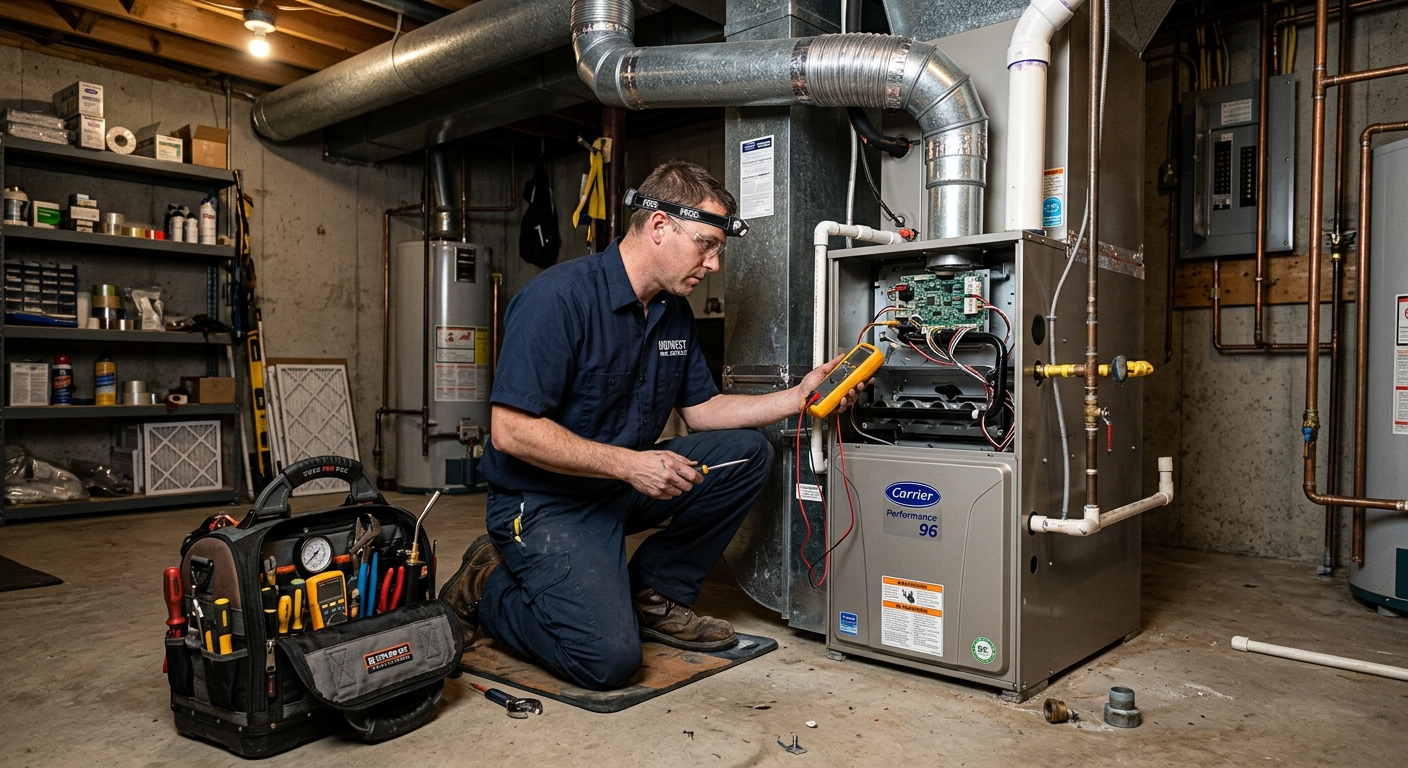
What a new HVAC system costs in Kennett Square
Kennett Square is a mix of older and newer homes, but a striking 79.0% of housing here was built before 1980 (U.S. Census Bureau, ACS 2024). With a homeownership rate of 56.4%, most projects are replacement jobs rather than first installs. Large areas of Chester County—including Kennett Square—feature homes from the 1970 to 2000 building boom, most originally fitted with forced-air systems that are now reaching end-of-life. If you have sound supply and return ducts already in place, replacing central AC is usually the simplest path. If your ducts are poorly sealed or not sized for modern high-efficiency units, some cost will shift to ductwork repair or replacement.
Southeastern Pennsylvania is a heating-dominated market with 4,800 heating degree days and only 1,450 cooling degree days. This means your heating system gets more hours of use compared to cooling, putting extra importance on picking a right-sized, efficient heating solution—whether gas, heat pump, or dual fuel.
| System |
Best for |
Efficiency |
Price range (installed) |
| Central AC replacement (existing ducts) |
homes with sound ductwork |
16–20 SEER2 |
$5,500–$13,000 |
| Air source heat pump (ducted) |
year-round heating and cooling |
8–10 HSPF2 |
$8,800–$18,500 |
| Cold-climate heat pump (ducted) |
heat pump as primary heat |
9–11 HSPF2 |
$14,500–$18,500 |
| Ductless mini-split (single zone) |
additions, rooms without ducts |
20–30 SEER2 |
$3,500–$7,700 |
| Full duct system installation |
homes with no existing ducts |
— |
$9,900–$20,000 |
Installed estimates for a typical Kennett Square home. Equipment tonnage, duct condition and electrical capacity move these more than brand.
Choosing an installer in Chester County
In Chester County, the difference between a comfortable, long-lasting HVAC system and a frustrating, expensive one almost always comes down to installation quality—not brand. Even the best equipment will fall short if it’s poorly sized, badly commissioned or sloppily installed. Always confirm your contractor is registered as a Home Improvement Contractor through the Pennsylvania Office of Attorney General for contracts over $500. On top of that, make sure the technician responsible for handling refrigerant carries current EPA Section 608 certification; this is a federal requirement, not just a suggestion.
Beyond credentials, a credible installer will perform a Manual J load calculation up front—not just “eyeball” the size based on your old equipment. The written quote should include specific equipment model numbers and system efficiency ratings, not just the tonnage. At commissioning, you want proof that airflow, refrigerant charge and controls were tested and balanced on site, with results left in writing.
- Confirm HIC registration at hic.attorneygeneral.gov
- Ask for EPA Section 608 certification for refrigerant work
- Demand a Manual J load calculation as part of your estimate
- Get a detailed, written contract for work over $500 (legally required)
- Check proof of general liability insurance and workers’ compensation via WCAIS (wcais.pa.gov)
- Review equipment model numbers and efficiency ratings on the proposal
- Ask how start-up commissioning is documented
- Clarify what’s included: permitting, disposal, warranty registration
- Check reviews from Kennett Square and Chester County, not just anywhere
- Request references for jobs completed in the past two years
- Find out who will actually be doing the work, not just selling it
- If your home is pre-1978, verify Lead RRP certification at certifiedrenovatorsearch.epa.gov
Red flag: With Kennett Square’s saturated HVAC market, someone who can start “tomorrow” at a suspiciously low price is skipping steps or cutting corners on code, calculation or labor.
Mini-splits and zoning in Kennett Square homes
Ductless mini-splits solve problems that central systems never could in Kennett Square’s mix of older homes and 1970s–2000s subdivisions. When you’re adding a sunroom, finishing an attic, or simply trying to heat and cool a room the old ducts never reached, a mini-split is almost always the cleaner, less intrusive fix. In Chester County, homes built before central air was the standard often have plaster or drywall that makes new ductwork a major event—opening walls, dropping ceilings and running up costs fast. Mini-splits sidestep this by mounting compact indoor “heads” on the wall or ceiling, piped to an outdoor unit by discreet refrigerant and power lines.
For one-off needs—like a master suite or converted basement—a single-zone system delivers maximum efficiency, control and simplicity. Multi-zone setups, which hook several indoor units to a single outdoor “condenser,” are tempting to save space, but can underperform if heads with very different loads fight each other (like a sunny office and a shaded bedroom on one compressor). Separate outdoor units for each zone cost more up front, but deliver better comfort and reliability if you’re mixing heavily-used and little-used rooms.
Aesthetic objection is the most common hesitation: heads are visible on the wall. But many homeowners quickly forget them once they experience the comfort and quiet. Always plan for proper condensate drainage—gravity to the outside, not a pump in most cases. With large tracts of Chester County ready for replacement, mini-splits are well-suited to houses that predate ducted AC, especially when you want real zoning and modern efficiency without gutting your walls.
Mechanical permits for HVAC work in Kennett Square
Pennsylvania does not issue a statewide HVAC contractor license. In practice, all residential HVAC work in Kennett Square falls under the Pennsylvania Uniform Construction Code (UCC), enforced locally by municipalities—including West Chester Borough, which requires mechanical permits for any installation or major replacement. Pennsylvania requires Home Improvement Contractor (HIC) registration for any job valued over $500, and a written contract is mandatory—giving you clear legal footing if something goes wrong.
All technicians handling refrigerant must hold a federal EPA Section 608 certification, regardless of what municipal or state credentials they have. This is your guarantee that they’re qualified to safely handle coolant leaks and system evacuation.
Permits and inspections are handled by the local codes department in each township or borough. It’s your contractor’s job to pull those permits, but you should always ask to see the approved documentation. To check insurance and workers' compensation, use the WCAIS system online; don’t just trust a piece of paper handed to you—the insurer list must match your contractor or their employer. For pre-1978 homes, only firms certified under the EPA Lead RRP Rule can legally do renovation, including HVAC work.
Manual J and the tonnage question
Getting the right size for your heating and cooling system is the single most important factor affecting comfort, energy bills, and system life. In Chester County, where the winter design temperature is just 14°F, proper sizing against peak cold (not just summer heat) is key. Too often, contractors size your new equipment simply by matching the tonnage on your old system’s nameplate—copying forward decades-old errors or changes in insulation and windows you may have made over the years.
Oversized equipment might sound appealing (“more power can’t hurt, right?”), but it’s a mistake. Systems that are too large will short cycle—turning on and off rapidly, never running long enough to pull moisture out of the air. This means feeling clammy or sticky even if the air’s cold. Short cycling also kills furnace and compressor life, raises your bills, and causes uneven temperature swings room to room.
The solution: require a Manual J load calculation for your home. This industry-standard calculation considers your home’s insulation, window area, orientation, number of occupants, and more—designing against Chester County’s actual climate rather than old rules of thumb. Your best question: “Did you run a load calculation, and can I see it?” If the answer is no, keep looking. Don’t let anyone sell you based on the old system or “square footage,” which is just an educated guess at best. A good Manual J is the groundwork for comfort for the next 20 years in southeastern Pennsylvania, where heating needs outstrip cooling much of the year.
SEER2, HSPF2 and AFUE decoded
SEER2 tells you how efficiently an air conditioner or heat pump cools during the summer; higher numbers mean less energy used per unit of cooling. HSPF2 rates the heating efficiency of heat pumps—the higher, the better in winter. AFUE applies only to furnaces, measuring the percent of fuel turned into indoor heat; a 95 AFUE furnace converts 95% of gas to heat. These “2” ratings (SEER2, HSPF2) use tougher testing than previous versions, so older SEER/HSPF numbers aren’t directly comparable.
In southeastern Pennsylvania, you’ll use your heating system a lot more than your cooling—a direct result of having 4,800 heating degree days versus just 1,450 cooling. This means it’s worth paying for a higher HSPF2 or AFUE, but less so for ultra-premium SEER2. For most, a 16–18 SEER2 AC is plenty; savings beyond that are minimal over real Chester County summers. A modern heat pump with 9–10 HSPF2 or a furnace with 95%+ AFUE hits the best balance for both comfort and payback, since you’ll use it much more often in this climate.
Gas, electric or both in southeastern Pennsylvania
The choice between gas furnace, heat pump, or a combination (“dual fuel”) in Chester County hinges on how our winters actually feel—and what utilities you have. With 4,800 heating degree days and a winter design minimum of 14°F, you need serious heating power on the coldest nights. Modern cold-climate heat pumps are a strong all-electric option, holding full capacity well below freezing, but it’s true that as temperatures plunge near design minimum, their output drops and efficiency falls off. That’s why dual fuel combines a heat pump for most of the season (lower bills, steady comfort) and a gas furnace as backup on bitter nights.
If you’re inside West Chester, Tredyffrin, or West Goshen and have natural gas onsite, a high-efficiency gas furnace is still the right answer for many: best reliability in deep cold, familiar maintenance, and lowest upfront costs ($5,500–$13,000 for furnace + AC). In rural Chester County, where natural gas isn’t available, the comparison shifts—propane or oil can cost two or three times more to run each winter than a heat pump. Here, switching to a modern cold-climate heat pump (maybe paired with electric strip heat for backup) can pay dividends over time.
Stick with a furnace if your envelope is drafty, insulation is poor, or you want highest output in a severe cold snap and already have gas. Otherwise, a heat pump or dual-fuel setup is often the better, future-proof move for comfort and savings in most Chester County homes.
| Option |
Installed cost |
Operating cost here |
Best when |
Incentive eligible |
| Gas furnace + central AC |
$5,500–$13,000 |
Low with gas service, stable in coldest zones |
existing gas service, coldest zones |
Possible, mainly for higher efficiency units |
| Ducted heat pump (cold climate) |
$8,800–$18,500 |
Lowest with good envelope, moderate savings over propane/oil |
good envelope, all-electric goal |
Yes |
| Dual fuel (heat pump + gas backup) |
$14,500–$18,500 |
Optimized, lowest bills during deep cold |
gas on site, deep cold spells |
Yes |
| Ductless multi-zone |
$9,900–$20,000 |
Low for zoned spaces, higher if heating whole home |
no ductwork, zone control |
Yes, for qualifying systems |
Frequently asked questions — HVAC installation in Kennett Square
When is the best time of year to replace HVAC in Kennett Square?
In Kennett Square, the best window for HVAC replacement is usually late winter through early spring, or early fall before the first real cold snap. These shoulder seasons mean HVAC contractors have better availability, can take the time for a proper Manual J load calculation, and you won’t go days without heat or cooling during the most uncomfortable parts of the year. If you wait until a July heatwave or a January cold spell, you’ll compete with every emergency buyer and may pay a premium for urgent service. Most installers in Chester County can complete a standard central AC or gas furnace replacement for $5,500–$13,000, but taking your time during off-peak periods also means more attention to detail and fewer compromises in permitting and commissioning.
How does southeastern Pennsylvania's climate affect system sizing?
System sizing here depends on the fact that Chester County is a heating-dominated climate. With 4,800 heating degree days and a winter design low of 14°F, you need a system sized to provide reliable comfort during an extended cold snap. That’s why you can’t just plug in some national “square-footage-per-ton” rule and call it done. A proper Manual J load calculation, factoring in insulation, air sealing, window quality, and solar orientation, is critical. Oversizing is common but can ruin dehumidification and shorten equipment life. Whether you’re looking at a heat pump in the $8,800–$18,500 range or a new furnace, always ask for documentation of the sizing process, not just a guess or a match to the old nameplate.
Is an annual maintenance plan worth it?
In Kennett Square, I recommend annual maintenance for most systems—especially heat pumps, gas furnaces, and mini-splits. Our heating-dominated climate means equipment gets heavy use from November through March, so filters get dirty, condensate lines can clog, and neglect leads directly to expensive emergency calls. Routine service will keep your efficiency up and spot issues before they cause damage. That said, if your contractor pushes a pricey multi-year contract or bundles in a lot of fine print, check that you’re not paying for what you don’t need. A typical single-system tune-up should cost far less than a new AC ($5,500–$13,000) and will add years of service life.
What is SEER2 and how is it different from SEER?
SEER2 is the updated federal efficiency rating for air conditioners and heat pumps, using a tougher test that better reflects real-world conditions. Where old SEER ratings were measured in a lab with minimal external resistance, SEER2 considers duct static pressure that matches actual installations in homes like those in Chester County. As a result, SEER2 numbers run a bit lower than the old SEER—meaning you can't directly compare them. If you see a new AC advertised as 16 SEER2 versus an older 18 SEER, they may be closer than you think. For a replacement central AC in Kennett Square ($5,500–$13,000), a solid SEER2 rating in the 16–18 range usually lands at the best value for money in our climate.
How much does a furnace replacement cost in Kennett Square?
In Kennett Square and the rest of Chester County, replacing a gas furnace (as part of a central heating system) typically falls in the $5,500–$13,000 range, including installation. The wide range depends on things like size, whether you’re adding a new central air system at the same time, and the efficiency rating—95% AFUE or higher is standard for this market. If yours vents with an old metal flue, budget for venting upgrades and possible ductwork repair, especially with homes built before 1980 (which is nearly 4 out of 5 here). Choosing the right system for our cold winters means focusing on reliability, efficiency, and correct sizing, not just brand.
Do I need ENERGY STAR equipment to qualify for incentives?
Utility and federal incentives for HVAC equipment in Pennsylvania typically require that the new system meets at least ENERGY STAR efficiency standards, but this requirement can change as new models are released and programs are updated. For most heat pumps ($8,800–$18,500) and high-efficiency furnaces installed in Kennett Square, qualifying means picking equipment with higher SEER2 or AFUE ratings than minimum code. Before you sign a contract, ask your installer for written confirmation of incentive eligibility and whether any paperwork or post-inspection is required—a careful dealer should handle this up front.
Should I repair or replace my HVAC system in Kennett Square?
In Kennett Square's older housing stock, the repair-versus-replace decision comes up regularly. If your system is over 15 years old, needs a repair close to half the cost of replacement, or struggles to keep up with either summer humidity or winter cold, replacement is generally better value. Repair costs can escalate fast, especially for refrigerant leaks or heat exchanger failures. For comparison, a central AC or furnace replacement starts in the $5,500–$13,000 band. Investing more than a third of that in a 20-year-old unit usually only makes sense if you’re getting ready to move or facing a truly minor part failure. Every year you limp along with an old system, you’re likely paying more in monthly bills than you’d save by hanging on.
Who inspects HVAC work in Kennett Square?
In Kennett Square and the surrounding Chester County area, municipal code offices (like the West Chester Codes Department or your local township) are responsible for inspecting permitted HVAC installation or major replacement jobs. The state oversees the general construction code, but enforcement for residential work is always handled locally—not at the statewide level. After installation, an inspector will check for code compliance, proper clearances, and correct venting and electrical work. For any job over $500, your contractor must also be registered as a Home Improvement Contractor and have the needed insurance, which you can verify online. While inspections and permitting may add a few days to your project, they’re your main protection for long-term safety and resale.
What does a ductless mini-split cost in Kennett Square?
For a single-zone ductless mini-split in Kennett Square—perfect for a new addition, converted attic, or a room the existing central system just can't reach—expect an installed price of $3,500–$7,700. Multi-zone systems, covering several heads on one outdoor compressor, can run higher, especially in larger homes or older buildings with challenging layouts. While the upfront cost may seem steep compared to a window unit, the year-round comfort and efficiency pay back long term, especially by avoiding the huge expense of opening walls to add ductwork to Chester County’s pre-central-AC homes. For any project, always budget for proper electrical and condensate drainage—shortcuts here really show up in local humidity when summer hits hard.