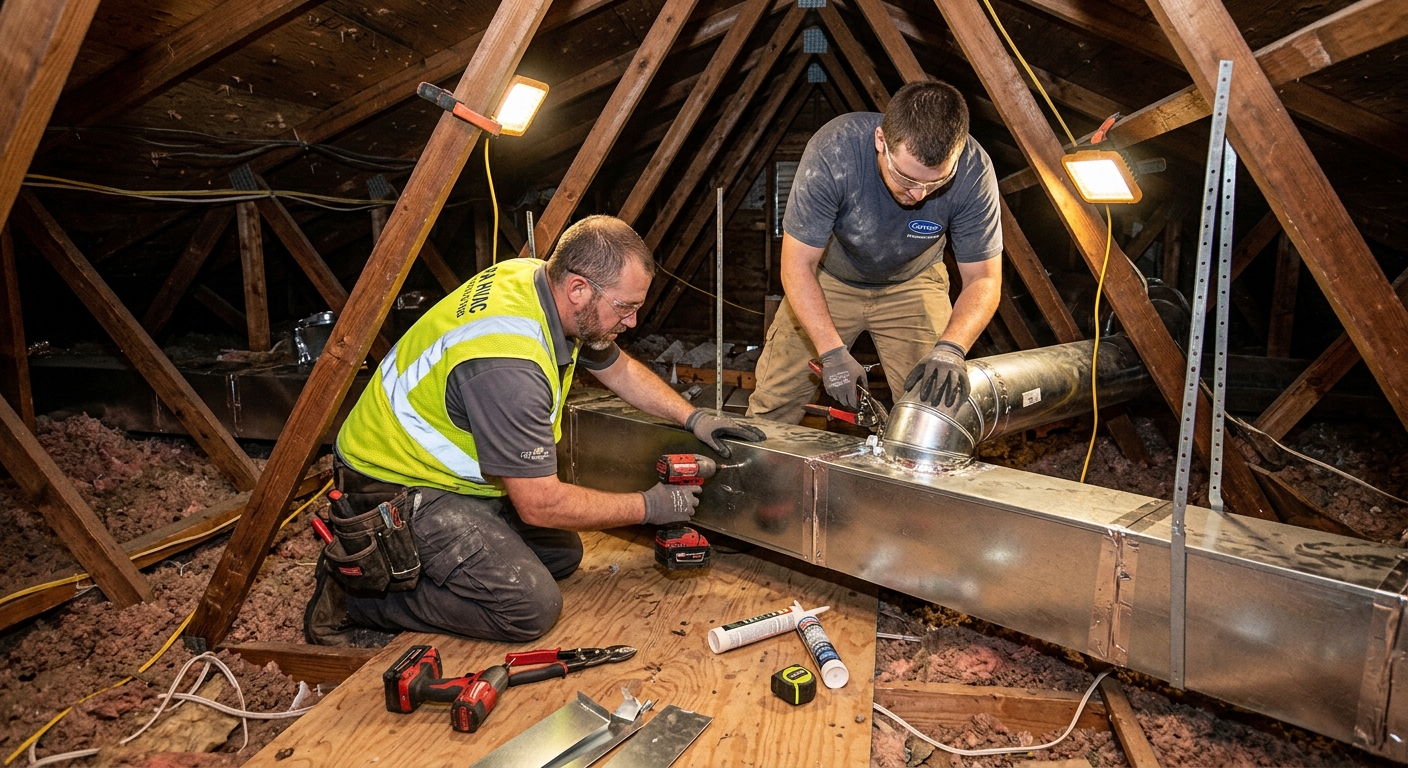
What a new HVAC system costs in East Buffalo
In East Buffalo, most homes are owner-occupied (87.1%) and a majority were built before 1980, with many even predating 1940, especially in Lewisburg and Mifflinburg (U.S. Census Bureau, ACS 2024). That means most HVAC jobs here aren’t first-time installations—they’re replacements or difficult retrofits, often complicated by tight, older attics and basements and sometimes patchy or outdated ductwork. If your house already has forced air, you’ll usually be looking at swapping out the system and possibly upgrading or resealing ducts. Homes without any ductwork, common in the oldest housing stock, often turn to mini-splits or a full custom duct system, which can run higher than a simple replacement.
This part of Union County is a heating-dominated market: we log roughly 6,300 heating degree days per year and face a typical winter design temperature of 2 °F. Cooling matter—a summer’s 750 cooling degree days is enough to justify good AC—but heating is the big-ticket item. That shifts the calculus: a high-efficiency heat pump or a robust furnace system pays real dividends, but ultra-premium cooling alone is rarely worth it here.
| System | Best for | Efficiency | Price range (installed) |
| Central AC replacement (existing ducts) |
homes with sound ductwork |
16–20 SEER2 |
$5,400–$13,000 |
| Air source heat pump (ducted) |
year-round heating and cooling |
8–10 HSPF2 |
$8,600–$18,500 |
| Cold-climate heat pump (ducted) |
heat pump as primary heat |
9–11 HSPF2 |
$14,000–$18,500 |
| Ductless mini-split (single zone) |
additions, rooms without ducts |
20–30 SEER2 |
$3,400–$7,500 |
| Full duct system installation |
homes with no existing ducts |
— |
$9,700–$19,500 |
Installed estimates for a typical East Buffalo home. Equipment tonnage, duct condition and electrical capacity move these more than brand.
Refrigerant rules and your existing system
East Buffalo homeowners should know that the HVAC industry is transitioning away from older refrigerants with a high global warming potential (GWP). Newly manufactured systems now use alternatives like R-454B and R-32, as part of a phase-down that addresses climate concerns. However, R-410A systems—still common in homes here—are legal to service and operate. For now, you can repair and recharge an R-410A system, but the refrigerant itself may become more expensive over time as supply tightens and production ramps down nationwide. This doesn’t render existing equipment obsolete, but it does mean that in the event of a major refrigerant leak, the cost of repair could exceed what it’s worth, given current replacement prices.
If your air conditioner or heat pump still works reliably and doesn’t have a refrigerant leak, there’s no need to replace it because of these regulatory changes. Service technicians in East Buffalo, as everywhere, are federally required to hold EPA Section 608 certification to handle any refrigerant—whether old or new—and can still get parts for older units. But if you’re facing a compressor replacement or a major repair that involves recharging a leaky older system, weigh those costs against the price of an efficient new installation ($5,400–$13,000 for standard AC or $8,600–$18,500 for a heat pump, installed). For most homeowners, the phase-down will only matter when a system nears end of life or springs a costly leak.
Permits, licensing and inspections in East Buffalo
Pennsylvania does not issue a statewide HVAC license for residential work. Instead, Union County relies on local code enforcement: East Buffalo Township operates its own office, while Lewisburg—our county seat—has its own as well. Contractors must have Home Improvement Contractor (HIC) registration from the state Attorney General for any contract over $500. Always verify HIC status at hic.attorneygeneral.gov. Mechanical permits are required for nearly all HVAC installations or replacements here and must be pulled through the township; inspection is local, not state-administered.
Anyone handling refrigerant—whether installing a new system, recharging it, or scrapping the old one—must have EPA Section 608 certification, which is a federal requirement. You can ask to see this credential for the technician actually doing the work, not just the company. Pennsylvania law also mandates workers’ compensation insurance for all employers. This can be independently checked through the WCAIS system at wcais.pa.gov, and you shouldn’t accept a certificate handed directly to you by a contractor without checking that it’s current and valid.
The bottom line: residential HVAC in East Buffalo is regulated at the municipal (not state) level. Your contractor must be registered, insured, able to pull permits, and send certified techs for refrigerant. Skip anyone unable or unwilling to meet those standards.
When an HVAC repair stops being worth it
In East Buffalo’s climate, it’s not always clear when it’s time to repair or replace an HVAC system. The best rule of thumb: if your unit is under 10 years old and the problem is a single part (think capacitor, contactor, igniter), repair makes sense, especially if the total is a small fraction of installing new. Once a unit gets past 12–15 years, or if the cost of repair approaches a third of a new install, then replacement is more logical. Pay special attention to what failed—if it’s a cracked heat exchanger or a compressor in an aging system, replacement isn’t optional. Also factor in refrigerant: if your older system uses a refrigerant headed for scarcity and you’re quoted top dollar for a recharge, consider that against the price of a modern system.
Efficiency upgrades can lower bills, but East Buffalo’s long heating season (6,300 heating degree days) means the biggest dollar savings come from better heating, not just cooling. Still, if “high bills” are the only symptom and your system works reliably, spend a few hundred first to test and seal the ductwork before diving into major equipment upgrades.
| Situation | Recommendation | Typical cost | Reasoning |
| Under 10 years, single component failure |
Repair |
$300–$1,200 |
Minor fix extends system life affordably |
| 10–15 years, repair over a third of replacement |
Consider replacing |
$5,400–$13,000 |
Old age, major repair often not economical |
| 15+ years, any major failure |
Replace |
$5,400–$13,000 |
System is at end of useful life |
| Cracked heat exchanger, any age |
Replace immediately |
$5,400–$13,000 |
Safety hazard, repair not viable |
| Compressor failure past warranty |
Replace |
$8,600–$18,500 |
Compressor is half the value of system |
| Working system, high bills |
Test ducts and envelope first |
$300–$800 |
Leakage and insulation defects are common culprits |
Gas, electric or both in north-central Pennsylvania
With a winter design temperature of 2 °F and 6,300 heating degree days per year, Union County—including East Buffalo—lives through some of the state’s coldest, longest winters. That shapes everything: equipment must handle true cold, not just chilly nights. Modern cold-climate heat pumps are not the heat pumps of the 1980s—today’s models maintain output well below freezing, so the old “don’t work in Pennsylvania” objection doesn’t hold up. That said, as temperature drops below about 10 °F, all air-source pumps do lose capacity, and back-up heat becomes critical.
If you’re in Lewisburg or Mifflinburg and have natural gas, you’ll compare a gas furnace to a heat pump or a dual-fuel (hybrid) setup, where the heat pump runs in mild weather and the furnace takes over in deep cold. In rural townships—where most homes run on propane or oil and natural gas isn’t available—the math changes: heat pumps become a lot more competitive, since propane and oil costs can be volatile, and electricity (from PPL Electric) is generally steadier.
A furnace is still the best call if you already have gas service, face regular subzero spells, or need high-output backup for long outages. Everywhere else, a cold-climate heat pump, possibly with electric or backup heat, is worth serious consideration.
| Option | Installed cost | Operating cost here | Best when | Incentive eligible |
| Gas furnace + central AC |
$5,400–$13,000 |
existing gas service, coldest zones |
Already have gas, consistent winter use |
Sometimes |
| Ducted heat pump (cold climate) |
$8,600–$18,500 |
good envelope, all-electric goal |
No gas available, all-electric home |
Often |
| Dual fuel (heat pump + gas backup) |
$14,000–$18,500 |
gas on site, deep cold spells |
Want efficiency plus peace of mind |
Often |
| Ductless multi-zone |
$9,700–$19,500 |
no ductwork, zone control |
Historic, no space for ducts |
Varies by program |
Comparing HVAC estimates in East Buffalo
When you get multiple HVAC quotes in East Buffalo, details matter more than the bottom-line price. Insist on model numbers for both the indoor and outdoor units—a system is only as efficient as its matched pair, and mismatches can forfeit all those advertised savings. Sizing should come with a written load calculation, not simply a match to your old system. Check if line sets (the pipes carrying refrigerant) are being replaced or reused, with rationale. Any inclusion of electrical work should spell out exactly what will be done: new breaker, possible panel upgrade, and whether the cost is covered. Typical quotes also cover condensate drainage, thermostat, permit fees, and the all-important startup commissioning (where airflow and refrigerant charge are measured—not guessed).
Labour warranty and equipment warranty should be listed separately, and the permit fee should be itemized—not just “permit included” or, worse, “not needed.” A quote that lists only a brand and a price can’t be properly compared.
| Line item | What to look for | Red flag if… |
| Equipment |
model numbers, indoor and outdoor matched |
brand name only |
| Sizing |
load calculation attached |
matched to the old nameplate |
| Ductwork |
condition assessed, sealing scoped |
not mentioned |
| Electrical |
circuit and panel capacity confirmed |
assumed adequate |
| Line set |
replaced or documented as reused |
silent |
| Commissioning |
measured airflow and charge, documented |
no startup report |
| Warranty |
labour years stated separately |
manufacturer only |
| Permit |
included and priced |
'not needed' |
How to vet an HVAC contractor in East Buffalo
In East Buffalo and greater Union County, what matters most is how well your HVAC system is installed—not which brand logo goes on the box. Identical equipment will perform very differently if it’s sized wrong, poorly ducted, or started up without proper commissioning. Always verify credentials before anyone touches your system: HIC registration is a must for contracts over $500 (check hic.attorneygeneral.gov). For refrigerant work, ensure the actual tech carries valid EPA 608 credentials. Load calculations should be more than lip service—demand the written numbers, not just “about 3 tons.” Model numbers should appear on every quote, not just brand and tonnage, along with commissioning documentation showing measured airflow and charge at startup.
- Check state HIC registration at hic.attorneygeneral.gov
- Verify EPA 608 certification for any crew handling refrigerant
- Ask to see workers’ compensation status via wcais.pa.gov
- Require a load calculation (Manual J or equivalent) with numbers
- Insist on matched equipment model numbers, not just tonnage
- Review line set plan (replace, flush, or reuse with rationale)
- Check that commissioning/test figures are promised and delivered
- Ensure all municipal permits and inspection fees are included
- Ask about documentation for all warranty coverage (equipment and labor)
- See if ductwork is reviewed for leaks and insulation, not ignored
- Ensure electrical compatibility is confirmed (not presumed okay)
- Request references or reviews from other local Union County homeowners
Red flag: If a contractor wants to “fit you in” between big city jobs or charges a high travel surcharge (a common practice in our thin rural market), get a second and third quote. And if model numbers, permits, or commissioning aren’t spelled out, cross them off your list.
Frequently asked questions — HVAC installation in East Buffalo
What is commissioning and why does it matter?
Commissioning is the process of testing and adjusting your new HVAC system as it’s installed to ensure it runs safely, efficiently, and according to the manufacturer’s specifications. In East Buffalo, commissioning means the installer actually measures airflow with instruments, checks refrigerant charge, and confirms everything—heating and cooling alike—performs as promised. Because our climate swings from harsh winters to humid summers, a system that’s not started up and checked properly might underperform when you need it most. The cost of mistakes—like too much or too little refrigerant, or an airflow issue—often isn’t obvious until high utility bills or comfort problems emerge. For a job running $8,600–$18,500, commissioning is nonnegotiable.
Why do HVAC quotes in East Buffalo vary so much?
HVAC estimates in East Buffalo can span several thousand dollars for what looks like the “same job” because housing conditions here are far from standard. With so many homes older than 1940 in Lewisburg and Mifflinburg, the difficulty of installing or replacing ductwork, compensating for cramped basements and attics, and updating electrical panels varies home by home. Some quotes include code-required permits and full commissioning, while others cut corners with basics only. System size, duct condition, and whether you need a custom install all move the price a lot more than picking Carrier vs. Trane. Expect a typical install to land between $8,600–$18,500, and read every line item carefully.
How cold does it get in East Buffalo and does that affect heat pumps?
East Buffalo faces a winter design temperature of 2 °F, one of the coldest in Pennsylvania, and racks up around 6,300 heating degree days each year. Older heat pump models used to struggle in these conditions, but today’s cold-climate units can still produce heat below zero. However, as temperatures drop, all heat pumps do lose some output, which means either backup electric heat or a dual-fuel furnace is often built into the recommendation. That can push a new system’s cost into the $14,000–$18,500 range if you’re pairing a heat pump and gas backup, but it keeps you warm even in the Northeast’s longest cold snaps.
How long should an HVAC system last in East Buffalo?
For most East Buffalo homes, a properly installed and maintained HVAC system will last about 15–20 years, though some high-quality gas furnaces or heat pumps in well-sealed homes have been known to run longer. Our long heating season does mean local systems work harder, especially if air filters or ducts aren’t kept up. If your unit is less than 10 years old and anything goes wrong, repair is almost always more sensible, with most repairs falling in the $300–$1,200 range. After year 15, replacement makes more economic sense, as repair costs plus high utility bills add up.
Is a heat pump a good choice for East Buffalo winters?
Yes — cold-climate heat pumps are absolutely viable for East Buffalo, even with our hard winters. The older myth that “heat pumps won’t keep you warm here” is based on outdated technology. Many homes in Lewisburg, Mifflinburg, and outlying Union County townships run efficiently on heat pumps, especially when the envelope (insulation and air sealing) is solid. If you’re rural and use propane or oil, a heat pump can cut winter costs. Installed prices typically range from $8,600–$18,500, and you may qualify for local or federal incentives. For uninsulated or very drafty houses, add backup heat or first fix the envelope.
Who inspects HVAC work in East Buffalo?
In East Buffalo Township, HVAC work is inspected by the municipal code enforcement office, not the state. Lewisburg has its own enforcement office, and other municipalities handle it on a local basis. Your contractor must pull a mechanical permit, and the inspection ensures compliance with the Pennsylvania Uniform Construction Code (UCC) for safety, efficiency, and venting. Never accept a quote that says “no permit needed”—that’s a red flag. Permit fees are typically included in a full quote, adding $150–$500, which is minimal next to a system that often totals $5,400–$13,000.
What is a Manual J load calculation?
A Manual J load calculation is the technical process of determining the exact size of HVAC equipment your East Buffalo home needs—no bigger or smaller. It accounts for square footage, insulation, window types, home orientation, and duct leakage. Too many installers still “match the old unit” or guess based on rough area, which can stick you with a system that cycles poorly or runs up big bills. For a replacement cost in the $5,400–$13,000 range, you want one accurately sized for both heating and cooling seasons. Ask for a copy of the sheet or report before you sign.
How much does a new HVAC system cost in East Buffalo?
Installed HVAC system prices in East Buffalo typically run between $5,400–$13,000 for a basic central AC replacement, and $8,600–$18,500 or more for a new heat pump or dual-fuel system. Adding ductwork, or fitting out a historic home without existing forced air, can bring totals closer to $9,700–$19,500. Your actual cost depends most on the home’s age, state of existing ducts, electrical system, and the efficiency goals you set. Always compare line-by-line estimates to ensure you’re pricing apples to apples—not just picking the lowest sticker.
Are duct sealing and insulation eligible for incentives?
Duct sealing and insulation upgrades are some of the smartest investments in East Buffalo’s old housing stock, especially with our long heating season. Many local and federal incentive programs cover these improvements because they reduce wasted energy (and save you money). While new equipment costs (like $8,600–$18,500 for a heat pump) are often eligible for rebates, don’t overlook that modest duct work—sealing, insulating, or repairing leaky runs in a 100-year-old basement—can sometimes get partial incentives as well. Ask your contractor to list them on your written estimate and check with your utility or finalize eligibility with state and federal agencies.